

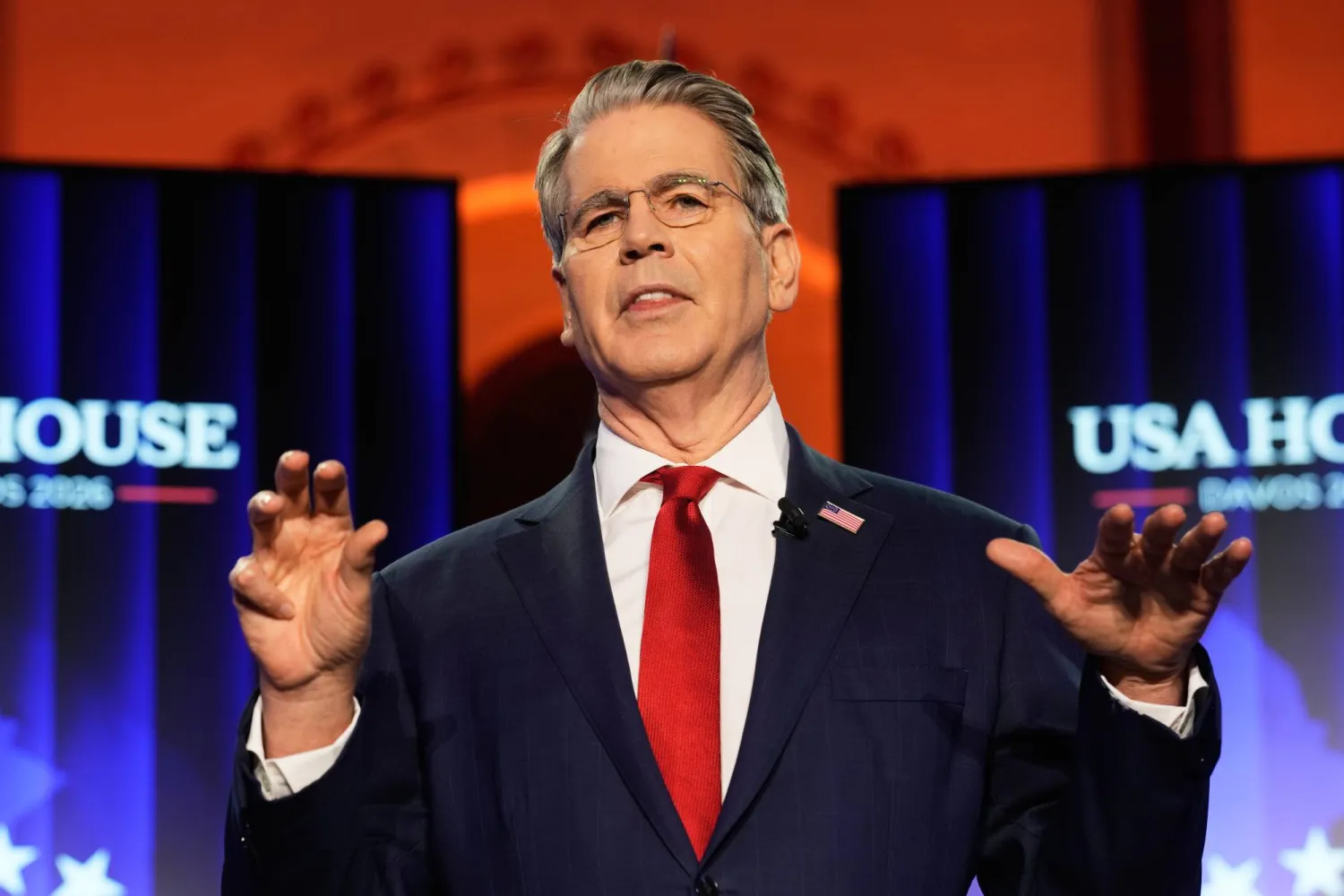

Bessent Says US-Europe Relations Have ‘Never Been Closer’ Despite Greenland Crisis

Scott Bessent, US Secretary of the Treasury, holds a speech at the USA House during the Annual Meeting of the World Economic Forum in Davos, Switzerland, Tuesday, Jan. 20, 2026. (AP)
TT

Bessent Says US-Europe Relations Have ‘Never Been Closer’ Despite Greenland Crisis

Scott Bessent, US Secretary of the Treasury, holds a speech at the USA House during the Annual Meeting of the World Economic Forum in Davos, Switzerland, Tuesday, Jan. 20, 2026. (AP)

US Treasury Secretary Scott Bessent on Tuesday said America’s relations with Europe remain strong and urged trading partners to “take a deep breath” and let tensions driven by the Trump administration's new tariff threats over Greenland “play out.”

“I think our relations have never been closer,” he said, speaking on the sidelines of the World Economic Forum annual meeting in Davos, Switzerland.

On Saturday, US President Donald Trump announced a 10% import tax starting in February on goods from eight European nations that have rallied around Denmark in the wake of his stepped up calls for the United States to take over the semi-autonomous Danish territory of Greenland.

Trump has insisted the US needs the territory for security reasons against possible threats from China and Russia.

The American leader’s threats have sparked outrage and a flurry of diplomatic activity across Europe, as leaders consider possible countermeasures, including retaliatory tariffs and the first-ever use of the European Union’s anti-coercion instrument.

The EU has three major economic tools it could use to pressure Washington: new tariffs, suspension of the US-EU trade deal, and the “trade bazooka” — the unofficial term for the bloc’s Anti-Coercion Instrument, which could sanction individuals or institutions found to be putting undue pressure on the EU.

Earlier Tuesday, Trump posted on social media that he had spoken with NATO Secretary General Mark Rutte. He said "I agreed to a meeting of the various parties in Davos, Switzerland,” which is hosting the World Economic Forum’s annual meeting this week.

France's Macron suggests G7 meeting

Trump also posted a text message from Emmanuel Macron in which the French president suggested a meeting of members of the Group of Seven industrialized democracies in Paris after the Davos gathering.

Later, however, Trump posted some provocatively doctored images. One showed him planting the US flag next to a sign reading “Greenland, US Territory, Est. 2026.” The other showed Trump in the Oval Office next to a map that showed Greenland and Canada covered with the US Stars and Stripes.

In a sign of how tensions have increased in recent days, thousands of Greenlanders marched over the weekend in protest of any effort to take over their island. Greenland Prime Minister Jens-Frederik Nielsen said in a Facebook post Monday that the tariff threats would not change their stance.

“We will not be pressured,” he wrote.

In his latest threat of tariffs, Trump indicated that the import taxes would be retaliation for last week’s deployment of symbolic numbers of troops from the European countries to Greenland — though he also suggested that he was using the tariffs as leverage to negotiate with Denmark.

Danish minister called for a stronger Europe

Denmark's minister for European affairs called Trump's tariff threats “deeply unfair." He said that Europe needs to become even stronger and more independent, while stressing there is "no interest in escalating a trade war."

"You just have to note that we are on the edge of a new world order, where having power has unfortunately become crucial, and we see a United States with an enormous condescending rhetoric towards Europe,” Marie Bjerre told Danish public broadcaster DK on Tuesday.

European markets opened sharply lower on Tuesday and US futures fell further as tensions rose over Greenland. Benchmarks in Germany, France and Britain fell about 1%. The future for the S&P 500 lost 1.5% and the Dow future was down 1.4%.

With US trading closed Monday for a holiday, financial markets had a relatively muted response to Trump’s threat to put a 10% extra tariff on exports from eight European countries that have opposed his push to exert control over Greenland. Jonas Golterman of Capital Economics described the situation as a lose-lose one for both the US and the targets of Trump’s anger. He said, “It certainly fells like the kind of situation that could get worse before it gets better.”

In another sign of tension between allies, the British government on Tuesday defended its decision to hand sovereignty of the Chagos Islands to Mauritius after Trump attacked the plan, which his administration previously supported.

Trump said that relinquishing the remote Indian Ocean archipelago, home to a strategically important American naval and bomber base, was an act of stupidity that shows why he needs to take over Greenland.

The United Kingdom signed a deal in May to give Mauritius sovereignty over the islands, though the UK will lease back the island of Diego Garcia, where the US base is located, for at least 99 years.



EU Moves to Sanction Iran over Hormuz Blockade

Traffic through Hormuz, a vital global shipping conduit, has come under Iranian control since the outbreak of war with Israel and the United States on February 28. (Photo by AFP) /
TT

EU Moves to Sanction Iran over Hormuz Blockade

Traffic through Hormuz, a vital global shipping conduit, has come under Iranian control since the outbreak of war with Israel and the United States on February 28. (Photo by AFP) /

European Union nations moved Friday towards imposing sanctions on Iranian officials and others responsible for blocking the Strait of Hormuz, the EU said.

Tehran effectively closed the key shipping lane for global gas and oil in retaliation to US-Israeli strikes launched in February.

Deeming the blockade "contrary to international law", EU governments took a technical step to extend the scope of its existing Iran sanctions regime allowing for more individuals to be targeted under it.

"The EU will now be able to introduce further restrictive measures in response to Iran's actions undermining the freedom of navigation in the Strait of Hormuz," the European Council representing EU nations said.

Brussels' punitive measures on Iran previously targeted the country's military support for Russia in its war against Ukraine and for armed groups across the Middle East.

The European Union has also imposed sanctions over human rights violations in the country.

The EU did not immediately name any individual or entities that would be targeted by the new sanctions, consisting of travel bans and asset freezes.

EU citizens and companies will also be banned from making funds, financial assets or other economic resources available to those listed.

The Iran war and the closure of Hormuz, which normally carries a fifth of global oil production, have sent ripples across the global economy, sending energy prices soaring.


Rubio Cites Some Progress on Iran Talks but "We're Not There Yet"

United States Secretary of State Marco Rubio during a signing ceremony on the sidelines of a meeting of NATO foreign ministers in Helsingborg, Sweden, Friday, May 22, 2026. Julia Demaree Nikhinson/Pool via REUTERS
TT

Rubio Cites Some Progress on Iran Talks but "We're Not There Yet"

United States Secretary of State Marco Rubio during a signing ceremony on the sidelines of a meeting of NATO foreign ministers in Helsingborg, Sweden, Friday, May 22, 2026. Julia Demaree Nikhinson/Pool via REUTERS

The United States has seen some progress in talks with Iran and is in constant communication with the Pakistani mediators, but there is more work to be done, Secretary of State Marco Rubio said on Friday.

"There's been some progress. I wouldn't exaggerate it. I wouldn't diminish it," Rubio told reporters after a NATO ministers meeting in Sweden.

"There's more work to be done," he added. "We're not there yet. I hope we get there."

President Donald Trump would prefer to do a good deal, Rubio said. The core concern remains that Iran cannot have a nuclear weapon and the issue of future uranium enrichment needs to be discussed as well as reopening the Strait of Hormuz, he said.

"We're dealing with a very difficult group of people, and if it doesn't change, then the president's been clear he has other options," Rubio said.

"He prefers the negotiated option and having a good deal, but he himself has expressed concern that maybe that's not possible. But we're going to keep trying."

Rubio said the United States was in constant communication with the Pakistanis who are facilitating the talks with Iran.

There was no specific ask from the US on Friday for help from NATO on the Strait of Hormuz but there needs to be a Plan B if Iran refuses to reopen the supply route, Rubio said after the close of the NATO meeting.


Netherlands to Ban Imports from Israel's Jewish Settlements

The Neve Yaakov settlement north of East Jerusalem, with the Israeli wall visible separating the Palestinian neighborhood of al-Ram in the West Bank (AFP). 
TT

Netherlands to Ban Imports from Israel's Jewish Settlements

The Neve Yaakov settlement north of East Jerusalem, with the Israeli wall visible separating the Palestinian neighborhood of al-Ram in the West Bank (AFP). 

The Dutch government has agreed to impose a ban on imports of goods produced in Jewish settlements in Israeli-occupied Palestinian territories, Dutch Prime Minister Rob Jetten said on Friday.

The ban is meant to prevent "any contribution through economic activities by the Netherlands to the unlawful occupation", Jetten said.

The previous Dutch government last year said it was planning the ban, which is now expected to take effect in the second half of the year.

The Netherlands is a leading global buyer of Israeli goods, but the government has never disclosed what volume of goods are currently imported from Jewish settlements.

Most world powers deem Israel's settlements, on land it captured in a 1967 war, illegal. Numerous UN Security Council resolutions have called on Israel to halt all settlement activity.

Israel disputes this, saying it has historical and biblical ties to the land.