


Larry Fink from Davos: In Age of Artificial Intelligence, Trust Is Hardest Currency

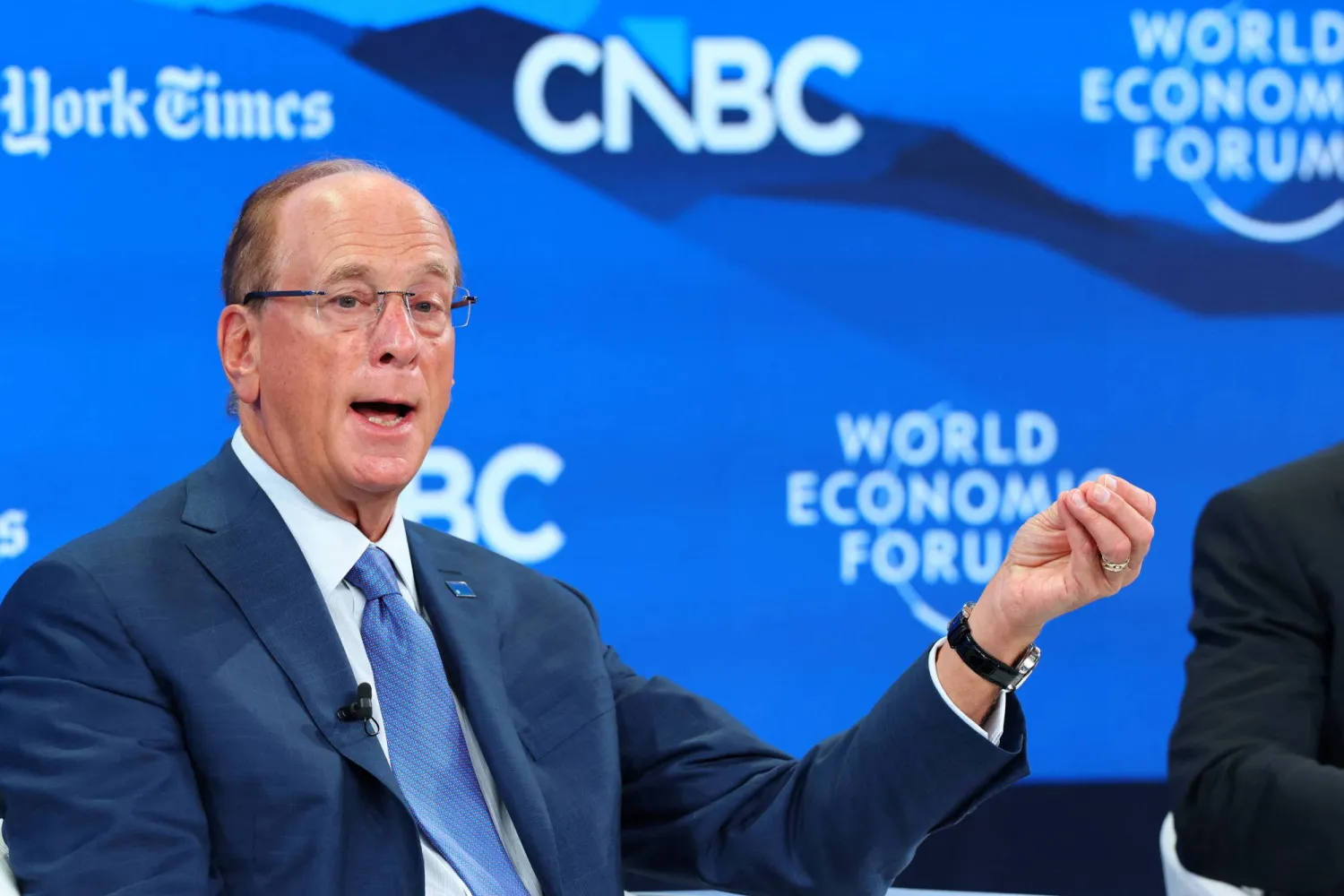
Chairman and CEO of BlackRock, Larry Fink, attends the 56th annual World Economic Forum (WEF) meeting in Davos, Switzerland, January 21, 2026. (Reuters)
TT

Larry Fink from Davos: In Age of Artificial Intelligence, Trust Is Hardest Currency

Chairman and CEO of BlackRock, Larry Fink, attends the 56th annual World Economic Forum (WEF) meeting in Davos, Switzerland, January 21, 2026. (Reuters)

CEO of BlackRock Larry Fink kicked off the World Economic Forum on Tuesday with a stark message, acknowledging a significant erosion of trust in global institutions and elites.

Speaking at the 56th Annual Meeting of the WEF in Davos, which gathered around 65 heads of state and government and nearly 850 of the world's top CEOs and chairpersons, he acknowledged that the gathering has lost trust and “feels out of step with the moment.”

“But now for the harder question: Will anyone outside this room care? Because if we’re being honest, for many people this meeting feels out of step with the moment: elites in an age of populism, an established institution in an era of deep institutional distrust,” he admitted.

Fink, who was appointed interim co-chair of the World Economic Forum in August 2025, said it is also obvious that the world now places far less trust in the forum to help shape what comes next.

“If WEF is going to be useful going forward, it has to regain that trust,” he said.

The billionaire boss of the world’s largest asset manager said that prosperity is not just growth in the aggregate. “It can’t be measured by GDP or the market caps of the world’s largest companies alone. It has to be judged by how many people can see it, touch it, and build a future on it.”

Fink said that since the fall of the Berlin Wall, more wealth has been created than in any time prior in human history, but in advanced economies, that wealth has accrued to a far narrower share of people than any healthy society can ultimately sustain.

He noted that now AI threatens to replay the same pattern.

Fink said early gains are flowing to the owners of models, data, and infrastructure, questioning what AI does to white-collar work what globalization did to blue-collar.

He urged those gathered at Davos to create a “credible plan” for broad participation in the gains AI can deliver.

“Not with abstractions about the jobs of tomorrow, but with a credible plan for broad participation in the gains.”

In another dimension of change, Fink said the forum shouldn’t want panels where everyone agrees 95% of the time.

“The objective isn’t agreement. It’s understanding. It’s sitting with people we disagree with, taking their arguments seriously, and being willing to admit that they might see something we don’t,” he said.

Fink also noted that the central tension of the forum is that many of the people most affected by what participants talk about will never come to the conference. “Davos is an elite gathering trying to shape a world that belongs to everyone.”

He added, “That’s why this year’s theme is the Spirit of Dialogue. Because dialogue is the only way a room like this earns the legitimacy to shape ideas for people who aren’t in it.”

Fink called for WEF to start doing something new: showing up and listening in the places where the modern world is actually built. “Davos, yes. But also places like Detroit and Dublin and cities like Jakarta and Buenos Aires. The mountain will come down to earth.”



Iraq Studies Alternative Options for Oil Exports

Floating oil export loading platforms at the Basra Oil Port, Iraq, March 12, 2026. REUTERS/Mohammed Aty
TT

Iraq Studies Alternative Options for Oil Exports

Floating oil export loading platforms at the Basra Oil Port, Iraq, March 12, 2026. REUTERS/Mohammed Aty

Iraq is studying alternative measures to export crude oil after disruptions to the process amid the US-Israeli war against Iran. At the same time, the country intends to continue producing crude oil at a level of 1.4 million barrels per day.

Iraqi Oil Minister Hayyan Abdul Ghani told the official television channel Al-Iraqiya News that oil exports account for 90 percent of Iraq’s revenues, and that the ministry has decided to continue producing crude oil at 1.4 million barrels per day.

He emphasized that the production and supply of petroleum products to meet domestic demand have not stopped.

He added that refineries are operating at full design capacity to cover local needs, and that sufficient quantities of liquefied gas are available to fully meet domestic needs.

Regarding exports, he explained that the export process has stopped in the south, prompting the government to search for possible alternatives to export crude oil. He revealed that an agreement is close to being signed to export oil through the Turkish Ceyhan pipeline.

Abdul Ghani added that the ministry has prepared a comprehensive plan to manage the current phase, particularly after the new circumstances in the Strait of Hormuz, noting that a plan has been activated to transport 200,000 barrels per day by tanker trucks through Türkiye, Syria, and Jordan.

In a separate context, the oil minister denied that tankers targeted in Iraqi waters belonged to Iraq, explaining that they were not Iraqi vessels and were carrying naphtha.

Iraq recently lost its entire oil export capacity of 3.35 million barrels per day after Iran closed the Strait of Hormuz following escalating conflict in the region.

Iraq relies on crude oil sales for about 95 percent of its revenues to meet the needs of the country’s annual federal budget. This means that the country would face a critical situation if the conflict in the Gulf region and the Strait of Hormuz continues.


Gold Set for Weekly Drop as Oil Price Surge Weighs on Rate-cut Hopes

FILE PHOTO: A goldsmith weighs gold jewelry inside a showroom in Ahmedabad, India, July 31, 2025. REUTERS/Amit Dave/File Photo
TT

Gold Set for Weekly Drop as Oil Price Surge Weighs on Rate-cut Hopes

FILE PHOTO: A goldsmith weighs gold jewelry inside a showroom in Ahmedabad, India, July 31, 2025. REUTERS/Amit Dave/File Photo

Gold prices were on track for a second consecutive weekly drop, despite edging up on Friday, as surging energy prices due to the Middle East war dimmed prospects for near-term US interest rate cuts.

Spot gold was up 0.3% at $5,095.55 per ounce, as of 0633 GMT on Friday. US gold futures for April delivery fell 0.1% to $5,100.20.

The US 10-year Treasury yields eased, increasing the appeal of the non-yielding bullion. Bullion, however, has ‌lost more ‌than 1% so far this week. Since the war ‌started ⁠on February 28, ⁠it has dropped over 3% so far.

Fears of inflation and questions about the Federal Reserve's ability to cut interest rates if high oil prices persist are somewhat counteracting gold's appeal, said Tim Waterer, KCM Trade chief market analyst.

"Given the ongoing uncertainty about the duration and scope of the conflict in the Middle East, I expect gold to remain on the ⁠radar for investors as a safety play." Heightening geopolitical ‌tensions, Iran's Supreme Leader Mojtaba Khamenei said ‌on Thursday that Tehran will keep the strategic Strait of Hormuz closed as ‌leverage against the US and Israel, which has stoked concerns about ‌global energy supply and risk assets.

Oil prices rose above $100 a barrel, as attacks on oil tankers in the Gulf and warnings from Iran shattered prospects of quick de-escalation in the Middle East conflict. As oil prices surged, US President Donald ‌Trump again demanded Fed Chair Jerome Powell cut interest rates.

Traders, however, expect the Fed to keep rates ⁠steady in the current ⁠3.5%-3.75% range at the end of its two-day meeting on March 18, according to CME Group's FedWatch tool. While recent inflation data suggest price growth is under control, the war and the resulting spike in crude prices have yet to filter through the data.

Investors are awaiting the release of the delayed January Personal Consumption Expenditures Index, expected on Friday. Gold discounts in India widened this week to their deepest point in nearly a decade as demand stayed subdued and some traders steered clear of paying import duties, while the escalating Middle East war boosted safe-haven demand in China.

Spot silver was down 1% at $82.91 per ounce. Spot platinum lost 1% to $2,111.45 and palladium fell 1% to $1,603.


Iran War and Rising Fuel Costs Could Boost Panama Canal Traffic, Administrator Says

A cargo ship sails under Las Americas bridge through the Panama Canal, in Panama City, Thursday, March 12, 2026. (AP)
TT

Iran War and Rising Fuel Costs Could Boost Panama Canal Traffic, Administrator Says

A cargo ship sails under Las Americas bridge through the Panama Canal, in Panama City, Thursday, March 12, 2026. (AP)

Panama Canal Administrator Ricaurte Vásquez said Thursday that the conflict in the Middle East and rising fuel costs could ultimately benefit the interoceanic waterway as global shippers adjust routes.

In an interview with The Associated Press, Vásquez said that higher energy, fuel and navigation costs could make the Panama Canal a more attractive option for commercial traffic.

“When costs increase, in general when the price of marine fuel rises, the Panama Canal becomes a more attractive route,” Vásquez said.

Oil prices have risen amid the war in the Middle East, which has led to the temporary closure of the Strait of Hormuz by Iran in response to US and Israeli attacks. About one-fifth of the world’s oil passes through the waterway at the mouth of the Gulf.

If higher energy costs persist, routing cargo through Panama can cut voyages by between three and 15 days, depending on the route, while reducing fuel consumption, he said.

Vásquez said higher fuel costs are expected to affect container ships, bulk carriers and tankers transporting liquefied natural gas. If Middle Eastern supplies are disrupted, shipments may be replaced by other sources, including the United States, which could redirect some LNG cargo from Europe to Asia via Panama.

Gerardo Bósquez, an executive with the Panama Maritime Chamber, said a prolonged conflict could reshape global trade routes, with gas transport among the segments likely to benefit.

Vásquez cautioned that any changes will not be immediate and will depend on how long cargo operators expect the conflict and instability in the Gulf last.