


Fragmentary Sculptures from the Umayyad Palace of Qasr al-Mshatta

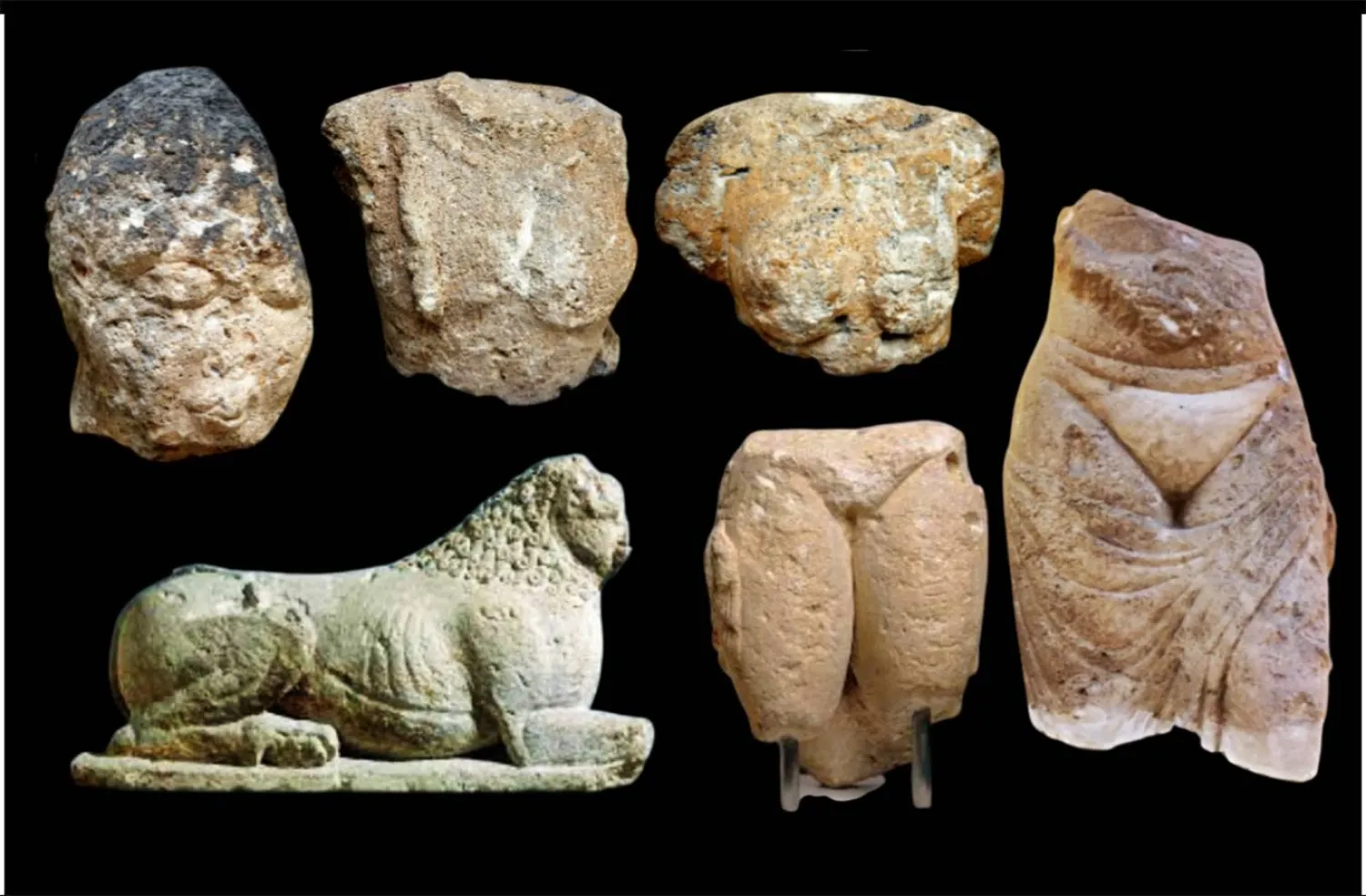
Five sculptures from Qasr al-Mshatta are preserved in the Museum of Islamic Art in Berlin, while a sixth sculpture is preserved in the Jordan Archaeological Museum in Amman.
TT

Fragmentary Sculptures from the Umayyad Palace of Qasr al-Mshatta

Five sculptures from Qasr al-Mshatta are preserved in the Museum of Islamic Art in Berlin, while a sixth sculpture is preserved in the Jordan Archaeological Museum in Amman.

by Mahmoud Zibawi

The Jordanian desert contains a series of Umayyad palaces, the largest of which is Qasr al-Mshatta, located in the Jiza District. Western Orientalist scholars first drew attention to this site in the late nineteenth century, and a German mission succeeded in transporting its massive southern facade to Berlin at the beginning of the twentieth century, after Sultan Abdulhamid II presented it as a gift to his ally, Kaiser Wilhelm II of Prussia.

The facade entered the Kaiser Friedrich Museum in 1903 and was later transferred to the Museum of Islamic Art in 1932. This museum is regarded as the oldest and largest institution dedicated exclusively to Islamic art in Europe and North America. The facade of Qasr al-Mshatta occupies the largest portion of this European complex, alongside a small, independent group of damaged sculptures that originally formed part of the palace’s furnishings. This group bears witness to a distinct Umayyad sculptural tradition, whose artistic identity became clearly defined through comparable assemblages discovered in other Umayyad palaces excavated during the 1930s.

The sculptures from Qasr al-Mshatta are displayed on white rectangular plinths in a corner of the gallery dedicated to the palace’s monumental facade at the Museum of Islamic Art in Berlin. At first glance, they resemble fragmented stone blocks positioned at the margins of this facade, which is adorned with limestone relief carvings that have largely preserved their original features. In this corner, one piece stands out for having retained most of its original form: a carved and polished block of limestone depicting a lion crouching on a white base, measuring 72 centimeters in length and 122 centimeters in width.

The lion appears firmly grounded on its folded hind legs atop a thin rectangular base devoid of ornament, with its front legs extended forward. Despite the loss of most of the head and the extremities of the forelegs, the sculptural composition remains clear and legible. The facial features have largely disappeared, making them difficult to reconstruct; however, the posture suggests an upright head pressed close to the chest, encircled by a dense mane composed of compact, parallel locks of hair that extend to include the beard, together forming a collar encircling the oval mass of the chin.

The body is elongated and smooth, with limbs clearly articulated in a manner that approaches naturalistic realism, as evidenced by the precise modeling of the joints. This approach is especially apparent in the treatment of the hind legs and is further emphasized by the pronounced protrusion of the claws marking their extremities. It is worth noting the existence of a small carved fragment originating from Qasr al-Mshatta in which these claws appear in a similar manner. It remains unclear whether this fragment originally belonged to the same sculpture or to a companion piece that formed a paired composition, in keeping with an artistic convention prevalent in the provinces of the Sasanian Empire. Although this empire came to an end with the Islamic conquest of Persia, its cultural legacy remained vibrant and left a profound imprint on Umayyad artistic production; the lion of Qasr al-Mshatta stands as compelling evidence of this cultural synthesis.

Facing this lion are several damaged sculptural fragments, each representing a small portion of a female figure whose original configuration is now difficult to reconstruct. One fragment preserves a head, retaining the wide eye sockets, the lower portion of the nose, and lips closed in a subtle smile. The cheeks are broad, suggesting that this youthful face belonged to a woman crowned by a voluminous mass of thick hair, whose upper surface is approximately twice the area of the face itself. By contrast, two additional fragments reveal a full and fleshy female torso.

A third fragment preserves the thighs of two closely set legs, which share the same robust character. This piece has retained its polished surface and is of medium scale, measuring 70 centimeters in height and 50 centimeters in width, indicating that it belonged to a statue conceived on a near life-size scale. This three-dimensional form preserves fine details of its execution, revealing a thin garment slipping away from the buttocks, with its edge still visible at the upper part of the left thigh. On this thigh appear traces of an inscription carved in Kufic script, running from top to bottom. Unfortunately, specialists have been unable to decipher the text, though one hypothetical reading suggests that it records the name of the woman represented by the statue.

The Jordan Archaeological Museum houses a comparable fragment uncovered during restoration and cleaning campaigns conducted by the Department of Antiquities in 1962 at Qasr al-Mshatta. This piece, likewise executed at near life size, measures 75 centimeters in height and 52 centimeters in width and represents the pelvis and upper portions of the legs. Here, the garment drapes over the right thigh, revealing the left thigh beneath, with sharply defined folds executed in accordance with the classical Greek style. The statue has lost its arms; however, the remaining lower portions indicate hands that once held objects whose identities can no longer be determined.

These sculptures attest to an Umayyad female sculptural ideal, whose formal characteristics first emerged through the study of the murals at an Umayyad desert site known as Qusayr ʿAmra, documented by the Czech scholar Alois Musil in a major two-volume publication issued in 1907. These characteristics were subsequently confirmed in the medium of sculpture through the discovery of similar female figures from an Umayyad palace located at Khirbat al-Mafjar, north of Jericho, during excavations conducted by a mission affiliated with the British Department of Antiquities in the mid-1930s.

This ideal is distinguished by a full, fleshy body inclined toward corpulence, as well as facial features that mirror this physical quality. The type recurs in multiple sculptural variants, and their study reveals the use of diverse hairstyles and ornamental schemes, forming a visual vocabulary that parallels the literary lexicon for which this remarkably productive period is renowned.



Saudi Arabia, Syria Underline Depth of their Cultural Ties

Syrian President al-Sharaa receives the Saudi minister of culture and the accompanying delegation at the Conference Palace in Damascus on Thursday. (SPA)
TT

Saudi Arabia, Syria Underline Depth of their Cultural Ties

Syrian President al-Sharaa receives the Saudi minister of culture and the accompanying delegation at the Conference Palace in Damascus on Thursday. (SPA)

Saudi Arabia and Syria underlined the strength of their cultural relationship during high-level meetings held in Damascus on Thursday, on the sidelines of the opening of the Damascus International Book Fair 2026, where the Kingdom is participating as guest of honor.

Syrian President Ahmad al-Sharaa received Saudi Minister of Culture Prince Badr bin Abdullah bin Farhan at the Conference Palace in the capital.

Earlier the same day, Prince Badr met with his Syrian counterpart, Minister of Culture Mohammad Yassin Saleh, during an official visit to attend the fair. T

he Saudi minister congratulated Syria on hosting the exhibition and expressed his wishes for continued prosperity, progress, and stability for the Syrian government and people.

Both meetings highlighted the depth of cultural relations between the two countries, the importance of expanding joint cultural cooperation across various fields, and the alignment of positions on issues of mutual interest in a way that serves both nations.

The Saudi delegation included senior officials and advisers, among them representatives from the Royal Court, the Ministry of Culture, and the King Abdulaziz Public Library, reflecting broad institutional engagement in the visit.

In the evening, Prince Badr attended the opening ceremony of the fair’s special session, held under the patronage and in the presence of al-Sharaa. The event drew wide official and cultural participation, including Arab ministers, political and intellectual figures, and a distinguished group of writers and cultural figures.

In a post on the X platform, Prince Badr thanked “our brothers in Syria for their generous hospitality and their efforts in organizing the Damascus International Book Fair.”

The minister also inaugurated the Kingdom’s pavilion at the fair in the presence of the Syrian minister of culture and the Qatari minister of culture.

Saudi Arabia’s guest-of-honor participation continues until Feb. 16 and reflects its growing prominence and leadership in the Arab and global cultural landscape.

This participation aligns with Saudi Vision 2030, which places culture at the heart of national development, viewing it as a space for dialogue, a bridge for civilizational communication, and a tool for strengthening ties among Arab peoples.

The Saudi Literature, Publishing and Translation Commission is leading the Kingdom’s participation, highlighting the development of the cultural sector and reaffirming the central role of books as carriers of knowledge and awareness.

The Saudi pavilion boasts a comprehensive cultural program featuring intellectual seminars, poetry evenings, a manuscript exhibition, traditional Saudi fashion displays, hospitality corners, archaeological replicas, and performing arts that express the depth of the Kingdom’s cultural heritage.

On the sidelines of the visit, Prince Badr, accompanied by Minister Saleh, toured the National Museum of Damascus, which houses rare artifacts spanning prehistoric eras, ancient Syrian civilizations, classical and Islamic periods, as well as traditional and modern art.


UNESCO Honors Al-Bisht Al-Hasawi as Thousands Flock to Al-Ahsa Festival

Visitors can explore interactive displays, participate in live workshops, and witness the meticulous process of tailoring this iconic symbol of prestige - SPA
TT

UNESCO Honors Al-Bisht Al-Hasawi as Thousands Flock to Al-Ahsa Festival

Visitors can explore interactive displays, participate in live workshops, and witness the meticulous process of tailoring this iconic symbol of prestige - SPA

The third edition of Al-Bisht Al-Hasawi Festival is drawing thousands of regional and international visitors to Ibrahim Palace in historic Al-Hofuf.

Organized by the Heritage Commission, this year’s festival celebrates the inscription of the Bisht on UNESCO’s Representative List of the Intangible Cultural Heritage of Humanity.

The event showcases Al-Ahsa’s centuries-old tradition of hand-weaving and gold embroidery, a craft passed down through generations of local families, SPA reported.

Visitors can explore interactive displays, participate in live workshops, and witness the meticulous process of tailoring this iconic symbol of prestige.

With UNESCO's participation and representatives from six countries, the festival has evolved into a global platform for cultural dialogue, cementing the Bisht’s status as a world-class cultural treasure.


Saudi, Syrian Culture Ministers Tour National Museum of Damascus

The ministers observed the museum’s extensive collections spanning prehistoric eras to modern art. SPA
TT

Saudi, Syrian Culture Ministers Tour National Museum of Damascus

The ministers observed the museum’s extensive collections spanning prehistoric eras to modern art. SPA

Saudi Minister of Culture Prince Badr bin Abdullah bin Farhan and his Syrian counterpart, Mohammed Yassin Saleh, have toured the National Museum of Damascus during the Kingdom’s participation as guest of honor at the 2026 Damascus International Book Fair.

The ministers observed on Thursday the museum’s extensive collections spanning prehistoric eras to modern art.

A particular focus was placed on the Arab-Islamic wing, featuring significant artifacts from the Umayyad period.

The Kingdom's participation as guest of honor at the 2026 Damascus International Book Fair, which runs until February 16, stems from the role culture plays within Saudi Vision 2030.