


US Military Transfers 150 ISIS Group Detainees from Syria to Iraq

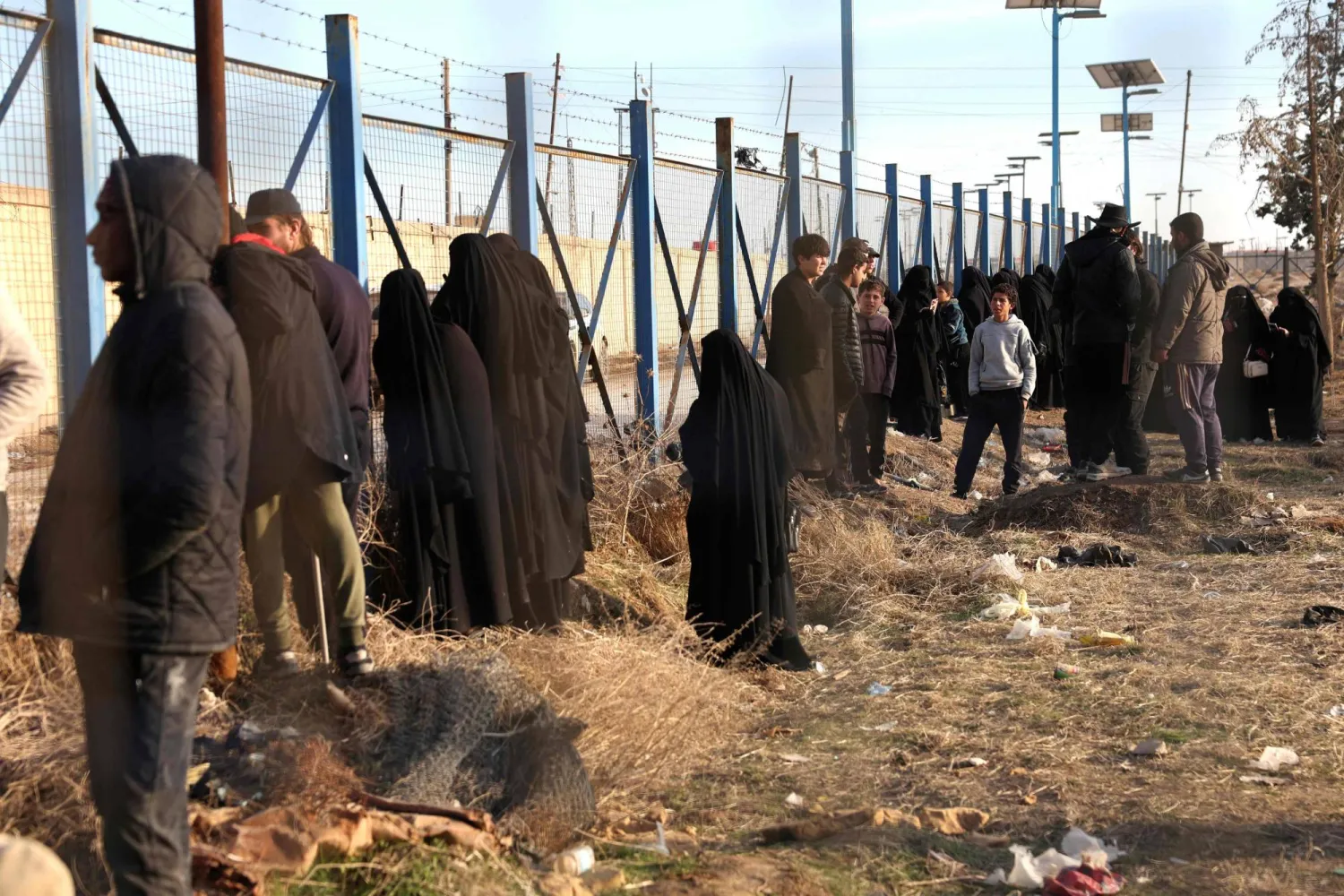
Relatives of suspected ISIS detainees, stand behind a fence in al-Hol camp in the desert region of Syria's Hasakeh province on January 21, 2026. (AFP)
TT

US Military Transfers 150 ISIS Group Detainees from Syria to Iraq

Relatives of suspected ISIS detainees, stand behind a fence in al-Hol camp in the desert region of Syria's Hasakeh province on January 21, 2026. (AFP)

The US military said on Wednesday that its forces have transferred 150 ISIS detainees from Syria to Iraq. The move comes after the rapid collapse of the Kurdish-led Syrian Democratic Forces in northeast Syria triggered uncertainty over the security of around a dozen prisons and detention camps they had been guarding. 

In a statement, the ‌US military said ‌the United States ‌was able ⁠to transport ‌150 ISIS fighters held at a detention facility in Hasakeh, Syria, to a secure location in Iraq. 

Ultimately, up to 7,000 ISIS detainees could be transferred from Syria to Iraqi-controlled facilities, the statement added. 

"We ⁠are closely coordinating with regional partners, including the Iraqi ‌government, and we sincerely appreciate their ‍role in ensuring ‍the enduring defeat of ISIS," said ‍US Admiral Brad Cooper, the head of US forces in the Middle East. 

Syria on Tuesday announced a ceasefire with Kurdish forces from which it has seized swathes of territory in the northeast and gave them ⁠four days to agree on integrating into the central state, which their main ally, the United States, urged them to accept. 

The lightning government advances in recent days and the apparent withdrawal of US support for SDF's continued holding of territory represent the biggest change of control in the country since opposition factions ousted Bashar al-Assad 13 ‌months ago. 


Egyptian Gaza Relief Group Says Israeli Strike on Photographers Was Deliberate

An aid distribution point in northern Gaza operated by the Egyptian Relief Committee (Egyptian Relief Committee)
TT

Egyptian Gaza Relief Group Says Israeli Strike on Photographers Was Deliberate

An aid distribution point in northern Gaza operated by the Egyptian Relief Committee (Egyptian Relief Committee)

The spokesperson for the Egyptian Relief Committee in Gaza, Mohamed Mansour, said Israel deliberately targeted three photojournalists while they were carrying out a humanitarian mission inside the Netzarim camp, an area located about six kilometers away from Israeli army forces.

Mansour told Asharq Al-Awsat that the attack was “a continuation of Israeli pressure on the committee’s work since it began operating, as part of the occupation’s efforts to tighten restrictions on anyone attempting to provide relief work and humanitarian services to the people of Gaza.”

The Israeli army killed three photojournalists on Wednesday who were working as a media team for the Egyptian Relief Committee for Gaza.

Field sources told Asharq Al-Awsat that the victims were Mohammed Salah Qashta, Abdul Raouf Shaat, and Anas Ghneim.

They were carrying out a filming mission using a small drone and cameras to document stages of work at camps that the Egyptian committee is helping to establish.

Mansour stressed that “the targeting of the photographers will only increase the committee’s determination to provide relief services and shelter to the Palestinian people.”

He said the committee would continue its work as usual to be “a genuine support for the people of the Strip, amid extremely complex security conditions.”

Israeli Army Radio reported, citing sources, that Egypt sent an angry message to Israel following the attack in Gaza in which Palestinians working for the Egyptian committee for the reconstruction were killed.

According to the radio report, Egypt expressed its protest that the attack took place outside the boundaries of the so-called yellow line, in an area that does not pose a threat to Israeli forces.

For its part, the Israeli army claimed it had targeted suspects operating a “Hamas-affiliated drone” in central Gaza.

In a statement on Wednesday, the army said: “Following the identification of the drone and due to the threat it posed to the forces, the Israeli army precisely struck the suspects who were operating the drone.”

The army said the details were under review.


Saudi Infrastructure Fund Announces $1.2 Bln ‘HUMAIN’ Financing in Davos

Saudi Infrastructure Fund Announces $1.2 Bln ‘HUMAIN’ Financing in Davos
TT

Saudi Infrastructure Fund Announces $1.2 Bln ‘HUMAIN’ Financing in Davos

Saudi Infrastructure Fund Announces $1.2 Bln ‘HUMAIN’ Financing in Davos

Saudi Arabia sharpened its push into artificial intelligence infrastructure on the sidelines of the World Economic Forum in Davos, as the National Infrastructure Fund, known as Infra, unveiled a framework agreement for up to $1.2 billion in strategic financing with HUMAIN, a Public Investment Fund-owned company, to back the expansion of AI and digital infrastructure across the kingdom.

Infra’s chief executive officer, Esmail bin Mohammad Alsallom, said in an interview with Asharq Al-Awsat that the announcement was “an extension of the fund’s role in supporting new categories of infrastructure assets that are seeing accelerating demand,” adding that developing advanced infrastructure, including digital infrastructure, is “a fundamental requirement for achieving the goals of Vision 2030.”

Crown Prince Mohammed bin Salman, prime minister and chairman of the Public Investment Fund, launched HUMAIN on May 12 to develop and manage artificial intelligence solutions and technologies, and to invest across the sector’s ecosystem.

Under the non-binding agreement, the parties set out financing terms to develop up to 250 megawatts of hyperscale AI data centers for HUMAIN, relying on advanced graphics processing units to train and run artificial intelligence models.

The facilities are intended to meet the company’s customers’ needs locally, regionally, and globally, according to an official statement from HUMAIN.

The statement said Infra and HUMAIN had also agreed to explore the creation of an AI data center investment platform anchored by both parties and structured to allow participation by local and global institutional investors, supporting the expansion of HUMAIN’s strategy in the sector.

HUMAIN chief executive officer Tareq Amin was quoted in the statement as saying that demand for advanced computing capacity is accelerating, and that the agreement positions the company to respond quickly and at scale.

He added that the goal is to deliver world-class AI data center infrastructure that companies can rely on as their computing needs become more complex.

Bridging financing gaps

Alsallom said the National Infrastructure Fund’s role is to bridge financing and structural gaps that some strategically essential infrastructure projects may face.

This role is vital at stages when commercial financing alone cannot meet funding needs, whether because of the size of the investment, its long time horizon, or the nature of the associated risks.

He said the fund’s focus is not simply on financing projects, but on enabling them to become investable and attractive to private capital, especially institutional investors, in ways that enhance sustainability and reduce reliance on direct government funding.

Expanding infrastructure asset classes

Alsallom described the framework agreement with HUMAIN as an extension of the fund’s support for new infrastructure asset classes experiencing rapid demand growth, foremost among them digital infrastructure and AI data centers.

He said such assets typically require significant, long-term capital investments and often need funding at early stages before they meet the conditions of traditional financing.

From this perspective, the fund’s intervention at this stage aims to raise market maturity, define appropriate financing structures, and enable broader, more sustainable participation by institutional investors.

A comprehensive approach

Asked whether the move signals a new focus on artificial intelligence, Alsallom said the fund does not target sectors as such, but instead focuses on the impact of infrastructure projects in supporting and enabling economic growth.

“Artificial intelligence today depends on an interconnected ecosystem of infrastructure assets, including energy, water, telecommunications, and data centers,” he said.

“When these projects become an important element in achieving sustainable economic development goals and attracting investment, the fund’s involvement is a natural extension of its role, regardless of the end sector these assets serve.”

Flexible financing solutions

Comparing the fund’s role with traditional commercial financing, Alsallom said its added value lies in aligning financing structures with the nature of the underlying asset.

“In new infrastructure projects, or those undergoing a transition in their operating or financing models, risks may be unbalanced or returns long-term in a way that does not suit traditional commercial financing,” he said.

“In this context, the fund provides flexible financing solutions that help encourage private sector participation, mitigate risk and support the financial sustainability of projects, without disrupting market balance or crowding out commercial finance.”

An AI data center investment platform

Alsallom said studying the creation of an AI data center investment platform reflects the fund’s approach of viewing such assets within an integrated framework rather than as standalone projects.

The aim, he said, is to build a scalable, repeatable model that enables asset aggregation, standardization, and the attraction of long-term capital from local and international institutional investors, thereby enhancing financing efficiency and investment sustainability.

Financial sustainability and private sector participation

In a broader context, Alsallom linked this approach to the objectives of Vision 2030, which aim to build a diversified, productive, and investment-attractive economy.

He said that developing advanced infrastructure, including digital infrastructure, is a prerequisite for that goal, and that the fund’s role is to accelerate this development in a financially sustainable way while strengthening private-sector participation.


Al-Wali to Asharq Al-Awsat: Riyadh Talks a Pivotal Moment for Yemen’s Southern Cause

Former Yemeni minister and veteran southern politician Abdel Nasser Al-Wali speaks to Asharq Al-Awsat.
TT

Al-Wali to Asharq Al-Awsat: Riyadh Talks a Pivotal Moment for Yemen’s Southern Cause

Former Yemeni minister and veteran southern politician Abdel Nasser Al-Wali speaks to Asharq Al-Awsat.

Former Yemeni minister and veteran southern politician Abdel Nasser Al-Wali described the meeting of Yemen’s southern leaders in Riyadh for consultations and dialogue on their cause on Sunday as a pivotal moment in its history, calling for the opening created by Saudi Arabia to be channeled into a political process that delivers lasting peace.

Speaking on the Asharq Al-Awsat podcast with Gulf affairs editor Badr Al-Qahtani, Al-Wali said Riyadh was not merely a diplomatic stop, but a place close to the heart of the Arab and Islamic worlds, offering a chance to correct past shortcomings in conveying the southern voice.

The veteran Yemeni politician said southerners now faced a “huge opportunity” under Saudi sponsorship, noting that Riyadh had taken the initiative to invite discussions on the issue and “left the matter in our hands.”

He pointed to Saudi Arabia’s role in bringing the parties together without imposing guardianship and in supporting whatever they agree upon without interference.

He said Saudi assurances had been explicit: “The opinion is yours, the decision is yours. We are sponsors and will not impose anything on you. Raise your ceiling to the sky.”

Al-Wali said a message from Saudi Defense Minister Prince Khalid bin Salman was clear and direct.

“The southern cause is just, with historical and social dimensions, and the Kingdom will not abandon the people of the south and will stand with their will,” he remarked.

“It is enough for the southern voice to reach Saudi Arabia, and for it to understand the justice of the pain that has accumulated since unification,” he stressed.

On preparations for the Riyadh Conference for Yemeni southern dialogue, Al-Wali said discussions would address the shape of the state and its system “with an open ceiling,” to be decided by consensus without exclusion.

The focus was on restoring the state as a path toward dignity, security, stability, development, and prosperity for people, he went on to say.

“The South has room for everyone. There are no intentions of marginalization or exclusion. Any other projects are not sidelined, but discussed,” he assured.

Al-Wali addressed a message to the southern people, saying: “Trust us. We represent in Riyadh those who authorized us,” in a reference to not compromising the cause or taking decisions that contradict popular will.

In another message, he said: “The Saudis will find from the southerners only what pleases God and pleases them, while preserving the bonds of neighborhood, blood, kinship, and shared interests.”

Turning to the roots of the issue, Al-Wali said Yemeni unity had not been an “invasion” or imposed by force, but a voluntary move toward Sanaa “with open hearts,” in the hope of a larger state, a broader economy, and deeper development.

He said that if the price of stability, calm, and development were Yemen’s return to two states, then it would be better, in his view, to have two neighboring states bound by affection, with flexible and smooth economic and social relations and strong fraternal ties, rather than antagonism that “paralyzed both peoples.”

Outlining his vision for a future state, Al-Wali presented the contours of a “federal southern state” that would grant governorates room to contribute to development, investment, and wealth, with equality in rights and duties and fairness in the distribution of resources so that they reach all who deserve them.

He reiterated the centrality of Saudi Arabia’s role, saying the Kingdom’s weight was “very balanced” regionally and globally, and that its engagement represented a historic opportunity to achieve peace “without it being followed by war.”

Asked how he found Riyadh, Al-Wali replied: “As I have always known it. A country of security and stability. Calm and serenity. Love and peace. You come to it, your soul settles, and you feel reassured.”

“Their promises are sincere and are not broken,” he stressed.
