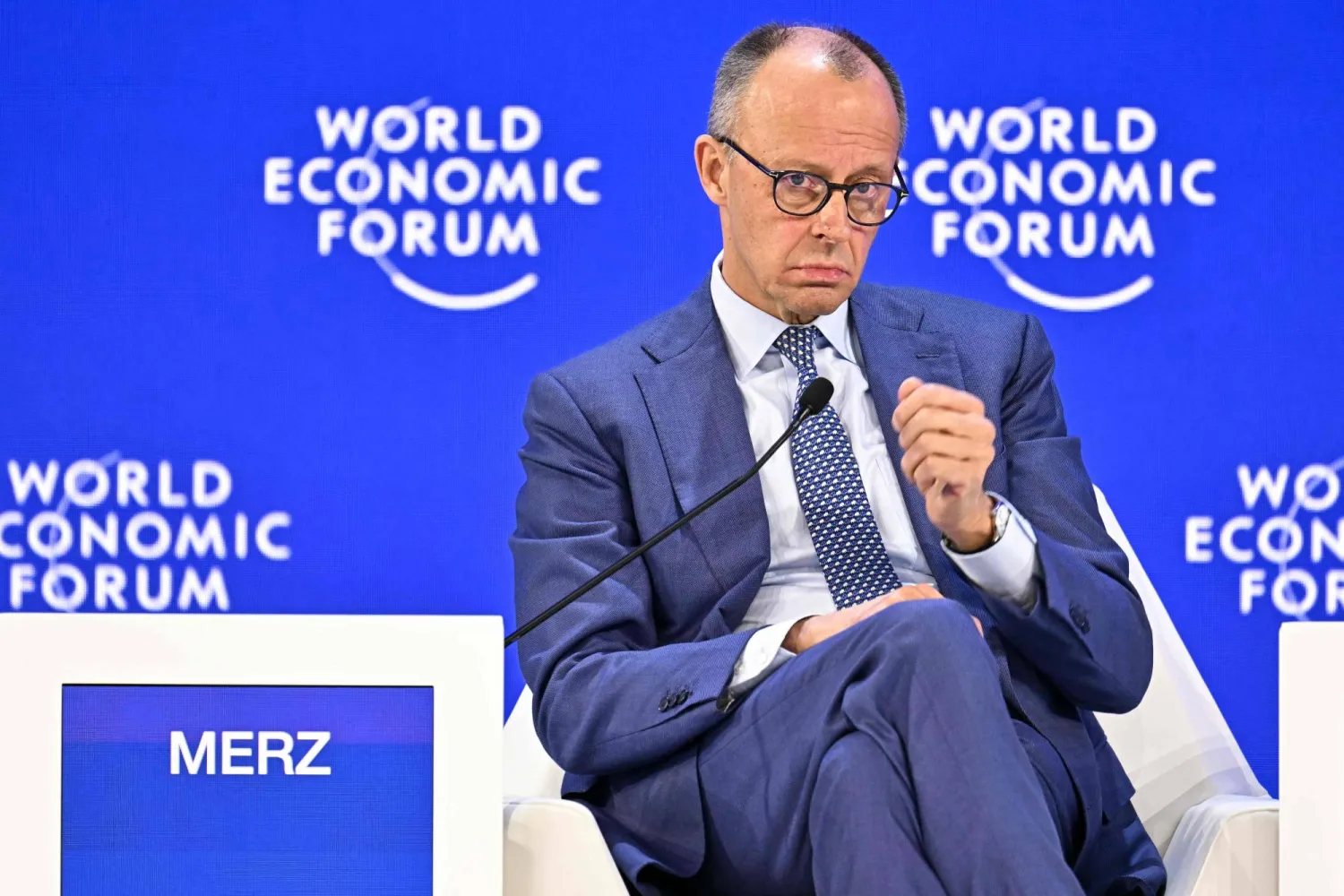
Merz Warns Great Power Politics Makes World 'a Dangerous Place'

Germany's Chancellor Friedrich Merz gestures as he speaks during the World Economic Forum (WEF) annual meeting in Davos on January 22, 2026. (Photo by Fabrice COFFRINI / AFP)
TT

Merz Warns Great Power Politics Makes World 'a Dangerous Place'

Germany's Chancellor Friedrich Merz gestures as he speaks during the World Economic Forum (WEF) annual meeting in Davos on January 22, 2026. (Photo by Fabrice COFFRINI / AFP)

German Chancellor Friedrich Merz warned Thursday that the international order is "unravelling at a breathtaking pace" and that "a world where only power counts is a dangerous place".

Speaking at the World Economic Forum in Davos, Merz pointed to Russia's war in Ukraine, a rising China and a United States that is "radically reshaping its foreign and security policy".

"A world where only power counts is a dangerous place," he said. "First for small states and for the middle powers, ultimately for the great ones."

The conservative leader of the top EU economy said Germany went down this road "to its bitter end" during the 20th century, reported AFP.

"It pulled the world into a black abyss," he said.

"So let us bear in mind: our greatest strength remains the ability to build partnerships and alliances among equals based on mutual trust and respect."

Merz called Russia's invasion of Ukraine "the most drastic expression" so far of a global "new era". He added that China, "with strategic foresight, has worked its way into the ranks of the great powers".

"The United States' global pole position is being challenged," Merz said, with Washington responding by "radically reshaping its foreign and security policy".

"We have entered a time of great power politics. The international order of the past three decades anchored in international law has always been imperfect. Today, its very foundations have been shaken."

He said Europe's power rested on three pillars.

"First we must invest massively in our ability to defend ourselves, and we are doing this," he said.

"Second, we must rapidly make our economies competitive, and we are doing this. Third, we must stand closer together among Europeans and among like-minded partners. We are doing this."


Israel Army Says Iran Using Cluster Munitions

An Iranian missile with cluster munitions flies towards Israel, amid the US-Israeli conflict with Iran, in central Israel, March 5, 2026. (Reuters)
TT

Israel Army Says Iran Using Cluster Munitions

An Iranian missile with cluster munitions flies towards Israel, amid the US-Israeli conflict with Iran, in central Israel, March 5, 2026. (Reuters)

Israel's military Friday said that Iran had launched cluster bombs "multiple times" since the start of the war that began with a US-Israeli attack on the country last week.

"They (the Iranians) are using cluster munitions", military spokesman Lieutenant Colonel Nadav Shoshani said during a press briefing, without providing details on when and where those munitions were launched.

"They've used it multiple times, which is a war crime when it's directed towards civilians and we're tracking that situation," Shoshani added.

Neither Iran nor Israel are among more than a hundred countries that are party to the 2008 Convention on Cluster Munitions, which prohibits the use, transfer, production and storage of cluster bombs.

AFP footage from Thursday evening showed a swarm of flaming projectiles falling in the darkened sky over central Israel.

Police did not comment on the sighting, but a military expert who reviewed the footage for AFP identified them as a part of a cluster bomb.

Israel's police had said Wednesday that bomb disposal experts found evidence of cluster munitions after incoming missiles from Iran were detected.

Due to military censorship rules in place in Israel since the start of its war with Iran, impact sites are generally closed to the public including journalists until they are cleared of Iranian missile debris and unexploded ordnances.

Police on Friday also published a public service announcement in which one of its bomb disposal technicians explained the dangers of cluster bombs.

"During the current war, the home front is facing a variety of threats, whether missiles, UAVs (drones), or rockets. I will talk to you about a threat that is a bit less known, but no less dangerous: the cluster munition threat," the technician said in the video.

During Israel's 12-day war with Iran in June 2025, the NGO Amnesty International reported Tehran’s use of widely banned cluster munitions.

The organization had said it analyzed photos and videos showing cluster munitions that, according to media reports, struck inside the Gush Dan metropolitan area around Tel Aviv on June 19.

The southern city of Beersheva on June 20 and Rishon LeZion to the south of Tel Aviv on June 22 were also "struck with ordnance that left multiple impact craters consistent with the submunitions seen in Gush Dan", Amnesty said.

Cluster munitions explode in mid-air and scatter bomblets.

Some of them may not explode on impact and can cause casualties over time, particularly among children.


Zelensky Visits Frontline Donetsk Region in East Ukraine

This handout photograph taken and released by the Ukrainian Presidential Press Service on March 6, 2026, shows Ukrainian President Volodymyr Zelensky (C) posing for a photo with Ukrainian servicemen while visiting the command post of the 3rd Battalion of the 28th Separate Mechanized Brigade named after the Knights of the Winter Campaign near Druzhkivka, Donetsk region, amid the Russian invasion of Ukraine. (Handout / Ukrainian Presidential Press Service / AFP)
TT

Zelensky Visits Frontline Donetsk Region in East Ukraine

This handout photograph taken and released by the Ukrainian Presidential Press Service on March 6, 2026, shows Ukrainian President Volodymyr Zelensky (C) posing for a photo with Ukrainian servicemen while visiting the command post of the 3rd Battalion of the 28th Separate Mechanized Brigade named after the Knights of the Winter Campaign near Druzhkivka, Donetsk region, amid the Russian invasion of Ukraine. (Handout / Ukrainian Presidential Press Service / AFP)

Ukrainian President Volodymyr Zelensky visited the frontline region of Donetsk in east Ukraine, where his forces are fighting against a grinding Russian assault, he said Friday.

The visit comes as Ukraine seeks to strengthen its frontline defenses.

The Russian army recorded its slowest advance on the front in nearly two years in February, as Kyiv successfully pushed back in some areas, according to data from the Institute for the Study of War.

"The Russians are not abandoning the war, and here, in the Donetsk region, they are preparing an offensive for the spring," Zelensky said in a post on X.

"It is important that our positions are strong," he added.

He posted a video that appeared to show him in Druzhkivka -- a town that lies about 15 kilometers (nine miles) from the front with Russia's troops, which has come under regular Russian shelling.

During the visit he also handed out awards to soldiers, he said in a separate Facebook post.

"The stronger we are here, the stronger we are in the negotiation process," he said.

Zelensky has made frequent visits to the front since Russia invaded in February 2022.


Merz Warns Against Iran State Collapse, Refugee Flows

German Chancellor Friedrich Merz delivers a speech during a campaign event of the Christian Democratic Union (CDU) party for the state election of Baden-Wuerttemberg in Stockach, Germany, 06 March 2026. (EPA)
TT

Merz Warns Against Iran State Collapse, Refugee Flows

German Chancellor Friedrich Merz delivers a speech during a campaign event of the Christian Democratic Union (CDU) party for the state election of Baden-Wuerttemberg in Stockach, Germany, 06 March 2026. (EPA)

German Chancellor Friedrich Merz said Friday the Middle East war must not lead to the collapse of the Iranian state, warning of the impact this would have on migration to Europe.

"An endless war is not in our interest. The same applies to a collapse of Iranian statehood or proxy conflicts fought on Iranian soil," he said in a statement.

"Such scenarios could have far-reaching consequences for Europe, including for security, energy supply and migration."

He added that "we share the goals of the United States and Israel regarding the Iranian nuclear and missile program, Tehran's threats against Israel, and its support for terrorism and proxies.

"The Iranian people have the right to freely decide their own destiny."

He warned against chaos, a point he also stressed speaking at a trade fair in Munich.

Germany and its European allies were "pushing hard for Iran's sovereignty to be preserved", he said there.

"We do not want to see a Syrian scenario here," he added.

"I am appealing both in Washington and in all talks with the Israeli government to create the conditions for this country to be stabilized as quickly as possible."

Merz said that "we naturally have a strong interest in this ourselves in order to avoid new waves of refugees from the region".

The United Nations refugee agency on Friday declared the Middle East war a major humanitarian emergency and insisted all fleeing civilians should be granted safe passage.

UNHCR said the war -- which began on Saturday when Israel and the United States launched strikes on Iran and has spread across the region since -- had already caused large numbers of people to flee their homes.

German Foreign Minister Johann Wadephul said Berlin would provide 100 million euros ($116 million) in humanitarian aid for Lebanon, which became engulfed in the war after the Iran-backed group Hezbollah on Monday fired missiles at Israel to avenge the death of Iranian supreme leader Ali Khamenei.

"We are currently seeing a new dynamic and a dramatic situation in Lebanon with many internally displaced persons, and we want to help throughout the region in order to provide assistance on the ground," Wadephul said.