


Possible ‘Emergency Exit’ for Iraqi Factions, But Not for Everyone

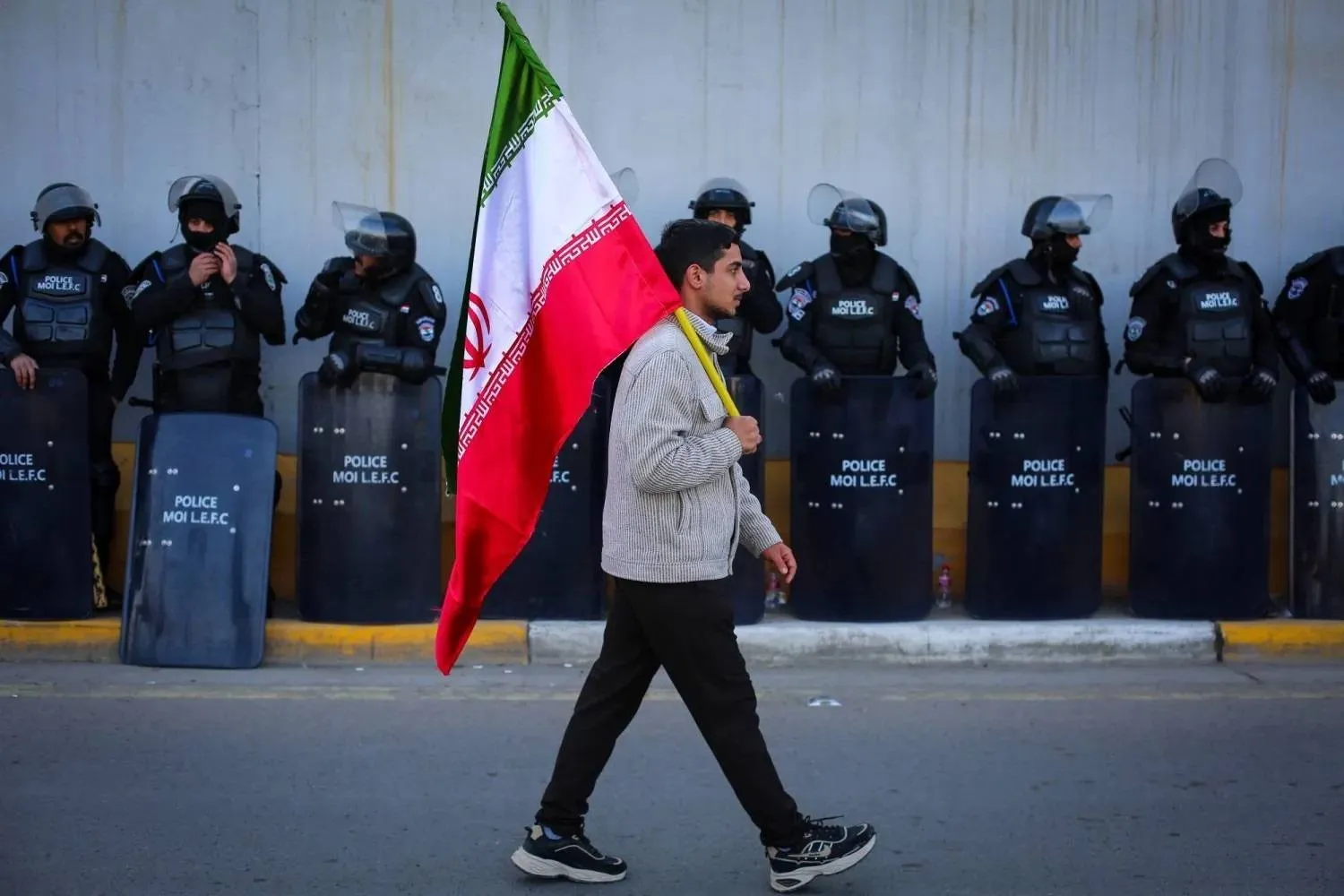
An Iraqi man carrying the Iranian flag passes in front of security forces outside the Iranian embassy in Baghdad during a demonstration to show solidarity against US threats (DPA). 
TT

Possible ‘Emergency Exit’ for Iraqi Factions, But Not for Everyone

An Iraqi man carrying the Iranian flag passes in front of security forces outside the Iranian embassy in Baghdad during a demonstration to show solidarity against US threats (DPA). 

Since protests erupted in Iran, political elites in Iraq have quietly debated whether the “Islamic Revolution” in Tehran might be nearing a rapid collapse. Yet the more cautious question circulating in Baghdad is different: what if the Iranian system survives, but weakened and stripped of its tools, for years to come?

This question now resonates within the corridors of the Coordination Framework, the coalition most closely tied to regional power dynamics. It appears to be repositioning itself amid shifting centers of influence, but not before paying a price.

Figures from Shiite parties and armed factions, as well as researchers interviewed by Asharq Al-Awsat, say anxiety over Iran’s trajectory is palpable in Baghdad, though rarely expressed openly for ideological reasons and because of what they describe as a chronic inability to produce independent national policies.

Pressure on Shiite forces has been building for months. Washington is pushing to dismantle militias and sever their operational and economic ties with Iran. Tehran is weighed down by sanctions and protests whose sparks have reached even the bazaars. Meanwhile, the Coordination Framework is attempting to engineer a governing formula capable of surviving these pressures.

It is widely believed that the heavy presence of armed factions’ representatives in parliament - holding more than about 80 seats - is part of a broader strategy to adapt to US pressure, whether Iran’s system collapses or remains weak for years.

Accordingly, Shiite political actors appear compelled to move from the era of militias toward the state, though only after establishing a strong central power within state institutions, in order to avoid confrontation with Washington and prepare for the possibility of Iran’s declining influence.

Over time, it has become clear that avoiding confrontation with the United States requires not only reducing Iranian influence but also constructing local power under the umbrella of a national political settlement.

A situation resembling Saddam Hussein

Since 2003, Shiite parties have rarely debated Iran’s future publicly. There is a prevailing belief that discussing the fate of a system led by Supreme Leader Ali Khamenei is ideologically taboo for those who profess absolute loyalty to him, according to a senior leader in the Coordination Framework.

Many also dismiss the possibility of Iran’s collapse altogether. But Hisham Dawood, a researcher at the French National Center, argues that the impact of maximum sanctions on Iranian society cannot be ignored. He said sanctions do not overthrow regimes as much as they reshape societies, shifting them from a culture of living to one of survival.

In private gatherings, Iraqi politicians have begun drawing an analogy that alarms Shiite groups. They note that Tehran’s system is approaching a condition similar to that of Saddam Hussein’s regime after the invasion of Kuwait and the subsequent economic embargo, a crushed social base and a leadership gradually stripped of its traditional tools.

Aqeel Abbas, a researcher on US affairs, does not believe Iran’s system will collapse but is convinced that its behavior will change. On that basis, Shiite forces may seek to adapt in order to weather the storm.

This trajectory, however, does not appear sufficient in Washington’s eyes. The United States is not searching for treasure but for the key. US presidential envoy Mark Savaya wrote that militias are merely a symptom of a deeper disease in Iraq. For months, he has been shaping among Shiite circles in Baghdad a narrative of sustained pressure within a broader American strategy.

Groups such as Asaib Ahl al-Haq have shown striking flexibility compared with their past. The faction that once fought the Americans now stands as one of the main pillars of government and parliament and is reportedly planning to dominate both in the next legislative cycle, according to associates of its leader, Qais al-Khazali.

During his election campaign months ago, al-Khazali welcomed US investments. Yet Washington continues to press for the removal of his representative in parliament from the post of deputy speaker, according to information leaked from meetings held by Acting Chargé d’Affaires Joshua Harris with Coordination Framework officials.

A Western diplomat who served in a mission between Baghdad and Damascus during the fight against ISIS explains US behavior toward Shiite factions: after months of “power diplomacy” in exchange for avoiding military targeting, the Americans are not seeking a truce but a decisive blow followed by a deal on their terms. Savaya’s role, he says, is likely to clarify and enforce those conditions.

More than weapons

Spokespersons for armed factions declined to comment on questions about their plans for dealing with US pressure. But a senior figure in an armed faction, speaking anonymously, said they had reached a stage of “confrontation without masks — no intermediaries, no maneuvering.”

Aqeel Abbas believes Shiite forces may attempt to transform existing militias into local forces under new names, limited to protecting the system inside Iraq without regional roles or provoking the United States and Israel.

Theoretically, such a shift could satisfy Washington. But the faction leader warned that the confrontation goes beyond weapons: the Americans, he said, want the core of influence and resistance. “We tried to confine the crisis to weapons, but now they are pressing on our existence, our economy, and our ideological ties. What room for maneuver remains except defending our dignity?”

He added that such questions are being raised in Baghdad faster than they are answered in Tehran.

Iran “that cannot be defeated”

Hisham Dawood divides Shiite reactions in Baghdad into three groups.

The first consists of pro-Iran forces with direct ideological ties to Tehran, which do not view the Iraqi state as the ultimate framework of political belonging but rather as a field of action within a transnational project. These forces, Dawood argues, are prepared to bear high costs - even if they affect the Iraqi state - so long as they serve what they consider a religious obligation toward Tehran.

Indeed, many factions place near-absolute confidence in Iran. A faction leader who was active in Syria before the collapse of Bashar al-Assad’s regime said some battles are managed according to logic that transcends local calculations, and that the final decision is not always in the hands of those who pay the price on the ground. He argued that without Iran, the Islamic Revolution would have no meaning.

The second group comprises forces that have governed Iraq since 2003 and occupy a more complex position. They are not overtly pro-Iran ideologically or organizationally, but they remain deeply influenced by Tehran for historical and sectarian reasons, and out of fear that Iranian influence could reshape internal Shiite alignments.

These forces seek to present themselves as holders of national legitimacy, yet in decisive moments they still defer to Tehran. Many observers believe this dynamic was reflected in what was described as Mohammed Shia al-Sudani’s “concession” to Nouri al-Maliki over the premiership - an attempt, according to a senior Shiite leader, to restore Maliki’s centrality through a new-old alliance.

Pro-Iran groups mobilized demonstrations in central and southern cities, carrying images of Khamenei and Iranian flags. But the Coordination Framework issued only one statement urging diplomatic solutions and warning of economic challenges and falling oil prices. This has revealed a leadership caught between traditional power calculations and growing risks.

The third group consists of a popular majority with weak political representation, which views the continuation of the Iranian model in Iraq as a source of political stagnation, economic crisis, social paralysis, and international isolation.

The Sadrist movement may represent part of this majority. Dawood argues that it is politically reduced to an image of Iranian extension, a simplification that imposes a heavy symbolic and political cost.

Most Iraqi Shiite forces - except some ideological actors - appear ready to strike deals with Washington, provided their interests within the Iraqi state are guaranteed, in a manner resembling the model the United States is testing in Syria.

Meanwhile, attempts to create a strong institutional umbrella to fill the vacuum have emerged through the prominent role of the Supreme Judicial Council. On the eve of the legislative elections, Judge Faiq Zaidan urged adherence to constitutional timelines for forming Iraq’s leadership. Weeks later, he began publicly naming factions that must limit weapons. Iraqi elites now speak of an alternative governing umbrella that could fill the vacuum with the force of law.

An emergency exit

A Western diplomat believes this is the first time in years that Shiite groups may be forced to reconsider options that appear unrealistic, not only for Washington but even for Tehran. He pointed to the fate of the Syrian Democratic Forces as a warning for those who bet on open and absolute hostility.

While these developments paint a suffocating picture for Shiite factions, they also open an emergency exit from the old game toward new alliances.

A former government adviser described such an exit as a search for new alliances during a period in which Iran remains an ideological umbrella but without claws. He argued that pressures on armed factions leave no luxury of choice: Shiite forces must first build sustainable local partnerships and then balance relations with emerging centers of power in the region and the Arab world.

Yet this emergency exit may not accommodate all Shiite players within what Dawood describes as a fragmented state. The central question remains open: will the United States seek to preserve pluralism among Shiite political and factional actors, or will it prefer to support a centralized authority with an authoritarian grip, as some actors in Baghdad now advocate?



Greenland Galvanizes Europe to Confront New US Reality

Apartment buildings and houses light up the city of Nuuk, Greenland on January 22, 2026. (AFP)
TT

Greenland Galvanizes Europe to Confront New US Reality

Apartment buildings and houses light up the city of Nuuk, Greenland on January 22, 2026. (AFP)

Europe may have rallied to see off President Donald Trump over Greenland, but its leaders recognize the confrontation is unlikely to be the last in dealings with his increasingly strident version of the United States.

The stakes could hardly be higher, given the $2 trillion trading relationship between the European Union and the US and the dominant role Washington continues to play in the NATO alliance and in support of Ukraine against Russia.

This week, ​in the space of a few hours at the World Economic Forum's annual meeting in Davos, Trump first ruled out taking Greenland by force and then removed the threat of new tariffs on eight European states standing in his way - hailing instead a vague deal for the Arctic island with NATO chief Mark Rutte.

European leaders believe Trump backed down in part because - in contrast to their more accommodating stance in last year's tariff negotiations - this time they made it clear he was crossing a red line by asserting that Greenland's status as an autonomous territory of Denmark was non-negotiable.

"All this shows that you cannot let the Americans trample all over the Europeans," said a European Union official, who requested anonymity to speak candidly about US ties.

"We did the right thing to push back, to be firm in what we said, but it is not over. My sense is that we will be tested constantly on issues like this," ‌the official told ‌Reuters.

While Europe may have learned the value of standing up to Trump, the challenge is ensuring it ‌is ⁠less ​exposed next time.

"It's ‌a hard route, and it's going to take time," said Rosa Balfour, director at Carnegie Europe, adding that Europe had "far more leverage than it has dared to use".

EUROPE NOT SEEKING A SPLIT

An emergency summit of Europe's leaders on Thursday called for last year's EU-US trade deal to be put back on track after lawmakers suspended its ratification in protest over Greenland.

"Despite all the frustration and anger of recent months, let us not be too quick to write off the transatlantic partnership," German Chancellor Friedrich Merz said in Davos beforehand.

While seeking to stabilize the partnership, Europe is also taking steps aimed at "de-risking" it given the open antipathy from Trump, whose new national security strategy accuses the continent of freeloading on defense and demands it open its markets to US companies.

Europe is only too aware of how long it can ⁠take to get agreement among 27 nations with different histories, politics and economies, which was highlighted in taunts this week by US Treasury Secretary Scott Bessent.

Two EU officials said the Greenland row has accelerated discussions on ‌how the approach taken on Ukraine - in which countries offer security guarantees on a voluntary basis ‍and no one has a right of veto - can be extended.

"We should ‍do more with coalitions of the willing and leave it open for others to follow if they want," said one, adding that joint efforts to ‍boost Europe's development of artificial intelligence technology could be one example.

Coalitions such as the "E3" group comprising France, Germany and Britain focusing on security matters also allow non-EU states to take part, which speaks to others on the rough end of Trump policies.

"The middle powers must act together, because if we're not at the table, we're on the menu," Canadian Prime Minister Mark Carney said in a Davos speech to warm applause.

Another route is using the leeway afforded by EU law.

In December, EU states used an emergency provision ​to indefinitely immobilize hundreds of billions of dollars of Russian assets. That removed the risk of a pro-Moscow country like Hungary blocking the roll-over of the measure at some point and forcing the EU to return the money.

NEW EUROPEAN DOCTRINE

Europe also plans to toughen ⁠up on economic policy.

Next month it will kickstart legislation that will include "Made in Europe" requirements on strategic sectors and strengthening conditionality clauses for any foreign direct investment in the EU.

"Some provisions were originally conceived to reduce reliance on China but in reality they will help us to de-risk from other markets," European Commissioner for Prosperity and Industrial Strategy Stephane Sejourne told Reuters.

"This will totally change the European doctrine on those sectors," Sejourne added.

Unlike Canada, there is no plan in Europe to pivot more towards China to compensate for transatlantic strains. But the bloc is actively pursuing others in a diversification drive.

While the impact of higher US tariffs on European goods is not clear - in fact Europe's trade surplus with the US initially rose over the course of 2025 as companies front-loaded exports ahead of the new levies - recent data shows that German companies nearly halved investments there last year.

After the signing of the EU-Mercosur pact this month - the largest in EU history - European Commission President Ursula von der Leyen said it is now "on the cusp" of a deal with India.

However, nobody is saying Europe can redress the imbalance with the US overnight, particularly on security.

Despite European commitments to a defense spending surge and even calls for an EU army, analysts say it will be years before its military might is up to ‌tasks which now include bolstering Arctic security.

The question is whether the past few weeks provide a catalyst for Europe to start reducing its US dependencies.

"All this is not surprising," Swedish deputy Prime Minister Ebba Busch said of Trump's showing in Davos.

"The EU needs to toughen up," she told Reuters.


'Too Dangerous to Go to Hospital': A Glimpse into Iran's Protest Crackdown

In this frame grab from video taken by an individual not employed by The Associated Press and obtained by the AP outside Iran shows people blocking an intersection during a protest in Tehran, Iran, Thursday Jan. 8, 2026. (UGC via AP)
TT

'Too Dangerous to Go to Hospital': A Glimpse into Iran's Protest Crackdown

In this frame grab from video taken by an individual not employed by The Associated Press and obtained by the AP outside Iran shows people blocking an intersection during a protest in Tehran, Iran, Thursday Jan. 8, 2026. (UGC via AP)

Young protesters shot in the back, shotgun pellets fired in a doctor's face, wounded people afraid to go to hospital: "Every family has been affected" by the deadly crackdown on Iran's recent wave of demonstrations, said one protester.

Speaking to AFP in Istanbul, this 45-year-old engineer who asked to be identified as Farhad -- not his real name -- was caught up in the mass protests that swept his home city of one million people just outside Tehran.

With Iran still largely under an internet blackout after weeks of unrest, eyewitness testimony is key for understanding how the events unfolded.

Angry demonstrations over economic hardship began late last year and exploded into the biggest anti-government protests since the 1979 Iranian revolution.

"On the first day, there were so many people in the streets that the security forces just kept their distance," he told AFP.

"But on the second day, they understood that without shooting, the people were not going to disperse."

As the protests grew, the security forces began a major crackdown under the cover of a communications blackout that began on January 8.

Sitting inside a church on the European side of Istanbul, this quietly-spoken oil industry worker said he was in his car with his sister on the night when the shooting began.

"We saw about 20 military people jumping from cars and start shooting at young people about 100 meters away. I saw people running but they were shooting at their backs" with rifles and shotguns, he told AFP.

"In front of my eyes, I saw a friend of ours, a doctor, being hit in the face by shotgun pellets," Farhad said. He does not know what happened to him.

Both Amnesty International and Human Rights Watch have accused the security forces of firing rifles and shotguns loaded with metal pellets directly at protesters' heads and torsos.

"I saw two people being carried, they were very badly injured, maybe dead," Farhad said.

A lot of people also died "in their cars because the bullets were coming out of nowhere".

'Afraid to go to hospital'

The scale of the crackdown is only slowly emerging.

Despite great difficulty accessing information, the Norway-based NGO Iran Human Rights says it has verified the deaths of 3,428 protesters killed by the security forces, but warned the true figure could be much higher, citing estimates of "between 5,000 and 20,000".

Those who were injured were often too afraid to go to hospital, Farhad said.

"People can't go to the hospital because the authorities and the police are there. Anyone with injuries from bullets or shotgun (pellets) they detain and interrogate," he said.

"Doctors have been going to people's houses to give them medical assistance."

He himself was beaten with a baton by two people on a motorbike and thought his arm was broken, but did not go to hospital because it was "too dangerous".

Many "opened their homes to let the demonstrators inside and give them first aid", including his sister and her friend who took in "around 50 boys, and gave them tea and cake".

There were a lot of very young people on the streets and "a lot of girls and women", he told AFP, saying he had seen children of "six or seven" shouting slogans against Iran's supreme leader Ali Khamenei.

The security forces were also staging spot checks for anyone with protest-related injuries or footage on their phones, he said.

"It's so dangerous because they randomly check phones. If they see anything related to this revolution, you are finished. They are also making people lift their shirts to look for signs of bullet or shotgun injuries.

"If they see that, they are taken for interrogation."

Speaking just before he flew back to Iran -- "because I have a job to go to" -- he insisted he was "absolutely not afraid".

Despite everything, people were still ready to protest "because they are so angry", he explained.

He is convinced US President Donald Trump will soon make good on his pledge to intervene, pointing to recent reports of US warships arriving in the region.

"The system cannot survive -- in Iran everybody is just overwhelmed with this dictatorship. We have had enough of them."


A US Shift Marked Kurdish-Led Forces’ Fall from Power in Syria

 Syrian government forces patrol inside the al-Hol camp as smoke rises from an arms depot explosion in northeastern Syria's Hasakeh province, Syria, Wednesday, Jan. 21, 2026, after the withdrawal of the Syrian Democratic Forces (SDF). (AP)
Syrian government forces patrol inside the al-Hol camp as smoke rises from an arms depot explosion in northeastern Syria's Hasakeh province, Syria, Wednesday, Jan. 21, 2026, after the withdrawal of the Syrian Democratic Forces (SDF). (AP)
TT

A US Shift Marked Kurdish-Led Forces’ Fall from Power in Syria

 Syrian government forces patrol inside the al-Hol camp as smoke rises from an arms depot explosion in northeastern Syria's Hasakeh province, Syria, Wednesday, Jan. 21, 2026, after the withdrawal of the Syrian Democratic Forces (SDF). (AP)
Syrian government forces patrol inside the al-Hol camp as smoke rises from an arms depot explosion in northeastern Syria's Hasakeh province, Syria, Wednesday, Jan. 21, 2026, after the withdrawal of the Syrian Democratic Forces (SDF). (AP)

Two tumultuous weeks saw the fall from power in Syria of the Kurdish-led force that was once the main US partner there, as Washington shifts its backing to the country's nascent government.

Analysts say the Syrian Democratic Forces miscalculated, taking a hard stance in negotiations with the new leaders in Damascus on the assumption that if a military conflict erupted between them, Washington would support the SDF as it had for years when they battled the ISIS group.

Instead, the Kurdish-led force lost most of its territory in northeast Syria to a government offensive after intense clashes erupted in the northern city of Aleppo on Jan. 6. Washington did not intervene militarily and focused on mediating a ceasefire.

By Wednesday, the latest ceasefire was holding, and the SDF had signed onto a deal that would effectively dissolve it.

Elham Ahmad, a senior official with the de facto autonomous administration in the Kurdish-led northeast, expressed surprise to journalists Tuesday that its calls for intervention by the US-led coalition against ISIS “have gone unanswered.”

Experts had seen it coming. "It’s been very clear for months that the US views Damascus as a potential strategic partner," said Noah Bonsey, senior advisor on Syria with the International Crisis Group, according The Associated Press.

US President Donald Trump has strongly backed the government of interim President Ahmed al-Sharaa, a former opposition leader, since his forces ousted former President Bashar al-Assad in December 2024 following years of civil war. Under al-Sharaa, Syria has joined the global coalition against ISIS.

US envoy to Syria Tom Barrack in a blunt statement Tuesday said the SDF’s role as Syria's primary anti-ISIS force “has largely expired" since the new government is "both willing and positioned to take over security responsibilities.” The US is not interested in "prolonging a separate SDF role,” he said.

Stalled negotiations led to gunfire

As al-Sharaa sought to pull the country together after 14 years of civil war, he and SDF leader Mazloum Abdi in March 2025 agreed that the SDF's tens of thousands of fighters would be integrated into the new army. The government would take over key institutions in northeast Syria, including border crossings, oil fields and detention centers housing thousands of suspected IS members.

But for months, US-mediated negotiations to implement the deal stalled.

Syrian government officials who spoke to The AP blamed fractured SDF leadership and their maximalist demands.

Syria’s ambassador to the United Nations, Ibrahim Olabi, said Abdi on several occasions agreed to proposals that the group’s more hardline leaders then rejected.

“Then he stopped agreeing to things and started saying, ‘I have to go back’ (to consult with other officials), which obviously didn’t work with us and the Americans," Olabi said. “We wanted to spend a week in one room and get everything done.”

A senior Syrian government official who spoke on condition of anonymity because he was not authorized to comment publicly said Barrack slammed his hand on the table during one negotiating session and demanded that Abdi clarify whether he wanted to continue with the agreement. Barrack declined to comment via a spokesperson.

Ahmad with the Kurdish-led administration accused Damascus officials of dodging meetings and said those that occurred "were only possible because of the Americans pushing Damascus to come and join.”

Talks were always likely to be thorny. The SDF's Kurdish base was wary of the new government, particularly after outbreaks of sectarian violence targeting other minority groups in Syria.

There was “a major disagreement over a huge substantive set of questions around the future of Syrian governance, how decentralized or centralized it should be,” Bonsey said.

Meghan Bodette, director of research at the pro-SDF Kurdish Peace Institute think tank, said the impasse came down to an “astronomical” gulf in political outlook.

Damascus sought to create a centralized state, while the (Kurdish-led authorities) wanted to keep maximum local autonomy through decentralization and institutionalizing minority rights, she said.

Integrating forces was especially tricky

Much debate focused on how the SDF forces would be integrated into the new army.

The senior Syrian official said SDF leaders at one point proposed integrating Syrian government military groups into their forces instead.

He said the government rejected that but agreed to keep the SDF unified in three battalions in northeastern Syria along with a border brigade, a women’s brigade and a special forces brigade.

In return, the government demanded that non-SDF military forces have freedom of movement in the northeast and that SDF divisions would report to the Ministry of Defense and not move without orders. The senior official said Abdi asked to be named deputy minister of defense, and the government agreed.

At the last negotiation session in early January, however, SDF commander Sipan Hamo — seen by Damascus as part of the hardline faction — demanded that the northeast brigades and battalions report to a person chosen by the SDF and that other forces could only enter the region in small patrols and with SDF permission, the senior official said. The government rejected that.

SDF officials did not respond to request for comment on details of negotiations.

Aleppo was a turning point

Days after that session, clashes erupted in Aleppo.

Olabi, the ambassador, said the Syrian military's success in limiting civilian casualties in Aleppo was another key to the diplomatic breakthrough with the SDF.

Syria's military leadership appeared to have learned lessons from confrontations elsewhere in which government-affiliated fighters carried out sectarian revenge attacks on civilians.

In Aleppo, the military opened “humanitarian corridors” so civilians could flee.

“If Aleppo had gone wrong, I think we would be in a very different place,” Olabi said.

After Syrian forces captured the Arab-majority oil-rich provinces of Raqqa and Deir Ezzor from the SDF, the two sides announced a deal. SDF would retain a presence only in Hasakeh province, the country's Kurdish heartland. And SDF fighters would be integrated into the army as individuals.

Bonsey said the SDF had been warned during negotiations that their effort to maintain their dominant role in the northeast conflicted with geopolitical shifts.

They ended up accepting a deal that is “much worse” than what was on offer just two weeks ago, he said.
