


Iraq Urges International Community to Help it Shoulder ISIS Burden

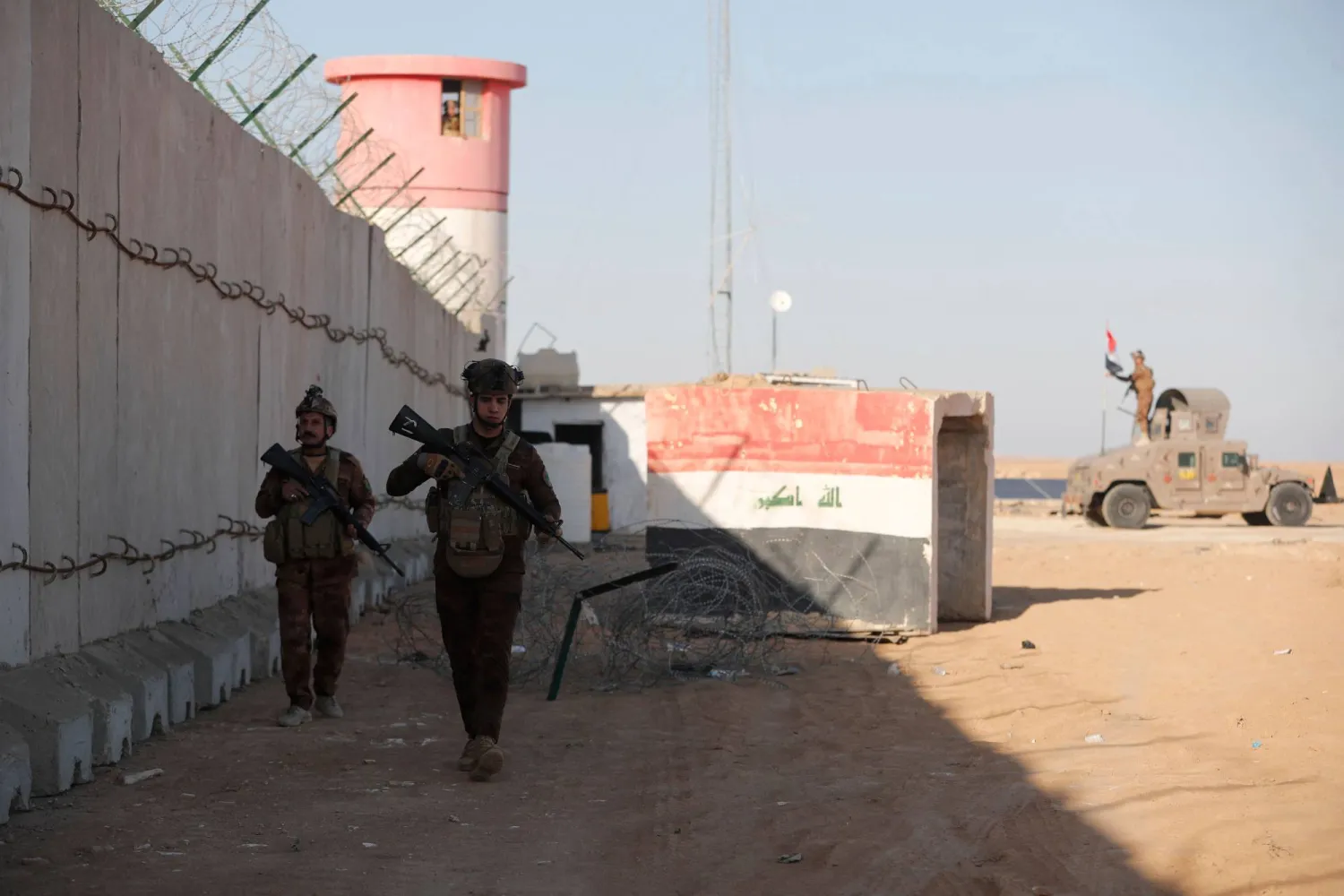
Members of the Iraqi border forces patrol along a concrete wall on the Iraqi-Syrian border, in the town of al-Baghuz in the Al-Qaim district of western Iraq, on January 21, 2026. (AFP)
TT

Iraq Urges International Community to Help it Shoulder ISIS Burden

Members of the Iraqi border forces patrol along a concrete wall on the Iraqi-Syrian border, in the town of al-Baghuz in the Al-Qaim district of western Iraq, on January 21, 2026. (AFP)

The transfer of ISIS detainees from northeastern Syria could saddle Iraq with annual costs of up to $25 million, an Iraqi government source said on Saturday.

The source said the number of detainees stands at around 7,000 members and that the cost of feeding them is estimated at roughly 33 billion Iraqi dinars a year, or about $25 million, according to Shafaq News.

The comments came as Foreign Minister Fuad Hussein said Iraq should not shoulder alone the security and financial burdens resulting from the transfer of ISIS prisoners from Syria to Iraq.

In a statement, the Foreign Ministry said Hussein made the remarks during a phone call with the European Union’s High Representative for Foreign Affairs and Security Policy, Kaja Kallas, during which they discussed developments in Syria and the issue of prisons holding ISIS members.

The statement said the officials discussed security risks arising from the escape of several ISIS members from some prisons outside the control of the Syrian Democratic Forces, as well as the security situation in Syria’s Hasakah province.

They also stressed the importance of resolving disputes peacefully.

Hussein was quoted as saying that responsibility for dealing with the ISIS detainee file “must be borne by all concerned countries and should not fall on Iraq alone.”

Earlier this week, the US military’s US Central Command said its forces had transferred 150 ISIS detainees from a detention facility in Syria’s Hasakah to Iraq, adding that the move was intended to prevent their escape.

Reuters quoted a US official as saying Washington expects the transfer of up to 7,000 detainees from prisons in Syria to Iraq to be completed in the coming days, noting that hundreds of detainees could be moved daily across the border.

Political debate

Falih al-Fayyad, head of Iraq’s pro-Iran Popular Mobilization Forces, said Iraq had received the first batch of detainees, adding that the government would begin talks with the international coalition to shoulder the costs associated with transferring the rest.

Fayyad said most of the detainees are wanted by the Iraqi judiciary and will stand trial under Iraqi law, adding that their transfer to prisons inside Iraq “serves security interests” compared with keeping them in unstable detention facilities outside the country.

The transfer of the detainees has sparked political and media debate in Iraq, amid concerns over the financial and security burdens involved. At the same time, the government says the issue is being handled as a national security matter in coordination with the international coalition.

Separately, Iraqi Prime Minister Mohammed Shia al-Sudani discussed with US Central Command commander Brad Cooper the timeline for the transfer, stressing the importance of security coordination to prevent any potential threats to Iraq and the region.

Sabah al-Numan, spokesman for the commander-in-chief of the armed forces, said the government had ordered the completion of a concrete wall along the Syrian border, which is 80% complete.

Numan said the transferred detainees are wanted on terrorism charges and will be held in fortified prisons, adding that the transfer “will be carried out under a tightly coordinated plan prepared by the Joint Operations Command and the relevant security agencies, in coordination with the Ministry of Justice, which has prepared an integrated plan to accommodate them inside Iraqi prisons.”



Lebanon PM Says International Force Needed After UNIFIL

 France's President Emmanuel Macron (R) wearing sunglasses shakes hands with Lebanon's Prime Minister Nawaf Salam prior to their meeting at the Elysee presidential palace in Paris, on January 23, 2026. (AFP)
France's President Emmanuel Macron (R) wearing sunglasses shakes hands with Lebanon's Prime Minister Nawaf Salam prior to their meeting at the Elysee presidential palace in Paris, on January 23, 2026. (AFP)
TT

Lebanon PM Says International Force Needed After UNIFIL

 France's President Emmanuel Macron (R) wearing sunglasses shakes hands with Lebanon's Prime Minister Nawaf Salam prior to their meeting at the Elysee presidential palace in Paris, on January 23, 2026. (AFP)
France's President Emmanuel Macron (R) wearing sunglasses shakes hands with Lebanon's Prime Minister Nawaf Salam prior to their meeting at the Elysee presidential palace in Paris, on January 23, 2026. (AFP)

Lebanon will need some sort of international force after the withdrawal of the United Nations's UNIFIL mission scheduled for 2027, Prime Minister Nawaf Salam said during a visit to Paris Saturday.

Some 10,800 UN Interim Force in Lebanon (UNIFIL) peacekeepers have manned a buffer zone between Israel and Lebanon since March 1978, but they will have one year to leave Lebanon starting 31 December, under a resolution passed last August under pressure from the United States and Israel.

"We will always need an international presence in the south, and preferably a UN presence, given the impartiality and neutrality that only the UN can provide," Nawaf Salam said the day after a meeting with French President Emmanuel Macron.

The force would need a mix of observers and peacekeepers, largely because of a "history of hostility" with Israel, he added.

UN peacekeepers current operate in southern Lebanon in cooperation with the Lebanese army, part of a ceasefire between Israel and the pro-Iranian Hezbollah in place since November 2024.

While Israel was supposed to withdraw its forces from southern Lebanon, it has maintained them in five areas it considers strategic.

It regularly conducts airstrikes in the country on what it claims are Hezbollah sites and members, whom it accuses of rearming.

Questioned about Hezbollah's promised disarmament, Salam said Phase 2 of this process had begun "two weeks ago".

The Lebanese army says it has completed the first phase, which calls for disarming Hezbollah south of the Litani River.

The second phase will involve disarmament between the Litani and the Awali River, an area further north that has significant Hezbollah influence.

"I can clearly see that Phase 2 has different requirements than Phase 1," said Salam, adding that Hezbollah's rhetoric had been "rather harsh".

"But let me be clear, we will not back down," he added.


Syria Frees 126 Minors After Taking Prison from Kurdish Forces

Relatives of detainees who were set free from al-Aqtan prison gather, following the control of the prison by the Syrian government, in Raqqa, Syria January 24, 2026. (Reuters)
TT

Syria Frees 126 Minors After Taking Prison from Kurdish Forces

Relatives of detainees who were set free from al-Aqtan prison gather, following the control of the prison by the Syrian government, in Raqqa, Syria January 24, 2026. (Reuters)

Syria's government freed at least 126 minors being held in a northern prison on Saturday, state media reported, after taking over the facility from Kurdish forces as part of an agreement.

Footage on state television showed crowds gathered to welcome the released minors, while Syria's official SANA news agency published the names of the remaining detainees, allowing people to look for them online.

State television reported "the release... of 126 detainees under the age of 18 from Al-Aqtan prison" in Raqqa province, which has been used to hold ISIS group detainees.

The Kurdish-led Syrian Democratic Forces (SDF) did not immediately respond to a request for comment.

Under military pressure from Damascus, which is seeking to extend its control across the country, the SDF has relinquished swathes of territory in recent days and withdrawn to parts of Hasakeh province in the far northeast.

On Sunday, Syrian President Ahmed al-Sharaa announced a deal with SDF chief Mazloum Abdi that included a ceasefire and the integration of the Kurds' de facto autonomous administration into the state, which will take responsibility for ISIS prisoners.

Kurdish fighters were transferred from the prison on Friday to the Kurdish-held city of Ain al-Arab, also known as Kobane, in Aleppo province on the northern border with Türkiye.

The same day, SANA quoted the army as saying the Al-Aqtan transfer was "the first step in implementing the January 18 agreement under which the interior ministry will take over administration of the prison".


Syria, Kurds Extend Truce to Allow Transfer of ISIS Detainees

 Syrian security force members ride in the back of a pickup truck in the town of Ain Issa, northeastern Syria, Saturday, Jan. 24, 2026. (AP)
Syrian security force members ride in the back of a pickup truck in the town of Ain Issa, northeastern Syria, Saturday, Jan. 24, 2026. (AP)
TT

Syria, Kurds Extend Truce to Allow Transfer of ISIS Detainees

 Syrian security force members ride in the back of a pickup truck in the town of Ain Issa, northeastern Syria, Saturday, Jan. 24, 2026. (AP)
Syrian security force members ride in the back of a pickup truck in the town of Ain Issa, northeastern Syria, Saturday, Jan. 24, 2026. (AP)

Syria's government and Kurdish forces on Saturday extended their truce by 15 days, with Damascus saying it was to support the US transfer of ISIS group detainees from Syria to Iraq.

Several sources had earlier told AFP the truce would be prolonged, with a Syrian official in Damascus citing the same reason.

In a statement, the Syrian defense ministry said the 15-day extension would take effect at 11pm (2000 GMT) on Saturday.

"The extension of the ceasefire comes in support of the American operation to transfer ISIS detainees from SDF prisons to Iraq," the statement added, referring to the Kurdish-led Syrian Democratic Forces.

The SDF also confirmed the extension, saying it was reached "through international mediation, while dialogue with Damascus continues".

"Our forces affirm their commitment to the agreement and their dedication to respecting it, which contributes to de-escalation, the protection of civilians, and the creation of the necessary conditions for stability," it said in a statement.

Damascus and the SDF had initially agreed to a four-day ceasefire on Tuesday after Kurdish forces relinquished swathes of territory to government troops, who also sent reinforcements to a Kurdish stronghold in the northeast.

Three sources, including a Kurdish source and a Syrian official in Damascus, had told AFP earlier on Saturday that the ceasefire would be extended.

- ISIS transfer -

After the SDF lost large areas to government forces, Washington said it would transfer 7,000 ISIS detainees to prisons in Iraq.

Europeans were among the 150 senior ISIS detainees who were the first to be transferred on Wednesday, and two Iraqi officials told AFP that a second batch of "up to 1,000 ISIS detainees" were being sent on Saturday.

Turkish Foreign Minister Hakan Fidan, whose country is a key backer of Damascus but hostile to the SDF, had said during a TV interview Friday that in light of the ISIS prisoner transfers, "extending the ceasefire for a while longer might be considered".

The transfer is expected to take several days.

ISIS swept across Syria and Iraq in 2014, committing massacres and other atrocities before ultimately being territorially defeated by the SDF and a US-led coalition.

The truce between Damascus and the Kurds is part of a new understanding over Kurdish-majority areas in Hasakeh province and a broader deal to integrate the Kurds' administration into the state.

Syrian President Ahmed al-Sharaa's opposition forces toppled longtime ruler Bashar al-Assad in 2024.

The new authorities are seeking to extend state control across Syria, resetting international ties including with the United States, now a key ally.

The Kurdish source said the SDF submitted a proposal to the authorities through US envoy Tom Barrack that would have the government managing border crossings -- a key Damascus demand.

It also proposes that Damascus would "allocate part of the economic resources -- particularly revenue from border crossings and oil -- to the Kurdish-majority areas", the source added.

Earlier this month, the Syrian army recaptured oil fields, including the country's largest, while advancing against Kurdish forces.

On Saturday, Syria's government freed at least 126 minors being held in a prison for ISIS detainees in Raqqa province in northern Syria after taking over the facility from Kurdish forces.