


Israel Says the Remains of Final Hostage in Gaza Are Recovered, Key for Ceasefire’s Next Phase

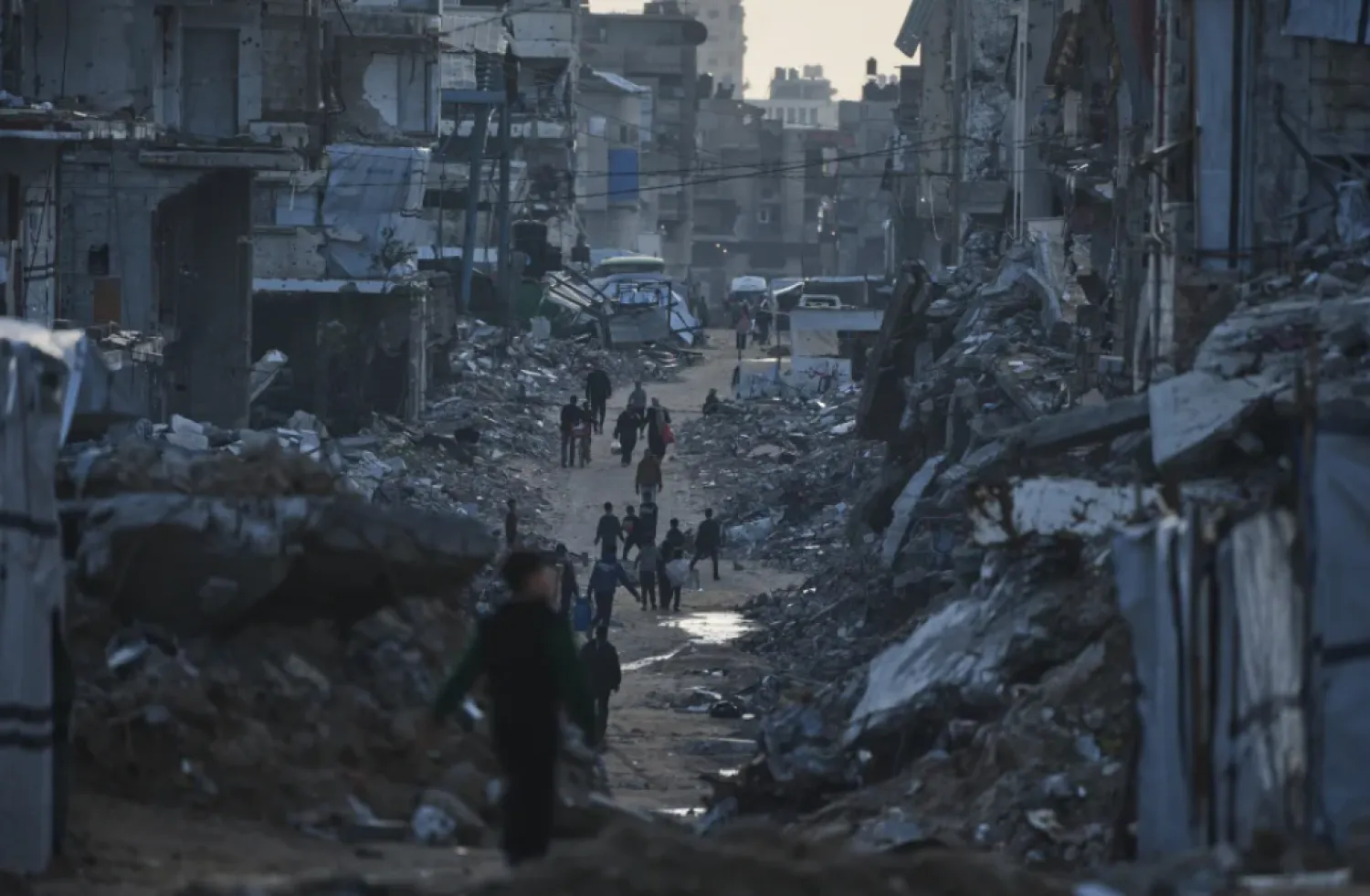
Palestinians walk amid buildings destroyed by Israeli air and ground operations in Gaza City Thursday, Jan. 15, 2026. (AP Photo/Jehad Alshrafi)
TT

Israel Says the Remains of Final Hostage in Gaza Are Recovered, Key for Ceasefire’s Next Phase

Palestinians walk amid buildings destroyed by Israeli air and ground operations in Gaza City Thursday, Jan. 15, 2026. (AP Photo/Jehad Alshrafi)

The remains of the final hostage in Gaza have been recovered, Israel's military said Monday, clearing the way for the next phase of the ceasefire that paused the Israel-Hamas war.

The announcement that the remains of Ran Gvili had been found and identified came a day after Israel’s government said the military was conducting a “large-scale operation” in a cemetery in northern Gaza to locate them.

Prime Minister Benjamin Netanyahu called it “an incredible achievement” for Israel and its soldiers, telling Israeli media that “I promised we would bring everyone home and we have brought everyone home." He said Gvili, who was killed during the Hamas-led attack on Oct. 7, 2023, that sparked the war, was among the first to be taken into Gaza.

The return of all remaining hostages, living or dead, has been a key part of the Gaza ceasefire’s first phase, and Gvili’s family had urged Israel’s government not to enter the second phase until his remains were recovered and returned.

Netanyahu’s office said Sunday that Israel would open the Rafah crossing between Gaza and Egypt, which Palestinians see as their lifeline to the world, once the search for Gvili was finished. It has been largely shut since May 2024, except for a small period in early 2025.

Israel and Hamas had been under pressure from ceasefire mediators including Washington to move into the second phase of the US-brokered truce, which took effect on Oct. 10.

Israel had repeatedly accused Hamas of dragging its feet in the recovery of the final hostage. Hamas said it had provided all the information it had about Gvili’s remains, and accused Israel of obstructing efforts to search for them in areas of Gaza under Israeli military control.

Israel’s military had said the large-scale operation to locate Gvili’s remains was “in the area of the Yellow Line” that divides the territory.

The Oct. 7, 2023 attack killed about 1,200 people and saw 251 taken hostage. Gvili, a 24-year-old police officer known affectionately as “Rani,” was killed while fighting Hamas militants.

Before Gvili’s remains were recovered, 20 living hostages and the remains of 27 others had been returned to Israel since the ceasefire, most recently in early December. Israel in exchange has released the bodies of hundreds Palestinians to Gaza.

The next phase of the 20-point ceasefire plan has called for creating an international stabilization force, forming a technocratic Palestinian government and disarming Hamas.

Palestinians killed in Gaza Israeli forces on Monday fatally shot a man in Gaza City’s Tuffah neighborhood, according to Shifa Hospital, which received the body. The man was close to an area where the military has launched the search operation for Gvili, the hospital said.

Another man was killed in the eastern side of Bureij refugee camp in central Gaza, according to Al-Aqsa Martyrs hospital, which received his body. The circumstances of his death were not immediately clear.

More than 480 Palestinians were killed by Israeli fire since Oct. 10, according to Gaza's Health Ministry. The ministry, which is part of the Hamas-led government, maintains detailed casualty records that are seen as generally reliable by UN agencies and independent experts.

Israel's top court considers petition to open Gaza for international journalists The Foreign Press Association on Monday asked Israel’s Supreme Court to allow journalists to enter Gaza freely and independently.

The FPA, which represents dozens of global news organizations, has been fighting for more than two years for independent media access to Gaza. Israel has barred reporters from entering Gaza independently since the Oct. 7, 2023, attacks by Hamas, which triggered the war, saying entry could put both journalists and soldiers at risk.

The army has offered journalists brief, occasional visits under strict military supervision.

FPA lawyers told the three judge panel that the restrictions are not justified and that with aid workers moving in and out of Gaza, journalists should be allowed in as well. They also said the tightly controlled embeds with the military are no substitute for independent access. The judges are expected to rule in the coming days.



Syria, Jordan Sign Gas Supply Deal to Bolster Syrian Power Grid

Syrian soldiers raise the Syrian national flag in front of the Syrian Defense Ministry building, which was heavily damaged by Israeli airstrikes last Wednesday, in Damascus, Syria, Saturday, July 19, 2025. (AP)
TT

Syria, Jordan Sign Gas Supply Deal to Bolster Syrian Power Grid

Syrian soldiers raise the Syrian national flag in front of the Syrian Defense Ministry building, which was heavily damaged by Israeli airstrikes last Wednesday, in Damascus, Syria, Saturday, July 19, 2025. (AP)

Syria and Jordan signed an agreement on Monday to supply natural gas to Syria via Jordanian territory, ​aiming to bolster Syria's fragile electricity grid, officials said.

The deal between the Syrian Petroleum Company and Jordan's National Electric Power Company, which was signed at Syria's Ministry of Energy in Damascus, provides for the delivery of about 4 million ‌cubic metres ‌of gas per ‌day — ⁠roughly ​140 million ‌cubic feet, Reuters reported.

The agreement builds on a broader energy arrangement signed last year to supply gas to Syria through Jordan, which is being financed by Qatar, part of regional efforts to ease Syria's acute power ⁠shortages after years of war and infrastructure damage, Syrian ‌and Jordanian officials have ‍said.

Jordan's energy minister, ‍Saleh al-Kharabsheh was quoted by Syrian state ‍media on Monday as saying deliveries began on January 1, with current volumes ranging between 30 million and 90 million cubic feet ​per day.

The deal would help Syria diversify its energy supply sources, the ⁠country's energy minister Mohamed al-Bashir said.

Supplies are being delivered via the Energos Force regasification vessel, leased from Egypt and docked at Jordan's Red Sea port of Aqaba until the end of March.

Jordan's National Electric Power Company has started procedures to lease a new floating storage and regasification unit to replace the existing vessel, ‌ensuring a continuous gas supply beyond March, Kharabsheh added.


UN Says Over 3 Million Sudanese Displaced by War Return Home

A Sudanese men who fled the conflict in Sudan's Darfur region, and was previously internally displaced in Sudan, walks past makeshift shelters near the border between Sudan and Chad, while taking refuge in Borota, Chad, May 13, 2023. © Zohra Bensemra, Reuters
TT

UN Says Over 3 Million Sudanese Displaced by War Return Home

A Sudanese men who fled the conflict in Sudan's Darfur region, and was previously internally displaced in Sudan, walks past makeshift shelters near the border between Sudan and Chad, while taking refuge in Borota, Chad, May 13, 2023. © Zohra Bensemra, Reuters

More than three million Sudanese people displaced by nearly three years of war have returned home, the United Nations migration agency said on Monday, even as heavy fighting continues to tear through parts of the country.

Since April 2023, Sudan has been locked in a devastating war pitting the regular army against the Rapid Support Forces (RSF).

The conflict has killed tens of thousands of people and created what the UN describes as the world's largest displacement and hunger crisis. At its peak, the war had displaced around 14 million people both internally and across borders.

In a report released on Monday, the International Organization for Migration (IOM) said an estimated 3.3 million displaced Sudanese had made their way back home by November of last year, AFP reported.

The rise in returns follows a sweeping offensive launched by the Sudanese army in late 2024 to retake central regions seized earlier in the conflict by the RSF.

The campaign culminated in the recapture of Khartoum in March 2025, prompting many displaced families to try to go back.

According to the IOM, more than three-quarters of those returning came from internal displacement sites, while 17 percent travelled back from abroad.

Khartoum saw the largest number of returns -- around 1.4 million people -- followed by the central state of Al-Jazira, where roughly 1.1 million have gone back.

Earlier this month, the army-backed government announced plans to return to the capital after nearly three years of operating from the Red Sea city of Port Sudan in the country's east.

Reconstruction work in Khartoum has been underway since the army retook the city.

Although Khartoum and several army-held cities in central and eastern Sudan have seen a relative lull in fighting, the RSF has continued to launch occasional drone strikes, particularly targeting infrastructure.

Elsewhere, violence remains intense.

In the country's south, RSF forces have pushed deeper into the Kordofan region after seizing the army's final stronghold in Darfur last October.

Reports of mass killings, rape, abductions and looting emerged after El-Fasher's RSF takeover, and the International Criminal Court launched a formal investigation into "war crimes" by both sides.


Hezbollah Chief Says Any Attack on Iran also Targets Group

29 July 2024, Iran, Tehran: Then Hezbollah deputy leader Sheikh Naim Qassem is pictured during a meeting in Tehran. (Iranian Presidency/dpa)
TT

Hezbollah Chief Says Any Attack on Iran also Targets Group

29 July 2024, Iran, Tehran: Then Hezbollah deputy leader Sheikh Naim Qassem is pictured during a meeting in Tehran. (Iranian Presidency/dpa)

Hezbollah chief Naim Qassem said Monday that any attack on the group's backer Tehran would also target the militants, and warned that any new war on Iran would ignite the region.

"Faced with aggression that does not distinguish between us... we are targeted by any potential aggression and determined to defend ourselves," he said in a televised address to supporters at a solidarity rally for Iran, AFP reported.

"We will choose at that time how to act... but we are not neutral," he said, warning that "a war on Iran this time will ignite the region".