


Lebanon Files Complaint against Israel at Security Council

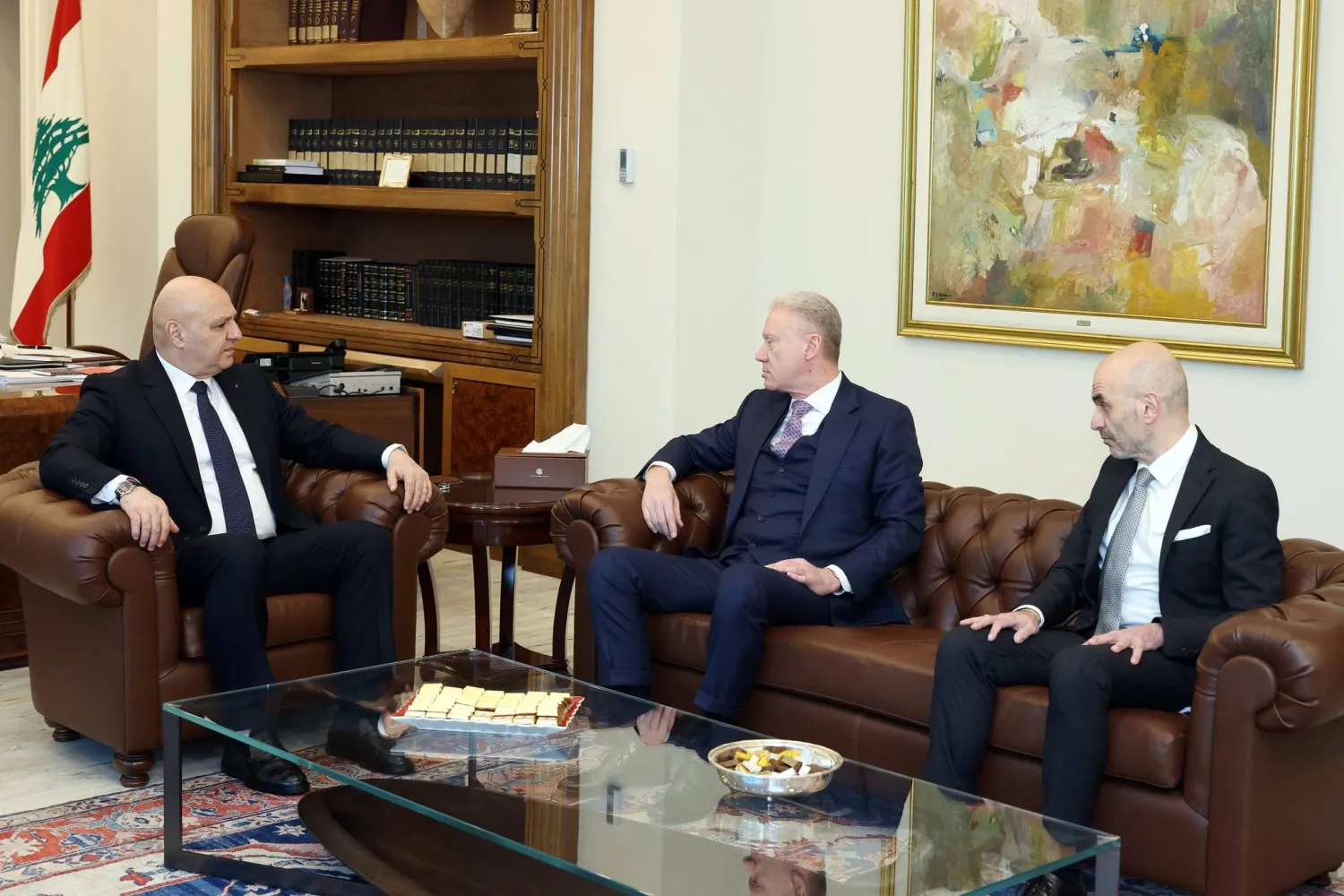
President Joseph Aoun meets with Foreign Minister Youssef Raggi on Monday. (Lebanese Presidency)
TT

Lebanon Files Complaint against Israel at Security Council

President Joseph Aoun meets with Foreign Minister Youssef Raggi on Monday. (Lebanese Presidency)

Lebanon's Foreign Ministry filed on Monday a complaint against Israel at the United Nations Security Council over its repeated violation of its sovereignty.

The complaint detailed violations committed by Israel in from October to December 2025.It documented 542 violations in October, 691 in November and 803 in December.

These incidents are a "flagrant" violation of Lebanon's sovereignty, said the ministry, accusing Israel of failing to commit to Security Council 1701 and the November 2024 ceasefire.

It called on the council to obligate Israel to implement the resolution, withdraw its forces from the five locations it is still occupying in southern Lebanon, release Lebanese prisoners and cease its repeated violations.

President Joseph Aoun met with Foreign Minister Youssef Raggi on Monday. Later on Monday, the FM held talks with French Ambassador to Lebanon Herve Magro on bilateral ties and regional and international developments, especially the situation in southern Lebanon.

The ambassador briefed him on Paris' preparations to hold a conference in support of the Lebanese army in March, stressing the importance of international pressure on Israel for it to implement resolution 1701.

Raggi, for his part, underlined the government's commitment to impose state monopoly over arms throughout the country.

Hezbollah said on Monday that an Israeli strike ​in the country's south killed TV presenter Ali Nour al-Din, who worked for the group's affiliated Al-Manar television station.

The group said the killing portends "the danger of ‌Israel's extended escalations (in Lebanon) ‌to include ‌the ⁠media community".

The ​Israeli ‌military said later on Monday that al-Din was a Hezbollah militant who recently worked to rehabilitate the group's artillery capabilities in southern Lebanon.

Israel and ⁠Lebanon agreed to a US-brokered ‌ceasefire in 2024 to end ‍more than ‍a year of fighting ‍between Israel and Hezbollah, which culminated in Israeli strikes that severely weakened the Iran-backed group. Since ​then, the sides have traded accusations over ceasefire violations.

Lebanon ⁠has faced growing pressure from the US and Israel to disarm Hezbollah. The group's leaders fear that Israel could dramatically escalate strikes across the battered country, aiming to push the Lebanese government for quicker action to confiscate Hezbollah's arsenal.



Türkiye Bans Protests in Province Bordering Syria

Pro-Kurdish protesters tear down a border fence as they attempt to cross to the Kurdish-controlled northeastern Syrian city of Qamishli during a demonstration in support of Syrian Kurds and against recent military clashes between the Syrian army and Kurdish forces, in Nusaybin, southeastern Türkiye, January 20, 2026. REUTERS/Ensar Ozdemir
TT

Türkiye Bans Protests in Province Bordering Syria

Pro-Kurdish protesters tear down a border fence as they attempt to cross to the Kurdish-controlled northeastern Syrian city of Qamishli during a demonstration in support of Syrian Kurds and against recent military clashes between the Syrian army and Kurdish forces, in Nusaybin, southeastern Türkiye, January 20, 2026. REUTERS/Ensar Ozdemir

Turkish officials in the southeastern Mardin province bordering Syria on Monday announced a six-day ban on gatherings following an outpouring of anger over an offensive against Kurdish fighters across the border.

Türkiye's Kurdish community has denounced the government's support for a Syrian offensive against a semi-autonomous northeastern region under Kurdish control.

During a protest to denounce the operation last week, over 1,000 people attempted to breach the border crossing into Syria from the town of Nusaybin.

The ban on gatherings in Mardin is in place until Saturday evening.

"With the exception of events deemed appropriate ... any action intended to be carried out in open spaces (gatherings, marches, press conferences, hunger strikes, sit-ins, the setting up of stands, the pitching of tents, the distribution of leaflets/brochures, the posting of posters/banners, etc.) is prohibited," the Mardin governorate said in a statement.

Türkiye's pro-Kurdish DEM party had called a protest on Tuesday in Nusaybin, which is across the border from the Syrian city of Qamishli.

The call came despite the ceasefire currently in effect in northern Syria.

Türkiye already banned outdoor gatherings in Diyarbakir, the main city in the predominantly Kurdish southeast, between Friday and Monday evening.

The Turkish government has launched a peace process with the banned Kurdistan Workers' Party (PKK), but the clashes in northern Syria threaten to derail negotiations.


Iraqi Hezbollah Calls for 'Total War' in Support of Iran amid Coordination Framework's Refusal

An Iraqi Kataib Hezbollah fighter. (X)
TT

Iraqi Hezbollah Calls for 'Total War' in Support of Iran amid Coordination Framework's Refusal

An Iraqi Kataib Hezbollah fighter. (X)

Secretary-General of Iraq's Kataib Hezbollah Abu Hussein al-Hamidawi called on Sunday so-called "mujahideen" fighters to prepare for "total war" in support of Iran amid the rising tensions between Tehran and the United States.

Officials acknowledged the arrival of a US aircraft carrier to the region Monday. President Donald Trump ordered the carriers to move to the Middle East as he threatened military action over Iran's crackdown on nationwide protests.

The entire region is mired in a tense waiting game to see if Trump will strike.

Kataib Hezbollah sat out from Israel's 12-day war on Iran in June that saw the US bomb Iranian nuclear sites. The hesitancy to get involved shows the disarray still affecting Iran's self-described “Axis of Resistance” after facing attacks from Israel during its war on Hamas in Gaza.

Al-Hamidawi's call was the first by Iran-aligned factions in Iraq in wake of the latest tensions, while the Baghdad government and majority of political parties have kept silent. Baghdad is embroiled in the process of forming a new government and naming a new prime minister.

In a statement, al-Hamidawi called on "mujahideen across the land to prepare for total war in support of" Iran that has "for over four decades stood by the weak, without discrimination over sect, race or color."

He said "Zionists across the earth are trying to destroy Iran", calling on members of the Axis to support it with whichever means they can.

"We affirm to the enemies that the war on Iran will not be a picnic; rather, you will taste the bitterest forms of death, and nothing will remain of you in our region," he declared.

Washington had previously designated as terrorist four Iraqi armed factions, including Kataib Hezbollah. It accused Iran of supporting "these militias in planning or facilitating attacks" across Iraq.

The US has for months been pressuring Iraqi authorities to limit the possession of weapons to the state and bring under control armed factions that operate independently of the armed forces and that have carried out attacks against Washington's interests in Iraq.

Meanwhile, an official source in the pro-Iran Coordination Framework distanced the coalition from al-Hamidawi's statement.

In remarks to Asharq Al-Awsat, the source said the Kataib Hezbollah's "behavior and statements at this time are inappropriate and only further complicate the situation in Iraq."

"Political forces in Iraq are preoccupied with the formation of a new government that has several problems to deal with, including the dire economy," added the source on condition of anonymity.

"The government is not prepared to join any war with any party," it stressed.

It doubted that al-Hamidawi's call to fight will be heeded by other factions "because they are aware that they cannot confront the US, just as they were aware during the 12-day war that they did not join."

The majority of the factions prefer to stand on the sidelines than join a war that may perhaps destroy or weaken them, it went on to say.

Moreover, the Coordination Framework leaderships refuse to embroil Iraq in a new war, it added.


UN Aid Convoy Delivers Supplies to Besieged City in Northeast Syria as a Shaky Ceasefire Holds

TOPSHOT - Members of Kurdish-led Syrian Democratic Forces (SDF) arrive at the Kurdish-held city of Ain al-Arab, also known as Kobani on January 23, 2026, after they withdrew from the Al-Aqtan prison in the Raqa province of Syria. (Photo by AFP)
TT

UN Aid Convoy Delivers Supplies to Besieged City in Northeast Syria as a Shaky Ceasefire Holds

TOPSHOT - Members of Kurdish-led Syrian Democratic Forces (SDF) arrive at the Kurdish-held city of Ain al-Arab, also known as Kobani on January 23, 2026, after they withdrew from the Al-Aqtan prison in the Raqa province of Syria. (Photo by AFP)

A United Nations aid convoy unloaded humanitarian supplies in the besieged enclave of Kobani in northeast Syria, officials said Monday.

It was the first aid convoy to reach the area since fighting kicked off between Syrian government forces and the Kurdish-led Syrian Democratic Forces earlier this month.

The government launched an offensive in which it seized much of the territory previously held by the SDF, leaving pockets of Kurdish-majority areas under SDF control.

A ceasefire that was announced Tuesday and then extended on Saturday for 15 more days appeared to be mostly holding, although sporadic skirmishes have been reported, with both sides accusing each other of violations.

Residents of Kobani, which is surrounded by government-held territory, have reported electricity and water cuts and shortages of essential goods, including bread, The Associated Press said.

The UN Office for the Coordination of Humanitarian Affairs said in a statement Monday that 24 trucks carrying supplies including fuel, food, medical and winterization kits delivered their cargo and exited the enclave. The trucks entered Kobani the day before.

The fighting in northeast Syria has displaced more than 173,000 people, according to the International Organization for Migration. As the situation has remained calm in most areas since the ceasefire, some have begun to return to their homes.

Syria’s interim government signed an agreement last March with the SDF for it to hand over territory and to eventually merge its fighters with government forces. In early January, a new round of talks failed to make progress over the merger, leading to renewed fighting between the two sides.

A new version of the accord was signed last weekend, and a four-day ceasefire was declared Tuesday. Part of the new deal is that SDF members will have to merge into the army and police forces as individuals.

The ceasefire was extended Saturday to give US forces a chance to transfer accused ISIS group militants who had been held in prisons in northeastern Syria to detention centers in Iraq.

Some 7,000 out of a total of 9,000 accused ISIS members held in Syria are to be moved to Iraq, amid fears they could escape if fighting resumes between government forces and the SDF.

Once in Iraq, prisoners accused of terrorism will be investigated by security forces and tried in domestic courts, Iraqi officials have said.