


Trump Balances War Drums and Brinkmanship With Iran

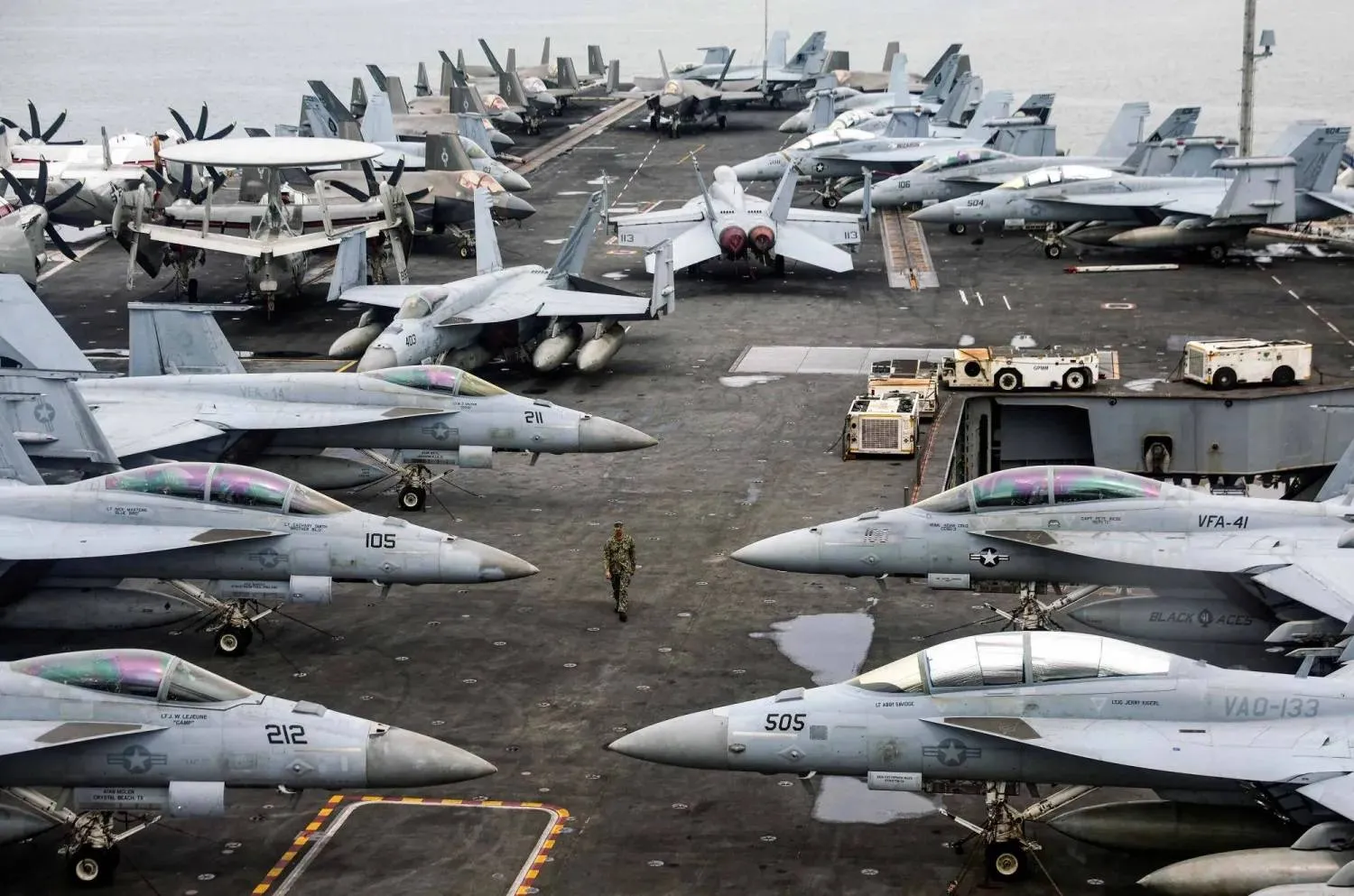
US fighter jets aboard the aircraft carrier Abraham Lincoln (AFP)
TT

Trump Balances War Drums and Brinkmanship With Iran

US fighter jets aboard the aircraft carrier Abraham Lincoln (AFP)

All indications suggest that US military action against Iran may be imminent. Yet the paradox is that edging toward the brink of confrontation may itself be part of negotiations being conducted under intense pressure.

Mutual threats, naval and air deployments, and deterrence messages are carefully calibrated to demonstrate seriousness without sliding into a war that President Donald Trump’s administration does not want.

Trump has repeatedly spoken of an “armada” in the region, while at the same time saying Tehran is sending signals of readiness to negotiate, a deliberate dual track aimed at keeping the adversary uncertain.

This tension between preparing for a strike and keeping the door to a deal ajar aligns with Farzin Nadimi's assessment. Nadimi is a senior Iran analyst at the Washington Institute for Near East Policy.

Speaking to Asharq Al-Awsat, Nadimi said he cannot predict what the US president will ultimately decide, adding that regardless of what Trump says to the media, the military buildup points to limited, focused strikes or a scaled-down military campaign.

According to Nadimi, such a campaign would intend to punish and deter the Iranian regime, weaken its ability to retaliate against the United States and its allies, and or disrupt oil flows from the Gulf.

The implication is that the buildup is not mere showmanship but the creation of an operational environment that enables a rapid strike if the political channel fails, without becoming mired in a prolonged war.

Calibrated options

The entry of the US aircraft carrier Abraham Lincoln and its strike group into the US Central Command area of operations in the western Indian Ocean shortens the timeline for possible action if a political decision is taken.

This has coincided with additional air reinforcements, including the deployment of F-15 fighter jets.

Together, these elements give Washington a ladder of options: a limited strike, a series of time-phased military strikes, or a defensive posture designed to raise the cost of any Iranian retaliation against US bases and allies.

But a “limited strike” is not just a technical choice; it is a political one, conditioned on answering a central question: what exactly does Washington want to achieve, and what is the “off-ramp” that would allow it to declare success and return to negotiations?

Here, Nadimi voices skepticism. He expressed doubts about the ability to achieve these objectives with such limited means.

A “mini” campaign may appear attractive because it avoids full-scale war, but it may not ensure deterrence or protect energy flows if Tehran opts for asymmetric retaliation, explained Nadimi.

Iran’s threats as a constraint

On the other side, Tehran and its regional allies have raised the tone of their threats. Iranian officials have warned of a “more painful” response if attacked, while statements from Hezbollah, Iraqi factions, and Yemen’s Houthis signal readiness to join any confrontation.

Such rhetoric serves the purpose of deterrence and boosting morale within the axis, but it carries a structural risk: the higher the ceiling of threats, the narrower the space for de-escalation.

The likelihood grows that an undisciplined actor, a faction or militia, could ignite an action that forces everyone into a “a cycle of retaliation,” widening the conflict beyond the calculus of a “limited” strike.

This is why Washington, according to reports, has focused on sending warning messages to Baghdad and to armed actors that any targeting of US forces would be met with direct retaliation against militias. The aim is to curb slippage that could turn a single strike into multiple fronts.

At the core of US concern is not only Iran’s ability to retaliate, but where it might do so. US bases across Iraq, Syria, and the Gulf are vulnerable targets in any escalation.

The buildup, therefore, has a clear defensive dimension, reinforcing interception systems and maritime and air defenses to contain missiles and drones.

While this is meant to protect forces, it also seeks to keep escalation in check: deterring or neutralizing retaliatory strikes so they do not force Washington into larger steps.

Alternatives to war

If force is used, the most likely scenario would involve limited, time-phased strikes targeting air defenses, missile sites, command-and-control nodes, and possibly sensitive facilities, before stopping at a point that allows a return to the political track.

The stated or implicit goal would be “punishment” and “deterrence” without ground entanglement.

Iran, however, always retains room to respond below the threshold but in painful ways, through proxies, disruption of shipping, or gradual attrition that embarrasses Washington and its allies and pushes them toward harder choices.

Here again, Nadimi questions whether limited tools would suffice, noting that success is not measured by the number of missiles launched on the first night, but by Washington’s ability to prevent Tehran from redefining the battlefield and its timing.

Targeting the leadership

In such crises, the question of “decapitation” often arises: could Washington move to target Iran’s leadership?

Nadimi addresses this cautiously, saying that targeting the supreme leader would be conceivable only “if there were a high probability of success and a low risk of casualties among US forces.”

He stresses the need to remember “the fundamental differences between Iran and Venezuela,” underscoring that what might be imagined in one political or security environment cannot be simply transplanted into Iran’s far more fortified and complex system.

Still, Nadimi adds that “the possibility of an internal operation should not be ruled out,” a phrase suggesting that the most dangerous scenarios may not begin with a missile, but with an internal rupture or movement intersecting with external pressure.

The heaviest factor in Washington’s calculations is not fear of immediate military defeat, but uncertainty about “the day after” if the system were shaken or lost control.

Iran is a large country with a complex institutional and security structure. Any major fracture could unleash a chain of scenarios, including factional conflict, security vacuums, economic turmoil, refugee flows, and immediate shocks to energy markets and the region.

Seen through this lens, the US buildup is also a negotiating tool: a threat sufficient to open doors without assuming responsibility for the consequences of collapse.

In sum, the Trump administration appears to be holding two threads at once: building up forces to make a strike an immediate option, and signaling enough pressure to force Tehran to consider negotiations, while trying to keep any confrontation below the threshold of a “mini campaign,” not a full-scale war.


Gazans Long for Reopening of ‘Lifeline’ Rafah Crossing

A gate at the Rafah border crossing between Egypt and the Gaza Strip, in Rafah, Egypt, January 27, 2026. (Reuters)
TT

Gazans Long for Reopening of ‘Lifeline’ Rafah Crossing

A gate at the Rafah border crossing between Egypt and the Gaza Strip, in Rafah, Egypt, January 27, 2026. (Reuters)

With Gaza's vital Rafah border crossing expected to soon reopen, residents of the war-shattered territory are hoping to reunite with family members, or are looking to leave themselves.

The Rafah crossing between Gaza and Egypt is the Palestinian territory's only gateway to the outside world that does not lead to Israel and is a key entry point for both people and goods.

It has been closed since Israeli forces took control of it in May 2024, except for a limited reopening in early 2025, and other bids to reopen failed to materialize.

Following a US-brokered ceasefire that took effect in October, Rafah is expected to reopen for pedestrians, after visiting US envoys reportedly pressed Israeli officials to reopen the crossing.

"Opening the Rafah crossing means opening the door to life for me. I haven't seen my wife and children for two years since they left at the beginning of the war and I was prevented from travelling," said 48-year-old Mahmud al-Natour, who hails from Gaza City.

"My children are growing up far away from me, and the years are passing by as if we are cut off from the world and life itself," he told AFP.

Randa Samih, 48, also called the crossing "the lifeline of Gaza," but is worried about whether she would be able to leave.

She had applied for an exit permit to get treatment for her injured back, which she fears might not be serious enough to be allowed out.

"There are tens of thousands of injuries in Gaza, most of them more serious than mine," she said.

"We'll die or our health will decline before we get to travel."

- 'Limited reopening' -

Gaza, a tiny territory surrounded by Israel, Egypt and the Mediterranean Sea, has been under Israeli blockade even before Hamas's attack sparked the war.

Palestinian gunmen took 251 people hostage on October 7, 2023, in an attack that killed 1,221 others, most of them civilians.

Israel's retaliatory offensive has killed at least 71,662 Palestinians, according to figures from the health ministry in Hamas-run Gaza that the United Nations considers reliable. The ministry does not say how many of the dead were fighters, though its data shows that more than half were women and children.

Ali Shaath heads the National Committee for the Administration of Gaza (NCAG), created as part of the ceasefire agreement. He announced last week that Rafah would reopen in both directions.

Israel said it would only allow pedestrians to travel through the crossing as part of its "limited reopening" once it had recovered the remains of the last hostage, Ran Gvili.

His remains were brought back to Israel later on Monday.

A Palestinian official told AFP on condition of anonymity that "estimates indicate that the Rafah crossing could be opened in both directions by the end of this week or early next week".

A member of the NCAG told AFP that the technocratic committee would be responsible for sending lists of travelers' names to the Israeli authorities for approval.

Outward travel will initially be limited to patients, the injured, students with university admission and visas, and holders of Egyptian citizenship or other nationalities and residency permits, the source said.

- 'Burning with anticipation' -

Gharam al-Jamla, a displaced Palestinian living in a tent in southern Gaza, told AFP she counted on the crossing's opening for her future.

"My dreams lie beyond the Rafah crossing. I applied for several scholarships to study journalism in English at universities in Türkiye. I received initial acceptance from two universities there," the 18-year-old said.

She added she would then want to return to Gaza "to be one of its voices to convey the truth to the world."

Gaza's civil defense agency spokesman, Mahmud Bassal, appealed for the full reopening of Rafah to allow the entry of unlimited aid and equipment for reconstruction.

"There are thousands of bodies under the rubble, including children, women and people with disabilities, which have not been recovered since the beginning of the war," he said.

The civil defense is a rescue force operating under Hamas authority.

Mohammed Khaled, 18, said he wanted to move on from the war.

"I'm burning with anticipation," he told AFP.

"I haven't seen my mother and sisters for two years. My mother traveled for medical treatment, and they only allowed my sisters to accompany her."

Khaled said he also hoped to be able to travel to have surgery for a shrapnel injury sustained during the war.


The Rafah Crossing Is Gaza’s Lifeline to the World and Could Open Soon

This picture taken on August 27, 2023 shows a view of the entrance of the Rafah border crossing with Egypt in the southern Gaza Strip. (AFP)
TT

The Rafah Crossing Is Gaza’s Lifeline to the World and Could Open Soon

This picture taken on August 27, 2023 shows a view of the entrance of the Rafah border crossing with Egypt in the southern Gaza Strip. (AFP)

Palestinians are eagerly awaiting the reopening of the Rafah border crossing, which is Gaza’s lifeline and only gateway to the outside world that wasn’t controlled by Israel before the war.

The opening is expected after Israel on Monday announced that the remains of the final hostage in Gaza, Ran Gvili, had been recovered. Hours earlier, Israel had said it would open the Rafah crossing with limitations once the search operation for Gvili was complete.

The opening of the crossing between Gaza and Egypt, which was controlled by Egypt before the war, is seen as ushering in the second phase of the US-brokered ceasefire, though its opening had been called for as part of the first phase.

Here’s why the crossing is so vital.

What comes next

It is not immediately clear when the crossing will open and whether it will allow the flow of goods and people both into and out of the war-shattered territory. Prime Minister Benjamin Netanyahu’s office late Sunday said Israel had agreed to a reopening “for pedestrian passage only, subject to a full Israeli inspection mechanism.”

Hamas in a statement Monday called on Israel to open the Rafah crossing in both directions “without restrictions.” Ali Shaath, head of the new Palestinian committee administering Gaza’s daily affairs, last week said the crossing would be opened this week to facilitate movement to and from the enclave.

A reopened Rafah crossing would make it easier for Gazans to seek medical treatment, travel internationally or visit family in Egypt, which is home to tens of thousands of Palestinians. It would also help Gaza’s devastated economy, as Palestinian-made olive oil and other products are widely sold in Egypt and throughout the Arab world.

“We hope this will close off Israel’s pretexts and open the crossing,” said Abdel-Rahman Radwan, a Gaza City resident whose mother is a cancer patient and requires treatment outside Gaza.

Israel also has said Palestinians wanting to leave Gaza will have to get Israeli and Egyptian security approval. Egypt says it wants the crossing immediately opened in both directions, so Palestinians in Egypt can enter Gaza. Egypt has been opposed to Palestinian refugees permanently resettling in that country.

A lifeline for Gaza

With much of Gaza turned to rubble, the United Nations has said the territory’s population of over 2 million people needs a massive influx of fuel, food, medicine and tents. While some aid has entered via the crossing, trucks have been lined up outside it for months while waiting for the chance to enter.

Before the war, the Rafah crossing bustled with goods and people. Although Gaza has four other border crossings, they are shared with Israel, and only Rafah links the territory with another neighboring country.

After Hamas-led fighters sparked the war by attacking southern Israel on Oct. 7, 2023, Egypt tightened its restrictions on traffic through the Rafah crossing. Israel took control of the Gaza side in May 2024 as part of its offensive and closed the crossing except to the occasional medical evacuation.

Questions about the future

The Gaza side of the Rafah crossing was heavily damaged during the war. Once it does reopen, Israel has agreed to adhere to the humanitarian terms put in place for the previous ceasefire that took effect in January 2025, including allowing a certain number of truckloads of aid per day into Gaza.

With the current ceasefire deal calling for Hamas to have no role in running Gaza, it’s unclear who will operate the territory’s side of the Rafah crossing once the war ends.

The crossing also will be central to Gaza's reconstruction. Last week, US President Donald Trump’s son-in-law and Middle East adviser Jared Kushner said postwar construction would first focus on building “workforce housing” in Rafah, the nearby southern city currently controlled by Israeli troops.

But Netanyahu on Monday told Israel's parliament, the Knesset: “We are at the start of the next (ceasefire) phase. What is the next phase? The next phase is disarming Hamas and demilitarizing the Gaza Strip. The next phase is not reconstruction.”

Meanwhile, humanitarian supplies inch forward. On Monday, the Egyptian Red Crescent facilitated the entry of a convoy carrying over 7,060 tons of food and medical aid through the Egyptian side of the Rafah crossing en route to Israeli inspection at Kerem Shalom before it potentially heads into Gaza, according to Egypt’s State Information Service.


Behind Israel’s Recovery of Last Hostage Body in Gaza

Israeli police officer Ran Gvili (Bring Them Home Now/Handout via REUTERS)
TT

Behind Israel’s Recovery of Last Hostage Body in Gaza

Israeli police officer Ran Gvili (Bring Them Home Now/Handout via REUTERS)

In an unexpected move, Israeli forces carried out a direct search operation to recover the body of the last Israeli hostage in Gaza, police officer Ran Gvili.

The Israeli military said on Monday it had recovered Gvili’s remains, adding that the retrieval of all hostages, living and dead, from Gaza completes a core provision of the first phase of US President Donald Trump’s plan to end the war in the enclave.

Under heavy air and artillery fire, and amid gunfire from Israeli vehicles and drones, several military bulldozers, accompanied by booby-trapped vehicles, advanced shortly after midnight between Saturday and Sunday to the west of the so-called Yellow Line, areas under Hamas control, in the al-Tuffah neighbourhood east of Gaza City.

According to eyewitnesses and field sources cited by Asharq Al-Awsat, the bulldozers later withdrew east of the Yellow Line, areas under Israeli control. Shortly afterward, three booby-trapped vehicles exploded, with the blasts heard across wide parts of the Gaza Strip.

The sources said that soon after the explosions, tanks, armoured vehicles and bulldozers, accompanied by excavation equipment, moved back into the area, specifically toward al-Batsh cemetery in al-Tuffah, west of the Yellow Line.

Sustained shelling and gunfire from vehicles and drones killed at least two Palestinians and wounded more than 25 others at different times, some critically, according to the sources.

Gaza’s civil defense has indicated that there may be additional casualties but access to them is prevented by Israeli forces.


Map showing the phases of withdrawal from Gaza under Trump’s plan (White House)


Not an Ordinary operation

Initial assessments suggested the move was a routine operation to expand the Yellow Line, similar to actions carried out in eastern Gaza City. It later emerged, however, from a statement issued by Abu Ubaida, spokesperson for the Izz ad-Din al-Qassam Brigades, Hamas’s armed wing, that the Israeli army was conducting the operation to search for the body of the last Israeli hostage, police officer Ran Gvili. This was later confirmed by the Israeli military spokesperson and by the office of Prime Minister Benjamin Netanyahu.

The announcement raised questions about the apparent shift in how Israel handled the recovery of hostages’ bodies. In previous cases, the al-Qassam Brigades had overseen such operations, including inside areas designated as Yellow Line zones and under Israeli control, in coordination with the International Committee of the Red Cross, following prior arrangements involving Hamas, mediators and Israel.

Israeli soldiers stand at the entrance of a tunnel in Rafah, Gaza Strip, December 8, 2025 (AP)

Israeli objection to al-Qassam Brigades' involvement

Field sources from Hamas told Asharq Al-Awsat that al-Qassam team, accompanied by the Red Cross, had been expected to carry out the operation. Israel, however, objected and demanded the handover of coordinates for the area where the body was believed to be located. The information was relayed through mediators, after which the Israeli operation began.

A senior political source involved in the ceasefire negotiations confirmed this information, saying Israel insisted on carrying out the operation itself. Israel cited reasons including the speed of the search, its technical capabilities to identify remains, and its ability to verify identity on site rather than recover the body for examination elsewhere.

The source said mediators supported the expedited approach that allowed Israel to extract the body directly.

According to the sources, Hamas did not have precise information on the body’s location but indicated al-Batsh cemetery, between the al-Tuffah and Shuja’iyya neighbourhoods.

This marked the second Israeli operation inside al-Batsh cemetery since the start of the Gaza war. Sources said it was the third operation to affect the site overall, where no Israeli bodies had previously been found.

Near Khalil al-Hayya’s Home

Footage released by Israeli media, taken by Israeli drones, showed machinery excavating most of the graves at the cemetery through Monday morning. Israeli army radio said more than 250 Palestinian graves had been exhumed.

The cemetery lies about 500 metres from the original Yellow Line, but successive expansions have left it only metres from the updated boundary.

Field sources told Asharq Al-Awsat that the area searched for the hostage’s body was about 30 metres from Khalil al-Hayya Street, named after the home of Hamas’s Gaza-based political leader, who is leading ceasefire negotiations. Tanks were deployed along the street and in surrounding areas to secure the forces operating at the cemetery.

How Was the Location Identified?

Previous searches for Gvili’s body, focused on the al-Zeitoun and Shuja’iyya areas, had failed. On why the search was focused on al-Tuffah, Hamas field and political sources said some fighters with indirect knowledge of the case had provided information indicating the body had, at one point, been buried in that cemetery.

They said the information could not be confirmed with high confidence because those directly involved had been killed or targeted in separate attacks or clashes during the war.

The sources suggested the information may have matched intelligence obtained by Israel’s Shin Bet security service from a Palestinian Islamic Jihad operative abducted about a month ago from Gaza City, who had links to the abduction of the Israeli police officer and the handling of his body.

The sources said Israel appeared to have information pointing to the cemetery even before Hamas relayed its own coordinates, linking the timing of the search to a decision to open the Rafah crossing, expected on Tuesday or, at the latest, Thursday.


Israeli soldiers in a tunnel that the army says Hamas militants used to attack the Erez crossing in northern Gaza, December 15, 2023 (AP)

Hamas Calls for Enforcement of the Agreement

Hamas spokesperson Hazem Qasim said in a statement that the recovery of the body of the last Israeli hostage in Gaza “confirms the movement’s commitment to all requirements of the ceasefire agreement, including the exchange track and its full completion in accordance with the deal.”

He reaffirmed Hamas’s commitment to all aspects of the agreement, including facilitating the work of the national committee tasked with administering Gaza, and called on mediators and the United States to compel Israel to halt violations of the agreement and implement its outstanding obligations.
