


US Intelligence Casts Doubts about Venezuela Leader's Cooperation

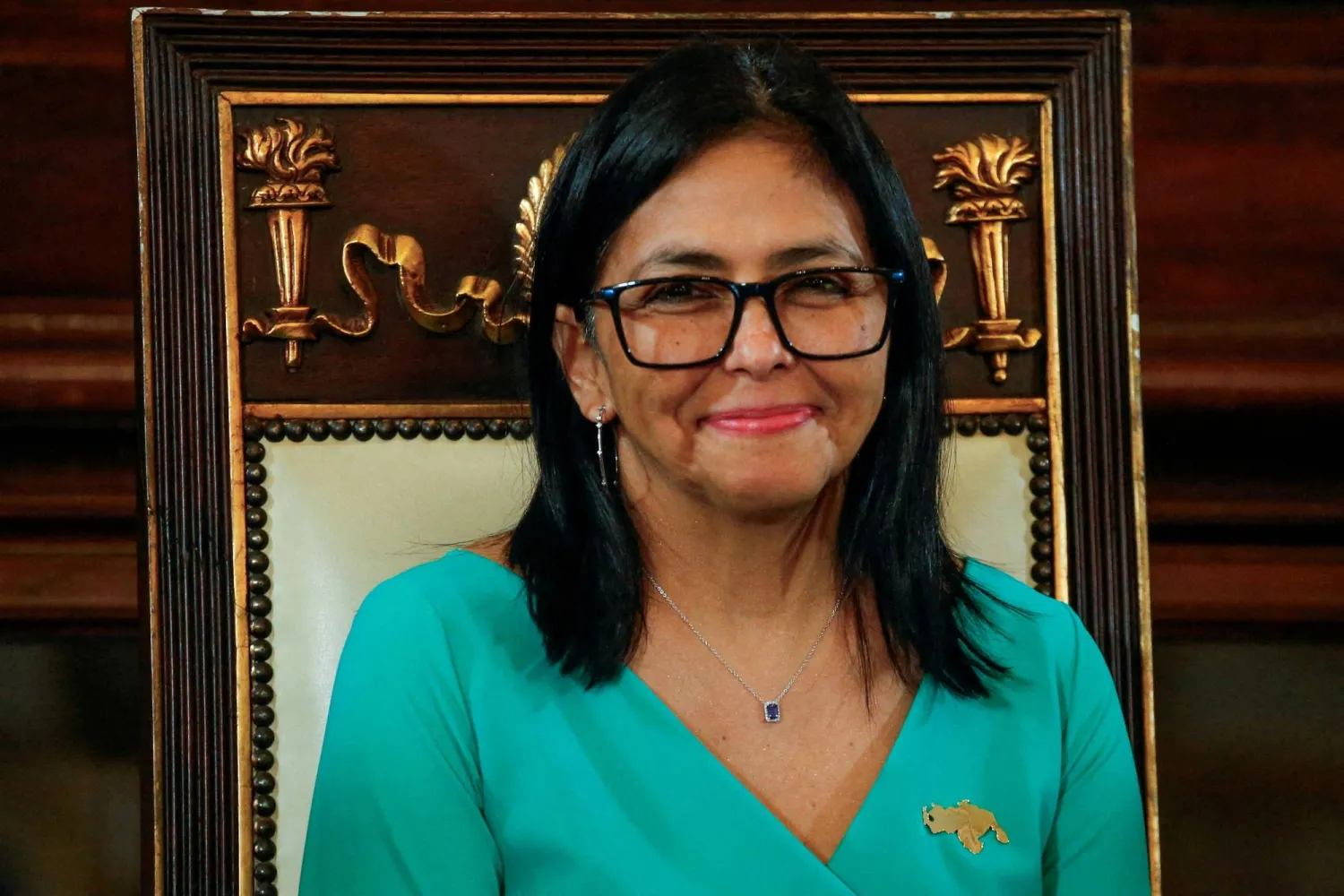
Vice President Delcy Rodriguez attends her swearing-in ceremony as Venezuela’s interim president at the National Assembly, after the US launched a strike on the country and captured President Nicolas Maduro and his wife Cilia Flores, in Caracas, Venezuela, January 5, 2026. (Reuters)
TT

US Intelligence Casts Doubts about Venezuela Leader's Cooperation

Vice President Delcy Rodriguez attends her swearing-in ceremony as Venezuela’s interim president at the National Assembly, after the US launched a strike on the country and captured President Nicolas Maduro and his wife Cilia Flores, in Caracas, Venezuela, January 5, 2026. (Reuters)

US intelligence reports have raised doubts about whether interim Venezuelan President Delcy Rodriguez will cooperate with the Trump administration by formally cutting ties with US adversaries, four people familiar with the reports told Reuters in recent days.

US officials have said publicly they want the interim president to sever relations with close international allies like Iran, China and Russia, including expelling their diplomats and advisers from Venezuela.

But Rodriguez, whose swearing-in ceremony was attended by representatives of those countries early this month, has yet to publicly announce such a move. She became president after the US captured former Venezuelan President Nicolas Maduro on January 3.

The US intelligence reports said it was not clear if she is fully on board with the US strategy in her country, according to the sources, who declined to be identified by name.

CIA Director John Ratcliffe traveled on January 15 to Caracas, where he discussed the country's political future with Rodriguez. Reuters could not determine if those conversations changed the intelligence agencies' opinion.

Washington wants to rein in its foes' influence in the Western hemisphere, including in Venezuela, where Trump is seeking to exploit the OPEC nation’s vast oil reserves.

If Rodriguez were to break ties with the US rivals, it would open more opportunity for US investment in Venezuela’s energy sector. But failure to control Rodriguez could undercut Washington’s efforts to direct the country’s interim rulers from afar and avoid a deeper US military role.

The Central Intelligence Agency and the Venezuela government did not respond to Reuters' requests for comment.

Asked for comment, a senior Trump administration official, who declined to be identified, said Trump “continues to exert maximum leverage” over Venezuela's leaders and “expects this cooperation to continue.”

Abandoning longtime allies?

The CIA has previously assessed that officials loyal to Maduro, including Rodriguez, were best positioned to govern the country following his ouster.

But critics of Trump's Venezuela strategy have expressed doubts about the wisdom of keeping Maduro's loyalists in place as the country's interim leaders.

The concerns about Rodriguez' reliability were present prior to the US military operation, said two sources.

For Venezuela, the US directive means abandoning its closest allies outside the region. Iran has helped Venezuela repair oil refineries while China has taken oil as repayment for debt. Russia has supplied weaponry, including missiles, to Venezuela's military.

Trump has also cited communist-led Cuba as another US foe he wants Venezuela to abandon. Havana has provided security and intelligence support while receiving cut-rate Venezuelan oil.

Since Maduro's removal, Rodriguez, whose deep ties to the oil sector are crucial to keeping the country stable, has taken steps to stay in favor with Washington including releasing political prisoners and authorizing the sale of 30 million to 50 million barrels of oil to the United States.

In a speech on Sunday, Rodriguez said she has had “enough” of US intervention.

Still, US officials have also held positive calls with her in recent days, according to two of the sources.

The Trump administration does not see an immediate alternative to working with Rodriguez, given it has publicly backed her so strongly, two of the sources said.

But US officials are developing contacts with senior military and security officials in case they decide to change their approach, a source briefed on Venezuela policy said.

Machado

The recent intelligence reports also found that opposition leader Maria Corina Machado is not currently able to run the country successfully in part because she lacks strong ties to the country’s security services or oil sector, the sources said.

Some observers and Machado's movement say it won a 2024 election that year by a huge margin, though the state backed a Maduro victory. She remains popular with Venezuelans.

Trump told reporters last week he wanted Machado “involved” in the country’s leadership, without providing details.

One person familiar with the administration’s discussions with Machado said she is well-liked by the White House and is considered a longer-term option for a leadership position in Venezuela.

The separate source briefed on Venezuela policy suggested that for now, Machado could be considered for an advisory role, but no firm decision had been made. Representatives for Machado did not respond to a request for comment.



Iran Rejects Negotiations with US in ‘Atmosphere of Threats’, Says FM

Iranian Foreign Minister Abbas Araghchi attends a joint press conference with his Iraqi counterpart Fuad Hussein, in Tehran on January 18, 2026. (AFP)
TT

Iran Rejects Negotiations with US in ‘Atmosphere of Threats’, Says FM

Iranian Foreign Minister Abbas Araghchi attends a joint press conference with his Iraqi counterpart Fuad Hussein, in Tehran on January 18, 2026. (AFP)

Iran's Foreign Minister Abbas Araqchi said he had not been ​in contact with US special envoy Steve Witkoff in recent days or requesting negotiations, state media reported on Wednesday.

US President Donald Trump said on Tuesday another "armada" is floating ‌toward Iran and ‌that he ‌hopes ⁠Tehran ​would ‌make a deal with Washington.

The US deployed additional military assets in the Gulf following nationwide protests in Iran which led to the country's bloodiest crackdown since the ⁠1979 revolution.

"There was no ‌contact between me and ‍Witkoff in ‍recent days and no request ‍for negotiations was made from us," Araqchi told state media, adding that various intermediaries were "holding consultations" and were ​in contact with Tehran.

"Our stance is clear, negotiations don't ⁠go along with threats and talks can only take place when there are no longer menaces and excessive demands."


Starmer Arrives in China to Defend ‘Pragmatic’ Partnership

Britain's Prime Minister Keir Starmer receives a bouquet of flowers upon his arrival at an airport in Beijing on January 28, 2026. (AFP)
TT

Starmer Arrives in China to Defend ‘Pragmatic’ Partnership

Britain's Prime Minister Keir Starmer receives a bouquet of flowers upon his arrival at an airport in Beijing on January 28, 2026. (AFP)

British Prime Minister Keir Starmer arrived in Beijing on Wednesday to meet with Chinese leader Xi Jinping, hoping to restore long fraught relations.

It is the first visit to China by a UK prime minister since 2018 and follows a string of Western leaders courting Beijing in recent weeks, pivoting from a mercurial United States.

Starmer, who is also expected to visit Shanghai on Friday, will later make a brief stop in Japan to meet with Prime Minister Sanae Takaichi.

For Xi, the trip is an opportunity to show Beijing can be a reliable partner at a time when President Donald Trump's policies have rattled historic ties between Washington and its Western allies.

Starmer is battling record low popularity polls and hopes the visit can boost Britain's beleaguered economy.

The trip has been lauded by Downing Street as a chance to boost trade and investment ties while raising thorny issues such as national security.

Starmer will meet with Xi for lunch on Thursday, followed by a meeting with Premier Li Qiang.

The British leader said on Wednesday this visit to China was "going to be a really important trip for us", vowing to make "some real progress".

There are "opportunities" to deepen bilateral relations, Starmer told reporters travelling with him on the plane to China.

"It doesn't make sense to stick our head in the ground and bury in the sand when it comes to China, it's in our interests to engage and not compromise on national security," he added.

China, for its part, "is willing to take this visit as an opportunity to enhance political mutual trust", foreign ministry spokesman Guo Jiakun reiterated Wednesday during a news briefing.

Starmer is the latest Western leader to be hosted by Beijing in recent months, following visits by Canadian Prime Minister Mark Carney and French President Emmanuel Macron.

Faced with Trump's threats to impose tariffs on Canada for signing a trade agreement with China, and the US president's attempts to create a new international institution with his "Board of Peace", Beijing has been affirming its support for the United Nations to visiting leaders.

- Reset ties -

UK-China relations plummeted in 2020 after Beijing imposed a sweeping national security law on Hong Kong, which severely curtailed freedoms in the former British colony.

They soured further since with both powers exchanging accusations of spying.

Starmer, however, was quick to deny fresh claims of Chinese spying after the Telegraph newspaper reported Monday that China had hacked the mobile phones of senior officials in Downing Street for several years.

"There's no evidence of that. We've got robust schemes, security measures in place as you'd expect," he told reporters on Wednesday.

Since taking the helm in 2024, Starmer has been at pains to reset ties with the world's second-largest economy and Britain's third-biggest trade partner.

In China, he will be accompanied by around 60 business leaders from the finance, pharmaceutical, automobile and other sectors, and cultural representatives as he tries to balance attracting vital investment and appearing firm on national security concerns.

The Labour leader also spoke to Xi on the sidelines of the G20 summit in Brazil in November 2024.


EU Top Diplomat Urges ‘More European’ NATO as Trump Upends Ties

European High Representative of the Union for Foreign Affairs, Kaja Kallas arrives for an informal meeting of the members of the European Council in Brussels, Belgium, 22 January 2026. (EPA)
TT

EU Top Diplomat Urges ‘More European’ NATO as Trump Upends Ties

European High Representative of the Union for Foreign Affairs, Kaja Kallas arrives for an informal meeting of the members of the European Council in Brussels, Belgium, 22 January 2026. (EPA)

Europe must step up efforts on defense and play a bigger role in NATO as US President Donald Trump has "shaken the transatlantic relationship to its foundation", EU top diplomat Kaja Kallas said Wednesday.

"Let me be clear: we want strong transatlantic ties. The US will remain Europe's partner and ally. But Europe needs to adapt to the new realities. Europe is no longer Washington's primary center of gravity," Kallas told a defense conference in Brussels.

"This shift has been ongoing for a while. It is structural, not temporary. It means that Europe must step up -- no great power in history has outsourced its survival and survived."

Trump rocked European allies this month by threatening to seize Greenland from NATO and EU member Denmark -- before eventually backing off.

The crisis -- the latest to buffet ties since his return to power a year ago -- has reinforced calls for the continent to cut its decades-long reliance on NATO's dominant military superpower for protection.

Kallas remained clear-eyed that NATO remains the bedrock of European security.

She said EU efforts should "remain complementary" to those of the alliance, but insisted Europe needed to play a bigger role.

"Especially now, as the US is setting its sights beyond Europe, NATO needs to become more European to maintain its strength," she said.

"For this, Europe must act."

European countries have already ramped up defense budgets since Russia invaded Ukraine four years ago, and agreed last year to massively hike NATO's spending target under pressure from Trump.

The EU last year also launched a raft of initiatives that it says could see its members plough an additional 800 billion euros into defense.

Washington meanwhile has said it wants European allies to take over more responsibility for the conventional defense of the continent as US focus switches to other threats like China.

"The risk of a full-blown return to coercive power politics, spheres of influence and a world where might makes right, is very real," Kallas said.

She insisted Europe "must acknowledge that this tectonic shift is here to stay. And to act with urgency."

Kallas' comments come after NATO chief Mark Rutte told EU lawmakers to "keep on dreaming" if they thought Europe could defend itself without the United States.

In a Monday address to the bloc's parliament, Rutte insisted that Europe would have to double its spending targets to afford the "billions and billions of euros" it would cost to replace the US nuclear umbrella.

The head of the Western military alliance also warned that if Europe tried to build its own forces to replace the United States in NATO then it would play into Russian leader Vladimir Putin's hands.

"Putin will love it. So think again," Rutte said.

Instead he urged the EU to use its traditional strengths to generate funding and cut regulation to help the defense industry grow.