

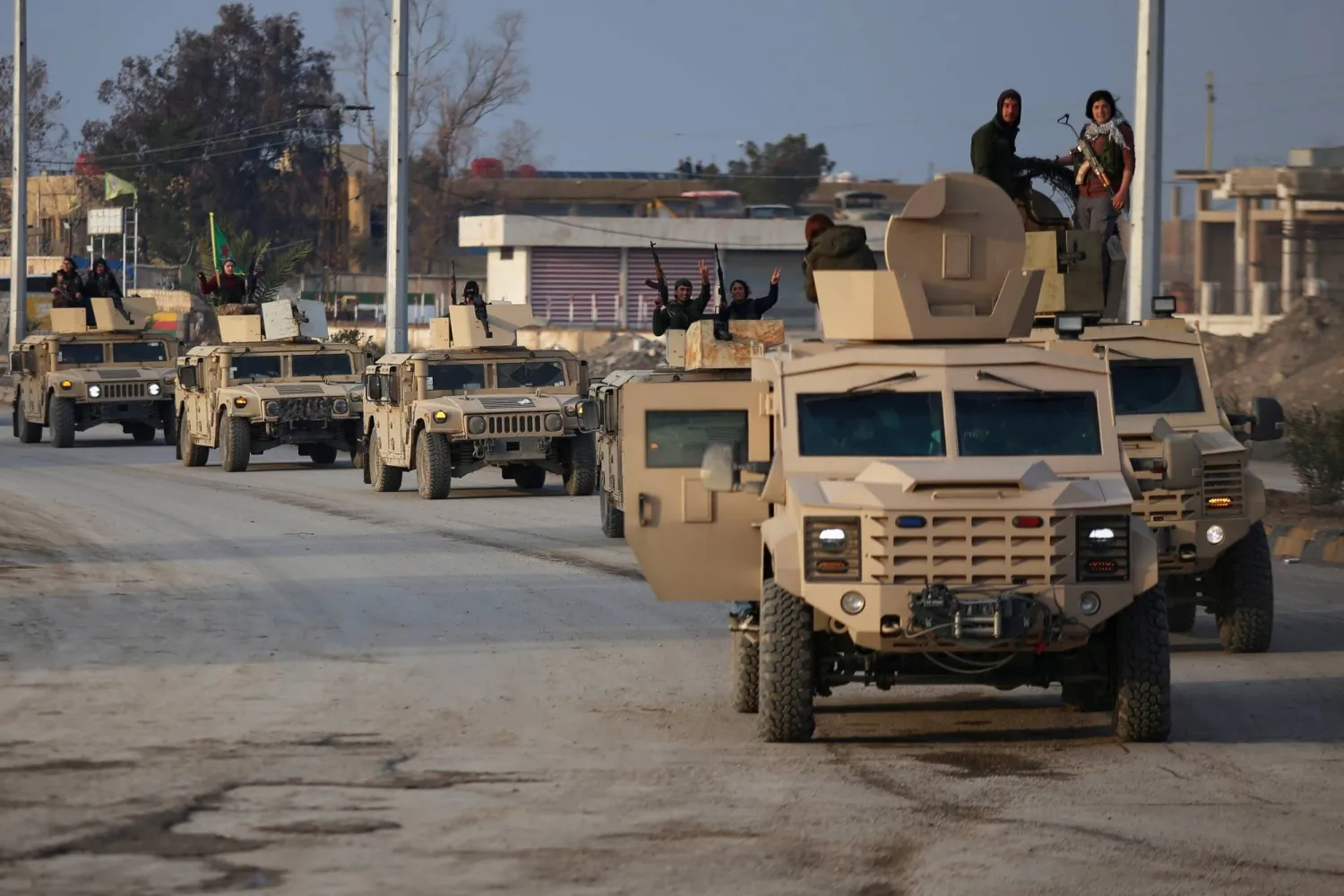

Kurdish-led Force and Syrian Government Reach New Agreement to Stabilize Ceasefire

SDF forces have completed their withdrawal to the Hasakah region, northeastern Syria (Reuters)
TT

Kurdish-led Force and Syrian Government Reach New Agreement to Stabilize Ceasefire

SDF forces have completed their withdrawal to the Hasakah region, northeastern Syria (Reuters)

The Kurdish-led Syrian Democratic Forces announced a new agreement Friday with the country's central government intended to stabilize a ceasefire that ended weeks of fighting and to lay out the steps toward integration between the two sides.

Under the agreement, the SDF said, security forces affiliated with the Syrian Ministry of Interior would go into the cities of al-Hassakeh and Qamishli in the Kurdish heartland, which they had previously been barred from entering, and the process of integrating SDF and government forces would begin.

This would include formation of a new military brigade comprising three brigades from the SDF, in addition to the formation of a brigade of SDF fighters within a government brigade in Aleppo province.

Local institutions in the Kurdish-led government of northeast Syria — which has operated as a de facto autonomous zone for years — and their employees would be integrated into state institutions.

The agreement also includes “civil and educational rights for the Kurdish people, and guaranteeing the return of the displaced to their areas,” the statement said.

“The agreement aims to unify the Syrian territories and achieve the full integration process in the region by enhancing cooperation between the concerned parties and unifying efforts to rebuild the country,” it said.

There was no immediate statement from Damascus, but Syrian state TV cited an unnamed official confirming the agreement.

The SDF lost most of its territory in northeast Syria to a government offensive after intense clashes erupted in the northern city of Aleppo on Jan. 6, following months of failed negotiations to implement an integration deal.

Syria’s new leaders, since toppling former President Bashar Assad in December 2024, have struggled to assert their full authority over the country torn by nearly 14 years of civil war. An agreement was reached in March that would merge the SDF with Damascus, but it didn’t gain traction.

Meanwhile the US, which had long been the main backer of the SDF as the group fought against ISIS militants, has moved closer to Damascus under new interim President Ahmad al-Sharaa. The US did not intervene military in this month's fighting but pushed the two sides to make a deal.

A truce was reached last week between the two sides and has been largely holding. Friday's announcement appears to be a step toward solidifying the ceasefire.



Israel Kills Three Gunmen in Gaza

Palestinians clear a road from building rubble with a bulldozer following overnight Israeli bombardment which hit the al-Habash family home at the Nuseirat refugee camp in the central Gaza Strip on March 20, 2024. (Photo by AFP)
TT

Israel Kills Three Gunmen in Gaza

Palestinians clear a road from building rubble with a bulldozer following overnight Israeli bombardment which hit the al-Habash family home at the Nuseirat refugee camp in the central Gaza Strip on March 20, 2024. (Photo by AFP)

The Israeli military said on Friday it launched overnight strikes at "eight terrorists" in the southern Gaza city of Rafah, killing three of them, with a fragile ceasefire still in place in the Palestinian territory.

The US-brokered ceasefire, which sought to halt the fighting between Israel and Hamas sparked by the group's October, 2023 attack has been in place for more than three months despite both sides accusing the other of repeated violations.

Earlier in January, Washington announced that the truce had progressed to its second phase, intended to bring a definitive end to the war, even as both sides accused each other of failing to comply with the terms of the truce, said AFP.

In a statement on Friday, the Israeli military said it had identified "eight terrorists" who emerged from underground and that the air force "struck and eliminated three of the terrorists".

Without providing any information on the identities of its targets, it said that further strikes were launched and that "soldiers continue to conduct searches in the area in order to locate and eliminate all the terrorists".

The Israeli military said its forces "remain deployed in accordance with the ceasefire agreement and will continue to operate to remove any immediate threat".

The first phase of the ceasefire largely halted the fighting and provided for the release of all remaining living and dead hostages held in Gaza in exchange for prisoners and the bodies of dead Palestinians held by Israel.

The remains of the final hostage, Ran Gvili, were returned earlier this week, with his funeral taking place on Wednesday.

- Hamas disarmament -

Israel said on Sunday that it would allow a limited reopening of the Rafah crossing, with only pedestrians allowed through, falling short of what aid groups and Gazans had hoped for.

The humanitarian situation in the territory of more than two million people remains dire, with most of the population displaced and many living in tents with little or no sanitation amid harsh winter weather.

The reopening of Rafah is also expected to allow the entry of the 15-member technocratic administrative committee created as part of the ceasefire to oversee the running of Gaza.

The National Committee for the Administration of Gaza, made up of Palestinians, is charged with managing day-to-day governance of the territory and answers to US President Donald Trump's "Board of Peace".

A key point of the ceasefire's second phase is the disarming of Hamas. On Thursday, Trump told his cabinet that "It looks like they're going to disarm".

Publicly, the Hamas group has fiercely resisted the idea of giving up its weapons.

In return, Israel is meant to fully withdraw its forces, who remain in control of more than half of Gaza, with an international stabilization force deployed in their stead.


UNICEF: Sudan Faces World’s Largest Internal Displacement Crisis

Sudan has the world’s largest internal displacement crisis (Reuters) 
TT

UNICEF: Sudan Faces World’s Largest Internal Displacement Crisis

Sudan has the world’s largest internal displacement crisis (Reuters) 

The UN Children’s Fund (UNICEF) said Thursday that Sudan has become the world’s largest internal displacement crisis, with an estimated 9.5 million people uprooted across 18 states.

In a statement on X, the agency said, “For nearly three years, Sudanese children have endured a deepening humanitarian emergency driven by violence, displacement, disease and widespread hunger.”

UNICEF said it continues to operate on the ground with partners to deliver life-saving services to children and families affected by the crisis, including health and nutrition care, access to safe water, psychosocial support and education.

Since April 15, 2023, the Sudanese army and the paramilitary Rapid Support Forces (RSF) have been locked in a war that has killed thousands of people.

Separately, High Representative of the EU Foreign Affairs Council, Kaja Kallas, said the Union’s foreign ministers approved on Thursday the imposition of sanctions on members of the two Sudanese warrying parties due to the dramatic escalation of violence and serious violations of international humanitarian and human rights law.

“The Ministers approved new sanctions against members of RSF and the SAF. These measures alone will not end the war, but they will increase the cost for those responsible,” she said.

The RSF captured the city of El-Fasher in late October after an 18-month siege, consolidating its control over western Sudan.

Extensive documentation confirmed the RSF committed severe atrocities in the city.

Meanwhile, Doctors Without Borders/Médecins Sans Frontières (MSF) described on Thursday El-Fasher as largely destroyed and emptied, with few civilians remaining, adding that its teams were granted access to the city to assess the current situation for civilians and health facilities after the RSF seized the city last October.

“On January 15, our team spent four hours in El-Fasher while under the constant supervision of security officials. We saw destroyed areas, largely emptied of the communities that used to live there. The regional capital now looks like a ghost town, with few civilians remaining,” the organization reported.

MSF said its fears are now growing that most of the civilians who were still alive when RSF seized the city have since been killed or displaced.

The team went to health facilities and two displacement sites hosting mostly women, children, and elderly people.

In the health facilities, the teams reiterated their willingness to support referrals of patients in need of surgery to existing MSF projects with surgical capacity.

“Our visit was too limited to allow us to get more than a glimpse of El-Fasher, yet this glimpse was a grim reminder of the sheer scale of the destruction that took place in the city as many of its residents were wiped out,” MSF said.

It affirmed that the patients in the nearby town of Tawila have shared stories of mass killings, torture, kidnappings, and other violence occurring in the city and along escape routes.

UNICEF spokesperson Eva Hinds said last week more than 500,000 displaced people are in Tawila, warning that further people are expected to arrive to the city.


Lavrov: Al-Assad’s Trial Closed Long Time Ago

A Syrian member of the military operations looks on as he stands at an inspection checkpoint for incoming vehicles before a Russian flag and Russian soldiers behind manning the entrance of the Russian-leased Syrian military base of Hmeimim in Latakia province in western Syria on December 29, 2024. (AFP) 
TT

Lavrov: Al-Assad’s Trial Closed Long Time Ago

A Syrian member of the military operations looks on as he stands at an inspection checkpoint for incoming vehicles before a Russian flag and Russian soldiers behind manning the entrance of the Russian-leased Syrian military base of Hmeimim in Latakia province in western Syria on December 29, 2024. (AFP) 

Russian Foreign Minister Sergei Lavrov confirmed Thursday that the trial of former Syrian President Bashar al-Assad was closed a long time ago, and that Russia's partners are fully aware of the circumstances of his arrival in Russia, according to Sputnik.

Asked about his position on requests for the prosecution of al-Assad, Lavrov told Turkish state TV channel, TRT, and Türkiye newspaper, that, “This issue has not been raised for a long time. Our partners are fully aware of the circumstances surrounding al-Assad and his family’s arrival in the Russian Federation in December 2024.”

Back then, Lavrov said, “Al-Assad’s life was under threat. He was granted asylum in Russia for purely humanitarian reasons, and he took it. As you may observe (if you follow our domestic affairs), al-Assad does not interfere in Syrian political affairs.”

He added that “understandings are now being substantiated. Processes long envisioned with our Turkish friends are beginning to take shape in Syria today, particularly regarding the political integration of Kurdish communities into Syria’s governmental, military and security structures,” he said.

On Thursday, Kremlin spokesman Dmitry Peskov said the presence of Russian military bases in Syria was discussed during talks between Putin and Syrian leader Ahmed al-Sharaa in Moscow.

Putin told al-Sharaa that Moscow always supported Syria’s integrity and congratulated him on reclaiming control over the area, describing it as a “very important step.”

“You know that we always stood for the restoration of Syria’s territorial integrity, and we support all your efforts in this direction,” Putin said.

For his part, al-Sharaa, who first visited Russia in October, thanked Putin for helping to stabilize Syria.

Al-Sharaa led a swift opposition offensive in December 2024 that ousted former Syrian President Bashar al-Assad, who enjoyed Moscow’s support for years as his government fought a devastating civil war.

Last Tuesday, President Recep Tayyip Erdogan said the rights of Kurdish citizens in Syria are guaranteed by a special presidential decree. On January 16, al‑Sharaa issued Decree No. (13) of 2026 affirming that Syrian Kurdish citizens are an integral and authentic part of the Syrian people, and that their cultural and linguistic identity is an inseparable component of Syria’s unified and diverse national identity.

Speaking at a ceremony for the Overseas Contracting Services Success Awards in Ankara, Erdogan reiterated his call on the PKK/YPG to abandon autonomy demands. “The shelf life of terrorism has expired,” he said.