


Lebanon-Israel Ceasefire Panel to Stay, French Role Remains Military

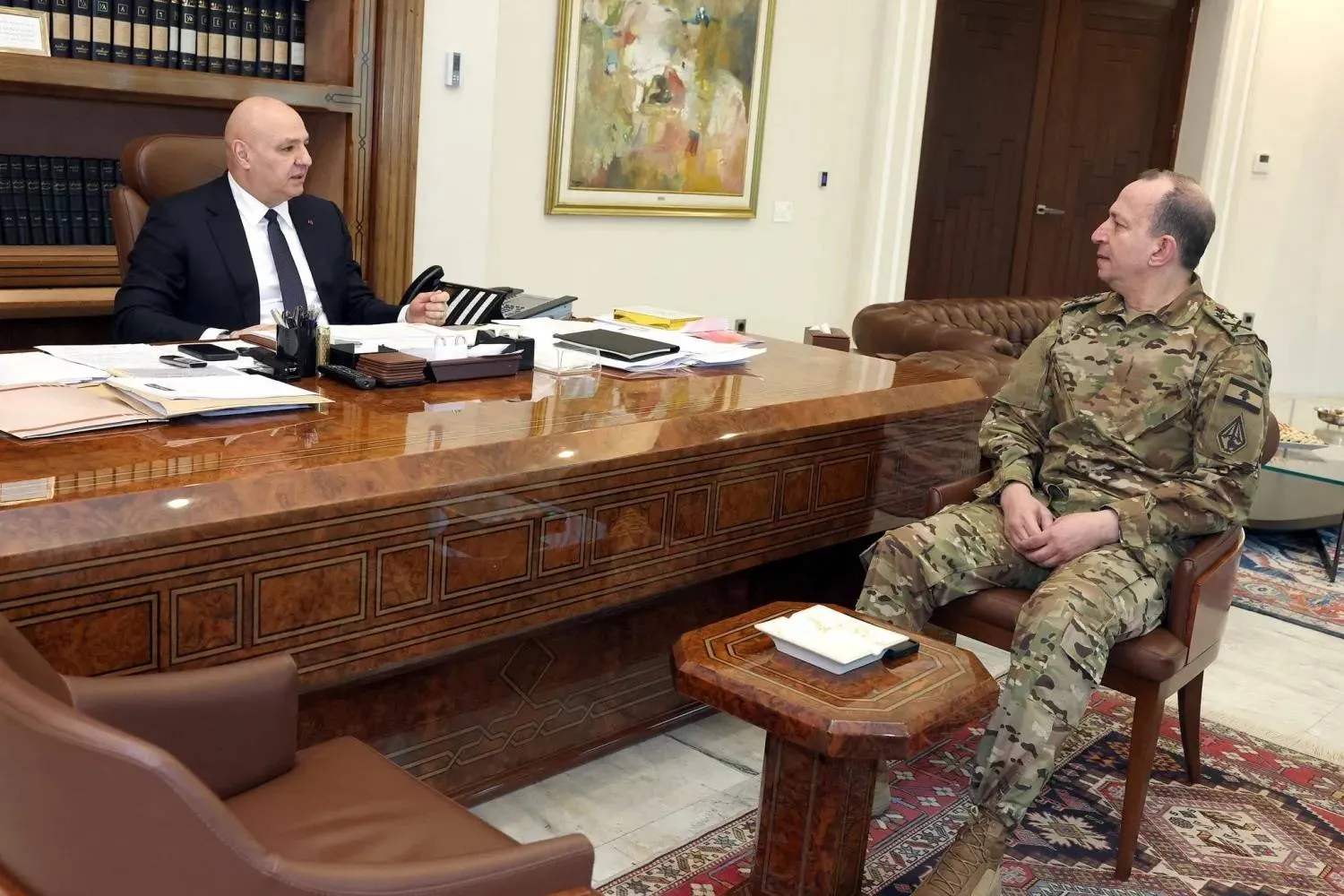
Lebanese President Joseph Aoun meets Armed Forces Commander General Rodolphe Haykal ahead of his departure for Washington (Lebanese Presidency)
TT

Lebanon-Israel Ceasefire Panel to Stay, French Role Remains Military

Lebanese President Joseph Aoun meets Armed Forces Commander General Rodolphe Haykal ahead of his departure for Washington (Lebanese Presidency)

A statement by the US embassy in Beirut has cut through weeks of Lebanese speculation over the fate of the committee monitoring the cessation of hostilities between Lebanon and Israel, following delays in its meetings.

The statement also signaled that no French civilian member would be added to the body, after sustained local media reports of US–French wrangling over its composition.

Notably, the embassy’s surprise statement, issued on Friday, emphasized the committee’s “military character” and set a date for its subsequent meetings in late February.

The developments come ahead of a visit by Lebanese Armed Forces Commander General Rodolphe Haykal to Washington, where he is due to meet several US officials over three days.

The three-day visit is scheduled for February 3-5.

Preparations for the visit were the focus of a meeting Haykal held with President Joseph Aoun, who was briefed on the arrangements and planned meetings, according to a statement from the presidency.

Military needs

According to ministerial sources, discussions centered on what Haykal will present in Washington, including the military’s needs at this sensitive stage, both logistical support and armaments.

This comes as the army’s responsibilities expand, particularly in southern Lebanon, where it has assumed increasing responsibilities for maintaining stability and protecting civilians.

Weapons exclusivity plan and obstacles

Sources told Asharq Al-Awsat that Haykal will brief US officials on the reality of the army’s deployment in the south under the weapons exclusivity plan, as well as the obstacles hindering its completion, especially south of the Litani River.

They said the continued Israeli occupation remains a direct impediment to the army’s ability to fully assert control and carry out its assigned missions under agreed mechanisms.

The army commander will also outline, the sources said, the measures the military has taken to implement the state’s weapons exclusivity plan, as well as the practical challenges it faces on the ground amid the prevailing security situation and the sensitivity of the current phase.

He will stress the need for comprehensive political and international backing to ensure the plan’s success.

Beyond south of the Litani

As anticipation grows in Lebanon and abroad over the next phase of weapons exclusivity north of the Litani, and amid objections voiced by Hezbollah officials, the sources said Haykal’s Washington visit will also address the post–south Litani phase.

He will explain the military’s vision for completing deployment, consolidating stability, and reactivating the “mechanism” committee, including the format of meetings and coordination procedures in the coming phase, on condition that Israel withdraws from occupied Lebanese territory.

In this context, ministerial sources said President Aoun stressed during the meeting the importance of Haykal focusing in his talks on the need for severe international pressure on Israel to withdraw, enabling the army to perform its role fully and paving the way for the release of Lebanese detainees and the restoration of lasting calm in the south.

Paris conference

The Paris conference expected on March 5 to support the Lebanese army will also feature in Haykal’s US meetings.

The conference has been postponed several times and is closely tied to the army’s implementation of the weapons exclusivity plan.

President Aoun had asked security agencies two weeks ago to prepare detailed reports on their needs so participants would be fully informed, helping the conference meet its objectives.

Haykal is scheduled to meet US Central Command (CENTCOM) Commander General Brad Cooper at the command’s headquarters in Tampa, Florida, to discuss military and security cooperation between Lebanon and the US. Discussions will also cover the mechanism committee.

He will then travel to Washington on Tuesday, February 3, to hold a series of security and diplomatic meetings with US officials, members of Congress, and White House officials through February 5.

Mechanism meeting on February 25

The developments come as Israeli attacks continued, including a strike that killed one person in the southern Lebanese town of Siddiqine after his car was targeted.

At the same time, the US embassy in Beirut announced that the mechanism committee will convene on February 25, following a one-month suspension of its meetings and reports suggesting it could be dissolved.

Writing on X, the embassy stated that the US Embassy in Beirut and US Central Command reaffirm that the military coordination framework, as established in the cessation of hostilities agreement announced on November 27, 2024, remains in place and fully operational, with the same objectives, participants, and leadership.”

The embassy added that the next mechanism meeting will be held in Naqoura on February 25, 2026, with subsequent meetings scheduled for March 25, April 22, and May 20, stressing that “these meetings serve as a core forum for military coordination among the participating parties.”



US Embassy in Beirut Warns of Possible Iran Threat to Universities in Lebanon

People walk past the main gate to the campus of the American University of Beirut (AUB) in the center of Beirut on January 13, 2022. (AFP)
TT

US Embassy in Beirut Warns of Possible Iran Threat to Universities in Lebanon

People walk past the main gate to the campus of the American University of Beirut (AUB) in the center of Beirut on January 13, 2022. (AFP)

The US embassy in Beirut said on ‌Friday ‌that Iran ‌and ⁠its aligned armed ⁠groups "may intend to target ⁠universities ‌in Lebanon".

In ‌a security ‌alert, ‌the embassy also ‌urged US citizens to depart ⁠Lebanon "while ⁠commercial flight options remain available".

Lebanon was dragged into the conflict in the Middle East when Iran-backed Hezbollah shot rockets at Israel in retaliation to the killing of Iranian supreme leader Ali Khamenei at the beginning of the war.

Over the past 24 hours, Israeli strikes killed 23 people and wounded 98, the Lebanese health ministry said Friday.

The ministry said that the overall death toll includes 125 children and 91 women, since Israel launched intense airstrikes across Lebanon after the Hezbollah fired rockets toward northern Israel in solidarity with Iran on March 2. The strikes have also wounded 4,138 others.

Among those killed are 53 health workers, while Israeli strikes have targeted 83 emergency medical service facilities, the health ministry said.


UN Force Says 3 Peacekeepers Wounded in Blast Inside South Lebanon Position

 UNIFIL vehicles drive on a main road in Qlayaa, amid escalating hostilities between Israel and Hezbollah, as the US-Israel conflict with Iran continues, in Qlayaa, southern Lebanon, March 27, 2026. (Reuters)
UNIFIL vehicles drive on a main road in Qlayaa, amid escalating hostilities between Israel and Hezbollah, as the US-Israel conflict with Iran continues, in Qlayaa, southern Lebanon, March 27, 2026. (Reuters)
TT

UN Force Says 3 Peacekeepers Wounded in Blast Inside South Lebanon Position

 UNIFIL vehicles drive on a main road in Qlayaa, amid escalating hostilities between Israel and Hezbollah, as the US-Israel conflict with Iran continues, in Qlayaa, southern Lebanon, March 27, 2026. (Reuters)
UNIFIL vehicles drive on a main road in Qlayaa, amid escalating hostilities between Israel and Hezbollah, as the US-Israel conflict with Iran continues, in Qlayaa, southern Lebanon, March 27, 2026. (Reuters)

The United Nations Interim Force in Lebanon said a blast hit one of its positions and wounded three peacekeepers on Friday, the third such incident in a week.

"This afternoon, an explosion inside a UN position... injured three peacekeepers, two seriously. They are all currently being evacuated to hospital. We do not yet know the origin of the explosion," UNIFIL spokesperson Kandice Ardiel said in a statement.

"UNIFIL reminds all actors of their obligations to ensure the safety and security of peacekeepers, including by avoiding combat activities nearby that could put them in danger," she added.

The UN force is deployed in south Lebanon near the Israeli border, where Israel and Hezbollah have been at war for a month and where Israeli troops are pressing a ground invasion.

Lebanon was drawn into the Middle East war on March 2 when the Tehran-backed Hezbollah launched rockets at Israel to avenge the US-Israeli attack that killed Iran's supreme leader Ali Khamenei.

Israel has responded with massive strikes across Lebanon, as well as the ground operation.

UNIFIL had said that a peacekeeper was killed on Sunday evening when a projectile of unknown origin "exploded in a UNIFIL position near Adchit al-Qusayr".

The following day, UNIFIL said an "explosion of unknown origin" destroyed a peacekeeping vehicle, killing two more Indonesian troops.

It said investigations had been launched into both incidents.

A UN security source told AFP this week that Israeli fire was the source of Sunday's attack, while a mine may have caused the following day's deadly blast.

Israel's military denied responsibility for Monday's incident.

"A comprehensive operational examination indicates that no explosive device was placed in the area by army troops, and that no troops were present in the area at all," the statement said.

According to the UN, 97 force members have been killed in violence since UNIFIL was first established to monitor the withdrawal of Israeli forces after they invaded Lebanon in 1978.

The mandate of the force, which for decades has acted as a buffer between Israel and Lebanon, finishes at the end of this year.


RSF in Sudan Kill at Least 10 People in Hospital Drone Attack, Medical Group Says

Fighters of the paramilitary Rapid Support Forces (RSF) drive an armored vehicle in Khartoum in 2023. (AFP)
TT

RSF in Sudan Kill at Least 10 People in Hospital Drone Attack, Medical Group Says

Fighters of the paramilitary Rapid Support Forces (RSF) drive an armored vehicle in Khartoum in 2023. (AFP)

Sudan ’s paramilitary forces killed at least 10 people on Thursday in a drone attack that hit a hospital in the south-central part of the country, said a medical group.

Doctors Without Borders, also known as MSF, said the Sudanese paramilitary Rapid Support Forces, RSF, launched two drone strikes on al-Jabalain Hospital in the White Nile province, hitting an operating theater and a maternity ward.

The strikes, the latest in an intensifying drone warfare between the army and the RSF, killed 10 people, including seven medical staffers, and injured at least 19 people. Those injured were transferred to a hospital in Kosti, which is around 50 miles (80 kilometers) away, said MSF.

Salah Moussa, a senior staffer in the nursing department at al-Jabalain Hospital, was injured in his leg in one of the two strikes. He told The Associated Press by phone on Friday that those killed include the hospital’s general manager, the administrative manager, several policemen and a citizen.

Moussa said he was in his house near the hospital when he heard the sound of explosions at around 11 a.m. on Thursday.

“I rushed to the hospital when I heard the explosion and while we were helping evacuate three injured staff members, another drone strike was launched and I got hit and lost consciousness,” he said. “The hospital lost all its medical and administrative leadership in this attack.”

The strikes are the latest in a series of attacks on the health care system in Sudan that continues to be hit hard during the ongoing war between the army and the RSF that broke out in April 2023. The World Health Organization said in March that over 200 attacks have targeted health care since the war began. Most recently, 70 people were killed, including at least 13 children, in a strike on a hospital in Sudan’s western Darfur region last month.

The nearly three-year conflict in Sudan killed more than 40,000 people, according to UN figures, but aid groups say the true number could be much higher.

“The attack is even more appalling as it occurred during a children’s immunization campaign,” the MSF said of the strike on the al-Jabalain hospital.

Meanwhile, Emergency Lawyers, a local rights group, said Thursday that the attacks also targeted a medical supply depot in Rabak, the capital city of the White Nile province.

The Emergency Lawyers said the “recurring pattern” of drone attacks by the warring parties since March in the provinces of South Kordofan, Blue Nile, East, Central and South Darfur displaced more people.

On Friday, Khalid Aleisir, the minister of culture, information, antiquities and Tourism condemned the attack and called for designating the RSF a terrorist organization and prosecuting its members.

“We also hold regional backers directly responsible for perpetuating this violent campaign through military and logistical support, including advanced weaponry and unmanned aerial systems, which have escalated violence and targeted civilians,” he wrote on X.

Sudan Doctors Network, a local group that monitors war violence, called the attack a “deliberate assault on health facilities and unarmed civilians” that further worsens an already deteriorating health sector in the country.

“MSF is outraged by these repeated attacks on health care, which have escalated dangerously in recent weeks,” said Esperanza Santos, MSF head of emergencies for Sudan in the group’s statement on Thursday. “Health facilities, medical staff, and patients must always be protected. We call on RSF and SAF to immediately stop this spiral of violence against medical facilities.”

A surge in drone strikes in the Sudanese region of Kordofan has taken a growing toll on civilians and hampered aid operations, analysts and humanitarian workers previously said.