

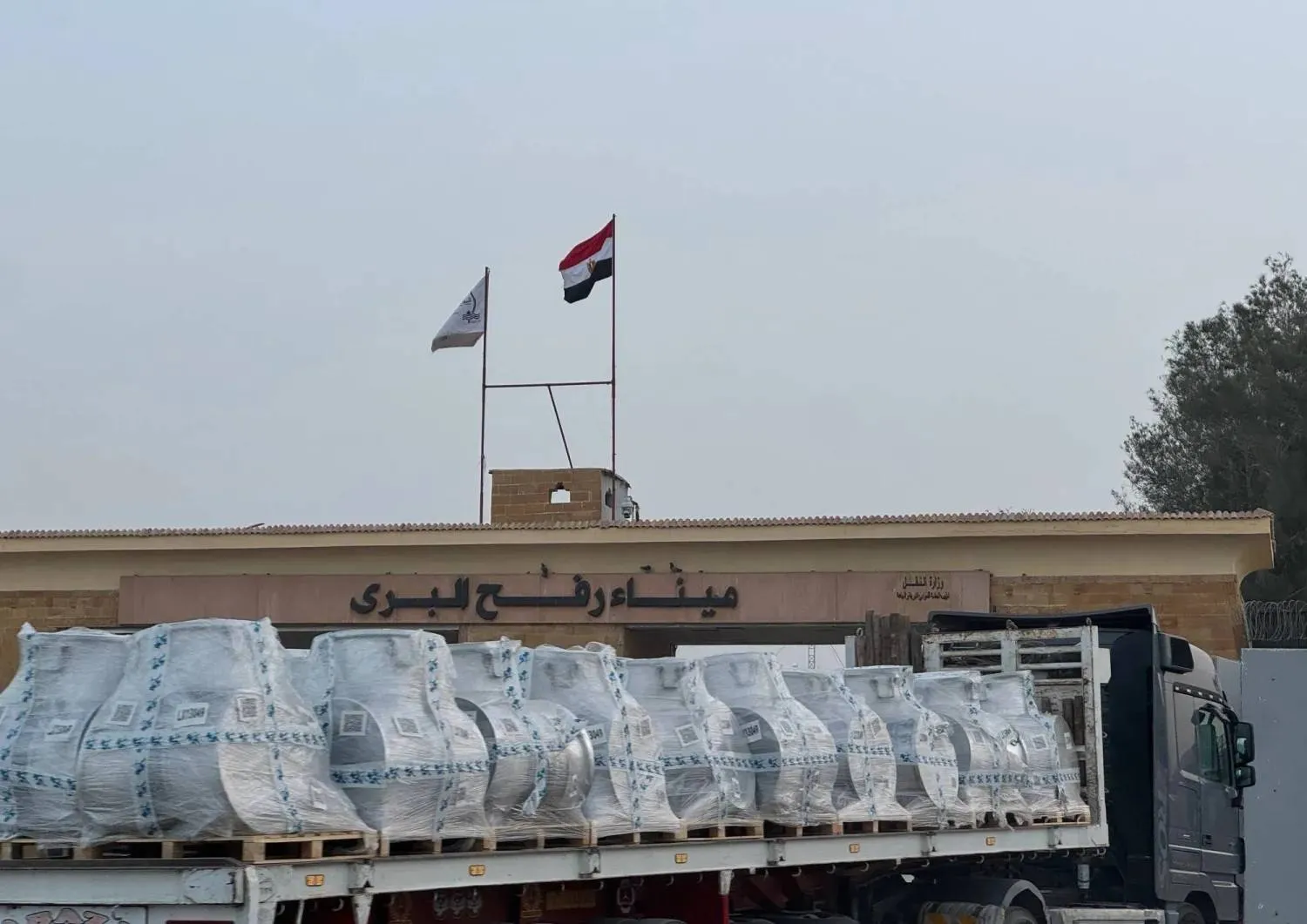

Gaza Awaits Arrival of Technocratic Committee

A truck carrying food aid at the Rafah crossing, Jan. 28, 2026 (EPA)
TT

Gaza Awaits Arrival of Technocratic Committee

A truck carrying food aid at the Rafah crossing, Jan. 28, 2026 (EPA)

Gaza residents are waiting for the arrival of a technocratic committee tasked with administering the territory, after Israel announced a partial reopening of the Rafah land crossing with Egypt on Sunday, allowing limited daily movement of travelers in and out of Gaza.

The 15-member National Committee for the Administration of Gaza (NCAG) is a team of Palestinian technocrats created as part of the US-sponsored ceasefire agreement which came into effect on October 10.

The head of the committee, Ali Shaath, said in a post on X that once logistical arrangements among the relevant parties are finalized, the reopening of Rafah would be officially announced starting Monday.

He said Sunday would be used as a trial day to test operational procedures at the crossing.

Sources told Asharq Al-Awsat that members of the committee are expected to enter Gaza on Sunday or Monday, provided Israel grants approval, adding that Israeli foot-dragging on the issue continues.

COGAT, the Israeli military body in charge of coordinating aid to Gaza, said on Friday that the Rafah crossing would reopen starting Sunday, under strict restrictions on passenger movement, particularly for those permitted to return to Gaza.

In a statement, the office said the crossing would operate in both directions, but with limited passenger numbers.

Travel would take place in coordination with Egypt, subject to prior Israeli security approval and under the supervision of a European Union mission, following the same mechanism activated in January 2025.

It said returning from Egypt to Gaza would be permitted only for residents who left the territory during the war, and only after obtaining prior Israeli security clearance. After an initial screening at Rafah by the EU mission, travelers would undergo a second identification check at an Israeli army checkpoint.

Israel’s Channel 12 reported that only 150 travelers per day would be allowed to enter Gaza from the Egyptian side, adding that Israeli efforts to impose a direct military presence at the crossing had failed.

Israeli army radio said the country’s security system would monitor the crossing remotely using sensors, metal detectors, cameras, and facial recognition technology to identify approved departures and arrivals.

Any attempt to smuggle an individual using a forged identity would result in denial of entry or exit and detention, without clarifying the mechanism or the responsible authority.

Israeli Prime Minister Benjamin Netanyahu said on Tuesday that Israel would maintain security control over the Rafah crossing.

Yedioth Ahronoth reported that Israel would allow lower-ranking Palestinian fighters, but not senior officials, wounded during the war, to leave Gaza via Rafah if they wished, noting that, in principle, all those who depart would be allowed to return.

On the Palestinian side, sources told Asharq Al-Awsat that preparations to compile lists of patients initially approved to travel through Rafah began on Sunday.

The sources said members of the Palestinian technocratic committee are expected to arrive in Gaza on Sunday or Monday, if Israel permits, noting continued Israeli stalling on the issue.

If the committee members arrive, they will hold meetings with Hamas-run government bodies in Gaza to agree on mechanisms for transferring authority in the territory.

Additional meetings are planned with Palestinian factions, civil society activists, and others to coordinate efforts related to Gaza’s current situation and future governance.




Strikes Hit Beirut's Southern Suburbs after Israeli Warning

Smoke and dust rise amid explosions in Lebanon, as seen from Israel, after Lebanon's Iran-backed Hezbollah and Israel exchanged fire amid the US-Israel conflict with Iran. REUTERS/Shir Torem
TT

Strikes Hit Beirut's Southern Suburbs after Israeli Warning

Smoke and dust rise amid explosions in Lebanon, as seen from Israel, after Lebanon's Iran-backed Hezbollah and Israel exchanged fire amid the US-Israel conflict with Iran. REUTERS/Shir Torem

Several strikes hit Beirut's southern suburbs on Monday after Israeli evacuation warnings, as seen on AFPTV's live broadcast, as Israel attacked the country following Hezbollah's dawn missile launches.

Plumes of smoke were rising from the targeted area as state media reported four Israeli strikes on the suburbs.

Meanwhile, the US Embassy in Lebanon renewed its call for citizens to leave Lebanon immediately.

"We urge US citizens not to travel to Lebanon. If you are in the country, depart Lebanon NOW," the US embassy said on Monday, as Israeli strikes pounded Beirut's southern suburbs, and dozens of villages mainly in south Lebanon.

"The US Embassy strongly encourages US citizens in Southern Lebanon, near the borders with Syria, in refugee settlements, and in the Dahiyeh neighborhood of Beirut to depart those areas immediately," the embassy said.


Families Take Shelter in Schools as Lebanon’s Government Calls Hezbollah’s Strike on Israel Illegal

A displaced family who fled Israeli airstrikes in southern Lebanon sits at a school turned into a shelter, in Beirut, Lebanon, Monday, March 2, 2026. (AP Photo/Bilal Hussein)
TT

Families Take Shelter in Schools as Lebanon’s Government Calls Hezbollah’s Strike on Israel Illegal

A displaced family who fled Israeli airstrikes in southern Lebanon sits at a school turned into a shelter, in Beirut, Lebanon, Monday, March 2, 2026. (AP Photo/Bilal Hussein)

Lebanese civilians fled from the country's south and Beirut’s southern suburbs on Monday, seeking refuge in schools in Lebanon's capital following a new and deadly escalation between Israel and the Iran-allied Lebanese militant group Hezbollah.

Lebanon’s Health Ministry reported at least 31 people were killed and 149 wounded in overnight strikes in the Beirut suburbs and southern Lebanon.

The Lebanese government later Monday slammed Hezbollah's decision to enter Iran's war with Israel and the United States, calling the militant group's actions illegal and demanding it hand over its weapons.

Highways were jammed overnight and into Monday with people fleeing after what was Israel's deadliest barrage on Lebanon in more than a year, striking hours after Hezbollah fired missiles across the border for the first time in more than a year.

Ali Hamdan was stuck in gridlock on the road between his village in southern Lebanon, Deir al-Zahrani, and the port city of Sidon. What should have been a half-hour’s drive had taken seven hours, he said.

“I don’t know how long it will take us to reach Beirut," he said. "I’m headed toward Beirut, but I don’t know where yet. We don’t have a place to stay.”

At a public school in Beirut, hastily converted into a temporary shelter, families arrived carrying mattresses, plastic bags, and bundles of clothing. Other families sat on sidewalks beside their belongings, some men smoking as they waited for space to open inside.

Volunteers moved through the crowd, registering names as families filled classrooms and gathered in the school courtyard.

Hussein Abu Ali, who fled a southern Beirut suburb with his wife and children, described the moment the strikes hit.

“My son began shaking and crying," he said. "Where are you supposed to go? I stepped outside, then back in because I was afraid of shooting in the air. I gathered my children and went down to the street.”

Nadia Al‑Salman, displaced from the southern town of Majdal Zoun, said they left their homes "not out of fear or terror of the United States, but to fulfill our religious and legal duty to protect ourselves.”

During the latest Israel-Hezbollah war in 2024, at one point, more than a million people were displaced in Lebanon. Many have been unable to return to their homes in the south, where villages along the border remain in ruins.

Hezbollah launched rockets into Israel a day after the militant Palestinian group Hamas attacked southern Israel on Oct. 7, 2023, triggering the war in Gaza. After months of low-level fighting, the conflict escalated into a full-scale war in September 2024 before a US brokered ceasefire nominally halted the fighting two months later.

Since that ceasefire, Israel has continued to launch near-daily strikes in Lebanon, saying it aims to stop Hezbollah from rebuilding.

Monday’s escalation also marked the first time in more than a year that Hezbollah has claimed responsibility for firing into Israel. Hezbollah said in a statement that the strikes were carried out in retaliation for the killing of Iran’s Supreme Leader Ali Khamenei, and for “repeated Israeli aggressions,” describing it as “a legitimate defensive response."

But Lebanon’s government said it considers Hezbollah’s military activities illegal and that the group should hand over its weapons. Prime Minister Nawaf Salam said after an emergency Cabinet meeting Monday that only the state should decide on matters of war and peace.

He added that Hezbollah’s military activities were banned going forward and called on security agencies to prevent the firing of missiles or drones from Lebanon and detain those behind the launch. It was the harshest stance the Lebanese government has taken yet toward Hezbollah, which also has a political party with a parliamentary bloc in addition to its armed militants.

Salam also called on the international community to work on getting a “clear and final commitment” from Israel to stop its strikes on Lebanon.

The Israeli military overnight issued a warning for residents of around 50 communities across southern and eastern Lebanon to evacuate. Military spokesman Brig. Gen. Effie Defrin said Israel is keeping “all options on the table,” including a potential ground invasion of Lebanon and threatened that “Hezbollah will pay a very heavy price."

He said Israel has called up more than 100,000 reservists since the war with Iran began on Saturday.


US Mission in Iraq Tells Nationals, Personnel to Shelter in Place

The US embassy in Baghdad, Iraq. (Reuters file)
TT

US Mission in Iraq Tells Nationals, Personnel to Shelter in Place

The US embassy in Baghdad, Iraq. (Reuters file)

The US embassy in Baghdad said Monday it directed US nationals and mission personnel to shelter in place, warning of threats posed by Iran-backed groups.

"The US Mission in Iraq advises US citizens to exercise increased caution, maintain a low profile, and shelter in place until further notice," the embassy said, adding that it had directed all staff to do the same.

The embassy warned that "Iran-aligned terrorist militias continue to pose a significant threat to public safety".