


Iran Says It Now Considers EU Militaries to Be Terrorist Groups

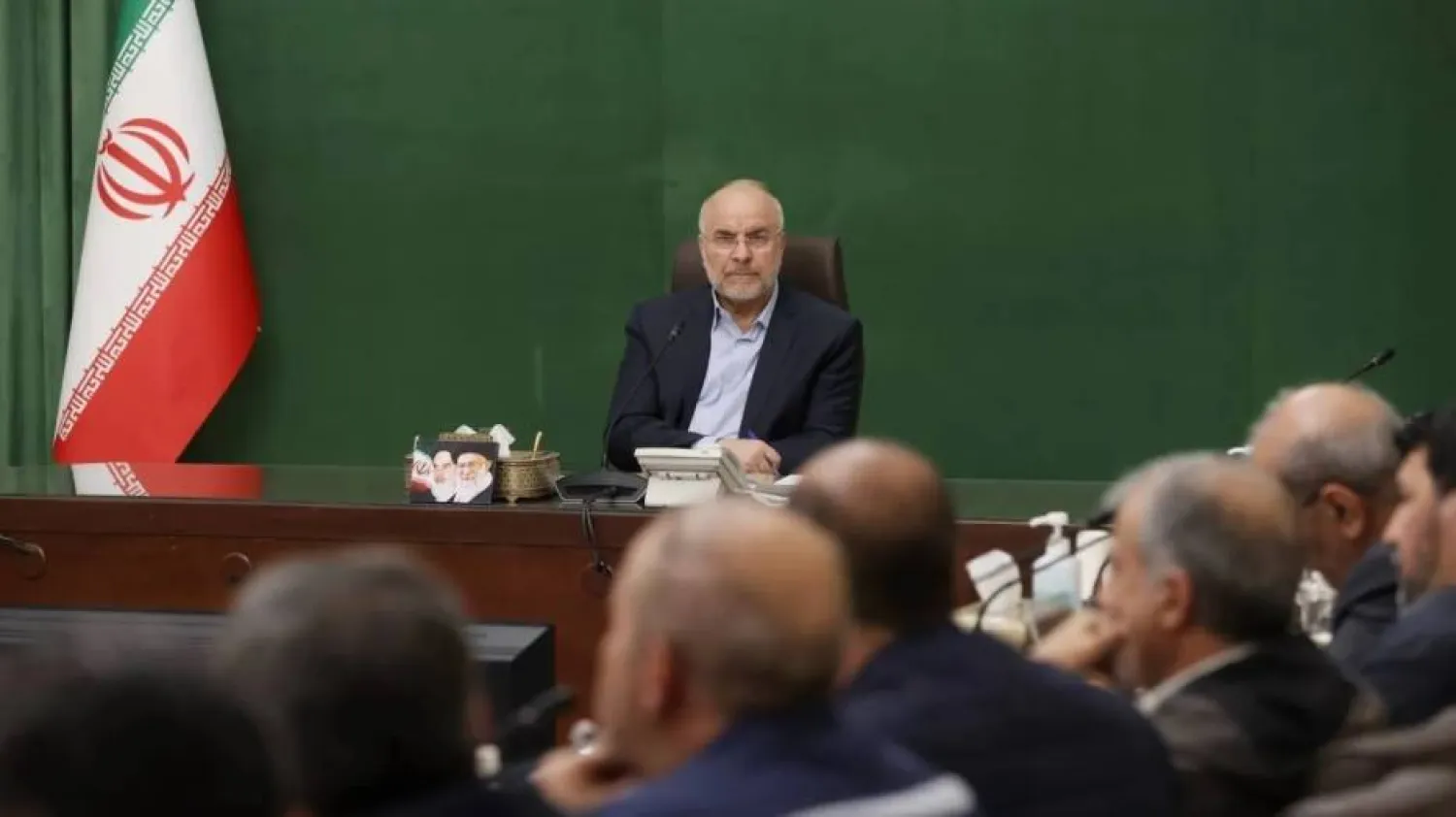
Iranian Parliament Speaker Mohammad Baqer Qalibaf (Iranian Parliament)
TT

Iran Says It Now Considers EU Militaries to Be Terrorist Groups

Iranian Parliament Speaker Mohammad Baqer Qalibaf (Iranian Parliament)

The speaker of Iran's parliament said Sunday that his country now considers all European Union militaries to be terrorist groups, lashing out after the bloc declared the country's paramilitary Revolutionary Guard a terror group over its bloody crackdown on nationwide protests.

The announcement by Mohammad Bagher Qalibaf, a former Guard commander, of the terror designation will likely be mostly symbolic. Iran has used a 2019 law to reciprocally declare other nations' militaries terror groups following the United States declaring the Guard a terror group that year, The Associated Press said.

However, it comes as tensions are high in the Mideast as US President Donald Trump weighs a possible military strike against Iran. Iran also planned a live fire military drill for Sunday and Monday in the strategic Strait of Hormuz, the narrow mouth of the Arabian Gulf through which a fifth of all oil traded passes.

Qalibaf made the announcement as he and others in parliament wore Guard uniforms in support of the force. The Guard, which also controls Iran's ballistic missile arsenal and has vast economic interests in Iran, answers only to Iran's 86-year-old Supreme Leader Ali Khamenei.

“By seeking to strike at the (Guard), which itself has been the greatest barrier to the spread of terrorism to Europe, Europeans have in fact shot themselves in the foot and, once again through blind obedience to the Americans, decided against the interests of their own people," Qalibaf said.

Lawmakers at the session later chanted: “Death to America!” and “Death to Israel!” at the session.

Trump has laid out two red lines for military action: the killing of peaceful protesters or the possible mass execution of those detained in a major crackdown over the demonstrations. He's increasingly begun discussing Iran's nuclear program as well, which the US negotiated over with Tehran in multiple sessions before Israel launched a 12-day war with Iran back in June.

The US bombed three Iranian nuclear sites during the war. Activity at two of the sites suggest Iran may be trying to obscure the view of satellites as it tries to salvage what remains there.

Trump on Saturday night declined to say whether he’d made a decision on what he wanted to do regarding Iran.

Speaking to reporters as he flew to Florida, Trump sidestepped a question about whether Tehran would be emboldened if the US backed away from launching strikes on Iran, saying, “Some people think that. Some people don’t.”

Trump said Iran should negotiate a “satisfactory” deal to prevent the Middle Eastern country from getting any nuclear weapons but said, “I don’t know that they will. But they are talking to us. Seriously talking to us.”

Ali Larijani, a top security official in Iran, wrote on X late Saturday that “structural arrangements for negotiations are progressing.” However, there is no public sign of any direct talks with the United States, something Khamenei has repeatedly ruled out.



Pope Renews Appeal for Peace in Middle East

 Pope Leo XIV appears at the window of his studio overlooking St. Peter's Square at the Vatican where Catholic faithful and pilgrims gathered for the traditional Sunday blessing at the end of the noon Angelus prayer, Sunday, March 15, 2026. (AP)
Pope Leo XIV appears at the window of his studio overlooking St. Peter's Square at the Vatican where Catholic faithful and pilgrims gathered for the traditional Sunday blessing at the end of the noon Angelus prayer, Sunday, March 15, 2026. (AP)
TT

Pope Renews Appeal for Peace in Middle East

 Pope Leo XIV appears at the window of his studio overlooking St. Peter's Square at the Vatican where Catholic faithful and pilgrims gathered for the traditional Sunday blessing at the end of the noon Angelus prayer, Sunday, March 15, 2026. (AP)
Pope Leo XIV appears at the window of his studio overlooking St. Peter's Square at the Vatican where Catholic faithful and pilgrims gathered for the traditional Sunday blessing at the end of the noon Angelus prayer, Sunday, March 15, 2026. (AP)

Pope Leo XIV renewed his appeal for peace in the Middle East on Sunday, calling for an end to the war and reopening of dialogue.

"Dear brothers and sisters, for two weeks the peoples of the Middle East have suffered the atrocious violence of war," the US pontiff said at his weekly Angelus prayer at the Vatican.

"Thousands of innocent people have been killed, and countless others have been forced to flee their homes.

"I renew my closeness to all those who have lost loved ones in the attacks that have hit schools, hospitals, and residential areas."

Leo said the situation in Lebanon was a particular cause for concern.

"On behalf of the Christians of the Middle East and of all women and men of goodwill, I address those responsible for this conflict," he said in Italian.

"Cease fire! Let paths of dialogue be reopened!

"Violence can never lead to the justice, stability and peace that people await."


Israel Approves Emergency Military Funding as Iran War Rages

Israeli security forces check the damage to cars after a rocket strike in Holon, in the Tel Aviv District on March 15, 2026. (AFP)
TT

Israel Approves Emergency Military Funding as Iran War Rages

Israeli security forces check the damage to cars after a rocket strike in Holon, in the Tel Aviv District on March 15, 2026. (AFP)

Israel has approved an $827-million emergency budget allocation for military purchases, Israeli media reported Sunday, as the war with Iran entered its third week.

The 2.6-billion-shekel package was approved over the weekend by cabinet ministers during a telephone meeting, the daily Haaretz reported.

It will be used for "security purchases" and to address "urgent needs", it said, without providing further details.

A finance ministry document circulated to all ministers and reported by several media outlets, including Channel 12, said that "given the intensity of the fighting" the additional budget allocation was necessary.

"An urgent and immediate need has arisen to provide an operational response, including the acquisition of munitions, the procurement of advanced weapons systems and the replenishment of critical combat stocks," the document said.

The document added that the move constituted "an exceptional emergency decision intended solely to address needs arising from the conduct of the fighting".

The funds will be drawn from the state budget, totaling $222 billion and approved by the government on March 12, and expected to be adopted by the Knesset by March 31, according to the reports.

The government of Prime Minister Benjamin Netanyahu has not yet officially commented on the measure or specified what purchases the funds will cover.

Since the Israeli-US bombardments against Iran that began on February 28, Israel has been targeted daily by Iranian ballistic missile fire, which the military has mostly intercepted using its missile defense systems.

According to Haaretz, citing security officials, 250 ballistic missiles had been fired by Iran at Israel as of March 13.

Twelve people have been killed in Israel by missiles or falling debris since the start of the war, according to an AFP tally of figures given by Israeli authorities and first responders.


UK Says Vital to 'De-escalate' Middle East War

FILE PHOTO: An aerial view of the island of Qeshm, separated from the Iranian mainland by the Clarence Strait, in the Strait of Hormuz, December 10, 2023. REUTERS/Stringer/File Photo
TT

UK Says Vital to 'De-escalate' Middle East War

FILE PHOTO: An aerial view of the island of Qeshm, separated from the Iranian mainland by the Clarence Strait, in the Strait of Hormuz, December 10, 2023. REUTERS/Stringer/File Photo

A British minister on Sunday said it was essential to calm the situation in the Middle East after US President Donald Trump demanded that other nations help protect world oil supplies passing through the Strait of Hormuz. 

The "plan now has to be to de-escalate the conflict", Energy Security Minister Ed Miliband told the BBC. 

"We are talking to our allies. There are different ways in which we can make maritime shipping possible. We are intensively looking with our allies at what can be done, because it's so important that we get the strait reopened," he added, speaking to Sky News. 

A spokesperson for the defense ministry said late on Saturday: "As we've said previously, we are currently discussing with our allies and partners a range of options to ensure the security of shipping in the region."