
NATO's Ability to Deter Russia Has Taken a Hit with Trans-Atlantic Infighting

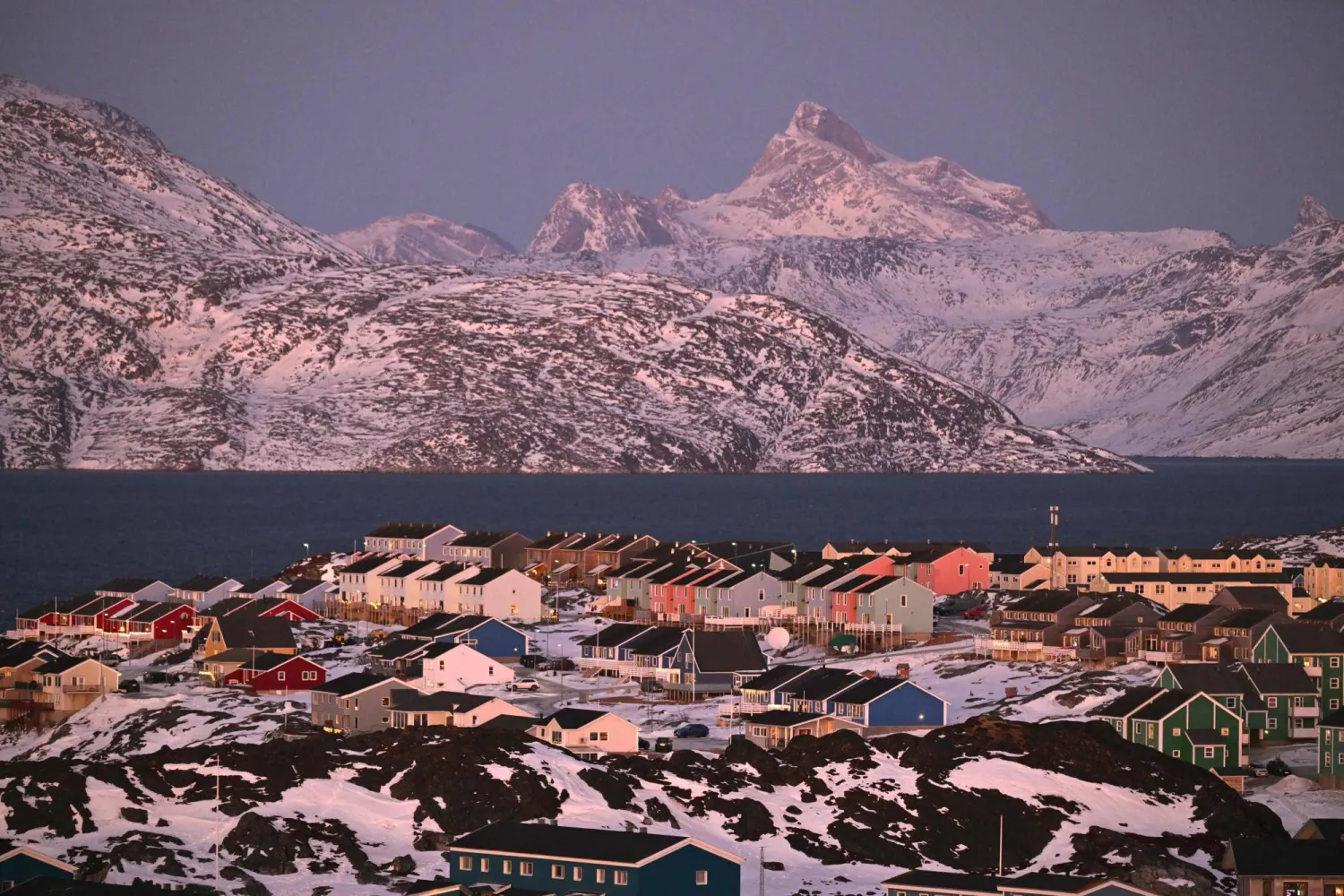
A photo shows a residential area near the airport at the city of Nuuk, western Greenland, with a slightly snow covered mountain in the background, on January 28, 2026. (AFP)
TT

NATO's Ability to Deter Russia Has Taken a Hit with Trans-Atlantic Infighting

A photo shows a residential area near the airport at the city of Nuuk, western Greenland, with a slightly snow covered mountain in the background, on January 28, 2026. (AFP)

European allies and Canada are pouring billions of dollars into helping Ukraine, and they have pledged to massively boost their budgets to defend their territories.

But despite those efforts, NATO’s credibility as a unified force under US leadership has taken a huge hit over the past year as trust within the 32-nation military organization dissolved.

The rift has been most glaring over U.S. President Donald Trump's repeated threats to seize Greenland, a semiautonomous territory of NATO ally Denmark. More recently, Trump's disparaging remarks about his NATO allies' troops in Afghanistan drew another outcry.

While the heat on Greenland has subsided for now, the infighting has seriously undercut the ability of the world’s biggest security alliance to deter adversaries, analysts say.

“The episode matters because it crossed a line that cannot be uncrossed,” Sophia Besch from the Carnegie Europe think tank said in a report on the Greenland crisis. “Even without force or sanctions, that breach weakens the alliance in a lasting way.”

The tensions haven’t gone unnoticed in Russia, NATO’s biggest threat.

Any deterrence of Russia relies on ensuring that President Vladimir Putin is convinced that NATO will retaliate should he expand his war beyond Ukraine. Right now, that does not seem to be the case.

“It’s a major upheaval for Europe, and we are watching it,” Russian Foreign Minister Sergey Lavrov noted last week.

Filling up the bucket

Criticized by US leaders for decades over low defense spending, and lashed relentlessly under Trump, European allies and Canada agreed in July to significantly up their game and start investing 5% of their gross domestic product on defense.

The pledge was aimed at taking the whip out of Trump's hand. The allies would spend as much of their economic output on core defense as the United States — around 3.5% of GDP — by 2035, plus a further 1.5% on security-related projects like upgrading bridges, air and seaports.

NATO Secretary-General Mark Rutte has hailed those pledges as a sign of NATO’s robust health and military might. He recently said that “fundamentally thanks to Donald J. Trump, NATO is stronger than it ever was.”

Though a big part of his job is to ensure that Trump does not pull the US out of NATO, as Trump has occasionally threatened, his flattery of the American leader has sometimes raised concern. Rutte has pointedly refused to speak about the rift over Greenland.

Article 5 at stake

The North Atlantic Treaty Organization was formed in 1949 to counter the security threat posed by the Soviet Union during the Cold War, and its deterrence is underpinned by a strong American troop presence in Europe.

The alliance is built on the political pledge that an attack on one ally must be met with a response from them all — the collective security guarantee enshrined in Article 5 of its rule book.

It hinges on the belief that the territories of all 32 allies must remain inviolate. Trump’s designs on Greenland attack that very principle, even though Article 5 does not apply in internal disputes because it can only be triggered unanimously.

“Instead of strengthening our alliances, threats against Greenland and NATO are undermining America’s own interests,” two US senators, Democrat Jeanne Shaheen and Republican Lisa Murkowski, wrote in a New York Times op-ed.

“Suggestions that the United States would seize or coerce allies to sell territory do not project strength. They signal unpredictability, weaken deterrence and hand our adversaries exactly what they want: proof that democratic alliances are fragile and unreliable,” they said.

Even before Trump escalated his threats to seize control of Greenland, his European allies were never entirely convinced that he would defend them should they come under attack.

Trump has said that he doesn’t believe the allies would help him either, and he recently drew more anger when he questioned the role of European and Canadian troops who fought and died alongside Americans in Afghanistan. The president later partially reversed his remarks.

In testimony to the Senate Foreign Relations Committee, US Secretary of State Marco Rubio dismissed criticism that Trump has undermined the alliance.

“The stronger our partners are in NATO, the more flexibility the United States will have to secure our interests in different parts of the world,” he said. “That’s not an abandonment of NATO. That is a reality of the 21st century and a world that’s changing now.”

A Russia not easily deterred

Despite NATO’s talk of increased spending, Moscow seems undeterred. The EU's foreign policy chief, Kaja Kallas, said this week that “it has become painfully clear that Russia will remain a major security threat for the long term.”

“We are fending off cyberattacks, sabotage against critical infrastructure, foreign interference and information manipulation, military intimidation, territorial threats and political meddling,” she said Wednesday.

Officials across Europe have reported acts of sabotage and mysterious drone flights over airports and military bases. Identifying the culprits is difficult, and Russia denies responsibility.

In a year-end address, Rutte warned that Europe is at imminent risk.

“Russia has brought war back to Europe, and we must be prepared for the scale of war our grandparents or great-grandparents endured,” he said.

Meanwhile in Russia, Lavrov said the dispute over Greenland heralded a “deep crisis” for NATO.

“It was hard to imagine before that such a thing could happen,” Lavrov told reporters, as he contemplated the possibility that “one NATO member is going to attack another NATO member.”

Russian state media mocked Europe's “impotent rage” over Trump's designs on Greenland, and Putin's presidential envoy declared that “trans-Atlantic unity is over.”

Doubt about US troops

US Defense Secretary Pete Hegseth is due to meet with his counterparts at NATO on Feb. 12. A year ago, he startled the allies by warning that America’s security priorities lie elsewhere and that Europe must look after itself now.

Security in the Arctic region, where Greenland lies, will be high on the agenda. It’s unclear whether Hegseth will announce a new drawdown of US troops in Europe, who are central to NATO’s deterrence.

Lack of clarity about this has also fueled doubt about the US commitment to its allies. In October, NATO learned that up to 1,500 American troops would be withdrawn from an area bordering Ukraine, angering ally Romania.

A report from the European Union Institute for Security Studies warned last week that although US troops are unlikely to vanish overnight, doubts about US commitment to European security means “the deterrence edifice becomes shakier.”

“Europe is being forced to confront a harsher reality,” wrote the authors, Veronica Anghel and Giuseppe Spatafora. “Adversaries start believing they can probe, sabotage and escalate without triggering a unified response.”

How Iranians Are Communicating Through Internet Blackout

 People walk past closed shops at the almost empty traditional main bazaar, in Tehran, Iran, Tuesday, March 10, 2026. (AP)
People walk past closed shops at the almost empty traditional main bazaar, in Tehran, Iran, Tuesday, March 10, 2026. (AP)
TT

How Iranians Are Communicating Through Internet Blackout

 People walk past closed shops at the almost empty traditional main bazaar, in Tehran, Iran, Tuesday, March 10, 2026. (AP)
People walk past closed shops at the almost empty traditional main bazaar, in Tehran, Iran, Tuesday, March 10, 2026. (AP)

Iran's latest internet blackout has lasted more than 14 days, connectivity monitor Netblocks said Friday.

The nature of the limits on internet activity shows "this is a government-imposed measure" and not the result of damage from US and Israeli airstrikes, Netblocks research chief Isik Mater told AFP.

"It is a deliberate shutdown imposed by the authorities to suppress the flow of information and prevent further dissent," said Raha Bahreini, Iran researcher at Amnesty International.

Here are some of the ways information is still flowing in and out of Iran.

- Shortwave radio -

Amsterdam-based nonprofit Radio Zamaneh began shortwave broadcasts during the January protests, sending a nightly Farsi news program from 11:00 pm Tehran time.

"It's really difficult for the regime to jam shortwave because it's a long-distance broadcast," executive director Rieneke van Santen told AFP.

"People can just listen on a super cheap, small, simple radio... It's one of those typical emergency fall-back solutions."

Declining to specify where the transmitter is located, she said it is "closer to the Netherlands than to Iran" -- although Tehran "can figure it out" if they choose.

- Phone calls -

Many with ties to Iran are still receiving landline phone calls from inside -- "quite surprising" given the internet blackout, said Mahsa Alimardani of global rights organization Witness.

Fearing the authorities listening in, people often avoid speaking directly about political topics, such as the killing of Ali Khamenei, she added.

"It's not possible to communicate about sensitive issues through these brief phone calls," Amnesty's Bahreini said.

The required prepaid international calling cards are expensive and often fail to provide their face value in minutes.

"You buy a phone card for 60 minutes, but in eight minutes, it's out," van Santen said.

"It's really just phone calls from family members saying, after the bombing, we're still alive."

- VPN or other internet services -

Virtual private networks (VPNs) -- widely-used services that encrypt internet traffic -- can't create an internet connection where none is available.

But even at around one percent of typical levels, Iran's connectivity is "still a large figure in absolute terms", Netblocks' Mater said.

Iranians suspected of using VPNs since the war began have received warning text messages claiming to be from the authorities.

Before the war, millions turned to Toronto-based company Psiphon, which creates specialist tools more capable than typical "off-the-shelf" VPNs.

Offering techniques including disguising users' data as different types of internet traffic, Psiphon "is able to evade detection more successfully", data and insights director Keith McManamen told AFP.

With up to six million unique daily users in Iran before the latest internet shutdown, connections have now tumbled to fewer than 100,000.

Few but the most tech-savvy users can reach Psiphon's network for now.

Nevertheless, "the situation is extremely dynamic. We're seeing changes not just day to day, but hour by hour," McManamen said.

A similar service, US-based Lantern, is also widely used in Iran.

- Satellite broadcasts -

Created by US-based nonprofit NetFreedom Pioneers, Toosheh is a "filecasting" technology using home satellite TV equipment to broadcast encrypted data to people in Iran.

Users record from the Toosheh satellite TV channel onto a USB stick plugged into their set-top box, which they can then decrypt using a special app installed on their phone or computer.

From that initial download, the data can be copied and shared across multiple households.

The group estimated around three million active users in Iran across 2025, with "thousands to hundreds of thousands... since the (internet) shutdown in January," the group's director of projects Emilia James told AFP.

From its usual educational repertoire ranging from English lessons to news, content these days includes more on "personal safety and digital security... helping people to stay safe," she added.

Since people are tuning in to a broadcast signal, there is no way for the government to track them, she added.

- Starlink -

Elon Musk-owned satellite internet service Starlink was used during this year's protests to get information out, while the government attempted to jam its signals.

At around $2,000 on Iran's black market, the terminals are expensive and very rare in poorer regions like Balochistan or Kurdistan that have suffered the most government repression, Alimardani said.

Meanwhile, Amnesty has received reports of "raids on houses... arrests of people who had Starlink devices," Bahreini said.

Charges for those caught communicating with the outside world range from prison sentences to the death penalty, she added.

Starlink did not respond to AFP's request for comment on usage in Iran.


How Iranians Are Communicating Through Internet Blackout

 People walk past closed shops at the almost empty traditional main bazaar, in Tehran, Iran, Tuesday, March 10, 2026. (AP)
People walk past closed shops at the almost empty traditional main bazaar, in Tehran, Iran, Tuesday, March 10, 2026. (AP)
TT

How Iranians Are Communicating Through Internet Blackout

 People walk past closed shops at the almost empty traditional main bazaar, in Tehran, Iran, Tuesday, March 10, 2026. (AP)
People walk past closed shops at the almost empty traditional main bazaar, in Tehran, Iran, Tuesday, March 10, 2026. (AP)

Iran's latest internet blackout has lasted more than 14 days, connectivity monitor Netblocks said Friday.

The nature of the limits on internet activity shows "this is a government-imposed measure" and not the result of damage from US and Israeli airstrikes, Netblocks research chief Isik Mater told AFP.

"It is a deliberate shutdown imposed by the authorities to suppress the flow of information and prevent further dissent," said Raha Bahreini, Iran researcher at Amnesty International.

Here are some of the ways information is still flowing in and out of Iran.

- Shortwave radio -

Amsterdam-based nonprofit Radio Zamaneh began shortwave broadcasts during the January protests, sending a nightly Farsi news program from 11:00 pm Tehran time.

"It's really difficult for the regime to jam shortwave because it's a long-distance broadcast," executive director Rieneke van Santen told AFP.

"People can just listen on a super cheap, small, simple radio... It's one of those typical emergency fall-back solutions."

Declining to specify where the transmitter is located, she said it is "closer to the Netherlands than to Iran" -- although Tehran "can figure it out" if they choose.

- Phone calls -

Many with ties to Iran are still receiving landline phone calls from inside -- "quite surprising" given the internet blackout, said Mahsa Alimardani of global rights organization Witness.

Fearing the authorities listening in, people often avoid speaking directly about political topics, such as the killing of Ali Khamenei, she added.

"It's not possible to communicate about sensitive issues through these brief phone calls," Amnesty's Bahreini said.

The required prepaid international calling cards are expensive and often fail to provide their face value in minutes.

"You buy a phone card for 60 minutes, but in eight minutes, it's out," van Santen said.

"It's really just phone calls from family members saying, after the bombing, we're still alive."

- VPN or other internet services -

Virtual private networks (VPNs) -- widely-used services that encrypt internet traffic -- can't create an internet connection where none is available.

But even at around one percent of typical levels, Iran's connectivity is "still a large figure in absolute terms", Netblocks' Mater said.

Iranians suspected of using VPNs since the war began have received warning text messages claiming to be from the authorities.

Before the war, millions turned to Toronto-based company Psiphon, which creates specialist tools more capable than typical "off-the-shelf" VPNs.

Offering techniques including disguising users' data as different types of internet traffic, Psiphon "is able to evade detection more successfully", data and insights director Keith McManamen told AFP.

With up to six million unique daily users in Iran before the latest internet shutdown, connections have now tumbled to fewer than 100,000.

Few but the most tech-savvy users can reach Psiphon's network for now.

Nevertheless, "the situation is extremely dynamic. We're seeing changes not just day to day, but hour by hour," McManamen said.

A similar service, US-based Lantern, is also widely used in Iran.

- Satellite broadcasts -

Created by US-based nonprofit NetFreedom Pioneers, Toosheh is a "filecasting" technology using home satellite TV equipment to broadcast encrypted data to people in Iran.

Users record from the Toosheh satellite TV channel onto a USB stick plugged into their set-top box, which they can then decrypt using a special app installed on their phone or computer.

From that initial download, the data can be copied and shared across multiple households.

The group estimated around three million active users in Iran across 2025, with "thousands to hundreds of thousands... since the (internet) shutdown in January," the group's director of projects Emilia James told AFP.

From its usual educational repertoire ranging from English lessons to news, content these days includes more on "personal safety and digital security... helping people to stay safe," she added.

Since people are tuning in to a broadcast signal, there is no way for the government to track them, she added.

- Starlink -

Elon Musk-owned satellite internet service Starlink was used during this year's protests to get information out, while the government attempted to jam its signals.

At around $2,000 on Iran's black market, the terminals are expensive and very rare in poorer regions like Balochistan or Kurdistan that have suffered the most government repression, Alimardani said.

Meanwhile, Amnesty has received reports of "raids on houses... arrests of people who had Starlink devices," Bahreini said.

Charges for those caught communicating with the outside world range from prison sentences to the death penalty, she added.

Starlink did not respond to AFP's request for comment on usage in Iran.


Will Ahmadinejad Return to the Political Scene in Iran?

Iranian former President Mahmoud Ahmadinejad. (AFP)
TT

Will Ahmadinejad Return to the Political Scene in Iran?

Iranian former President Mahmoud Ahmadinejad. (AFP)

A report by The Atlantic said the strike that hit a region close to Iranian former President Mahmoud Ahmadinejad’s residence in the first days of the war on Iran has returned to the spotlight a still controversial political figure even though he left office for over a decade ago.

On the first day of the Iran war, the assassination of Supreme Leader Ali Khamenei overshadowed news of a strike near Ahmadinejad’s home, said the report.

“Many who remembered his term in office - marked by Holocaust denial, atom-bomb fetishism, and shoving revolutionary ideology down the throats of a country already weary of it - celebrated his reported assassination,” it added. He was president from 2005 to 2013.

“Among those who have followed Ahmadinejad’s post-presidential career, however, his targeting was more of an enigma. Since leaving office, Ahmadinejad has harshly criticized the Iranian government, and as a result, Iran’s Guardian Council has formally excluded him from running for president,” said the report.

For more than a decade, he has been known more as a regime opponent than as a supporter. “I don’t understand why Israel would want to kill him in the first place,” Meir Javedanfar, who co-wrote a biography of Ahmadinejad, told The Atlantic. “Perhaps to settle scores? It makes no sense.”

Contrary to early reports, Ahmadinejad is alive, his associates revealed, requesting anonymity. “The circumstances of his survival may prove significant as the war drags on. Whatever the intent, Ahmadinejad’s associates say the strike was in effect a jailbreak operation that freed the former president from regime control.”

“Long before the war, the government had posted a small number of bodyguards near Ahmadinejad, nominally to protect a prominent citizen but also to keep tabs on him. The regime has never been sure what to do with him,” said the report.

About a month ago, after the January protests, his freedom of movement was further reduced, his phones confiscated, and the contingent of bodyguards increased from single digits to about 50. The bodyguards were based a few hundred meters from Ahmadinejad’s residence itself, at the entrance to a cul-de-sac in Narmak, in northeast Tehran. They established a checkpoint to monitor the houses and high school on that street.

“A February 28 strike hit not the residence, but the security forces nearby. In the ensuing mayhem, Ahmadinejad and his family evidently escaped their home and went underground. The government believed he had died, and his death was announced by official channels, as well as the reformist daily Sharq.”

“When rumors arose that Ahmadinejad had escaped, regime elements immediately suspected that he had been spirited away to take part in a coup,” said The Atlantic. “Ahmadinejad’s only public statement since the attack has been a brief eulogy for the supreme leader, calculated to show that Ahmadinejad was alive and to dispel speculation that he had declared himself an enemy of the state. His location is unknown to the government.”

In 2018, former Defense Minister Hussein Dehghan likened Ahmadinejad to “the door of the mosque, which can’t be burned or thrown away” without torching the mosque itself.

“Arresting Ahmadinejad could unsettle the regime,” Javedanfar said. “He knows a hell of a lot about it.”

“Ahmadinejad’s fans say that he has popular support, and that any postwar government will want him around to lend that support. If the current regime survives, it will need all the legitimacy it can get. If it does not, the United States might need someone with intimate - if outdated - knowledge of the Iranian state to be involved with what comes next. Ahmadinejad could still be useful,” the report said.