

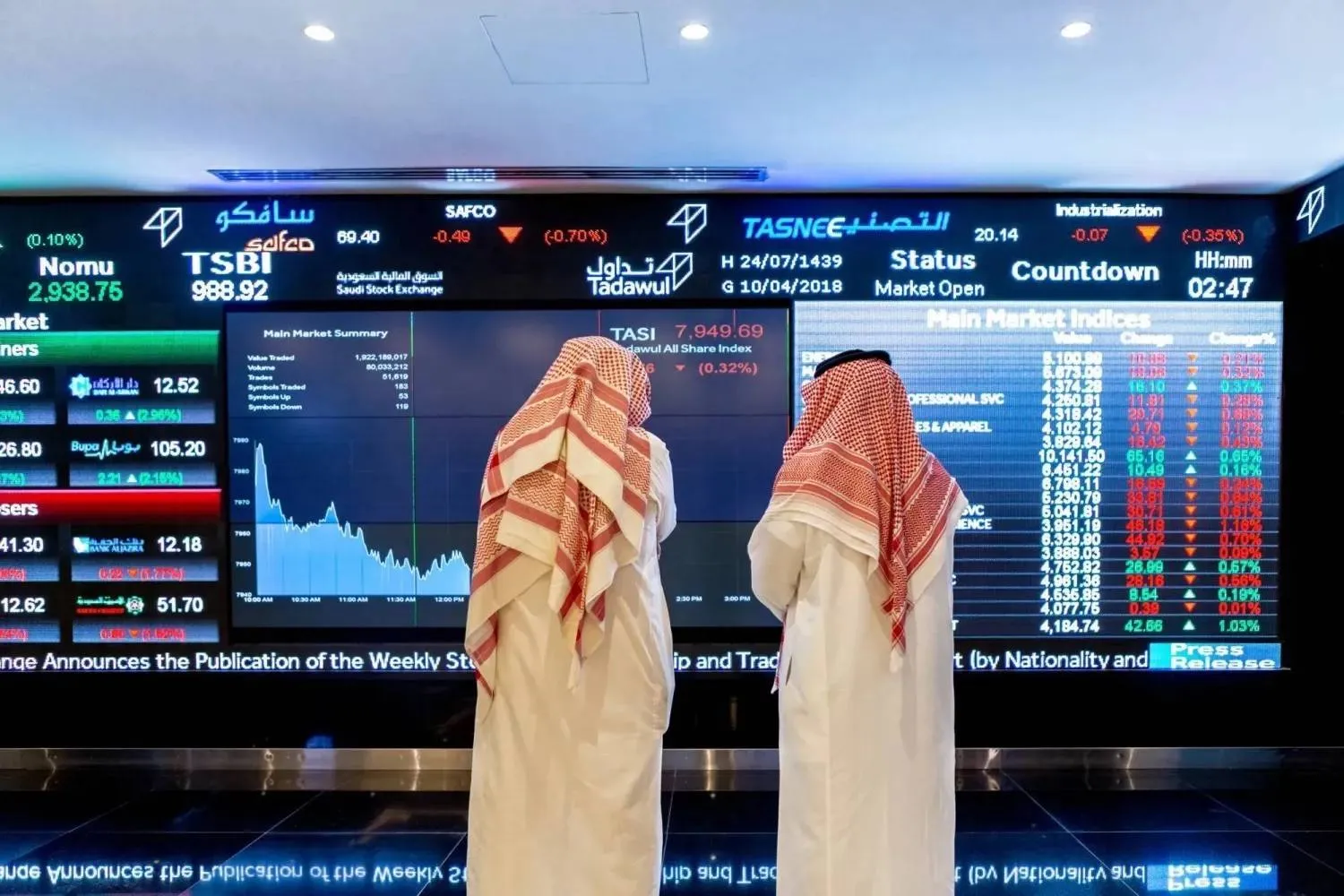

Saudi Stock Market Opens Its Doors to Direct Foreign Investment

Traders watch a screen at the Saudi stock market. (Reuters)
TT

Saudi Stock Market Opens Its Doors to Direct Foreign Investment

Traders watch a screen at the Saudi stock market. (Reuters)

When trading opened on this Sunday, Saudi Arabia’s stock exchange marked more than the start of a routine session. The day signaled a pivotal shift in the Kingdom’s financial history, as the market formally opened to direct foreign investment, positioning it as a destination for global capital and one of the most consequential milestones in Saudi Arabia’s economic transformation.

With the removal of long-standing restrictions and pre-qualification requirements, the Saudi market is moving beyond its earlier status as an ambitious emerging exchange. It is now seeking to stand shoulder to shoulder with advanced global markets, backed by a robust regulatory framework and an increasingly confident investor base.

Analysts say the reforms could pave the way for deeper liquidity, broader participation, and an eventual climb toward the 17,000-point level for the benchmark index.

Market specialists view the move as reinforcing Saudi Arabia’s appeal as an international investment hub and as a vote of confidence in the market’s regulatory maturity and capacity to absorb large capital inflows.

Expectations are that the changes will help attract long-term, strategic foreign investors, raise trading activity, and enhance market depth. Optimistic forecasts point to gains over the next two years, driven by anticipated interest in sectors such as banking, petrochemicals, and technology.

Sweeping regulatory reform

The decision by the Capital Market Authority in January to abolish the Qualified Foreign Investor regime and dismantle the framework governing swap agreements marked a fundamental regulatory overhaul rather than a technical adjustment.

The new rules allow non-resident foreign investors to access the main market directly, removing historic barriers and simplifying the process of opening and operating investment accounts.

Regulators say the reforms are aimed at attracting long-term capital that supports not only liquidity, but also higher standards of governance and transparency in line with global best practices.

The changes are part of a broader strategy to make the Saudi market more accessible to international investors, including Gulf Cooperation Council (GCC) residents and individuals with prior ties to the region.

Market gains ahead of the shift

The market has already reacted positively. Hamad Al-Olayan, chief executive of Villa Capital, told Asharq Al-Awsat that the benchmark index gained nearly 1,000 points in January alone, following the announcement of the regulatory changes.

“This rally comes ahead of foreign participation,” Al-Olayan said, noting that many listed companies had seen their share prices decline over the past two years. “Current investors are unlikely to sell strong stocks at these low levels, and recent sessions have seen concentrated buying in companies with solid balance sheets and promising outlooks.”

Key sectors in focus

Al-Olayan described the Saudi market as the strongest in the region, citing a stream of positive assessments from global banks and advisory firms, as well as optimistic growth projections for the Saudi economy in 2026.

He said the market continues to be anchored by two core sectors: banking, which plays the leading role, and petrochemicals, which remain attractive despite near-term challenges. Recent asset sales by SABIC in Europe and the United States—transactions that drew foreign investors—underscore sustained international confidence in Saudi companies.

Momentum has also been building around the Saudi Arabian Mining Company (Maaden), supported by rising global prices for gold, silver, and other metals. Al-Olayan noted that international investors increasingly favor companies with strategic assets, including Saudi Aramco and Maaden.

Toward advanced-market status

Mohamed Hamdy Omar, chief executive of G World, described the move as “a historic step that strengthens the Saudi market’s position as an emerging exchange steadily progressing toward developed-market status.”

He said the decision reflects strong regulatory and economic confidence and builds on earlier reforms following the market’s inclusion in major global indices.

Omar expects foreign inflows to build gradually from the second half of 2026, with clearer effects on trading volumes and prices emerging in 2027.

While short-term volatility linked to portfolio rebalancing is possible, he stressed that the medium- and long-term outlook remains firmly positive.

Key figures

Despite market volatility in 2025 driven by geopolitical tensions, global economic uncertainty, and oil price swings, foreign ownership in Saudi equities climbed to SAR 590 billion ($157.3 billion) by the end of the third quarter of the year, up from SAR 498 billion ($132.8 billion) a year earlier.

Total trading value reached SAR 1.30 trillion ($346.7 billion) in 2025, underscoring the market’s resilience and growing international appeal.

EU Says US Must Honor a Trade Deal after Court Blocks Trump Tariffs

FILE PHOTO: US President Donald Trump speaks during a press briefing at the White House, in Washington, D.C., US, February 20, 2026. REUTERS/Kevin Lamarque/File Photo
TT

EU Says US Must Honor a Trade Deal after Court Blocks Trump Tariffs

FILE PHOTO: US President Donald Trump speaks during a press briefing at the White House, in Washington, D.C., US, February 20, 2026. REUTERS/Kevin Lamarque/File Photo

The European Union's executive arm requested “full clarity” from the United States and asked its trade partner to fulfill its commitments after the US Supreme Court struck down some of President Donald Trump’s most sweeping tariffs.

Trump has lashed out at the court decision and said Saturday that he wants a global tariff of 15%, up from the 10% he announced a day earlier.

The European Commission said the current situation is not conducive to delivering "fair, balanced, and mutually beneficial” trans-Atlantic trade and investment, as agreed to by both sides and spelled out in the EU-US Joint Statement of August 2025.

American and EU officials sealed a trade deal last year that imposes a 15% import tax on 70% of European goods exported to the United States. The European Commission handles trade for the 27 EU member countries.

A top EU lawmaker said on Sunday he will propose to the European Parliament negotiating team to put the ratifying process of the deal on pause.

“Pure tariff chaos on the part of the US administration,” Bernd Lange, the chair of Parliament’s international trade committee, wrote on social media. “No one can make sense of it anymore — only open questions and growing uncertainty for the EU and other US trading partners.”

The value of EU-US trade in goods and services amounted to 1.7 trillion euros ($2 trillion) in 2024, or an average of 4.6 billion euros a day, according to EU statistics agency Eurostat.

“A deal is a deal,” the European Commission said. “As the United States’ largest trading partner, the EU expects the US to honor its commitments set out in the Joint Statement — just as the EU stands by its commitments. EU products must continue to benefit from the most competitive treatment, with no increases in tariffs beyond the clear and all-inclusive ceiling previously agreed."

Jamieson Greer, Trump’s top trade negotiator, said in a CBS News interview Sunday morning that the US plans to stand by its trade deals and expects its partners to do the same.

He said he talked to his European counterpart this weekend and hasn’t heard anyone tell him the deal is off.

“The deals were not premised on whether or not the emergency tariff litigation would rise or fall,” Greer said. “I haven’t heard anyone yet come to me and say the deal’s off. They want to see how this plays out.”

Europe’s biggest exports to the US are pharmaceuticals, cars, aircraft, chemicals, medical instruments, and wine and spirits. Among the biggest US exports to the bloc are professional and scientific services like payment systems and cloud infrastructure, oil and gas, pharmaceuticals, medical equipment, aerospace products and cars.

“When applied unpredictably, tariffs are inherently disruptive, undermining confidence and stability across global markets and creating further uncertainty across international supply chains,” The Associated Press quoted the commission as saying.

As primarily a trading bloc, the EU has a powerful tool at its disposal to retaliate — the bloc’s Anti-Coercion Instrument. It includes a raft of measures for blocking or restricting trade and investment from countries found to be putting undue pressure on EU member nations or corporations.

The measures could include curtailing the export and import of goods and services, barring countries or companies from EU public tenders, or limiting foreign direct investment. In its most severe form, it would essentially close off access to the EU’s 450-million customer market and inflict billions of dollars of losses on US companies and the American economy.


GCC GDP Jumps to $2.3 Trillion

GCC countries continued to record GDP growth, supported by economic diversification programs and fiscal reforms (Oman News Agency).
TT

GCC GDP Jumps to $2.3 Trillion

GCC countries continued to record GDP growth, supported by economic diversification programs and fiscal reforms (Oman News Agency).

A statistical report published on Sunday showed that the economies of the Gulf Cooperation Council countries recorded growth in gross domestic product, supported by economic diversification programs and fiscal reforms. Combined GDP reached $2.3 trillion, ranking ninth globally, with a growth rate of 2.2 percent.

The report revealed that GCC countries achieved qualitative advances in 2024 across competitiveness, energy, trade, and digitization, driven by growth in non-oil sectors, improved quality of life, the development of digital infrastructure, and a stronger regional and international presence.

In the “GCC in Numbers” report issued by the Statistical Center for the Cooperation Council for the Arab Countries of the Gulf, it was emphasized that GCC states continue to record real GDP growth “thanks to economic diversification programs and fiscal reforms, with GDP reaching $2.3 trillion, ranking ninth globally, and posting growth of 2.2 percent.”

The report also showed improvement in global economic indicators, including competitiveness, resilience, and economic dynamism.

GCC countries ranked first globally in oil reserves at 511.9 billion barrels, third worldwide in natural gas production at 442 billion cubic metres, and second globally in natural gas reserves at 44.3 billion cubic metres.

GCC countries ranked 10th globally in total exports valued at $849.6 billion, 11th in imports at $739.0 billion, 10th in total trade at $1.5895 trillion, and sixth worldwide in trade balance surplus at $109.7 billion.


Algeria Tenders to Buy Nominal 50,000 Metric Tons Soft Milling Wheat

Mature spring wheat awaits harvest on a farm near Beausejour, Manitoba, Canada August 20, 2020. REUTERS/Shannon VanRaes/File Photo
TT

Algeria Tenders to Buy Nominal 50,000 Metric Tons Soft Milling Wheat

Mature spring wheat awaits harvest on a farm near Beausejour, Manitoba, Canada August 20, 2020. REUTERS/Shannon VanRaes/File Photo

Algeria's state grains agency OAIC has issued an international tender to buy soft milling wheat to be sourced from optional origins, European traders said on Sunday.

The tender sought a nominal 50,000 metric tons but Algeria often buys considerably more in its tenders than the nominal volume sought, Reuters reported.

The deadline for submission of price offers in the tender is Tuesday, February 24, with offers having to remain valid until Wednesday, February 25. The wheat is sought for shipment in three periods from the main supply regions including Europe: April 16-30, May 1-15 and May 16-31. If sourced from South America or Australia, shipment is one month earlier.

Algeria is a vital customer for wheat from the European Union, especially France, but Russian and other Black Sea region exporters have been expanding strongly in the Algerian market.
