


Besieged by Gang Violence, Palestinian Citizens in Israel Demand More Security

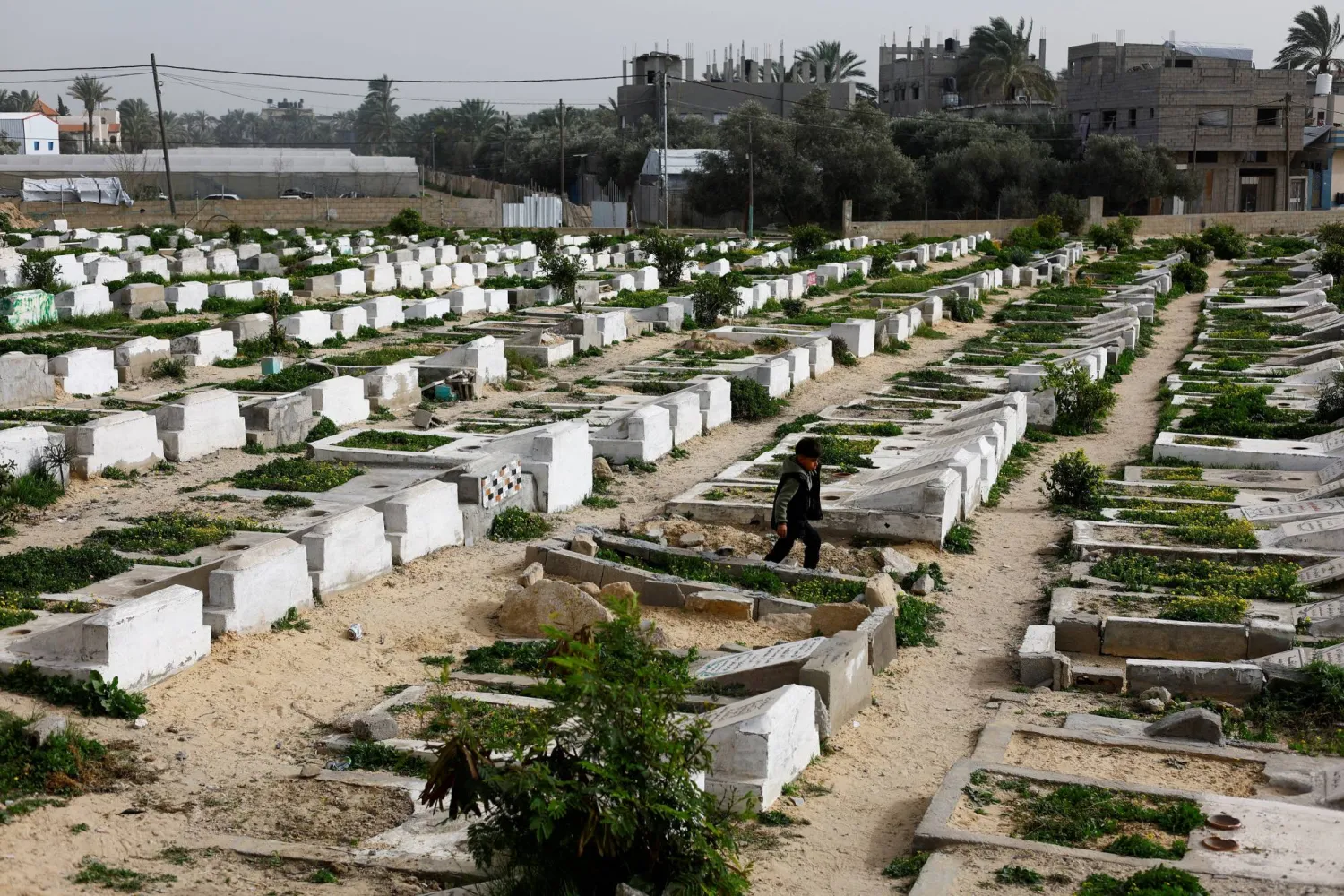
A Palestinian child walks through the cemetery with graves of some of those killed during the war, in Deir al-Balah, central Gaza Strip, January 30, 2026. REUTERS/Mahmoud Issa
TT

Besieged by Gang Violence, Palestinian Citizens in Israel Demand More Security

A Palestinian child walks through the cemetery with graves of some of those killed during the war, in Deir al-Balah, central Gaza Strip, January 30, 2026. REUTERS/Mahmoud Issa

Nabil Safiya had taken a break from studying for a biology exam to meet a cousin at a pizza parlor when a gunman on a motorcycle rode past and fired, killing the 15-year-old as he sat in a black Renault.

The shooting — which police later said was a case of mistaken identity — stunned his hometown of Kafr Yasif, long besieged, like many Palestinian towns in Israel, by a wave of gang violence and family feuds.

“There is no set time for the gunfire anymore,” said Nabil’s father, Ashraf Safiya. “They can kill you in school, they can kill you in the street, they can kill you in the football stadium.”

The violence plaguing Israel’s Arab minority has become an inescapable part of daily life. Activists have long accused authorities of failing to address the issue and say that sense has deepened under Israel's current far-right government, The Associated Press said.

One out of every five citizens in Israel is Palestinian. The rate of crime-related killings among them is more than 22 times higher than that for Jewish Israelis, while arrest and indictment rates for those crimes are far lower. Critics cite the disparities as evidence of entrenched discrimination and neglect.

A growing number of demonstrations are sweeping Israel. Thousands marched in Tel Aviv late Saturday to demand action, while Arab communities have gone on strike, closing shops and schools.

In November, after Nabil was gunned down, residents marched through the streets, students boycotted their classes and the Safiya family turned their home into a shrine with pictures and posters of Nabil.

The outrage had as much to do with what happened as with how often it keeps happening.

“There’s a law for the Jewish society and a different law for Palestinian society,” Ghassan Munayyer, a political activist from Lod, a mixed city with a large Palestinian population, said at a recent protest.

An epidemic of violence

Some Palestinian citizens have reached the highest echelons of business and politics in Israel. Yet many feel forsaken by authorities, with their communities marked by underinvestment and high unemployment that fuels frustration and distrust toward the state.

Nabil was one of a record 252 Palestinian citizens to be killed in Israel last year, according to data from Abraham Initiatives, an Israeli nongovernmental organization that promotes coexistence and safer communities. The toll continues to climb, with at least 26 additional crime-related killings in January.

Walid Haddad, a criminologist who teaches at Ono Academic College and who previously worked in Israel’s national security ministry, said that organized crime thrives off weapons trafficking and loan‑sharking in places where people lack access to credit. Gangs also extort residents and business owners for “protection,” he said.

Based on interviews with gang members in prisons and courts, he said they can earn anywhere from thousands to hundreds of thousands of dollars, depending on whether the job is torching cars, shooting at buildings or assassinating rival leaders.

"If they fire at homes or people once or twice a month, they can buy cars, go on trips. It’s easy money,” Haddad said, noting a widespread sense of impunity.

The violence has stifled the rhythm of life in many Palestinian communities. In Kafr Yasif, a northern Israel town of 10,000, streets empty by nightfall, and it’s not uncommon for those trying to sleep to hear gunshots ringing through their neighborhoods.

Prosecutions lag

Last year, only 8% of killings of Palestinian citizens led to charges filed against suspects, compared with 55% in Jewish communities, according to Abraham Initiatives.

Lama Yassin, the Abraham Initiatives’ director of shared cities and regions, said strained relations with police long discouraged Palestinian citizens from calling for new police stations or more police officers in their communities.

Not anymore.

“In recent years, because people are so depressed and feel like they’re not able to practice day-to-day life ... Arabs are saying, ‘Do whatever it takes, even if it means more police in our towns,’” Yassin said.

The killings have become a rallying cry for Palestinian-led political parties after successive governments pledged to curb the bloodshed with little results. Politicians and activists see the spate of violence as a reflection of selective enforcement and police apathy.

"We’ve been talking about this for 10 years," said Knesset member Aida Touma-Suleiman.

She labeled policing in Palestinian communities “collective punishment,” noting that when Jews are victims of violence, police often set up roadblocks in neighboring Palestinian towns, flood areas with officers and arrest suspects en masse.

“The only side that can be able to smash a mafia is the state and the state is doing nothing except letting (organized crime) understand that they are free to do whatever they want,” Touma-Suleiman said.

Many communities feel impunity has gotten worse, she added, under National Security Minister Itamar Ben-Gvir, who with authority over the police has launched aggressive and visible campaigns against other crimes, targeting protests and pushing for tougher operations in east Jerusalem and the occupied West Bank.

Israeli police reject allegations of skewed priorities, saying that killings in these communities are a top priority. Police also have said investigations are challenging because witnesses don’t always cooperate.

“Investigative decisions are guided by evidence, operational considerations, and due process, not by indifference or lack of prioritization,” police said in a statement.

Unanswered demands

In Kafr Yasif, Ashraf Safiya vowed his son wouldn’t become just another statistic.

He had just gotten home from his work as a dentist and off the phone with Nabil when he learned about the shooting. He raced to the scene to find the car window shattered as Nabil was being rushed to the hospital. Doctors there pronounced him dead.

“The idea was that the blood of this boy would not be wasted,” Safiya said of protests he helped organize. “If people stop caring about these cases, we’re going to just have another case and another case.”

Authorities said last month they were preparing to file an indictment against a 23-year-old arrested in a neighboring town in connection with the shooting. They said the intended target was a relative, referring to the cousin with Nabil that night.

And they described Nabil as a victim of what they called "blood feuds within Arab society.”

At a late January demonstration in Kafr Yasif, marchers carried portraits of Nabil and Nidal Mosaedah, another local boy killed in the violence. Police broke up the protest, saying it lasted longer than authorized, and arrested its leaders, including the former head of the town council.

The show of force, residents said, may have quashed one protest, but did nothing to halt the killings.


Hezbollah, Israel Trade Evacuation Warnings as Ground Campaign Remains Unclear

A Lebanese man walks near the rubble of buildings destroyed by Israeli air strikes in Beirut’s southern suburbs (Reuters)
TT

Hezbollah, Israel Trade Evacuation Warnings as Ground Campaign Remains Unclear

A Lebanese man walks near the rubble of buildings destroyed by Israeli air strikes in Beirut’s southern suburbs (Reuters)

Hezbollah and the Israeli military have entered a new phase of the conflict in southern Lebanon, marked by a sharp escalation in missile fire that began late Wednesday.

Israel responded by widening evacuation warnings in southern Lebanon to areas north of the Litani River and south of the Zahrani River, as Israeli ground operations over the past 10 days have consisted of limited incursions followed by withdrawals.

Israel also issued evacuation warnings in central Beirut, specifically in the Bashoura area adjacent to downtown Beirut, triggering major disruption in the capital.

The area is hosting tens of thousands of displaced people from southern Lebanon and Beirut’s southern suburbs. The Israeli military enforced the warning by striking a building with two heavy air raids following two warning strikes.

Later, the Israeli military said Hezbollah had stored hundreds of millions of dollars beneath the targeted building and that armed guards were stationed there. It said access to the storage site was through the parking lot.

The military then issued another warning for a building dozens of meters away in the Zoqaq al-Blat area and struck it in an air raid.

The escalation reached a new level when a precision strike targeted the Lebanese University’s Faculty of Sciences, killing two professors inside the building.

In Israel, Defense Minister Israel Katz said in a statement that he and Prime Minister Benjamin Netanyahu had instructed the Israeli military to “prepare to expand operations in Lebanon and restore calm and security to the northern communities.”

Katz said he warned Lebanon’s president, Joseph Aoun, that if the Lebanese government cannot control its territory and prevent Hezbollah from threatening the northern communities and firing rockets toward Israel, it will do so itself, and it will seize territory.

Hezbollah escalation

Hezbollah launched a heavy rocket barrage late Wednesday, with most of the projectiles fired from north of the Litani River toward Israel. The rockets targeted northern border settlements as well as military sites deeper inside Israel, according to Israeli media and Hezbollah.

More than 200 rockets were fired in successive barrages over nearly four hours, causing no deaths or injuries, according to Israeli authorities.

Hezbollah appeared to escalate after days of heavy Israeli bombardment targeting Beirut’s southern suburbs.

Lebanese sources monitoring Hezbollah said the decision to escalate “appears to have been taken after Israel announced it would not evacuate the northern settlements, so that displaced residents would not create pressure on it.”

The sources said Hezbollah was therefore trying to pressure Tel Aviv by forcing evacuations in northern Israel.

Northern Israel was expected to remain largely insulated from the fighting after Hezbollah vacated the area south of the Litani following the 2024 war, and after the Lebanese army and UN peacekeepers cleared and destroyed Hezbollah rocket depots south of the river.

However, most of the rockets targeting northern Israel were launched from north of the Litani.

A Lebanese security source said 95% of the rockets fired at Israel during the latest escalation overnight Wednesday originated north of the Litani.

The Israeli military said Thursday that Hezbollah had launched “around 200 rockets and around 20 drones, in addition to ballistic missiles that were being launched from Iran at the same time,” describing it as the largest barrage Hezbollah has fired since the start of the war.

It vowed to respond forcefully, while Hezbollah rockets struck areas in Tel Aviv and Israeli military facilities in Haifa, Tiberias and Safed.

Evacuation warnings

Israel quickly responded Thursday by issuing what it described as the broadest evacuation warning since the war began, covering the area between north of the Litani River and south of the Zahrani River, extending to western Bekaa.

Avichay Adraee, the Israeli military’s Arabic-language spokesperson, said on X that residents should move north of the Zahrani River, which lies about 56 kilometers from the Israeli border at its midpoint.

The warning covers the Zahrani district and part of Nabatieh district, particularly the Iqlim al-Tuffah area, which is entirely included in the evacuation order, as well as villages in western Bekaa.

Local sources in southern Lebanon told Asharq Al-Awsat that the area north of the Litani came under very heavy air strikes overnight Wednesday-Thursday, with bombardment lasting for hours in villages where Hezbollah was launching rockets.

Ground battle

The shape of the ground battle remains unclear, with Israeli forces carrying out incursions inside Lebanese territory without establishing permanent positions.

A Lebanese security source told Asharq Al-Awsat that Israeli incursions have been taking place for 10 days, ranging from a few hundred meters to 3 kilometers inside Lebanon.

The source said the Israeli military “has not established any new military position inside Lebanese territory,” but instead enters areas and then withdraws.

According to the sources, incursions have occurred on several axes. In the east, they included the area south of Kfar Shouba, as well as the villages of Adaisseh, Markaba, Kfar Kila and south of Khiam, extending to the outskirts of Tall al-Nahas.

Other incursions took place farther south in Aitaroun, Yaroun, Maroun al-Ras and Qawzah.

The sources stressed that what is happening “is not an invasion, but incursions after which Israeli forces withdraw beyond the border.”

At the same time, Hezbollah said its fighters carried out large-scale missile and drone attacks targeting strategic military bases in the suburbs of Tel Aviv and elite training centers, as well as “pounding Zionist settlements and barracks with swarms of attack drones and precision rocket salvos.”

The death toll from Israeli strikes on Lebanon has risen to 687 since the war between Israel and Hezbollah began on March 2, 2026, Lebanese Information Minister Paul Morcos said. He added that the dead include “98 children and 52 women.”


Iran, Hezbollah ‘Parallel Missile War’: Tactic to Confuse Israel or War of Attrition?

A damaged building in Beirut’s southern suburbs after an Israeli strike on the area, with a large portrait of Iran’s late Supreme Leader Ali Khamenei displayed on it (Reuters)
TT

Iran, Hezbollah ‘Parallel Missile War’: Tactic to Confuse Israel or War of Attrition?

A damaged building in Beirut’s southern suburbs after an Israeli strike on the area, with a large portrait of Iran’s late Supreme Leader Ali Khamenei displayed on it (Reuters)

The war in the region is showing a striking military shift, with Iran and Hezbollah launching missiles simultaneously toward Israel, signaling a move from sporadic attacks to coordinated fire across two fronts.

The step reflects an effort to impose new military equations and generate simultaneous pressure across multiple arenas.

Experts say the confrontation is effectively being run as a single front led by Tehran, with the Lebanese front appearing as a direct extension of the battle Iran is fighting.

Hezbollah underscored that when it said its missile attacks were in retaliation for the killing of Iran’s late Supreme Leader Ali Khamenei, while Iran’s Islamic Revolutionary Guard Corps said in a statement Wednesday evening that it had joined Hezbollah in what was called “Operation Al-Asf Al-Makoul.”

Lebanese government summons Iranian embassy official

The Iranian statement triggered a response in Lebanon. The cabinet decided to summon the Iranian embassy’s charge d’affaires, linking the move to a recent decision banning any activity by Iran’s Revolutionary Guards in Lebanon.

Information Minister Paul Morcos said that after the Revolutionary Guards’ statement referring to a joint operation with Hezbollah, Prime Minister Nawaf Salam asked Foreign Minister Youssef Rajji to “summon the appropriate official from the Iranian embassy.”

Rajji subsequently summoned the Iranian charge d’affaires and tasked the secretary-general of the Foreign Ministry with meeting him on Friday morning to convey Lebanon’s position rejecting any Iranian interference in the country’s internal affairs.

One front managed between Tehran and Beirut

Since the start of the US-Iran war, near-daily barrages have been launched from Iranian territory toward Israel’s interior, alongside dozens of rockets fired from southern Lebanon toward northern Israel.

The synchronized attacks deliver both a political and military message. Air raid sirens have sounded across wide areas from northern to central Israel during the barrages.

The latest operation was what Hezbollah called “Operation Al-Asf Al-Makoul,” which the Revolutionary Guards also said it had joined alongside the group.

Israeli military spokesperson Nadav Shoshani said Thursday that Hezbollah, in coordination with Iran, launched an overnight attack involving missiles and drones targeting cities and communities across Israel.

About 200 rockets and 20 drones were fired, he said, in addition to ballistic missiles launched from Iran at the same time.

Shoshani described it as the largest barrage Hezbollah has fired since the start of the war, but said Israeli air defenses and a rapid response limited the damage.

A security source told Asharq Al-Awsat the parallel strikes leave “no room for doubt that the military order comes from the same source,” adding that Iran views the war as “one front, not two,” managed from Tehran and Beirut alike.

The source said that view is also reflected in Israeli assassinations targeting Revolutionary Guard commanders, adding that those carrying out operations tied to that source “must execute the orders.”

Tactic aimed at Israeli air defenses

Retired Brigadier General Yaroob Sakher said the parallel launches reflect a tactic aimed primarily at confusing Israel’s air defense systems.

He said barrages fired by Hezbollah from southern Lebanon, given the group’s geographic proximity to Israel, serve to occupy defense systems and disperse their ability to respond to threats, opening a time window for long-range Iranian missiles attempting to penetrate those defenses.

Hezbollah as an ‘attrition front’

Sakher said the approach relies on synchronized barrages: closer-range rockets serve as a defensive distraction, while missiles launched farther away aim to exploit the resulting confusion.

But he said the tactic’s results remain limited, succeeding at times but failing often because of the density and sophistication of Israeli air defenses.

Sakher places the approach within what he describes as a broader Iranian strategy. In his view, Tehran sees the war as a major confrontation that could threaten its future and is therefore deploying all available tools.

That includes expanding regional tension while activating its regional allies, foremost Hezbollah, which forms the front closest to Israel.

However, he said Hezbollah no longer possesses all its previous capabilities after the blows it has sustained, leaving its role closer to a front of attrition or distraction than a decisive battlefield.

Israel strikes across multiple fronts

Sakher said Israel, in turn, is pursuing a parallel strategy by spreading its strikes across multiple fronts.

As Iran operates simultaneously from Tehran and Beirut, Israel is balancing its attacks between Iran and Hezbollah, backed by significant military and logistical capabilities, along with a US military presence in the region and the continued arrival of cargo aircraft carrying weapons to Israel.

He said the ongoing strikes have begun to affect Iran’s missile capabilities by targeting production sites and storage facilities above and below ground, gradually reducing its ballistic missile stockpile.

Hezbollah’s missile arsenal, he added, is also being depleted under sustained Israeli strikes.

In Sakher’s assessment, the balance of power clearly favors the United States and Israel because of the wide gap in military technology.

Iran, he said, relies on less advanced capabilities than those of the opposing side, including technologies based on artificial intelligence.

“In the short term, the battle does not appear to be moving in Tehran’s favor,” Sakher said, pointing to the continuing strikes on Iran’s missile capabilities.

He added that this could accelerate the confrontation's resolution, unless new political or military developments emerge.


Strike Kills 2 Academics at Lebanese University as Israel Bombs Central Beirut

People stand amid debris in front of damaged buildings in the aftermath of a reported Israeli strike in Zuqaq al-Blat, central Beirut, Lebanon March 12, 2026. REUTERS/Mohamed Azakir
TT

Strike Kills 2 Academics at Lebanese University as Israel Bombs Central Beirut

People stand amid debris in front of damaged buildings in the aftermath of a reported Israeli strike in Zuqaq al-Blat, central Beirut, Lebanon March 12, 2026. REUTERS/Mohamed Azakir

An Israeli strike that hit in the vicinity of Lebanon’s only public university killed the director of the faculty of sciences Hussein Bazzi and professor Mortada Srour.

The campus is in Hadath, on the outskirts of Beirut’s southern suburbs, which Israel had warned last week should be evacuated.

It was not clear whether the campus was directly targeted, but smoke could be seen rising near the building’s courtyard in the aftermath.

Lebanese President Joseph Aoun condemned the bombing, which he said targeted the campus, as a crime and a “violation of international laws and norms that prohibit attacks on educational institutions and civilians.”

Israel’s military said Thursday night it had begun another wave of strikes on Lebanon’s capital, saying it was targeting Hezbollah sites.

Israeli strikes hit two buildings in busy residential and commercial districts near central Beirut.