


Oil Prices Fall Nearly 5% on US-Iran De-escalation

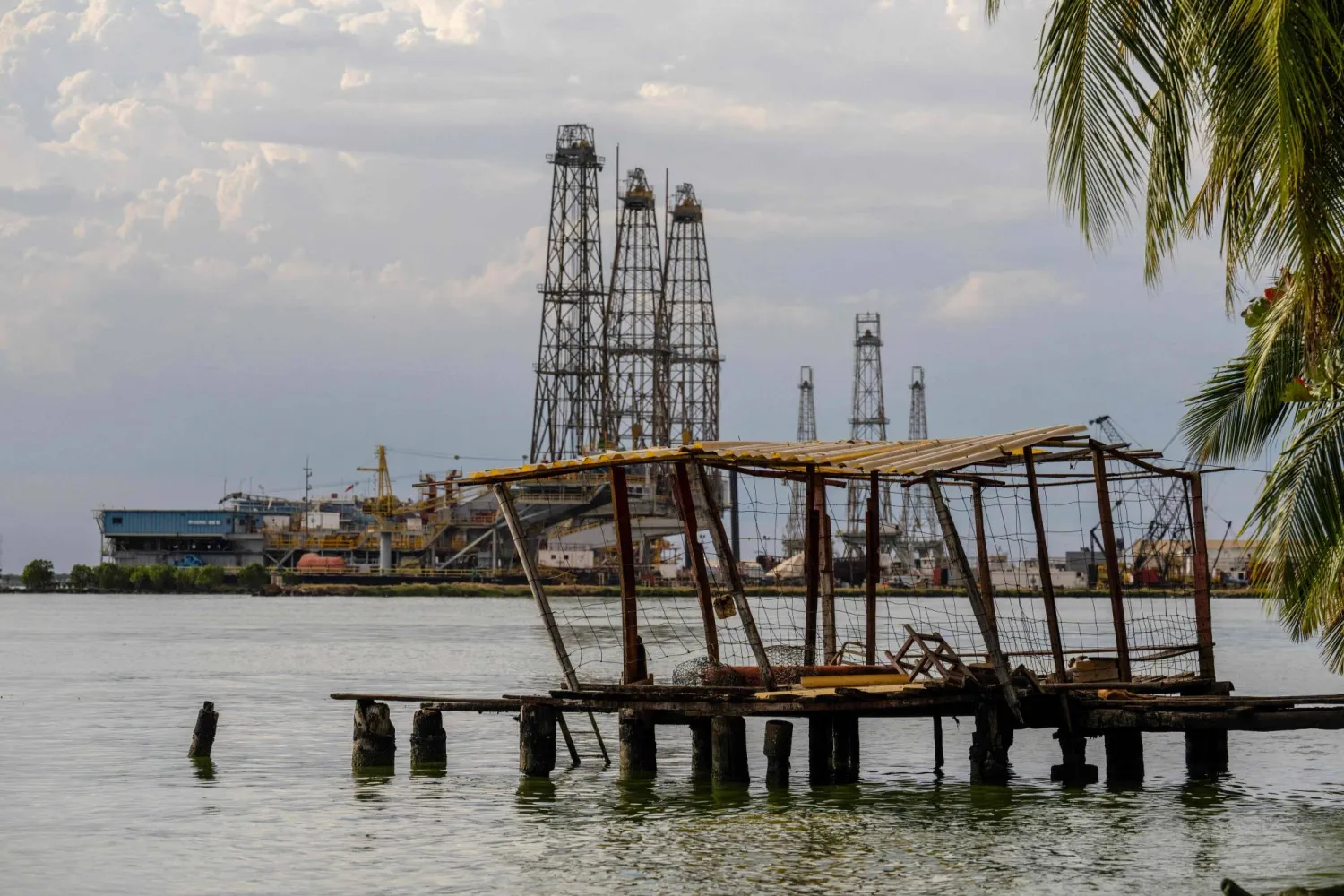
Oil rigs are pictured in Cabimas, south of Lake Maracaibo, Zulia State, Venezuela, on January 31, 2026. (Photo by Maryorin Mendez / AFP)
TT

Oil Prices Fall Nearly 5% on US-Iran De-escalation

Oil rigs are pictured in Cabimas, south of Lake Maracaibo, Zulia State, Venezuela, on January 31, 2026. (Photo by Maryorin Mendez / AFP)

Oil prices fell nearly 5% on Monday, heading for the steepest single-session decline in more than 6 months, after US President Donald Trump said Iran was "seriously talking" with Washington, signaling de-escalation with an OPEC member.

Brent crude futures were down $3.30, or 4.8%, at $66.02 per barrel at 0528 GMT. US West Texas Intermediate crude fell $3.23, or nearly 5%, to $61.98 per barrel.

Both contracts are ‌dropping sharply from ‌multi-month highs as risks of a ‌military ⁠strike receded after ‌Trump's weekend comments.

He had repeatedly threatened Iran with intervention if it did not agree to a nuclear deal or continued killing protesters. The persistent threats have underpinned oil prices throughout January, said Priyanka Sachdeva, an analyst at Phillip Nova.

"The recent pullback has also been reinforced by renewed strength in the US dollar, which ⁠typically makes dollar-denominated oil more expensive for non-US buyers, further weighing on prices," Sachdeva ‌said.

On Saturday Trump told reporters Iran ‍was "seriously talking," hours after Tehran's top ‍security official Ali Larijani said arrangements for negotiations were underway.

Trump's ‍comments, along with reports that the naval forces of Iran's Revolutionary Guards have no plans for live-fire exercises in the Strait of Hormuz, are signs of de-escalation, said IG market analyst Tony Sycamore.

"The crude oil market is interpreting this as an encouraging step back from confrontation, easing the geopolitical risk premium built ⁠into the price during last week's rally and prompting a bout of profit-taking," he said.

At a meeting on Sunday, OPEC+ agreed to keep its oil output unchanged for March. In November the grouping had frozen further planned increases for January through March 2026 because of seasonally weaker consumption.

"Geopolitical risks mask a fundamentally bearish oil market," Capital Economics said in a note on January 30.

"The historical example of last year's 12-day war (between Israel and Iran), and a well-supplied oil market, will still bear down ‌on Brent crude prices by end-2026."


Saudi Stocks Open to Foreign Investors as Inflows of Global Capital Loom

A trader monitors stock movements on a screen at the Saudi stock exchange. (Reuters)
TT

Saudi Stocks Open to Foreign Investors as Inflows of Global Capital Loom

A trader monitors stock movements on a screen at the Saudi stock exchange. (Reuters)

Saudi Arabia’s equity market has been formally opened to all categories of foreign investors, a move widely expected to attract substantial international capital inflows in the coming period.

The decision follows the entry into force, on Sunday, of a new regulatory framework allowing non-resident foreign investors to invest directly in the Saudi stock market.

Market experts say the reform could draw global funds seeking exposure to the Kingdom’s largest listed companies and fast-growing economy.

By the end of the third quarter of 2025, foreign investors’ ownership in the Saudi capital market exceeded SAR 590 billion ($157.3 billion). Investments in the main market alone stood at around SAR 519 billion ($138.4 billion), up from SAR 498 billion ($132.8 billion) at the end of 2024, underscoring steady growth even before the latest reforms. Analysts expect the new rules to further boost foreign participation.

On Sunday, the Saudi Capital Market Authority announced that the market would be fully open to all foreign investor categories from February 1, following approval by its board of the new regulatory framework. With this step, all segments of the Saudi market are now accessible to investors worldwide through direct investment.

Market performance, however, was mixed. The benchmark index recorded its strongest monthly gain since 2022 in January, closing at 11,382.08 points.

On the first day of foreign investors being allowed to trade directly, the index fell 1.9 percent to 11,167.48 points, losing 214.6 points amid broad declines, particularly in energy, banking, and basic materials stocks.

Leading stocks

Hamad Al-Olayan, chief executive of Villa Capital, said the initial decline was “natural,” noting that several major stocks had posted strong gains in recent days following the announcement of the decision last month.

Speaking to Asharq Al-Awsat, he attributed the pullback largely to profit-taking in leading stocks such as Maaden.

Al-Olayan also pointed to pressure on banking shares, especially Al Rajhi Bank and Saudi National Bank, after recent rallies, as well as volatility in gold and silver prices.

Some investors may still be unclear about ownership limits and sector-specific restrictions, he added.

Outlook improves

The recent decline may also reflect psychological factors, profit-taking, and limited geopolitical pressures, he remarked. Sentiment would improve once procedures for foreign entry, account opening, execution, and ownership thresholds become clearer.

The reforms abolish the concept of the “qualified foreign investor” in the main market and cancel swap agreements previously used by non-resident investors to gain only economic exposure. Direct ownership of listed shares is now permitted.

In July 2025, the CMA had already eased account-opening procedures for certain foreign investors, a transitional step toward full liberalization.

The latest changes align with the authority’s gradual approach to opening the market and aim to position Saudi Arabia as a global investment destination while supporting the domestic economy.


IMF Chief Says Global Inflation to Fall, Trade Integration is Needed

International Monetary Fund (IMF) managing director Kristalina Georgieva gestures as she speaks during the final day of the World Economic Forum (WEF) annual meeting in Davos on January 23, 2026. (Photo by Fabrice COFFRINI / AFP)
TT

IMF Chief Says Global Inflation to Fall, Trade Integration is Needed

International Monetary Fund (IMF) managing director Kristalina Georgieva gestures as she speaks during the final day of the World Economic Forum (WEF) annual meeting in Davos on January 23, 2026. (Photo by Fabrice COFFRINI / AFP)

Global inflation is expected to fall to 3.8% this year and to 3.4% in 2027, helped by softer demand and lower energy prices, the IMF chief ‌said on ‌Monday.

Managing Director ‌Kristalina ⁠Georgieva said ‌in a speech in the Annual Arab Fiscal Forum in Dubai that global growth has held up 'remarkably well' amid profound shifts ⁠in geopolitics, trade policy, technology, ‌and demographics.

Georgieva also ‍called for ‍more trade integration as unilateral ‍trade agreements are seen on the increase, Reuters said.

"In the world of trade fragmentation, more trade integration is absolutely paramount."

"What we have ⁠seen this year is that trade did not go down the way we feared it would. In fact trade is growing slightly slower than global growth," she added.


Turkish Manufacturing Downturn Deepens as Inflation Pressures Rise, PMI Shows

People look at gold jewelleries as they stand outside a jewellery shop at the Grand Bazaar in Istanbul, Türkiye, January 26, 2026. (Reuters)
TT

Turkish Manufacturing Downturn Deepens as Inflation Pressures Rise, PMI Shows

People look at gold jewelleries as they stand outside a jewellery shop at the Grand Bazaar in Istanbul, Türkiye, January 26, 2026. (Reuters)

Türkiye's manufacturing sector faced continued challenges in January, with new orders and production continuing to decline, while inflationary pressures ​surged, a survey from S&P Global reported on Monday.

The Istanbul Chamber of Industry Türkiye Manufacturing Purchasing Managers' Index (PMI) fell to 48.1 in January from 48.9 in December, remaining below the 50.0 threshold that indicates growth for the twenty-second consecutive ‌month.

Muted demand ‌conditions were evident as ‌new ⁠orders ​eased further, ‌albeit at a modest pace, the panel said. New export orders slowed more significantly than total new business, reflecting broader challenges in the global market, the survey showed.

Manufacturers responded by reducing output, and the slowdown in production ⁠was more pronounced than in December, the survey said.

In ‌line with reduced output, ‍firms cut back ‍on employment, purchasing activity, and inventories of ‍inputs and finished goods at the start of the year.

Inflationary pressures intensified, with input costs rising sharply. The pace of inflation accelerated, driven ​by higher raw material costs, particularly metals. Consequently, output prices surged as firms passed ⁠on increased costs to customers, the survey said.

"The Turkish manufacturing sector began 2026 in a similar position to that which it ended 2025, seeing modest slowdowns in new orders and production as business conditions remained challenging," said Andrew Harker, Economics Director at S&P Global Market Intelligence.

"Firms will be hoping to see these pressures abate somewhat in the ‌months ahead to provide an easier path to growth."
