Report: Iran Fears US Strike May Reignite Protests, Imperil Rule

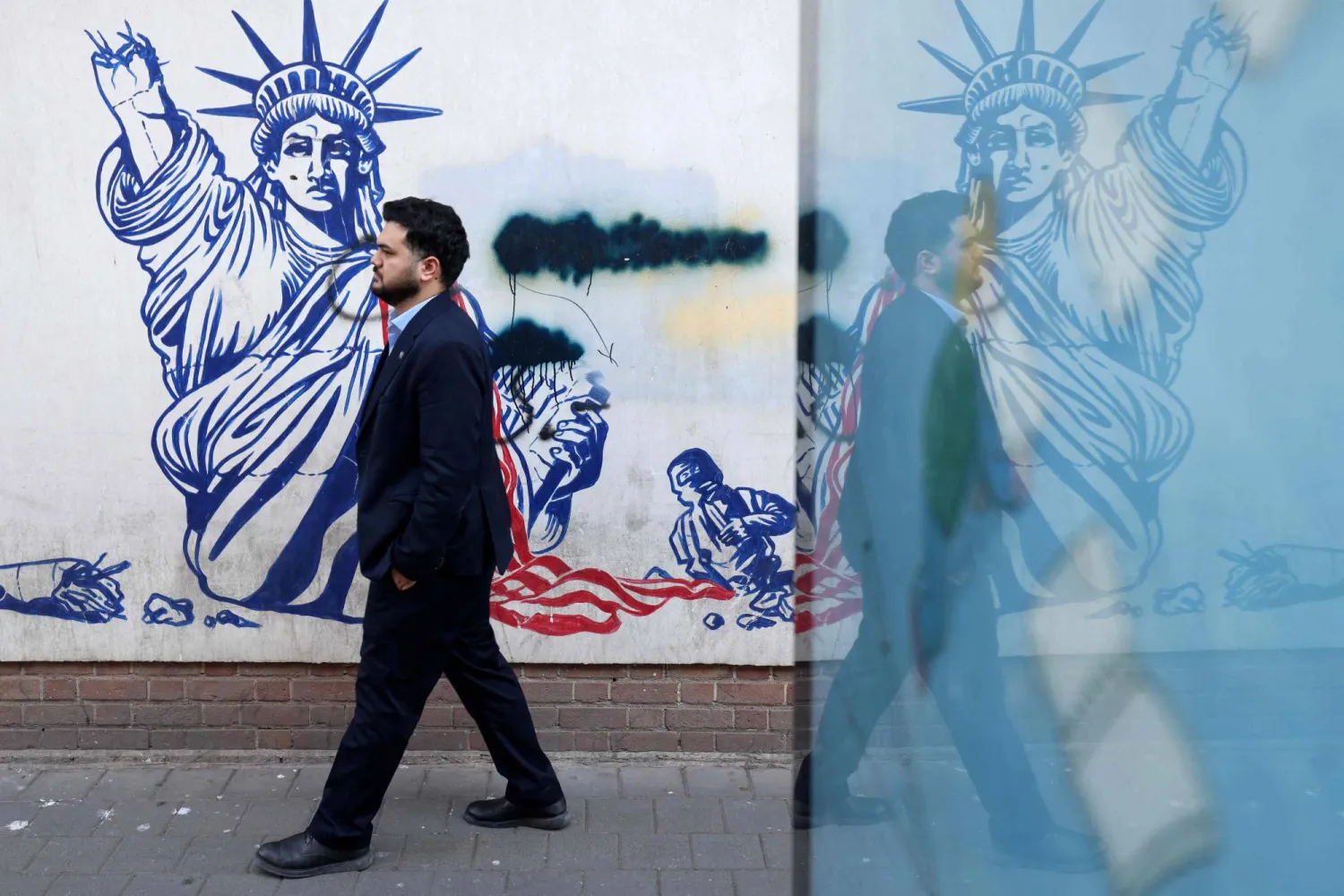
A man walk past a mural depicting the Statue of Liberty with the torch-bearing arm broken, painted on the outer walls of the former US embassy in Tehran, colloquially-referred to as the "Spy Den,"on February 1, 2026. (AFP)
TT

Report: Iran Fears US Strike May Reignite Protests, Imperil Rule

A man walk past a mural depicting the Statue of Liberty with the torch-bearing arm broken, painted on the outer walls of the former US embassy in Tehran, colloquially-referred to as the "Spy Den,"on February 1, 2026. (AFP)

Iran’s leadership is increasingly worried a US strike could break its grip on power by driving an already enraged public back onto the streets, following a bloody crackdown on anti-government protests, according to six current and former officials.

In high-level meetings, officials told Supreme Leader Ali Khamenei that public anger over last month's crackdown -- the bloodiest since the 1979 revolution-- has reached a point where fear is no longer a deterrent, four current officials briefed on the discussions said.

The officials said Khamenei was told that many Iranians were prepared to confront security forces again and that external pressure such as a limited US strike could embolden them and inflict irreparable damage to the political establishment.

One of the officials told Reuters that Iran's enemies were seeking more protests so as to bring the republic to an end, and "unfortunately" there would be more violence if an uprising took place.

"An attack combined with demonstrations by angry people could lead to a collapse (of the ruling system). That is the main concern among the top officials and that is what our enemies want," said the official, who like the other officials contacted for this story declined to be named ‌due to the sensitivity of ‌the matter.

The reported remarks are significant because they suggest private misgivings inside the leadership at ‌odds ⁠with Tehran’s defiant public stance ‌towards the protesters and the US.

The sources declined to say how Khamenei responded. Iran's Foreign Ministry did not immediately respond to a Reuters request for comment on this account of the meetings.

Multiple sources told Reuters last week that US President Donald Trump is weighing options against Iran that include targeted strikes on security forces and leaders to inspire protesters, even as Israeli and Arab officials said air power alone would not topple the clerical rulers.

PEOPLE ARE EXTREMELY ANGRY, SAYS FORMER OFFICIAL

Any such uprising in the wake of a US strike would stand in contrast to Iranians' response to Israeli and US bombing attacks on Iran's nuclear program back in June, which was not followed by anti-government demonstrations.

But a former senior moderate official said the situation had changed since the crackdown in ⁠early January.

"People are extremely angry," he said, adding a US attack could lead Iranians to rise up again. "The wall of fear has collapsed. There is no fear left."

Tensions between Tehran and Washington are ‌running high. The arrival of a US aircraft carrier and supporting warships in the Middle ‍East has expanded Trump's ability to take military action if he so ‍wishes, after repeatedly threatening intervention over Iran's bloody crackdown.

'THE GAME IS OVER,' SAYS FORMER PRIME MINISTER

Several opposition figures, who were part of the establishment ‍before falling out with it, have warned the leadership that "boiling public anger" could result in a collapse of the ruling system.

"The river of warm blood that was spilled on the cold month of January will not stop boiling until it changes the course of history," former prime minister Mirhossein Mousavi, who has been under house arrest without trial since 2011, said in a statement published by the pro-reform Kalameh website.

"In what language should people say they do not want this system and do not believe your lies? Enough is enough. The game is over," Mousavi added in the statement.

During the early January protests, witnesses and rights groups said, security forces crushed demonstrations with lethal force, leaving thousands killed and many wounded. Tehran blamed the ⁠violence on "armed terrorists" linked to Israel and the US.

Trump stopped short of carrying out threats to intervene, but he has since demanded Iran make nuclear concessions. Both Tehran and Washington have signaled readiness to revive diplomacy over a long-running nuclear dispute.

SIMMERING ANGER, 'DANGER OF BLOODSHED'

Analysts and insiders say that while the streets are quiet for now, deep-seated grievances have not gone away.

Public frustration has been simmering over economic decline, political repression, a widening gulf between rich and poor, and entrenched corruption that leaves many Iranians feeling trapped in a system offering neither relief nor a path forward.

"This may not be the end, but it is no longer just the beginning," said Hossein Rassam, a London-based analyst.

If protests resume during mounting foreign pressure and security forces respond with force, the six current and former officials said they fear demonstrators would be bolder than in previous unrest, emboldened by experience and driven by a sense that they have little left to lose.

One of the officials told Reuters that while people were angrier than before, the establishment would use harsher methods against protesters if it was under US attack. He said the result would be a bloodbath.

Ordinary Iranians contacted by Reuters said they expected Iran's rulers to crack down hard on any ‌further protests.

A Tehran resident whose 15-year-old son was killed in the protests on January 9 said the demonstrators had merely sought a normal life and had been answered "with bullets.”

"If America attacks, I will go back to the streets to take revenge for my son and the children this regime killed."


What to Know about Gaza's Rafah Border Crossing

Ambulances wait on the Egyptian side of the Rafah border crossing with the Gaza Strip in northeastern Egypt on February 1, 2026. (Photo by AFP)
TT

What to Know about Gaza's Rafah Border Crossing

Ambulances wait on the Egyptian side of the Rafah border crossing with the Gaza Strip in northeastern Egypt on February 1, 2026. (Photo by AFP)

Pedestrians are set to begin passing through the Rafah border crossing between the Gaza Strip and Egypt on Monday, after it was largely shut for close to two years since Israeli forces seized the Palestinian side.

The reopening, demanded by the United Nations and aid groups, is a key part of the second phase of US President Donald Trump's truce plan for the Palestinian territory.

AFP looks at what to know about this crucial crossing:

- Vital access point -

COGAT, the Israeli defense ministry body coordinating Palestinian civilian affairs, has said it will only be open for the passage of "residents in both directions".

AFP images showed ambulances lined up on the Egyptian side of the border, preparing to receive medical evacuees, who are expected to be the first groups allowed out.

The Rafah crossing into Egypt -- often called Gaza's "lifeline" -- was the only border access for the territory that does not pass through Israel.

It now lies in an area held by Israeli forces following their withdrawal behind the so-called "Yellow Line" under the terms of the US-brokered ceasefire.

For a long time, the crossing was the main exit point for Palestinians from Gaza who were authorized to leave the narrow strip of land, under Israeli blockade since 2007.

From 2005 to 2007, it was the first Palestinian border terminal controlled by the Palestinian Authority, and later became a symbol of Hamas control over the Gaza Strip after the group seized power.

- Under Israeli control -

On May 7, 2024, the Israeli army took control of the Palestinian side, claiming that the crossing was being "used for terrorist purposes".

Many access points have since been mostly closed, including those used by the United Nations.

Rafah briefly reopened for medical evacuations during a short ceasefire between Israel and Hamas in January of last year.

Israel has said it will "conduct security clearance of individuals" permitted in and out of Gaza, which is meant to be administered by a 15-member Palestinian technocratic body.

The National Committee for the Administration of Gaza is also waiting to enter the territory, after Israel's approval.

No agreement has yet been reached on the number of Palestinians permitted through, sources said, noting that Egypt plans to admit "all Palestinians whom Israel authorizes to leave".

Palestinians intending to return to Gaza will be allowed limited luggage, no metal or electronic items and limited amounts of medication, according to the Palestinian embassy in Cairo.

- EU-Palestinian mission -

COGAT said "an initial pilot phase" began Sunday, "in coordination with the European Union Border Assistance Mission (EUBAM), Egypt, and all relevant stakeholders."

"The actual passage of residents in both directions will begin upon completion" of preliminary preparations, it added.

The Palestinian side of the crossing is expected to be administered by EUBAM and a delegation from the Palestinian Authority.

The EU had set up a civilian mission in 2005 to help monitor the Rafah crossing, but it was suspended two years later after the Hamas group took control of Gaza.

The European mission aims to provide a neutral, third-party presence at the key crossing and involves police from Italy, Spain and France. It was briefly redeployed in January of last year but suspended again in March.

Both the EUBAM and the Palestinian Authority delegation have arrived at the crossing, sources at the border told AFP.

- Aid entry -

Trump's plan, which underpins the ceasefire agreement between Israel and Hamas, stipulates the reopening of the Rafah crossing and the entry of 600 aid trucks per day.

But Israeli authorities have stalled on the matter and life-saving aid remains inadequate, according to aid groups.

International aid is generally routed from Egypt, through the Rafah checkpoint, before trucks are directed to the nearby Israeli crossing of Kerem Shalom -- which currently processes three-quarters of aid entering Gaza.

Drivers disembark their vehicles, which go through strict Israeli inspection before being unloaded and reloaded onto other vehicles authorized to enter Gaza.

Two aid sources on the Egyptian side told AFP on Thursday that Israel has continued to obstruct aid delivery, returning "dozens" of trucks without unloading them.

Other access points have operated in the past, but Israeli authorities have not communicated on whether they will reopen.


NATO's Ability to Deter Russia Has Taken a Hit with Trans-Atlantic Infighting

A photo shows a residential area near the airport at the city of Nuuk, western Greenland, with a slightly snow covered mountain in the background, on January 28, 2026. (AFP)
TT

NATO's Ability to Deter Russia Has Taken a Hit with Trans-Atlantic Infighting

A photo shows a residential area near the airport at the city of Nuuk, western Greenland, with a slightly snow covered mountain in the background, on January 28, 2026. (AFP)

European allies and Canada are pouring billions of dollars into helping Ukraine, and they have pledged to massively boost their budgets to defend their territories.

But despite those efforts, NATO’s credibility as a unified force under US leadership has taken a huge hit over the past year as trust within the 32-nation military organization dissolved.

The rift has been most glaring over U.S. President Donald Trump's repeated threats to seize Greenland, a semiautonomous territory of NATO ally Denmark. More recently, Trump's disparaging remarks about his NATO allies' troops in Afghanistan drew another outcry.

While the heat on Greenland has subsided for now, the infighting has seriously undercut the ability of the world’s biggest security alliance to deter adversaries, analysts say.

“The episode matters because it crossed a line that cannot be uncrossed,” Sophia Besch from the Carnegie Europe think tank said in a report on the Greenland crisis. “Even without force or sanctions, that breach weakens the alliance in a lasting way.”

The tensions haven’t gone unnoticed in Russia, NATO’s biggest threat.

Any deterrence of Russia relies on ensuring that President Vladimir Putin is convinced that NATO will retaliate should he expand his war beyond Ukraine. Right now, that does not seem to be the case.

“It’s a major upheaval for Europe, and we are watching it,” Russian Foreign Minister Sergey Lavrov noted last week.

Filling up the bucket

Criticized by US leaders for decades over low defense spending, and lashed relentlessly under Trump, European allies and Canada agreed in July to significantly up their game and start investing 5% of their gross domestic product on defense.

The pledge was aimed at taking the whip out of Trump's hand. The allies would spend as much of their economic output on core defense as the United States — around 3.5% of GDP — by 2035, plus a further 1.5% on security-related projects like upgrading bridges, air and seaports.

NATO Secretary-General Mark Rutte has hailed those pledges as a sign of NATO’s robust health and military might. He recently said that “fundamentally thanks to Donald J. Trump, NATO is stronger than it ever was.”

Though a big part of his job is to ensure that Trump does not pull the US out of NATO, as Trump has occasionally threatened, his flattery of the American leader has sometimes raised concern. Rutte has pointedly refused to speak about the rift over Greenland.

Article 5 at stake

The North Atlantic Treaty Organization was formed in 1949 to counter the security threat posed by the Soviet Union during the Cold War, and its deterrence is underpinned by a strong American troop presence in Europe.

The alliance is built on the political pledge that an attack on one ally must be met with a response from them all — the collective security guarantee enshrined in Article 5 of its rule book.

It hinges on the belief that the territories of all 32 allies must remain inviolate. Trump’s designs on Greenland attack that very principle, even though Article 5 does not apply in internal disputes because it can only be triggered unanimously.

“Instead of strengthening our alliances, threats against Greenland and NATO are undermining America’s own interests,” two US senators, Democrat Jeanne Shaheen and Republican Lisa Murkowski, wrote in a New York Times op-ed.

“Suggestions that the United States would seize or coerce allies to sell territory do not project strength. They signal unpredictability, weaken deterrence and hand our adversaries exactly what they want: proof that democratic alliances are fragile and unreliable,” they said.

Even before Trump escalated his threats to seize control of Greenland, his European allies were never entirely convinced that he would defend them should they come under attack.

Trump has said that he doesn’t believe the allies would help him either, and he recently drew more anger when he questioned the role of European and Canadian troops who fought and died alongside Americans in Afghanistan. The president later partially reversed his remarks.

In testimony to the Senate Foreign Relations Committee, US Secretary of State Marco Rubio dismissed criticism that Trump has undermined the alliance.

“The stronger our partners are in NATO, the more flexibility the United States will have to secure our interests in different parts of the world,” he said. “That’s not an abandonment of NATO. That is a reality of the 21st century and a world that’s changing now.”

A Russia not easily deterred

Despite NATO’s talk of increased spending, Moscow seems undeterred. The EU's foreign policy chief, Kaja Kallas, said this week that “it has become painfully clear that Russia will remain a major security threat for the long term.”

“We are fending off cyberattacks, sabotage against critical infrastructure, foreign interference and information manipulation, military intimidation, territorial threats and political meddling,” she said Wednesday.

Officials across Europe have reported acts of sabotage and mysterious drone flights over airports and military bases. Identifying the culprits is difficult, and Russia denies responsibility.

In a year-end address, Rutte warned that Europe is at imminent risk.

“Russia has brought war back to Europe, and we must be prepared for the scale of war our grandparents or great-grandparents endured,” he said.

Meanwhile in Russia, Lavrov said the dispute over Greenland heralded a “deep crisis” for NATO.

“It was hard to imagine before that such a thing could happen,” Lavrov told reporters, as he contemplated the possibility that “one NATO member is going to attack another NATO member.”

Russian state media mocked Europe's “impotent rage” over Trump's designs on Greenland, and Putin's presidential envoy declared that “trans-Atlantic unity is over.”

Doubt about US troops

US Defense Secretary Pete Hegseth is due to meet with his counterparts at NATO on Feb. 12. A year ago, he startled the allies by warning that America’s security priorities lie elsewhere and that Europe must look after itself now.

Security in the Arctic region, where Greenland lies, will be high on the agenda. It’s unclear whether Hegseth will announce a new drawdown of US troops in Europe, who are central to NATO’s deterrence.

Lack of clarity about this has also fueled doubt about the US commitment to its allies. In October, NATO learned that up to 1,500 American troops would be withdrawn from an area bordering Ukraine, angering ally Romania.

A report from the European Union Institute for Security Studies warned last week that although US troops are unlikely to vanish overnight, doubts about US commitment to European security means “the deterrence edifice becomes shakier.”

“Europe is being forced to confront a harsher reality,” wrote the authors, Veronica Anghel and Giuseppe Spatafora. “Adversaries start believing they can probe, sabotage and escalate without triggering a unified response.”


A Bullet Shattered Her Knee. Now a Gaza Teen's Chances of Walking Depend on Rafah Border Crossing

Islam Saleh, who was injured in her left leg in an Israeli strike on a school shelter in Jabalia in 2024, sits in a wheelchair inside her family’s tent in Zawaida, Gaza Strip, Tuesday, Jan. 27, 2026, as she awaits permission to travel outside Gaza for treatment. (AP Photo/Abdel Kareem Hana)
TT

A Bullet Shattered Her Knee. Now a Gaza Teen's Chances of Walking Depend on Rafah Border Crossing

Islam Saleh, who was injured in her left leg in an Israeli strike on a school shelter in Jabalia in 2024, sits in a wheelchair inside her family’s tent in Zawaida, Gaza Strip, Tuesday, Jan. 27, 2026, as she awaits permission to travel outside Gaza for treatment. (AP Photo/Abdel Kareem Hana)

Rimas Abu Lehia was wounded five months ago when Israeli troops opened fired toward a crowd of hungry people mobbing an aid truck for food in Gaza and a bullet shattered the 15-year-old Palestinian girl's left knee.

Now her best chance of walking again is surgery abroad. She is on a long list of more than 20,000 Palestinians, including 4,500 children, who have been waiting — some more than a year — for evacuation to get treatment for war wounds or chronic medical conditions, according to the Gaza Health Ministry, The AP news reported.

Their hopes hinge on the reopening of the crucial Rafah border crossing between Gaza and Egypt, a key point under the nearly 4-month-old ceasefire between Israel and Hamas. Israel has announced the crossing would open in both directions on Sunday.

The Israeli military body in charge of coordinating aid to Gaza said Friday that “limited movement of people only” would be allowed. Earlier, Prime Minister Benjamin Netanyahu had said Israel will allow 50 patients a day to leave; others have spoken of up to 150 a day.

That's a large jump from about 25 patients a week allowed to leave since the ceasefire began, according to UN figures. But it would still take anywhere from 130 to 400 days of crossings to get everyone in need out.

Abu Lehia said her life depends on the crossing opening.

“I wish I didn’t have to sit in this chair,” she said, crying as she pointed at the wheelchair she relies on to move. “I need help to stand, to dress, to go to the bathroom.”

Evacuations are critical as Gaza hospitals are decimated Israel’s campaign in Gaza after the Hamas October 2023 attack on southern Israel that triggered the war has decimated the territory’s health sector — the few hospitals still working were overwhelmed by casualties. There are shortages of medical supplies and Israel has restricted aid entry.

Hospitals are unable to perform complicated surgeries for many of the wounded, including thousands of amputees, or treat many chronic conditions. Gaza’s single specialized cancer hospital shut down early in the war, and Israeli troops blew it up in early 2025. Without giving evidence, the military said Hamas militants were using it, though it was located in an area under Israeli control for most of the war.

More than 10,000 patients have left Gaza for treatment abroad since the war began, according to the World Health Organization.

After Israeli troops seized and closed the Rafah crossing in May 2024 and until the ceasefire, only around 17 patients a week were evacuated from Gaza, except for a brief surge of more than 200 patients a week during a two-month ceasefire in early 2025, according to WHO figures.

About 440 of those seeking evacuation have life-threatening injuries or diseases, according to the Health Ministry. More than 1,200 patients have died while waiting for evacuation, the ministry said Tuesday.

A UN official said one reason for the slow pace of evacuations has been that many countries are reluctant to accept the patients because Israel would not guarantee they would be allowed to return to the Gaza Strip. The official spoke on condition of anonymity because he was not authorized to discuss the issue. The majority of evacuees have gone to Egypt, the United Arab Emirates, Qatar and Türkiye.

He said it wasn't clear if that would change with Rafah's opening. Even with "daily or almost daily evacuations,” he said, the number is not very high. Also, Israel has said it will only allow around 50 Palestinians a day to enter Gaza while tens of thousands of Palestinians hope to go back.

Israel has also banned sending patients to hospitals in the Israeli-occupied West Bank and east Jerusalem since the war began, the official said — a move that cut off what was previously the main outlet for Palestinians needing treatment unavailable in Gaza.

Five human rights groups have petitioned Israel’s High Court of Justice to remove the ban. The court has not ruled. Still, one cancer patient in Gaza was allowed to travel to the West Bank for treatment on Jan. 11, after the Jerusalem District Court accepted a petition in his case by the Israeli rights group Gisha.

Thousands of cancer patients need evacuation Gaza has more than 11,000 cancer patients and some 75% of the necessary chemotherapy drugs are not available, the Health Ministry said. At least 4,000 cancer patients need urgent treatment abroad, it added.

Ahmed Barham, a 22-year-old university student, has been battling leukemia. He underwent two lymph node removal surgeries in June but the disease is continuing to spread “at an alarming rate,” his father, Mohamed Barham, said.

“There is no treatment available here," the elder Barham said.

His son, who has lost 35 kilograms (77 pounds), got on the urgent list for referral abroad this past week but still doesn’t have a confirmation of travel.

“My son is dying before my eyes,” the father said.

Desperate for Rafah to open Mahmoud Abu Ishaq, a 14-year-old, has been waiting for more than a year on the referral list for treatment abroad.

The roof of his family home collapsed when an Israeli strike hit nearby in the southern town of Beni Suhaila. The boy was injured and suffered a retinal detachment.

“Now he is completely blind,” his father, Fawaz Abu Ishaq said. “We are waiting for the crossing to open.”

Abu Lehia was wounded in August, when she went out from her family tent in the southern city of Khan Younis, looking for her younger brother, Muhannad, she told The Associated Press. The boy had gone out earlier that morning, hoping to get some food off entering aid trucks.

At the time, when Gaza was near famine, large crowds regularly waited for trucks and pulled food boxes off them, and Israeli troops often opened fire on the crowds. The Israeli military said its forces were firing warning shots, but hundreds were killed over the course of several months, according to Gaza health officials.

When Abu Lehia arrived at the edge of a military-held zone from which the trucks were passing, dozens of people were fleeing as Israeli troops fired. A bullet hit Abu Lehia in the knee, and she fell to the ground screaming, she said.

At the nearby Nasser Hospital, she underwent multiple surgeries, but they were unable to repair her knee. Doctors told her she needs knee replacement surgery outside Gaza.

Officials told the family last month that she would be evacuated in January. But so far nothing has happened, said her father, Sarhan Abu Lehia.

“Her condition is getting worse day by day,” he said. “She sits alone and cries.”