

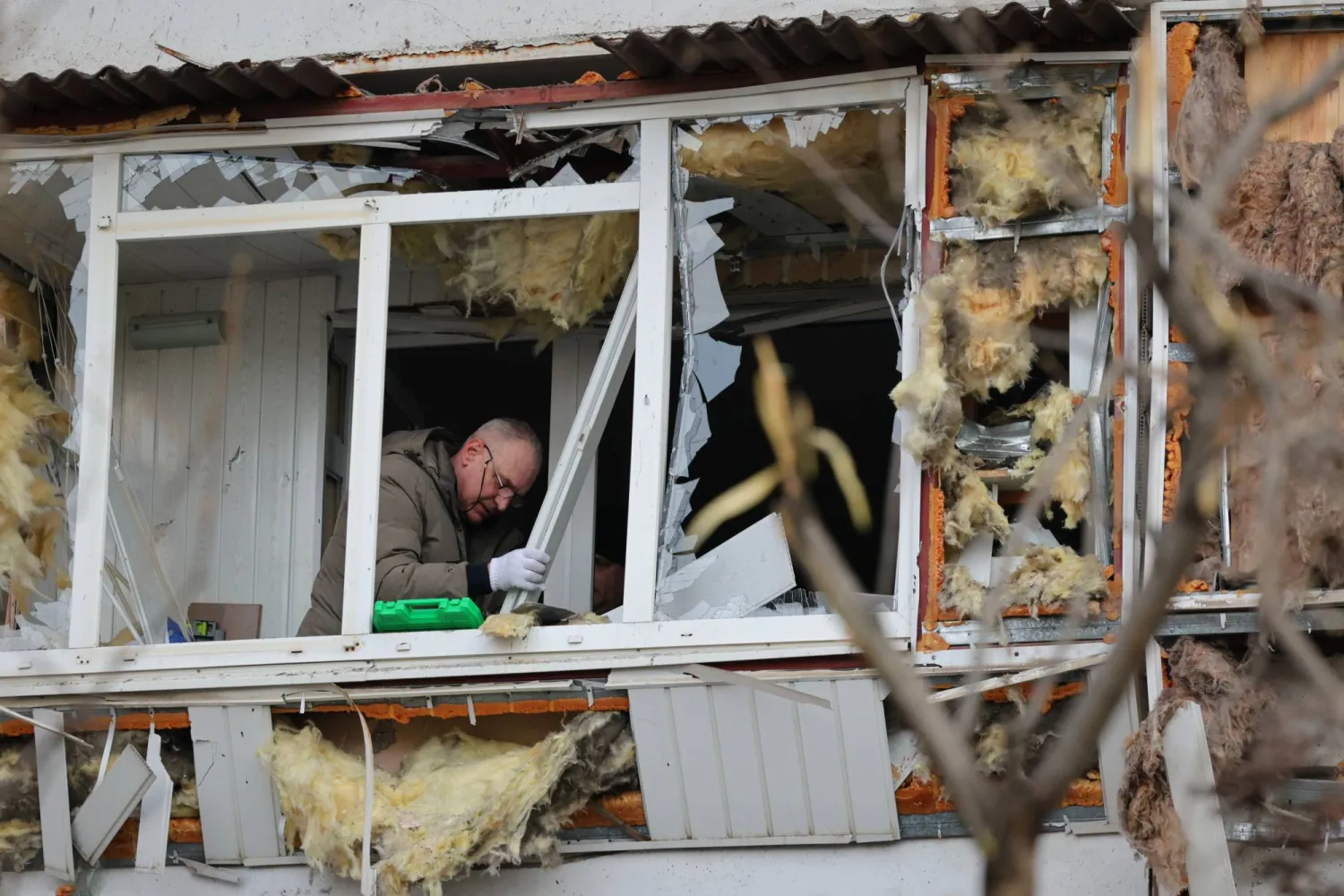

Russia Resumes Strikes on Freezing Ukrainian Capital

A local resident clears up debris from his broken balcony after a Russian attack in Zaporizhzhia, Ukraine, Wednesday, Jan. 28, 2026. (AP Photo/Kateryna Klochko)
TT

Russia Resumes Strikes on Freezing Ukrainian Capital

A local resident clears up debris from his broken balcony after a Russian attack in Zaporizhzhia, Ukraine, Wednesday, Jan. 28, 2026. (AP Photo/Kateryna Klochko)

Russia resumed strikes on Kyiv on Tuesday, Ukrainian officials said, as a brief truce announced by US President Donald Trump gave way to renewed attacks in freezing conditions.

Trump said on Thursday that Russian President Vladimir Putin had agreed to stop striking Kyiv and "various towns" during cold weather.

The Kremlin said the truce would last until Sunday but did not link it to the subzero temperatures. Ukraine said Moscow had kept up its strikes anyway.

Russia hit Kyiv "in the bitter cold with another massive strike" overnight, Tymur Tkachenko, the head of the city's military administration, said Tuesday on Telegram.

The emergency services said in a later post that three people in Kyiv had been wounded, reported AFP.

In the eastern city of Kharkiv, two people were wounded by Russian shelling, regional military chief Oleg Synegubov said.

The hours-long attack targeted energy infrastructure and aimed to "cause maximum destruction... and leave the city without heat during severe frost", Synegubov wrote on Telegram.

Authorities had to cut heating to more than 800 homes to prevent the wider network from freezing, he said, urging people to go to round-the-clock "invincibility points" around the city if they needed to warm up.

Overnight temperatures plunged to minus 17C in Kyiv and sank as low as minus 23C in Kharkiv.

- New talks planned -

Russia's invasion of Ukraine will hit the four-year mark on February 24.

Washington has sought to craft a peace settlement between both sides, but the first round of trilateral talks held in Abu Dhabi last weekend failed to yield a breakthrough.

A second round is due to begin on Wednesday in the Emirati capital.

Ukrainian President Volodymyr Zelensky said on Monday that recent "de-escalation" with Russia was helping build trust in negotiations, apparently referring to a break in attacks on energy facilities.

But territory remains a sticking point, and the warring sides have not yet shown willingness for compromise.

Russia wants full control of Ukraine's eastern Donetsk region, which Kyiv has ruled out, saying such a move would only embolden Moscow.

After failing in its aim of a lightning offensive to capture Kyiv and topple Ukraine's leadership in a matter of days in 2022, Russia has been bogged down in the face of Ukrainian defenses and is now mounting a grinding advance that has come at huge human cost.

Moscow's troops accelerated their advance in Ukraine throughout January, capturing almost twice as much land as in the previous month, according to an AFP analysis.

Russia seized 481 square kilometers (186 square miles) in January, analysis of data from the Institute for the Study of War, which works with the Critical Threats Project, showed.

The January gains were up from 244 square kilometers in December 2025 and one of the largest advances during a winter month since Russia invaded four years ago.



Moscow: Russian Soldiers Helped to Repel Niger Airport Attack

A drone picture shows the main street of a suburb following the attack on the international airport in Niamey, Niger January 30, 2026. REUTERS/ Mahamadou Hamidou
TT

Moscow: Russian Soldiers Helped to Repel Niger Airport Attack

A drone picture shows the main street of a suburb following the attack on the international airport in Niamey, Niger January 30, 2026. REUTERS/ Mahamadou Hamidou

Russian soldiers helped to repel an attack on Niger's main airport in the capital Niamey last week which was claimed by the ISIS group, Moscow said on Monday.

Niger's ruling junta earlier said "Russian partners" helped to fend off the rare assault on the capital, which saw 20 attackers killed and four army soldiers wounded, AFP.

"The attack was repelled through the joint efforts of the Russian Ministry of Defense's African Corps and the Nigerien armed forces," the Russian Foreign Ministry said.

"Moscow strongly condemns this latest extremist attack," it added.

ISIS said it staged the attack and released a video of events through its propaganda agency Amaq. The video shows several dozen attackers with assault rifles firing near a hangar and setting ablaze one plane before leaving on motorbikes.

Niger's junta accused Benin, France and Ivory Coast of sponsoring the attack on the airport, which also houses a military base.

Junta chief Abdourahamane Tiani visited the Russian military base to express "personal gratitude for a high level of professionalism", the ministry said.

Russia rarely comments on its military activity in the Sahel region, where Moscow has been increasing its influence in a region that has seen a series of coups.

Facing isolation since its invasion of Ukraine, Russia has tried to build new military and political partnerships in Africa.

Apart from Niger, Russian troops or military instructors have been reported to be deployed in Burkina Faso, Equatorial Guinea, the Central African Republic and Libya.

Russia's African Corps has taken over from the Wagner paramilitary group across the continent.

According to Moscow, the corps helps "fighting terrorists" and "strengthening regional stability" in the Sahel.

Niger's authorities have been fighting the Al-Qaeda-linked Group and the Islamic State in the Sahel (EIS) for the past decade.


Shamkhani: Iran Does Not Seek Nuclear Weapons

Ali Shamkhani, advisor to Iranian Supreme Leader Ali Khamenei (AFP)
TT

Shamkhani: Iran Does Not Seek Nuclear Weapons

Ali Shamkhani, advisor to Iranian Supreme Leader Ali Khamenei (AFP)

Ali Shamkhani, adviser to Iran's Supreme Leader Ali Khamenei, spoke on the nuclear issue late Monday saying that Iran does not seek nuclear weapons and suggesting that if the talks with the US happened, they would be indirect at the beginning, then moving to direct talks if a deal appeared to be attainable.

The pan-Arab satellite channel Al Mayadeen, which is politically allied with the Iranian-backed Lebanese militant group Hezbollah, aired the interview with Shamkhani.

He also said that the US “must offer something in return” if Iran were to reduce the level of enrichment.

Shamkhani, who now sits on the country’s Supreme National Security Council and who in the 1980s led Iran's navy, wore a naval uniform as he spoke.

He suggested if the talks happened, they would be indirect at the beginning, then moving to direct talks if a deal appeared to be attainable.

Direct talks with the US long have been a highly charged political issue within Iran's theocracy, with reformists like President Masoud Pezeshkian pushing for them and hard-liners dismissing them.

The talks would solely focus on nuclear issues, he added.

Asked about whether Russia could take Iran's enriched uranium like it did in Tehran's 2015 nuclear deal with world powers, Shamkhani dismissed the idea, saying there was “no reason” to do so. Kremlin spokesperson Dmitry Peskov on Monday said Russia had “long offered these services as a possible option that would alleviate certain irritants for a number of countries.”

“Iran does not seek nuclear weapons, will not seek a nuclear weapon and will never stockpile nuclear weapons, but the other side must pay a price in return for this," he said.

Iran had been enriching uranium up to 60% purity, a short, technical step away from weapons-grade levels. The International Atomic Energy Agency had said Iran was the only country in the world to enrich to that level that wasn't armed with the bomb.

Iran has been refusing requests by the IAEA to inspect the sites bombed in the June war.

“The quantity of enriched uranium remains unknown, because part of the stockpile is under rubble, and there is no initiative yet to extract it, as it is extremely dangerous," Shamkhani said.


Almost 140 Foreigners Arrested in Central Iran over Protests

Iranians walk in a street in Tehran, Iran, 02 February 2026. EPA/ABEDIN TAHERKENAREH
TT

Almost 140 Foreigners Arrested in Central Iran over Protests

Iranians walk in a street in Tehran, Iran, 02 February 2026. EPA/ABEDIN TAHERKENAREH

Iranian authorities arrested 139 foreign nationals in central parts of the country during recent anti-government protests, local media reported Tuesday.

Iran's Tasnim news agency quoted the police chief in the city of Yazd as saying those arrested were involved "in organizing, inciting and directing riotous actions, and in some cases were in contact with networks outside the country".

The nationalities of those held were not specified, AFP reported.

"During the review of cases related to the recent rioters, it was determined that 139 of those arrested in these disturbances were foreign nationals," police chief Ahmad Negahban said.

Protests against the rising cost of living broke out in Iran on December 28 before morphing into nationwide anti-government demonstrations.

Tehran has acknowledged that more than 3,000 deaths occurred during the unrest, but insists that most were members of the security forces and innocent bystanders, attributing the violence to "terrorist acts".

The Human Rights Activists News Agency, a US-based NGO, says it has confirmed 6,854 deaths, mostly protesters killed by security forces, with other rights groups warning the figure is likely far higher.

Iranian authorities have said the rallies began as peaceful demonstrations before turning into "riots" involving killings and vandalism that were inflamed by arch-foes the United States and Israel.