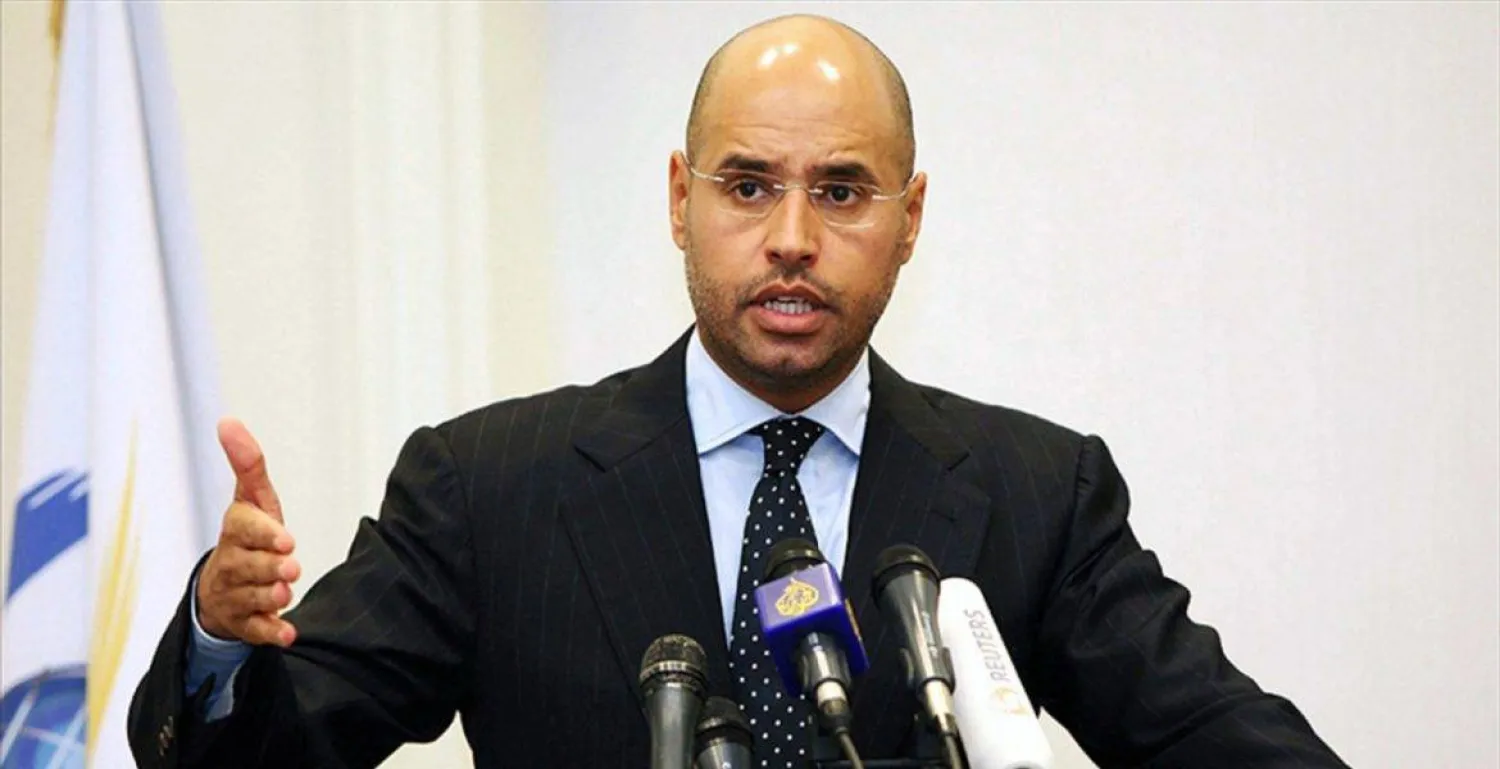
Seif al-Islam Gadhafi Shot Dead in Zintan

Seif al-Islam Gadhafi. (Reuters file)
TT

Seif al-Islam Gadhafi Shot Dead in Zintan

Seif al-Islam Gadhafi. (Reuters file)

The most prominent son of late Libyan leader ​Moammar al-Gadhafi, Seif al-Islam Gadhafi, has been killed, sources close to the family, his lawyer Khaled el-Zaydi and Libyan media said on Tuesday.

The 53-year-old was killed in the town Zintan, 136 kilometers (85 miles) southwest of the capital, Tripoli, according to Libyan's chief prosecutor's office.

The office said in a statement that an initial investigation found that Seif al-Islam was shot to death, but did not provide further details about the circumstances of his killing.

Khaled al-Zaidi, a lawyer for Seif al-Islam, confirmed his death on Facebook, without providing details.

Abdullah Othman Abdurrahim, who represented Gadhafi in the UN-brokered political dialogue which aimed to resolve Libya’s long-running conflict, also announced the death on Facebook.

Seif al-Islam's political team later released a statement saying that “four masked men” stormed his house and killed him in a “cowardly and treacherous assassination.” The statement said that he clashed with the assailants, who closed the CCTV cameras at the house “in a desperate attempt to conceal traces of their heinous crimes.”

Born in June 1972 in Tripoli, Seif al-Islam was the second-born son of the longtime ruler. He studied for a PhD at the London School of Economics and was seen as the reformist face of the Gadhafi regime.

Moammar Gadhafi was toppled in a NATO-backed popular uprising in 2011 after more than 40 years in power. He was killed in October 2011 amid the ensuing fighting that would turn into a civil war. The country has since plunged into chaos and divided between rival armed groups and militias.

Seif al-Islam was captured by fighters in Zintan late in 2011 while attempting to flee to neighboring Niger. The fighters released him in June 2017 after one of Libya's rival governments granted him amnesty. He had since lived in Zintan.

A Libyan court convicted him of inciting violence and murdering protesters and sentenced him to death in absentia in 2015.

In November 2021, Seif al-Islam announced his candidacy in the country’s presidential election in a controversial move that was met with outcry from anti-Gadhafi political forces in western and eastern Libya.

The country’s High National Elections Committee disqualified him, but the election wasn’t held over disputes between rival administrations and armed groups that have ruled Libya since the bloody ouster of Moammar Gadhafi.


Gaza Civil Defense Says 9 Dead in Israeli Strikes

Children walk past tents and makeshift shelters in the Bureij refugee camp in the central Gaza Strip on February 3, 2026. (Photo by Eyad BABA / AFP)
TT

Gaza Civil Defense Says 9 Dead in Israeli Strikes

Children walk past tents and makeshift shelters in the Bureij refugee camp in the central Gaza Strip on February 3, 2026. (Photo by Eyad BABA / AFP)

Gaza's civil defense agency said Israeli strikes on Wednesday killed nine people in the Palestinian territory, including three children, with Israel's military saying it struck after gunfire targeting its troops wounded an officer.

The civil defense agency said the nine people were killed in a series of strikes, with at least 31 others wounded.

Three bodies were brought to Nasser Hospital after Israeli strikes hit tents and homes in the southern Khan Yunis area, the agency said.

Six more bodies were taken to Al-Shifa Hospital following similar strikes in Gaza City, the territory's largest urban center, it added.

The Israeli military said it had conducted "precision strikes" after "terrorists opened fire on troops,” seriously wounding an officer, adding that it considers the incident a violation of the ceasefire.

The military said the troops came under attack near the so-called "Yellow Line,” beyond which Israeli forces are stationed in Gaza.

Despite the US-brokered truce entering its second phase last month, violence has continued in the Gaza Strip, with Israel and Hamas accusing each other of breaching the agreement.


Yemen: Route for Illegal Migration

Tens of thousands of illegal migrants are reaching Yemen through dangerous routes. (UN)
TT

Yemen: Route for Illegal Migration

Tens of thousands of illegal migrants are reaching Yemen through dangerous routes. (UN)

Yemen's coastlines witnessed one of the highest waves of illegal migrants during the last three months of 2025, highlighting the country's role as the main gateway on the Eastern Route, primarily for populations originating in the Horn of Africa.

In a report summarizing findings from October 1 to December 31, 2025, the International Organization for Migration (IOM) said a total of 62,779 movements were documented, including 57,340 inflow migrants arriving in Yemen and 5,439 outflow migrants departing the country.

It said the majority of migrants were male, with men older than 18 accounting for 77% of the total.

The IOM report also showed that the majority of the migrants - 68% - came from Djibouti and landed in the Taiz, Abyan and Shabwah governorates. Somalia accounted for 22% of the remaining departure points to Yemen.

Data collected in this period showed that arrivals in Yemen always reached more than 2,000 individuals per week. The highest arrival recorded occurred in the last week of December.

The majority of migrants arriving in Yemen planned to head from there to various Gulf countries, while some 15% said Yemen was their final destination.

Migrants departing Yemen primarily aimed to travel to Djibouti before continuing their journeys to their origin countries.

Humanitarian and security challenges

The report said Yemen’s role as a crucial transit country and, at the same time, a point of forced reversal for vulnerable populations is highlighted by the continuity of this outgoing flow.

Given that the outflow includes vulnerable people like children, pregnant women, and unaccompanied minors who must make the dangerous reverse sea journey to the Horn of Africa, this dynamic indicates serious protection risks.

During the monitoring period, a total of 5,439 outgoing migrant movements were noted. These were all non-Yemeni migrants, 96% of whom started heading back towards the Horn of Africa after failing to reach intended destinations, while the rest turned to Oman.

The majority of migrants arriving in Yemen during the reporting period were Ethiopian nationals, accounting for 97% of the total, while 3% were Somali nationals, with other nationalities representing less than 1%.

Meanwhile, the Yemeni Interior Ministry said on Tuesday that security authorities in Shabwah announced the arrival of 200 illegal migrants on the coast of Kida, raising the total number of arrivals in January to 890.

All of the migrants are Ethiopian, the Ministry said.


Israel Sets Up Points Across ‘Yellow Line’ to Collect Hamas Arms

Fighters from the Ezzedine al-Qassam Brigades, the military wing of Hamas, in Khan Younis, February 20, 2025. (dpa)
TT

Israel Sets Up Points Across ‘Yellow Line’ to Collect Hamas Arms

Fighters from the Ezzedine al-Qassam Brigades, the military wing of Hamas, in Khan Younis, February 20, 2025. (dpa)

The Israeli army had recently set up collection points across the Yellow Line, where Hamas is supposed to hand over its weapons to international stabilization forces as outlined by the second phase of US President Donald Trump's ceasefire plan, Israel's Haaretz reported on Tuesday.

The move came as senior Hamas officials denied having agreed to disarm or surrender weapons.

Haaretz said the collected weapons are intended to be transported from these points along the Yellow Line into Israel, where they will be destroyed.

However, it added, the Israeli military noted that so far, there has been no sign that any handover has begun, and it is unclear whether these collection points will actually be used in the process.

The newspaper said the collection of Hamas' weapons was supposed to be overseen by the international stabilization force in the Gaza Strip. However, this force, which is currently operating from the Civil-Military Coordination Center (CMCC) in southern Israel's Kiryat Gat, has not yet been deployed.

Meanwhile, sources within the Israeli army told Haaretz that they have identified attempts by Hamas to restore the movement's capabilities to produce rockets and other weapons, albeit on a smaller scale than the attempts that took place before the ceasefire took effect in October last year.

Although Tel Aviv has not openly opposed Trump's plan, it is hoping it will collapse when Hamas refuses to surrender its weapons.

In the meantime, the army reportedly drew up plans for renewed ground operations inside Hamas‑held areas, amid intelligence assessments that Hamas is restoring tunnels, funding fighters and strengthening its forces as postwar governance remains unresolved.

But the army has been instructed not to initiate any moves that would violate the Trump plan to avoid angering the Americans, according to informed sources.

In recent days, the army has spread reports saying Hamas is increasingly motivated to rebuild and recover from the heavy losses inflicted upon it throughout the last two years of war, a narrative apparently aimed at legitimizing a possible resumption of war.

Haaretz wrote that officials in the Israeli military are struggling to understand the interests of each side involved in the Gaza plan, and what Israel's political leadership plans to do with the situation.

It said with no signs of disarmament or demilitarization, and no signs that such a process is beginning, nor any effective enforcement of the peace plan on either side of the Gaza Strip's Yellow Line, Hamas is strengthening its position as the once-again unchallenged authority controlling the Gaza Strip.

On Monday evening, Channel 13 news reported that the military recently delivered a document to Prime Minister Benjamin Netanyahu detailing how Hamas is gaining strength in Gaza and rebuilding its capabilities since the ceasefire.

The channel quoted the three-page report as saying that “approximately three months after the ceasefire agreement in the Gaza Strip, it is evident that Hamas, despite the difficulties, continues to deepen its governance, looking ahead to the next phase of the agreement — an increase can be identified across all indicators of Hamas’s governance.”

“Hamas is taking steps on the ground intended to preserve its influence and grip on the Gaza Strip from below. This is being done by integrating its operatives into government ministries and the security apparatuses,” the document said.

“Looking ahead: In the absence of Hamas’s disarmament, and under the auspices of the technocratic committee, Hamas will, in our assessment, succeed in maintaining influence and control in the Gaza Strip,” the document added, according to the report.

Control of Gaza

All Israeli media outlets reported on Tuesday that the Israeli army found a huge haul of around 110 mortar rounds, as well as some rockets and other military items, concealed within UNRWA blankets and humanitarian aid in southern Gaza.

A statement said that the army’s 7th armored brigade found the weapons during its standard patrols within Israeli-held territory east of the Yellow Line.

Early this week, the army said it killed four Palestinian fighters who approached troops near the Gaza ceasefire line in the Strip’s north.

Hamas retains control of just under half of Gaza following the ceasefire deal.

Officials told The Times of Israel that at least in the short term, Hamas would remain de facto in control of the territory.

According to an Israeli security official, Israel believes that even if Hamas officially announces that it has handed over control of Gaza to the technocratic government, it would still have tens of thousands of armed members in its military wing and internal security forces across the Strip, as well as civil servants in key roles.

The security official also said it was more likely that the Israeli army would have to act militarily against Hamas to disarm it, as it believes the movement will not do so of its own accord.

Last week, Trump claimed that “it looks like” Hamas is “going to disarm,” while his special envoy Steve Witkoff said: “They will because they have no choice. They’re going to give up their AK-47s.”

A leaked document shared by KAN News on Sunday said Hamas plans to continue having administrative control of Gaza, contrary to what the ceasefire agreement establishes.

The document outlines how officials affiliated with Hamas must act before the establishment of the National Committee for the Administration of Gaza (NCAG), including dos and don'ts to avoid raising suspicions with the new government.

The document also states that NCAG members can't be attacked, while activities must continue “as if nothing had changed.”

“No personal contact should be made, or information and news should be passed on to the NCAG, outside of the relevant channels,” the document stated.

The document shared on Sunday was reportedly a secret memo only to be seen by Hamas officials inside Gaza, KAN reported.