


Saudi Arabia’s AlUla Conference: A Global Platform for Shaping Future of Emerging Markets

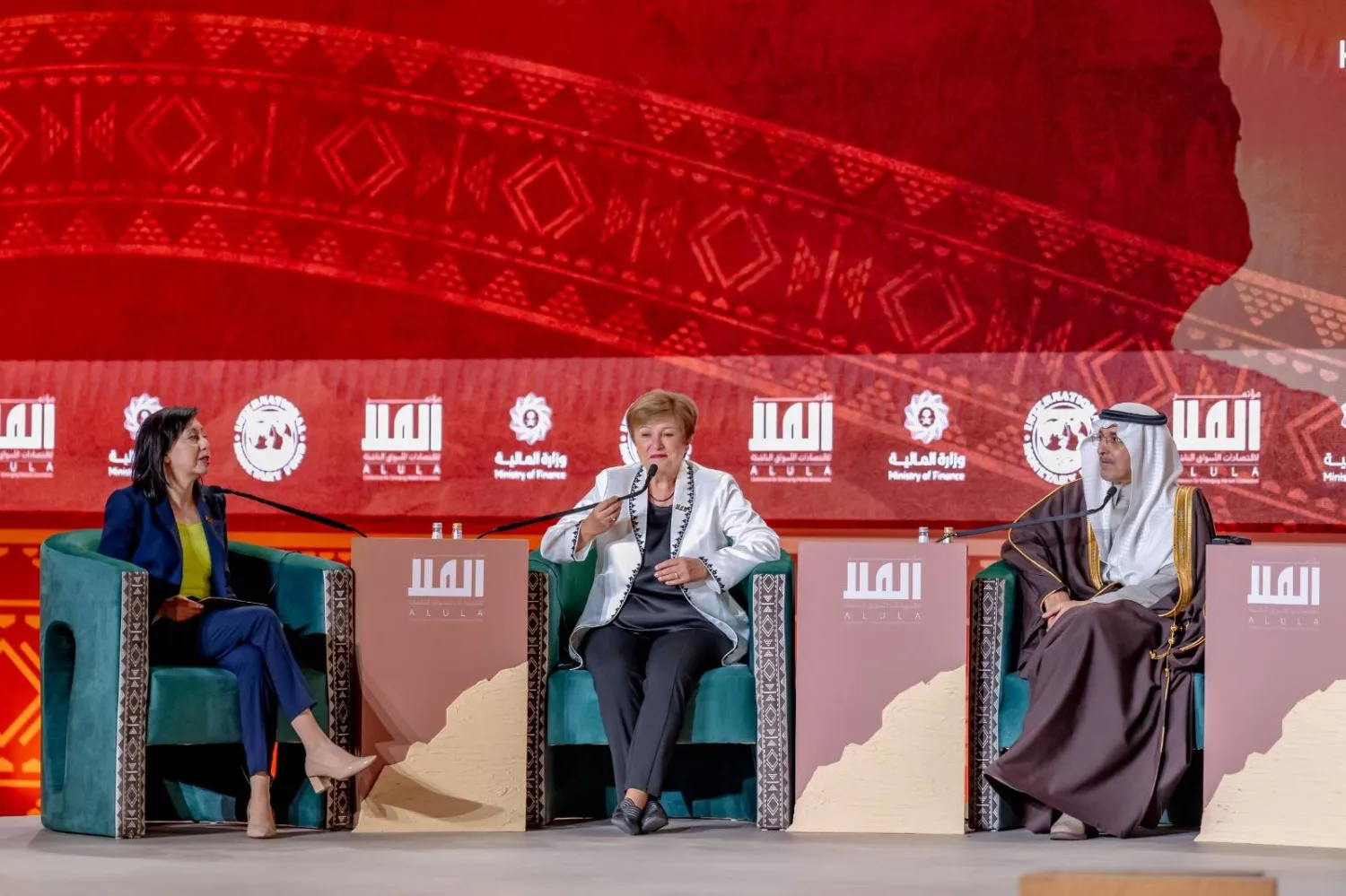
The closing session with Georgieva and Aljadaan last year (AlUla Conference)
TT

Saudi Arabia’s AlUla Conference: A Global Platform for Shaping Future of Emerging Markets

The closing session with Georgieva and Aljadaan last year (AlUla Conference)

Saudi Arabia is preparing to host the second annual AlUla Conference for Emerging Market Economies, to be held on February 8 and 9 in AlUla Governorate.

The conference is organized in partnership between the Ministry of Finance and the International Monetary Fund (IMF), with broad participation from finance ministers, central bank governors, policymakers, leaders of international financial institutions, and economic experts from around the world.

The conference will take place amid rapid transformations in the global economy, requiring emerging-market economies to strengthen their resilience and seize new opportunities to ensure sustainable growth and improve living standards, contributing positively to global economic stability.

The conference underscores the strength of the strategic partnership between the Ministry of Finance and the IMF, and it reflects the Kingdom’s growing role in supporting international economic dialogue and enhancing global cooperation.

Minister of Finance Mohammed Aljadaan stressed that hosting the conference reflects the Kingdom’s continued commitment to supporting international efforts aimed at strengthening global financial and economic stability.

He noted that emerging-market economies are a pivotal component of the global economic system due to their direct impact on global growth and stability.

“AlUla Conference for Emerging Market Economies provides a unique platform for exchanging views on global economic developments and discussing policies and reforms that support inclusive growth and enhance economic resilience, through broader international cooperation to address shared challenges,” Aljadaan said.

IMF Managing Director Kristalina Georgieva noted that the conference offers a vital platform for emerging economies to discuss how to navigate risks and seize opportunities ahead.

She highlighted that sweeping global transformations — driven by technology, demographic shifts, and geopolitics — created a more complex and uncertain policy environment, underscoring the need for sound macroeconomic and financial policies to strengthen resilience.

Conference participants will exchange expertise, coordinate policies, and support economic reform pathways, enabling emerging-market economies to benefit from global economic transformations and achieve more inclusive and sustainable growth.

The conference also aims to raise international awareness of the challenges facing emerging-market economies, highlight successful experiences in developing innovative solutions, strengthen international cooperation, support investment attraction, and help improve living standards and achieve economic prosperity.


Oil Prices Rise 3% as US and Iran Extend Talks into Next Week

FILE PHOTO: A flame burning natural gas is seen at an heavy-crude treatment plant operated by Venezuela's state oil company PDVSA, in the oil rich Orinoco belt, near Cabrutica at the state of Anzoategui April 16, 2015. Picture taken on April 16, 2015. REUTERS/Carlos Garcia Rawlins/File Photo
TT

Oil Prices Rise 3% as US and Iran Extend Talks into Next Week

FILE PHOTO: A flame burning natural gas is seen at an heavy-crude treatment plant operated by Venezuela's state oil company PDVSA, in the oil rich Orinoco belt, near Cabrutica at the state of Anzoategui April 16, 2015. Picture taken on April 16, 2015. REUTERS/Carlos Garcia Rawlins/File Photo

Oil prices rose around 3% on Friday as traders remained on alert for potential supply disruptions after the United States and Iran extended nuclear talks.

Brent crude futures advanced by $2.01, or 2.8%, to $72.76 a barrel by 1310 GMT while US West Texas Intermediate crude was up $2.11, or 3.2%, at $67.32.

"Uncertainty prevails, fear is pushing prices higher today," said Tamas Varga, an oil analyst at brokerage PVM. "It is completely driven by the outcome of the Iranian nuclear talks and possible military action the US might take against Iran."

For the week, Brent and WTI were both set to finish with a gain of 1.4%, Reuters reported.

The United States and Iran held indirect talks in Geneva on Thursday after US President Donald Trump ordered a military buildup in the region.

Oil prices gained more than a dollar a barrel during the talks on media reports indicating that discussions had stalled over US insistence on zero enrichment of uranium by Iran. However, prices eased after the Omani mediator said the two sides had made progress in the talks.

They plan to resume negotiations with technical-level discussions scheduled next week in Vienna, Omani Foreign Minister Sayyid Badr Albusaidi said on X.

"We think the latest round of talks offers some hope on chances of a peaceful resolution, but military strikes are in no way out of the equation," said DBS analyst Suvro Sarkar.

Trump said on February 19 that Iran must make a deal over its nuclear programme within 10 to 15 days or "really bad things" will happen.

Geopolitical risk premiums of $8 to $10 a barrel have built in oil prices on fears that a conflict will disrupt Middle East supply through the Strait of Hormuz, where about 20% of global oil supply passes, Sarkar said.

Producer group OPEC+ is also likely to consider raising oil output by 137,000 barrels per day for April at its March 1 meeting, sources said, after suspending production increases in the first quarter.


IMF Approves $8.1 Billion Loan for Ukraine, with $1.5 Billion to Go Immediately

FILE - Kristalina Georgieva, Managing Director of the International Monetary Fund, attends the Annual Meeting of the World Economic Forum in Davos, Switzerland, Jan. 23, 2026. (AP Photo/Markus Schreiber, File)
TT

IMF Approves $8.1 Billion Loan for Ukraine, with $1.5 Billion to Go Immediately

FILE - Kristalina Georgieva, Managing Director of the International Monetary Fund, attends the Annual Meeting of the World Economic Forum in Davos, Switzerland, Jan. 23, 2026. (AP Photo/Markus Schreiber, File)

The International Monetary Fund's executive board on Thursday approved an $8.1 billion, four-year loan for Ukraine, with $1.5 billion to be disbursed immediately to help keep the government running as its war against Russia's invasion drags into a fifth year.

The IMF said the new Extended Fund Facility arrangement for Ukraine would help anchor a $136.5 billion international support package for the war-torn country, which this week marked the fourth anniversary of Russia's full-scale invasion.

The new loan, which replaces a $15.5 billion program that was approved in 2023, will help Kyiv to maintain economic stability and keep public spending flowing, Reuters quoted the IMF as saying.

Ukrainian Prime Minister Yulia Svyrydenko hailed the IMF loan as part of a broader financial framework that would cover an estimated budget shortfall of $136.5 billion over four years, including a 90-billion-euro loan from the European Union.

"It is very important for us that in the fifth year of the full-scale war, against the backdrop of systematic attacks on the energy sector, Ukraine ‌has guaranteed international financial ‌support from partners and the resources for the stable functioning of the state," she ‌wrote ⁠on Telegram.

The World ⁠Bank, European Union, United Nations and the Ukrainian government this week issued a new report that put the cost of rebuilding Ukraine at $588 billion over the next decade.

According to Reuters, IMF Managing Director Kristalina Georgieva said the IMF loan would resolve Ukraine’s balance of payments problem and restore medium-term external viability, while boosting prospects for reconstruction and growth after the war ended and help to facilitate Ukraine's steps to join the European Union.

“Ukraine and its people have weathered a long and devastating war for over four years with remarkable resilience," she said in a statement, lauding work by Ukrainian authorities to maintain overall macroeconomic and financial stability, boost domestic revenues and advance some critical reforms.

She ⁠said officials were committed to "tackling longstanding bottlenecks to growth," including through continued efforts to combat ‌corruption, address tax avoidance and evasion, reform energy markets, and strengthen financial market ‌infrastructure.

The program would be "promptly recalibrated" in the case of successful peace negotiations, she said in a statement.

Georgieva, who ‌paid a surprise visit to Ukraine last month, said the war had taken a toll on economic and social ‌conditions, despite efforts by authorities to stabilize the economy, contain inflation and restructure private sector debt. The new loan aimed to deepen structural reforms, she said.

That meant growth was slowing and the economic outlook remained "subject to exceptionally high uncertainty," she said.

The IMF now projects that Ukraine's economy will grow by 1.8% to 2.5% in 2026, after growth of an estimated 1.8% to 2.2% in 2025. Inflation was expected to be ‌around 6.1% this year, half the 12.7% rate recorded in 2025, the IMF said.

Ukraine's estimated financing gap of $52 billion in 2026 would be filled through disbursements under the newly ⁠approved IMF program, European Union arrangements, ⁠funds from the Group of Seven advanced economies and bilateral support, the IMF said.

Georgieva said a large number of IMF members, including the US, Germany, Canada, Britain and Japan, had reaffirmed their recognition of the IMF's preferred creditor status in respect to the money it owed the Fund, and agreed to "adequate financial support" to ensure Ukraine could repay its debts to the IMF.

Other countries backing Ukraine were Austria, Belgium, Denmark, Estonia, Finland, France, Greece, Iceland, Ireland, Italy, Lithuania, Luxembourg, the Netherlands, Norway, Poland, Portugal, Spain and Sweden, she said.

The Group of Creditors of Ukraine, which holds the majority of Ukraine’s official bilateral debt, also agreed to extend the current debt standstill and complete a definitive debt treatment after the resolution of the current state of "exceptionally high uncertainty," the IMF said in its statement.

Georgieva said the risks to the loan were exceptionally high and the program's success would depend on continued international support, as well as the authorities' "steadfast determination" to implement ambitious structural reforms.

A staff report noted that progress on reforms had been mixed under the previous program, with Kyiv completing some important milestones, but missing two end-December benchmarks related to public investment management and valuation standards.

Ukraine's progress on the program will be reviewed quarterly, with nine reviews planned over the next four years.


Saudi Arabia’s AviLease Reports $664 Million in Revenues in 2025

An AviLease plane. Asharq Al-Awsat
TT

Saudi Arabia’s AviLease Reports $664 Million in Revenues in 2025

An AviLease plane. Asharq Al-Awsat

AviLease, the global aircraft leasing company headquartered in Riyadh, has reported a strong performance, saying it recorded in 2025 total revenues of $664 million, an increase of 19% year-on-year.

It said in a statement on Thursday that the revenues were “driven by disciplined portfolio growth, strong aircraft remarketing and sustained global demand for new technology, fuel-efficient aircraft.”

“Pre-Tax earnings doubled versus the previous year to $122 million,” said the statement.

Last year, AviLease expanded its portfolio to 202 owned and managed aircraft, leased to 50+ airline customers across 30+ countries, with a total asset value of $9.3 billion.

“The company maintained 100% fleet utilization, underscoring the resilience of its platform and the strength of its airline relationships,” said the statement.

AviLease also placed aircraft orders with Airbus (A320neo Family & A350F) and Boeing 737-8) to support future growth and help meet sustained customer demand for modern aircraft.

The company also said that it “established its investment-grade credit profile, with ratings from Moody’s (Baa2) and Fitch (BBB), reflecting its disciplined financial framework, strong liquidity position, and prudent leverage management.”

The company’s CEO, Edward O’Byrne, said: “2025 was a defining year for AviLease. We delivered strong financial results, expanded our global footprint, and reinforced our position as a disciplined, investment-grade aircraft leasing platform.”

“Our performance reflects the quality of our portfolio, the strength of our airline partnerships, and our focus on deploying capital responsibly in high-demand, new technology assets," he added.

Throughout the year, AviLease continued to play a central role in Saudi Arabia’s growing aviation ecosystem. The company supported the launch and scale-up of the Kingdom’s new national carrier Riyadh Air, through a sale-and leaseback of a Boeing 787-9, marking the airline’s first aircraft.

AviLease also established a strategic partnership with Hassana Investment Company to provide access to the aviation financing asset class for both international and local investors, while leveraging AviLease’s technical expertise and operational capabilities to support the partnerships growth and performance. Hassana has agreed to acquire an initial portfolio of 10 new-technology aircraft from AviLease.