US Troops to Leave Al-Shaddadi Base in Syria

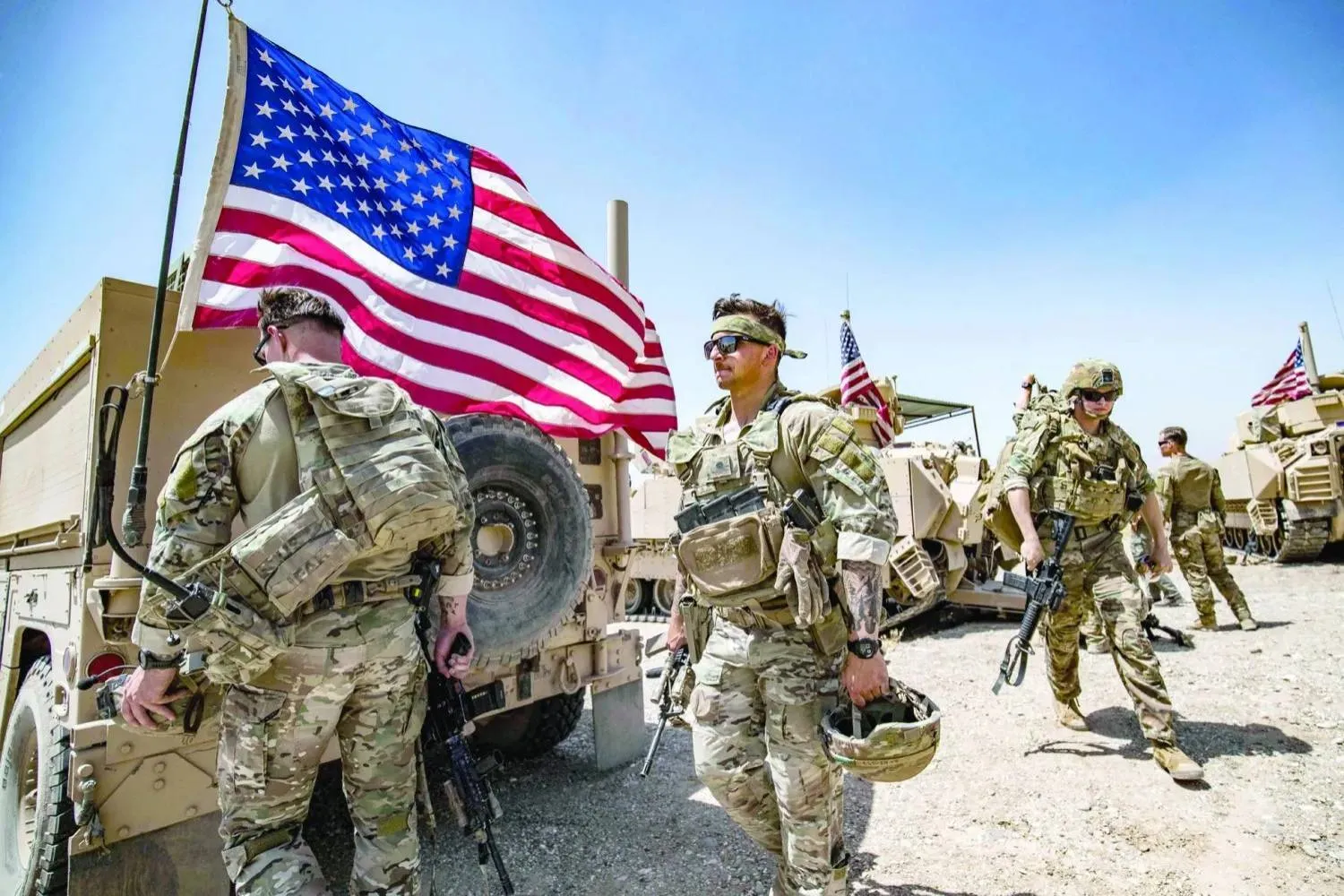
US soldiers patrol the countryside of Rumaylan in Syria's northeastern Hasakeh province on June 7, 2023. (AFP) 
TT

US Troops to Leave Al-Shaddadi Base in Syria

US soldiers patrol the countryside of Rumaylan in Syria's northeastern Hasakeh province on June 7, 2023. (AFP) 

US troops at Al-Shaddadi base in Syria's northeastern Al-Hasakah province are preparing to withdraw completely in the coming hours.

“The US forces at the base are preparing for a complete withdrawal outside Syrian territories in the next 24 hours,” a source told Syria TV on Wednesday.

Earlier, the Hasaka Media Center reported that a truck convoy belonging to the international coalition entered from Iraq through the Yaarabiya crossing and headed to Al-Shaddadi base south of Al-Hasakah province.

Civilian sources in the area said the empty trucks were sent to load military equipment from the base.

Local eyewitnesses also reported that the international coalition is evacuating the Kharab al-Jir base, a key United States military installation located in northeastern Al-Hasakah.

Since Tuesday, the sources added, the sound of drones in Qamishli were heard. They said gunshots were also heard intermittently, signaling that international coalition forces were destroying some of their positions in the Kharab al-Jirb base.

Late last month, the Turkish Anadolu Agency said heightened military activity was seen at Al-Shaddadi air base, which is used by the US-led anti-ISIS coalition, according to local sources.

It said observers have reported the landing of a US cargo aircraft.

Syrian government forces entered the Kurdish-majority city of Qamishli on Tuesday as part of a deal agreed last week to gradually integrate the Kurds' forces and institutions into the state and began preparing to take over the airport.

Kurdish forces have ceded swathes of territory to advancing government troops in recent weeks following months of tension and sporadic clashes as Syria's new authorities have sought to impose their authority across the country.

“A convoy of internal security forces began entering the city of Qamishli,” the official SANA news agency said.

Sources explained that the Syrian security forces stopped at the entrance of the Qamishli airport in preparation to enter the facility, in addition to government buildings.

Few people were seen on the streets inside the city amid a curfew in place until Wednesday morning, with Kurdish security forces also lightly deployed.


Attempted Killing of Security Official Rekindles Tensions in Libya’s Misrata

Al-Dbeibah during the opening of the Municipal Hotel in Misrata last week (Al-Dbeibah’s Office)
TT

Attempted Killing of Security Official Rekindles Tensions in Libya’s Misrata

Al-Dbeibah during the opening of the Municipal Hotel in Misrata last week (Al-Dbeibah’s Office)

A state of cautious tension has gripped the western Libyan city of Misrata following an attempted assassination of Colonel Mustafa al-Har, who is tasked with running the Anti-Terrorism and Subversive Activities Office in the central region, amid accusations pointing to figures linked to the Benghazi, Ajdabiya and Derna Shura Councils of Revolutionaries.

Local media reported that unidentified gunmen opened heavy fire on al-Har while he was in his car in Misrata on Wednesday evening. There has been no official comment from the interim Government of National Unity, headed by Prime Minister Abdulhamid al-Dbeibah.

At the same time, a statement circulated, attributed to residents of Misrata, declaring their disavowal of certain figures whom they said were “calling for discord and fueling divisions.”

Those named included Abdul Salam al-Zoubi, Deputy Minister of Defense in al-Dbeibah’s government, and Ali al-Sallabi, Secretary-General of the International Union of Muslim Scholars.

In the statement — which bore no official signature — residents of Misrata from social, political and military circles announced their disavowal of 40 individuals described as “groups seeking discord and corruption.”

They said those named represented only themselves and that their actions did not reflect the city’s authenticity or its “honorable history in building the state.”

Libya’s Attorney General Al-Siddiq al-Sour had no immediate public comment.

The statement warned that “anyone who dares to undermine the security of the city or civil peace in the country will face a firm and harsh response.”

Residents also called for the identities of those who attacked Colonel al-Har to be disclosed and for them to be brought to justice, in order to avert strife and preserve social peace.

Amid the tensions, Libyan political analyst Mohammed Ghashout said the situation in Misrata was “sliding into a very dangerous trajectory.”

He urged the city and its residents to abandon what he described as “extremist councils that fled Benghazi, Ajdabiya and Derna,” warning that “allowing the city to be hijacked by those who provide them with safety and refuge will turn them into time bombs that will explode in Misrata before any other city in the western region.”

Ghashout added that “the attack on the General Intelligence headquarters in recent days — amid the silence of the city’s residents and security services — during which extremist elements revealed their faces and intentions, did not stop there.

Brigadier Mustafa al-Har of the General Intelligence was subjected to kidnapping, beating and humiliation, and he is now in critical condition.”

The rising tension and anger in Misrata come after an armed group affiliated with the Defense Ministry of the interim unity government took control of the headquarters of the General Intelligence Service, which is affiliated with the Presidential Council, in developments that triggered a wave of anger and protests inside the city, home to al-Dbeibah and a number of senior security officials.


Iran-Backed Gaza Factions Face Financial Strain, Fear Collapse

Ziyad al-Nakhalah, head of the Palestinian Islamic Jihad movement (seated right), alongside Naim Qassem, secretary-general of Lebanon’s Hezbollah, and senior Iranian military officials during the funeral of late Hamas leader Ismail Haniyeh in Tehran, August 2024 (Reuters)
TT

Iran-Backed Gaza Factions Face Financial Strain, Fear Collapse

Ziyad al-Nakhalah, head of the Palestinian Islamic Jihad movement (seated right), alongside Naim Qassem, secretary-general of Lebanon’s Hezbollah, and senior Iranian military officials during the funeral of late Hamas leader Ismail Haniyeh in Tehran, August 2024 (Reuters)

Field commanders and activists from Iranian-backed Palestinian factions in Gaza warn of a potential “complete collapse” as a worsening financial crisis comes amid signs of a possible US strike on Tehran.

Nearly two years of Israeli war in Gaza, along with strikes extending to Lebanon, Iran and parts of Syria, have strained money transfer routes and drained the factions’ assets and savings.

Islamic Jihad is the largest faction financially and logistically tied to Iran. To a lesser extent, links also reach the Popular Resistance Committees, the Mujahideen Brigades and other armed groups. Sources from those factions and activists in Gaza said the financial squeeze has hit all of them.

One source said stipends for individual members have dropped to between 200 and 400 shekels (the dollar equals 3.10 shekels) every 60 to 70 days, down from 800 to 2,200 shekels per month or every 40 days for some prominent members and activists before the war.

“Even at the leadership level, allocations have fallen to 1,000 shekels at most every two months or more, compared with more than 3,000 shekels nearly every month before the war,” the source said.

A source in a more minor faction said members of his group have received nothing for more than three months and now rely on intermittent donations from other parties, arriving roughly every two months or more, to distribute just 200 shekels per member.

Sanctions deepen the strain

Economic sanctions imposed by Washington in recent months on Iranian individuals and entities have compounded the difficulty of sustaining support, with leaders and field operatives locked in constant discussions about the crisis and its outlook.

Some factions receive direct backing from Iran and, to a lesser degree, rely on ties with Lebanon’s Hezbollah dating to their founding years, particularly during the second Intifada that erupted in late 2000.

Islamic Jihad sources said dwindling resources have hit charities affiliated with the movement. At the same time, allocations to other “humanitarian institutions” have been cut back to minimal activity, despite their direct affiliation with the Iranian regime.

More than one source within the movement described an unprecedented financial crisis, both inside and outside Gaza, especially in Lebanon, where Hezbollah has sustained heavy blows, and in Syria, where the movement has weakened significantly since the collapse of Bashar al-Assad’s rule.

Even so, sources said Islamic Jihad may be the last to face “collapse,” citing its popular base and ability to manage some affairs if security conditions stabilize at home and abroad.

The risk appears more immediate for other Iran-linked factions, which, before the war, relied on funding from Hamas. That support has stopped as Hamas grapples with mounting financial troubles of its own.

Hamas, however, has diversified revenue streams. Its years of governing Gaza enabled it to establish “investment projects” inside and outside the enclave, alongside tax revenues and other income collected by its government.

Iranian regret

Asharq Al-Awsat has learned that Iranian parties have expressed regret to some faction leaders over the current situation, citing the difficult circumstances facing Iran that have disrupted financial and military support.

Field sources said growing concern over a possible strike on Iran is intensifying fears of collapse among Tehran-linked factions, particularly given their fragile finances. Some field or armed members have been forced to seek basic jobs to support their families despite Israeli pursuit, they said.

Those who eased security precautions under financial pressure do not represent the majority, the sources added. Most leaders and members continue to carry out assigned tasks, banking on a diplomatic deal on Iran’s nuclear program to head off a US strike on the country.


Israel Says Struck 8 Hezbollah Compounds in East Lebanon, Syrian Teen Killed

Khiam resident, Hussain Khrais stands in front of his store that was damaged during the latest hostilities between Israel and Lebanon, in Khiam village, near the border with Israel, southern Lebanon, February 19, 2026. REUTERS/Aziz Taher
TT

Israel Says Struck 8 Hezbollah Compounds in East Lebanon, Syrian Teen Killed

Khiam resident, Hussain Khrais stands in front of his store that was damaged during the latest hostilities between Israel and Lebanon, in Khiam village, near the border with Israel, southern Lebanon, February 19, 2026. REUTERS/Aziz Taher

The Israeli military said on Thursday it struck eight compounds belonging to Hezbollah’s Radwan Force in eastern Lebanon's Baalbek area, as the Lebanese Health Ministry reported a Syrian teenager killed.

The military said the compounds were being utilized to prepare and plan for attacks against its troops and Israeli civilians.

"Within the compounds, numerous weapons were stored, including firearms and rockets belonging to Hezbollah," it said.

"The terrorists' activities at these compounds and Hezbollah's attempts to rearm constitute a violation of the ceasefire understandings between Israel and Lebanon, and pose a threat to the state of Israel."

Lebanese state media reported several strikes on mountainous areas in the country's east, mainly in the outskirts of the city of Hermel.

"Israeli enemy airstrikes on the Bekaa this evening resulted, according to an initial toll, in the killing of a 16-year-old Syrian boy and the injury of another person," the Lebanese Health Ministry said in a statement.

Hezbollah and Israel agreed to a ceasefire in November 2024 after a year of war, but Israel has continued to strike it on a near-daily basis, saying it is enforcing ceasefire provisions against the group rearming.

Hezbollah and the Lebanese government have protested the attacks as ceasefire violations.