


Dollar Recovers as Central Bank Decisions Loom, Markets Turn Risk-off

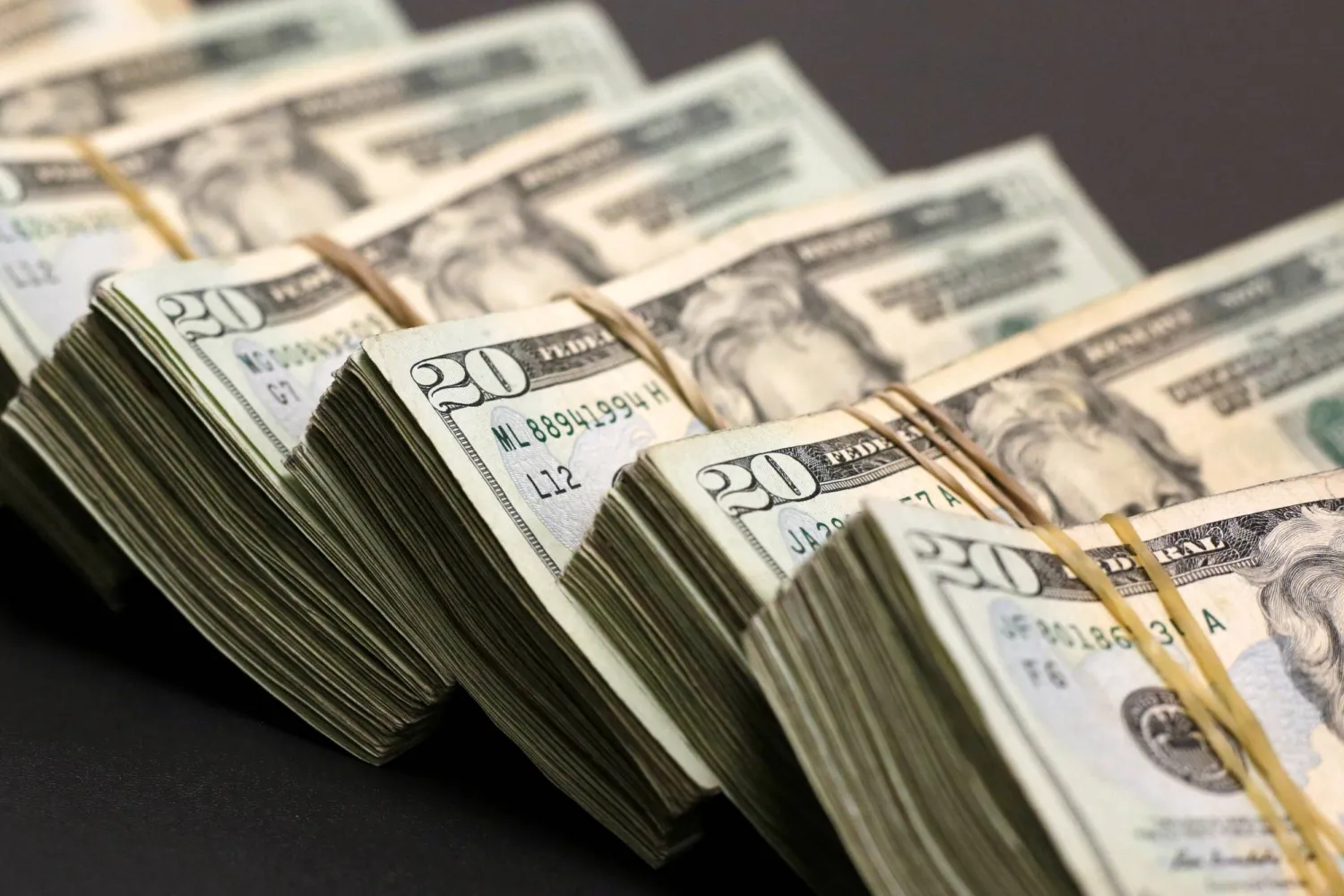
US dollar banknotes (Reuters)
TT

Dollar Recovers as Central Bank Decisions Loom, Markets Turn Risk-off

US dollar banknotes (Reuters)

The dollar climbed to a two-week high on Thursday as fresh volatility gripped stocks and precious metals, while traders counted down to rate decisions from the European Central Bank and the Bank of England.

The US dollar index, which measures the greenback's strength against a basket of six currencies, was last up 0.1% at 97.762, extending gains into a second day.

"There’s a bit of risk aversion coming through," said Sim Moh Siong, currency strategist at OCBC in Singapore. "When there's risk aversion, the dollar tends to strengthen."

The dollar has regained some strength this week and stocks turned risk-off as financial markets assess US corporate earnings season, now halfway complete, Reuters said.

Gold and silver, which have become more volatile recently as a ‌result of leveraged ‌buying and speculative flows, were rocked by a fresh selloff on ‌Thursday, ⁠which saw silver ‌falling as much as 16.6% to a low of $73.41.

The Nasdaq Composite has fallen 2.9% during the past two days, its biggest slide since October, with volatility triggered by market bellwethers including Google parent Alphabet , which reported aggressive spending plans on Wednesday, and a rout in software stocks as they adapt to a new era of generative AI.

Against the yen, the US dollar was trading at 156.81 yen, holding steady after an auction of 30-year Japanese government bonds drew solid demand, while Japan's election campaign entered its final stretch ahead of Sunday's poll.

The euro ⁠was last down 0.2% at $1.1790 ahead of the ECB decision, where it is expected to keep rates on hold. Investors' attention will be ‌focused on the post-policy press conference to gauge the outlook for ‍rates over the coming months.

"The emphasis will likely ‍be on higher uncertainty," with only minor tweaks in communication, according to analysts from Bank of America, ‍who expect the ECB to hold rates later in the day. "Our conviction in a March cut is not rock solid, but we remain convinced of an easing bias from here."

The British pound was last down 0.2% at $1.3621 ahead of the BoE's policy decision, at which it is also expected to remain on hold.

As the Asian trading session began, Federal Reserve Governor Lisa Cook said in a speech she is more concerned about stalled progress on inflation than a weakening labor market, a strong signal that she will ⁠not support another interest-rate cut until tariff-induced price pressures begin to recede.

Fed funds futures are pricing an implied 88% probability that the US central bank will hold rates at its next two-day meeting ending on March 18, though bets on a rate cut edged up to 12% from 9.4% a day earlier, according to the CME Group's FedWatch tool.

Against the offshore yuan, the US dollar was last flat at 6.9439 yuan following a phone call between US President Donald Trump and Chinese counterpart Xi Jinping in which they discussed trade, security issues and US arms sales to Taiwan.

Antipodean currencies, which often mirror global risk appetite, saw their strength fade during the trading session as investor confidence dimmed.

The Australian dollar fell 0.4% to $0.6968, giving up earlier gains following the release of trade balance data which was a little ahead of market estimates. The New Zealand dollar was last down ‌0.3% at $0.5986.

Cryptocurrencies extended losses after a selloff, which saw digital assets fall to the lowest since November 2024, with bitcoin tumbling as much as 3.54% to $70,052.48, and ether off 1.3% at $2,098.44.



Iraq in Talks with Gulf States on Pipeline Exports beyond Hormuz

Workers carry out maintenance on a pipeline at a gas separation station in the Zubair oil field near Basra (AP). 
TT

Iraq in Talks with Gulf States on Pipeline Exports beyond Hormuz

Workers carry out maintenance on a pipeline at a gas separation station in the Zubair oil field near Basra (AP). 

Iraq is in talks with Gulf countries to use their pipeline networks to secure alternative oil export routes beyond the Strait of Hormuz, the state oil marketer SOMO said Thursday.

The move is part of an emergency strategy by the oil ministry to tap regional infrastructure and bypass maritime chokepoints, ensuring Iraqi crude continues to reach global markets while offsetting higher transport costs linked to the current crisis.

Ali Nizar al-Shatari, head of the State Organization for Marketing of Oil (SOMO), said the ministry is prioritizing negotiations to access Gulf pipeline systems extending beyond the Strait of Hormuz and into the Arabian Sea, allowing exports to avoid areas of military tension.

“The goal is to secure stable routes that guarantee efficient flows of Iraqi oil at lower transport costs,” Shatari said, adding that Iraq generated about $2 billion in oil revenues in March, up 28 percent from February.

He said SOMO exported around 18 million barrels of crude from Basra, Kirkuk and the Kurdistan region by using all available outlets, including southern ports that operated until early March and northern routes to Türkiye’s Mediterranean port of Ceyhan.

As part of efforts to diversify export options, Shatari revealed that the first shipments of fuel oil and Basra Medium crude successfully reached Syrian ports.

He noted that Iraq had signed a deal to export 50,000 barrels per day via this route, describing cooperation with Syria as “very significant,” with storage and security provided to ensure safe delivery to the port of Baniyas.

The route has proven effective and could become a permanent option after the crisis, he added.

Shatari further noted that the oil ministry is close to completing repairs on the Iraq-Türkiye pipeline, which suffered extensive damage in previous years.

Technical teams have inspected the most difficult terrain, with about 200 kilometers (125 miles) still to be assessed in the coming days before full pumping of Kirkuk crude resumes.

In a notable logistical move, Iraq has begun pumping Basra crude northwards for export via Ceyhan.

Flows started at 170,000 barrels per day and are expected to stabilize between 200,000 and 250,000 bpd, helping offset disrupted southern exports and supply energy-hungry markets in Europe and the Americas.

Shatari said Iraq has benefited from rising global prices by selling Kirkuk crude — a medium-grade oil — at strong premiums.

He also confirmed the reactivation of an agreement with the Kurdistan region to reuse the pipeline through the region to Ceyhan, helping lift total exports to 18 million barrels in March.

This came despite a drop in production in Kurdistan fields to about 200,000 bpd due to security threats, he added.


World Food Prices Rose in March as Iran War Lifted Energy Costs, FAO Says

 A farmer carries harvested rice at a paddy field in Samahani, Aceh province on April 2, 2026. (AFP)
A farmer carries harvested rice at a paddy field in Samahani, Aceh province on April 2, 2026. (AFP)
TT

World Food Prices Rose in March as Iran War Lifted Energy Costs, FAO Says

 A farmer carries harvested rice at a paddy field in Samahani, Aceh province on April 2, 2026. (AFP)
A farmer carries harvested rice at a paddy field in Samahani, Aceh province on April 2, 2026. (AFP)

The war in the Middle East has pushed food commodity prices higher due to higher energy and fertilizer costs, the UN's food agency said Friday. 

The UN's Food and Agriculture Organization (FAO) said its Food Price Index, which measures the monthly changes in international prices of a basket of food commodities, had increased 2.4 percent in March from February. 

It was the second rise in a row, which the agency said was largely due to higher energy prices linked to conflict in the Middle East. 

Within the index, the category of vegetable oil saw the sharpest rise, of 5.1 percent over February, as palm oil prices reached their highest point since the middle of 2022, due to effects from spiking crude oil prices, FAO said. 

However, a "broadly comfortable" supply of cereal has cushioned the damaged from the conflict, FAO said. 

"Price rises since the conflict began have been modest, driven mainly by higher oil prices and cushioned by ample global cereal supplies," said FAO Chief Economist Maximo Torero in a statement. 

But he warned that if the conflict goes on beyond 40 days and the high prices on fertilizer continue, "farmers will have to choose: farm the same with fewer inputs, plant less, or switch to less intensive fertilizer crops". 

"Those choices will hit future yields and shape our food supply and commodity prices for the rest of this year and all of the next." 

Disruptions to production and supply chain routes had also introduced "additional uncertainty" into the outlook for wheat and maize, FAO found. 


Turkish Inflation Near 2% Monthly in March, Below Forecasts

A full moon rises behind Galata Tower, in Istanbul, Türkiye, Thursday, April 2, 2026. (AP)
TT

Turkish Inflation Near 2% Monthly in March, Below Forecasts

A full moon rises behind Galata Tower, in Istanbul, Türkiye, Thursday, April 2, 2026. (AP)

Turkish consumer price inflation was 1.94% month-on-month in March, while the annual figure fell to 30.87%, data from the Turkish Statistical Institute showed ‌on Friday.

In ‌a Reuters ‌poll, ⁠monthly inflation was ⁠forecast to be 2.32%, with the annual rate seen at 31.4%, driven by ⁠a rise in ‌fuel prices ‌and weather-related pressures ‌on food inflation.

In ‌February, consumer prices rose 2.96% month-on-month and 31.53% year-on-year, broadly in ‌line with estimates and reinforcing expectations that ⁠the ⁠disinflation process may be stalling.

The data also showed the domestic producer index rose 2.30% month-on-month in March for an annual increase of 28.08%.