

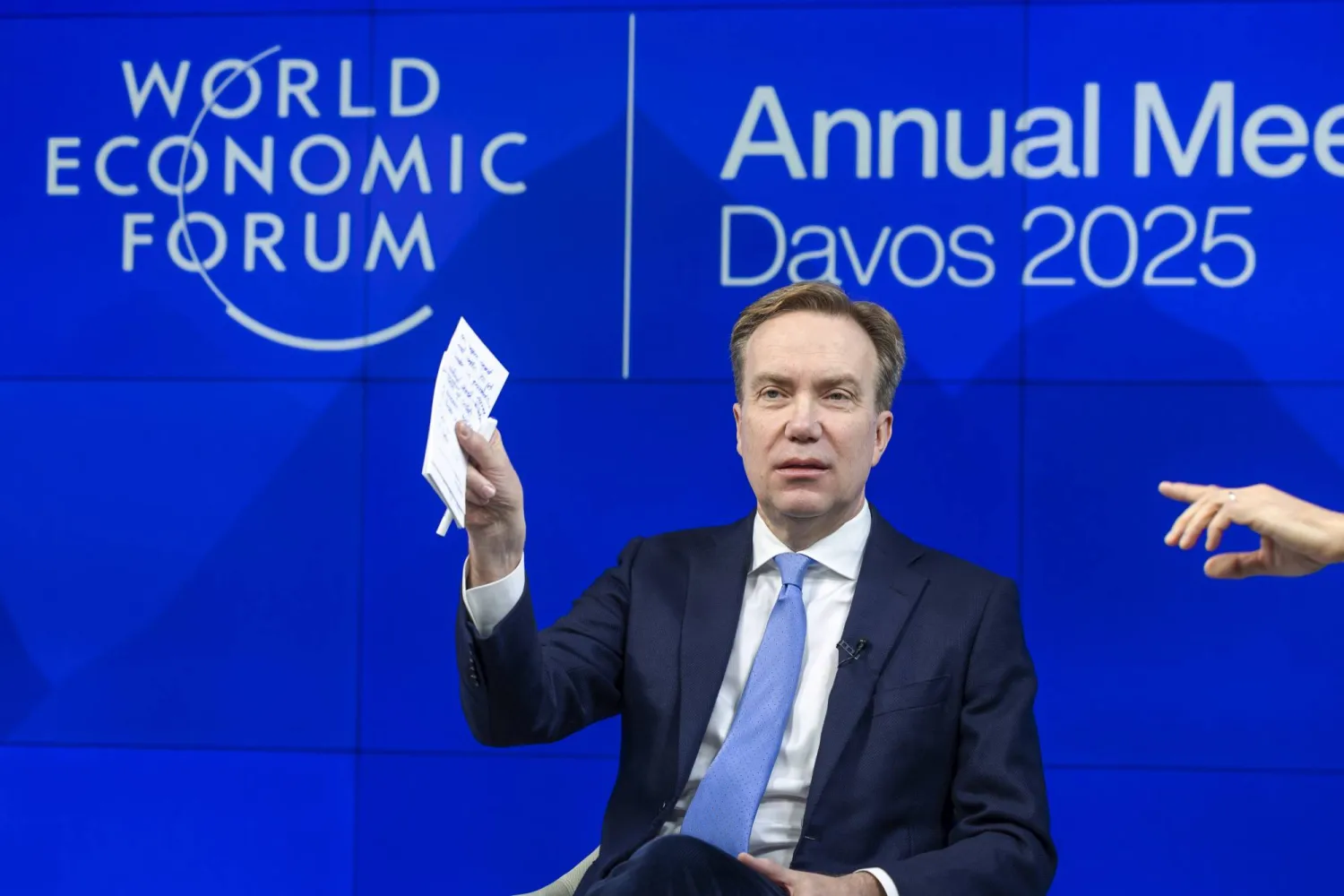

World Economic Forum Opens Probe Into its CEO over Epstein Links

Norwegian Borge Brende, President and CEO of the World Economic Forum (WEF). EPA/SALVATORE DI NOLFI
TT

World Economic Forum Opens Probe Into its CEO over Epstein Links

Norwegian Borge Brende, President and CEO of the World Economic Forum (WEF). EPA/SALVATORE DI NOLFI

The World Economic Forum, which organizes the Davos summit, said Thursday that it would conduct an independent review into its chief executive's interactions with convicted sex offender Jeffrey Epstein.

Former Norwegian foreign minister Borge Brende, 60, has since 2017 been president of the WEF, which organizes the annual gathering of the super-rich and powerful in the Swiss ski resort of Davos.

"The WEF seeks to clarify recent disclosures regarding its president and CEO, Borge Brende, and his participating in three business dinners with Jeffrey Epstein, along with subsequent email and SMS communications," the forum said.

"In light of these interactions, the governing board requested the audit and risk committee to look into the matter, which subsequently decided to initiate an independent review."

According to AFP, the forum said it was committed to transparency and aimed to handle the matter thoughtfully and efficiently.

The Geneva-based organization said Brende would continue to fulfil his roles at the WEF, without involvement in the review process.

Brende was mentioned more than 60 times in the millions of new Epstein documents released last week by the US Justice Department.

Appearing in the released Epstein files does not in itself imply wrongdoing.

Epstein pleaded guilty in 2008 to procuring a child for prostitution and served 13 months of an 18-month sentence.

Epstein was facing charges of alleged sex trafficking when he killed himself in detention in 2019.

Brende said in a statement that during a visit to New York in 2018, he received an invitation for former Norwegian deputy prime minister Terje Rod-Larsen to join him for dinner with several other leaders, plus "someone who was presented to me as an American investor, Jeffrey Epstein".

"The following year, I attended two similar dinners with Epstein, alongside other diplomats and business leaders. These dinners, and a few emails and SMS messages, were the extent of my interactions with him," he said.

"I was completely unaware of Epstein's past and criminal activities."

He said that had he known about Epstein's background, he would have declined the initial invitation for dinner and any other subsequent invitations or communications.

Brende said he recognized that he could have conducted a more thorough investigation into Epstein's history, and regretted not doing so.

He welcomed the independent review, "which I indeed requested".


‘Surprise Strikes’ Loom If US–Iran Talks Collapse

A combined image of US President Donald Trump, Iran’s Supreme Leader Ali Khamenei, and Israeli Prime Minister Benjamin Netanyahu (AFP). 
TT

‘Surprise Strikes’ Loom If US–Iran Talks Collapse

A combined image of US President Donald Trump, Iran’s Supreme Leader Ali Khamenei, and Israeli Prime Minister Benjamin Netanyahu (AFP). 

As anticipation grows over the resumption of US–Iran negotiations in Oman, Israeli Prime Minister Benjamin Netanyahu convened an emergency meeting of Israel’s security cabinet on Thursday to assess scenarios in the event the talks fail and to consider the possibility of renewed military escalation.

Ahead of the meeting, Netanyahu briefed a confidential subcommittee of the Knesset’s Foreign Affairs and Defense Committee, stressing that the Israeli military is prepared to launch a major strike against Iran—one he said could be harsher than the so-called Twelve-Day War.

Israeli media later reported that the discussions reflected growing concern in Jerusalem over the direction of diplomacy with Tehran.

Channel 12 quoted a source familiar with the security cabinet deliberations as saying there is “full coordination with the United States” on Iran-related matters.

At the same time, The Jerusalem Post reported that Israel’s Chief of Staff, Eyal Zamir, told US officials that Israel is ready to carry out “surprise strikes” against targets inside Iran should Tehran “choose the path of war.”

According to the report, Zamir emphasized that any US concessions on Iran’s ballistic missile program would cross a red line for Israel, alongside other red lines linked to Iran’s nuclear activities.

This stance, the newspaper said, helps explain US Secretary of State Marco Rubio’s insistence that the ballistic missile program be included in the agenda of upcoming talks with Tehran. Rubio reiterated earlier this week that negotiations should address both Iran’s nuclear and missile programs.

Iran, however, has pushed back firmly. Ebrahim Rezaei, spokesman for the Iranian parliament’s National Security Committee, said both uranium enrichment and the ballistic missile program are non-negotiable “red lines” for Tehran.

Netanyahu said he does not yet know what decision US President Donald Trump will take regarding a possible military strike on Iran, but expressed confidence that Washington will adopt a tougher approach in the current round of negotiations.

Channel 12 described Israeli satisfaction with the US position as having taken on a “deep strategic dimension,” noting a recent secret visit by Zamir to Washington that Israeli officials have portrayed as significant.

Former national security adviser Tzachi Hanegbi shed further light on the background in remarks at a policy seminar in Herzliya. He said Netanyahu had previously sought to persuade former President Joe Biden to authorize a strike on Iran, but Biden rejected the idea, preferring to exhaust diplomatic options.

Netanyahu later made similar appeals during Trump’s second term, warning of an approaching “zero hour,” yet Trump initially resisted military action, opting instead for sanctions and warnings.

Hanegbi said Trump’s position shifted in June after reviewing the results of Israeli strikes on Iran ahead of the Twelve-Day War and the successful interception of two large-scale Iranian attacks with US assistance, without American casualties or disruption to shipping in the Strait of Hormuz.

He added that Trump was impressed by Israel’s military performance and eventually gave the green light for war, agreeing to join its final phase.

Meanwhile, Israeli political sources told the news site Walla that there is a growing sense in Jerusalem that Washington entered the current negotiations at a poor moment and from a weak position.

They argued that Iran today is more confident and assertive than in 2015, believing its threats of regional escalation were enough to push the United States back to diplomacy.


Senior Russian Officer Hospitalized after Being Shot in Moscow

A person walks along an embankment of the Moskva River near the Kremlin wall in Moscow, Russia February 5, 2026. REUTERS/Anastasia Barashkova
TT

Senior Russian Officer Hospitalized after Being Shot in Moscow

A person walks along an embankment of the Moskva River near the Kremlin wall in Moscow, Russia February 5, 2026. REUTERS/Anastasia Barashkova

A senior Russian officer, Lieutenant General Vladimir Alexeyev, was rushed to hospital after being shot in Moscow on Friday, officials said.

Alexeyev is deputy chief of the Main Directorate of the General Staff at ‌the Defense ‌Ministry.

When mercenary ‌chief Yevgeny ⁠Prigozhin staged ‌a short-lived mutiny in June 2023, Alexeyev was one of the top officials who were sent to negotiate with him.

The Moscow prosecutor's office said Alexeyev ⁠had been shot several times at a ‌residential building in ‍northwest Moscow ‍by an unidentified assailant who fled ‍the scene.

Investigative Committee spokesperson Svetlana Petrenko didn’t say who could be behind the attack on Alekseyev.

Several senior Russian officers have been assassinated since the start of the war in Ukraine, with Moscow blaming the attacks on Kyiv. In some cases, ⁠Ukrainian military intelligence has claimed responsibility.

The most recent officer to be killed was the head of the General Staff's army training directorate, Lieutenant General Fanil Sarvarov, who was killed by a bomb under his car on December 22.

Friday’s attack came a day after Russian, Ukrainian and US negotiators wrapped up two days of talks in Abu Dhabi. The Russian delegation was led by the military intelligence chief, Adm. Igor Kostyukov.


In Show of Support, Canada, France Open Consulates in Greenland

A flag of Greenland hangs from a crane in the city of Nuuk, western Greenland, on January 28, 2026. (Photo by Ina FASSBENDER / AFP)
TT

In Show of Support, Canada, France Open Consulates in Greenland

A flag of Greenland hangs from a crane in the city of Nuuk, western Greenland, on January 28, 2026. (Photo by Ina FASSBENDER / AFP)

Canada and France, which both adamantly oppose Donald Trump's wish to control Greenland, will open consulates in the Danish autonomous territory's capital on Friday, in a strong show of support for the local government.

Since returning to the White House last year, Trump has repeatedly insisted that Washington needs to control the strategic, mineral-rich Arctic island for security reasons.

The US president last month backed off his threats to seize Greenland after saying he had struck a "framework" deal with NATO chief Mark Rutte to ensure greater American influence, reported AFP.

A US-Denmark-Greenland working group has been established to discuss ways to meet Washington's security concerns in the Arctic, but the details of the talks have not been made public.

While Denmark and Greenland have said they share Trump's security concerns, they have insisted that sovereignty and territorial integrity are a "red line" in the discussions.

"In a sense, it's a victory for Greenlanders to see two allies opening diplomatic representations in Nuuk," said Jeppe Strandsbjerg, a political scientist at the University of Greenland.

"There is great appreciation for the support against what Trump has said."

French President Emmanuel Macron announced Paris's plans to open a consulate during a visit to Nuuk in June, where he expressed Europe's "solidarity" with Greenland and criticized Trump's ambitions.

The newly-appointed French consul, Jean-Noel Poirier, has previously served as ambassador to Vietnam.

Canada meanwhile announced in late 2024 that it would open a consulate in Greenland to boost cooperation.

The opening of the consulates is "a way of telling Donald Trump that his aggression against Greenland and Denmark is not a question for Greenland and Denmark alone, it's also a question for European allies and also for Canada as an ally, as a friend of Greenland and the European allies also," Ulrik Pram Gad, Arctic expert at the Danish Institute of International Studies, told AFP.

"It's a small step, part of a strategy where we are making this problem European," said Christine Nissen, security and defense analyst at the Europa think tank.

"The consequences are obviously not just Danish. It's European and global."

- Recognition -

According to Strandsbjerg, the two consulates -- which will be attached to the French and Canadian embassies in Copenhagen -- will give Greenland an opportunity to "practice" at being independent, as the island has long dreamt of cutting its ties to Denmark one day.

The decision to open diplomatic missions is also a recognition of Greenland's growing autonomy, laid out in its 2009 Self-Government Act, Nissen said.

"In terms of their own quest for sovereignty, the Greenlandic people will think to have more direct contact with other European countries," she said.

That would make it possible to reduce Denmark's role "by diversifying Greenland's dependence on the outside world, so that it is not solely dependent on Denmark and can have more ties for its economy, trade, investments, politics and so on", echoed Pram Gad.

Greenland has had diplomatic ties with the European Union since 1992, with Washington since 2014 and with Iceland since 2017.

Iceland opened its consulate in Nuuk in 2013, while the United States, which had a consulate in the Greenlandic capital from 1940 to 1953, reopened its mission in 2020.

The European Commission opened its office in 2024.
