


US Accuses China of Secret Nuclear Testing

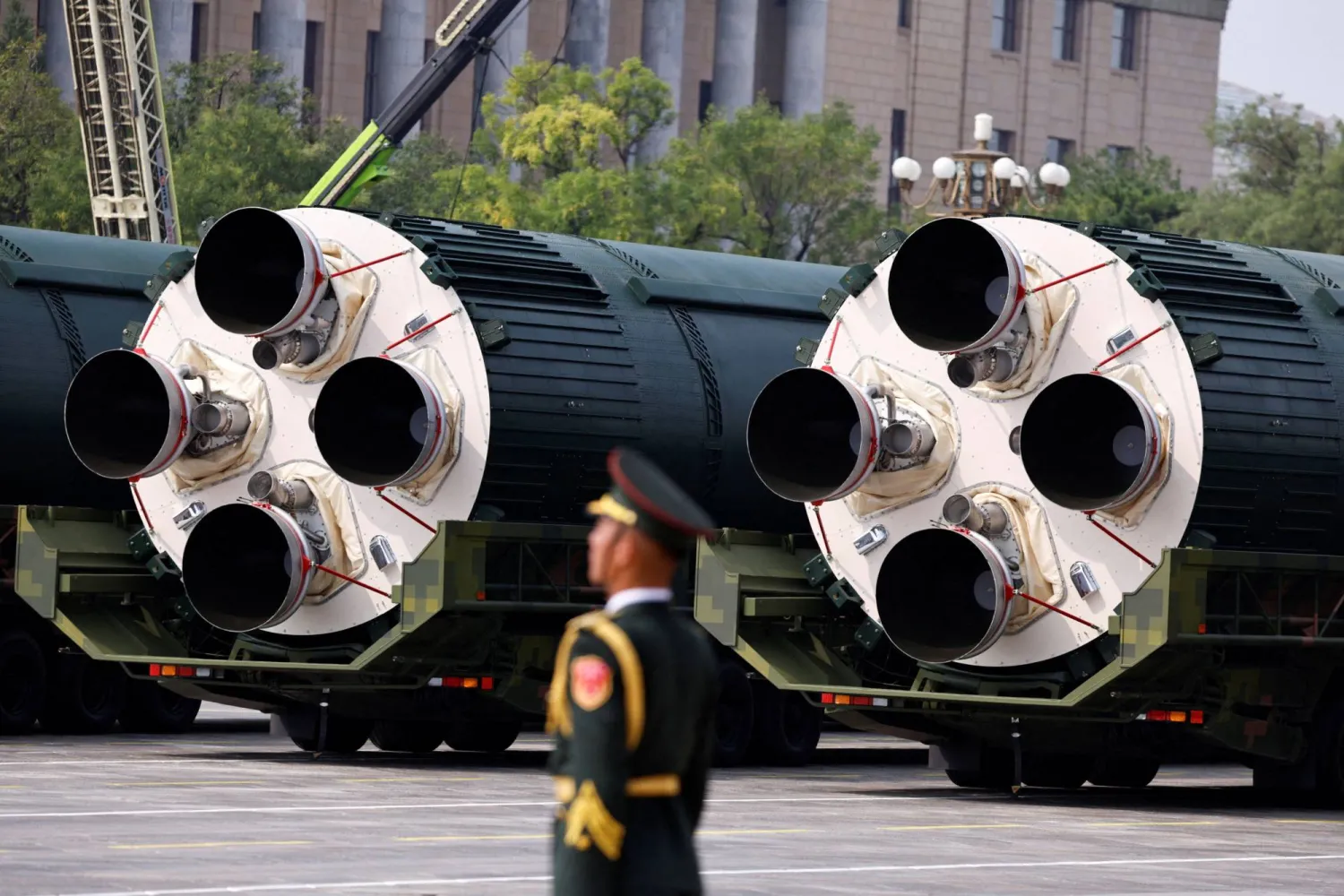
A member of the People's Liberation Army stands as the strategic strike group displays DF-5C nuclear missiles during a military parade to mark the 80th anniversary of the end of World War Two, in Beijing, China, September 3, 2025. (Reuters)
TT

US Accuses China of Secret Nuclear Testing

A member of the People's Liberation Army stands as the strategic strike group displays DF-5C nuclear missiles during a military parade to mark the 80th anniversary of the end of World War Two, in Beijing, China, September 3, 2025. (Reuters)

The United States accused Beijing on Friday of conducting a secret nuclear test in 2020 as it called for a new, broader arms control treaty that would bring in China as well as Russia.

The accusations at a global disarmament conference highlighted serious tension between Washington and Beijing at a pivotal moment in nuclear arms control, a day after the treaty limiting US and Russian missile and warhead deployments expired.

"I can reveal that the US government is aware that China has conducted nuclear explosive tests, including preparing for tests with designated yields in the hundreds of tons," US Under Secretary of State for Arms Control and International Security Thomas DiNanno told a Disarmament Conference in Geneva.

The Chinese military "sought to conceal testing by obfuscating the nuclear explosions because it recognized these tests violate test ban commitments. China has used 'decoupling', a method to decrease the effectiveness of seismic monitoring, to hide their activities from the world," he said.

DiNanno said China had conducted one such "yield-producing test" on June 22, 2020.

China's ambassador on disarmament, Shen Jian, did not directly address DiNanno's charge but said ‌Beijing had always acted ‌prudently and responsibly on nuclear issues.

"China notes that the US continues in its statement to hype ‌up ⁠the so-called China ‌nuclear threat. China firmly opposes such false narratives," he said.

"It (the US) is the culprit for the aggravation of the arms race."

Diplomats at the conference said the US allegations were new and concerning. China, like the US, has signed but not ratified the Comprehensive Nuclear Test Ban Treaty (CTBT), which bans explosive nuclear tests. Russia signed and ratified it, but withdrew its ratification in 2023.

GLOBAL ARMS CONTROL FACES A CRITICAL MOMENT

The 2010 New START treaty which ran out on Thursday left Russia and the United States for the first time since 1972 without any binding constraints on their deployments of strategic missiles and warheads.

US President Donald Trump wants to replace it with a new agreement including China, which is rapidly increasing its own arsenal. In the meantime, Washington says it will keep modernizing its own nuclear forces.

"Russia and ⁠China should not expect the United States to stand still while they shirk their obligations and expand their nuclear forces. We will maintain a robust, credible, and modernized nuclear deterrent," US Secretary of State ‌Marco Rubio wrote in a post on the online publishing platform Substack.

DiNanno told the Geneva conference: "Today, the ‍United States faces threats from multiple nuclear powers. In short, a bilateral ‍treaty with only one nuclear power is simply inappropriate in 2026 and going forward."

He reiterated US projections that China will have over 1,000 nuclear ‍warheads by 2030.

Shen, the Chinese delegate, reiterated that his country would not participate in new negotiations at this stage with Moscow and Washington. Beijing has previously highlighted that it has a fraction of their warhead numbers - an estimated 600, compared to around 4,000 each for Russia and the US.

"In this new era we hope the US will abandon Cold War thinking... and embrace common and cooperative security," Shen said.

Tomas Nagy, a nuclear expert at security think-tank GLOBSEC in Bratislava, said Washington had chosen this moment to call out Beijing for alleged secret testing from nearly six years ago because it felt Beijing was unlikely to cooperate on the issue.

"This is a reflection of the fact that the Americans have actually understood by now that for the ⁠next couple of years, there's going to be no motion in a positive direction with the Chinese. So they decided to disclose this information," he said in a phone interview.

Trump held what he called "very positive" talks with China's President Xi Jinping on trade and wider security issues this week and is due to visit Beijing in April.

EXPIRY OF NEW START LEAVES ARMS CONTROL VOID

Security analysts say a new nuclear arms control deal would take years to negotiate, with Russia and the US developing new weapons and tension over Ukraine, the Middle East and other flashpoints resulting in a higher risk of miscalculation.

Forced to rely on worst-case assumptions about the other's intentions, the US and Russia would see an incentive to increase their arsenals, especially as China plays catch-up.

Russia would prefer to have a dialogue with the United States after New START but is ready for any scenario, Foreign Minister Sergei Lavrov said on Friday. The Kremlin said the two sides, at talks in Abu Dhabi this week, had reached an understanding they would both act responsibly.

Russia says the nuclear allies of NATO members Britain and France should also be up for negotiation - something those countries reject.

At the Geneva forum, Britain said China, Russia and the US should come to an understanding, adding that ‌it shared US concerns about Beijing's rapid expansion of its nuclear arsenal. France said agreement between states with the biggest nuclear arsenals was crucial at a time of an unprecedented weakening of nuclear norms.



French, Japanese Ships Cross Strait of Hormuz in First Since War

A cargo ship in the Gulf, near the Strait of Hormuz, as seen from northern Ras al-Khaimah, near the border with Oman’s Musandam governance, amid the US-Israeli conflict with Iran, in United Arab Emirates, March 11, 2026. (Reuters)
TT

French, Japanese Ships Cross Strait of Hormuz in First Since War

A cargo ship in the Gulf, near the Strait of Hormuz, as seen from northern Ras al-Khaimah, near the border with Oman’s Musandam governance, amid the US-Israeli conflict with Iran, in United Arab Emirates, March 11, 2026. (Reuters)

One French- and another Japanese-owned vessel are among a handful of vessels to have crossed the war-torn Strait of Hormuz, maritime tracking data showed Friday.

The passage, a vital maritime route for oil and liquified natural gas, has been virtually blocked by Iran since the start of the war, said AFP.

But both ships made the crossing on Thursday, according to ship tracking company Marine Traffic's website.

The Maltese-flagged Kribi belonging to the French maritime transport group CMA CGM crossed the waterway to leave the Gulf on Thursday afternoon, Marine Traffic's data showed.

By early Friday, it was off Muscat, Oman, still broadcasting the message "owner France" on its transponder system in the field usually used to give the destination.

The vessel's navigation data showed it had crossed via an Iranian-approved route through its waters, dubbed the "Tehran Toll Booth" by leading shipping journal Lloyd's List.

- Southern route -

In addition, three tankers -- including one co-owned by a Japanese company -- crossed the Strait of Hormuz on Thursday by taking an alternative, southern route.

They hugged close to the shore of Oman's Musandam Peninsula -- a first in nearly three weeks according to Lloyd's List.

Before the war, which started more than a month ago, about a fifth of global oil and liquefied natural gas (LNG) passed through the Strait.

All three ships signaled they were an "OMANI SHIP" in the message broadcast by their transponder as they crossed the strait.

The Sohar LNG, which was empty when crossing, is co-owned by Japanese shipping company Mitsui O.S.K.

That makes it the first Japanese vessel to exit the Gulf since the start of the war, according to a company statement quoted by Japanese media.

The Hong-Kong flagged New Vision, which crossed the strait on March 1 right after the war started, is expected in the French port of Le Havre on Saturday evening.

Since the conflict started however, that has dwindled to a trickle as Iran selectively attacks ships and energy facilities throughout the Gulf in retaliation for US and Israeli attacks.

A few commercial ships crossing the Strait of Hormuz recently have passed through the Iranian-approved route in the north of the waterway.

- Down to a trickle -

Just 221 commodities vessels have crossed the Strait of Hormuz since March 1, some more than once, according to Kpler data up to Friday morning.

In peacetime, the same waterway handles around 120 daily transits, according to Lloyd's List.

Of the vessels that made the crossing, 60 percent either came from Iran or were heading there.

It was not clear from the data how many had been cleared to make the crossing by Tehran.

But it did show that, among the 118 crossings by ships carrying cargo, 37 had left the Gulf carrying crude oil.

Most of those oil tankers -- 30 of them -- came from Iran or sailed under the Iranian flag. And most ships carrying Iranian oil did not specify their destination on their transponder.

Of those who did, all but one reported they were heading to China.

In the early days of the war, transponder data showed dozens of ships broadcasting messages such as "Chinese crew" or "Chinese owner" in the field usually used for their destination.

This appeared to be an attempt by the ships to avoid being targeted by Iran.


Iran Executes Two Linked to Opposition Group

Executions in Iran have surged in recent years - AFP
TT

Iran Executes Two Linked to Opposition Group

Executions in Iran have surged in recent years - AFP

Iran on Saturday executed two men it said were convicted of links to an opposition group, the People's Mojahedin Organization of ‌Iran, and ‌of carrying out armed ‌attacks, ⁠domestic media reported.

The ⁠executions were the latest in recent days of individuals with PMOI links.

The PMOI confirmed ⁠Saturday's executions, saying ‌in ‌a statement that Iran was "trying ‌to hide its ‌weakness by executing political prisoners, especially PMOI members and supporters." Four PMOI ‌members were executed earlier this week, ⁠it ⁠said.

The group said the two men executed on Saturday were arrested in January 2024 and had their death sentences upheld in December 2025.


Earthquake Kills 8 Members of Same Family near Afghan Capital

Previous earthquake in Afghanistan (Archive-Reuters)
TT

Earthquake Kills 8 Members of Same Family near Afghan Capital

Previous earthquake in Afghanistan (Archive-Reuters)

An earthquake that struck Afghanistan overnight killed eight members of the same family in Kabul province, the health ministry said on Saturday.

The 5.8-magnitude quake struck at 8.42 pm (1612 GMT) on Friday at a depth of 186 kilometers (115 miles) at the epicenter in northeastern Badakhshan province, according to the US Geological Survey (USGS).

Shaking was felt in multiple parts of the country, including the capital Kabul, according to AFP journalists.

"In the Gosfand Dara area of Kabul Province, eight members of a family died as a result of the earthquake," Health Ministry spokesman Sharafat Zaman said in a message to media.

He added that a child aged around two years old was the only survivor from the household and the country's disaster management agency said the boy had been injured in the tremor.

Afghanistan is frequently jolted by earthquakes, particularly along the Hindu Kush mountain range near where the Eurasian and Indian tectonic plates meet.

In August, a shallow magnitude 6 earthquake wiped out mountainside villages and killed more than 2,200 people in eastern Afghanistan, making it the deadliest tremor in the country's recent history.