


Damascus Moves to Implement SDF Deal amid Regional and International Backing

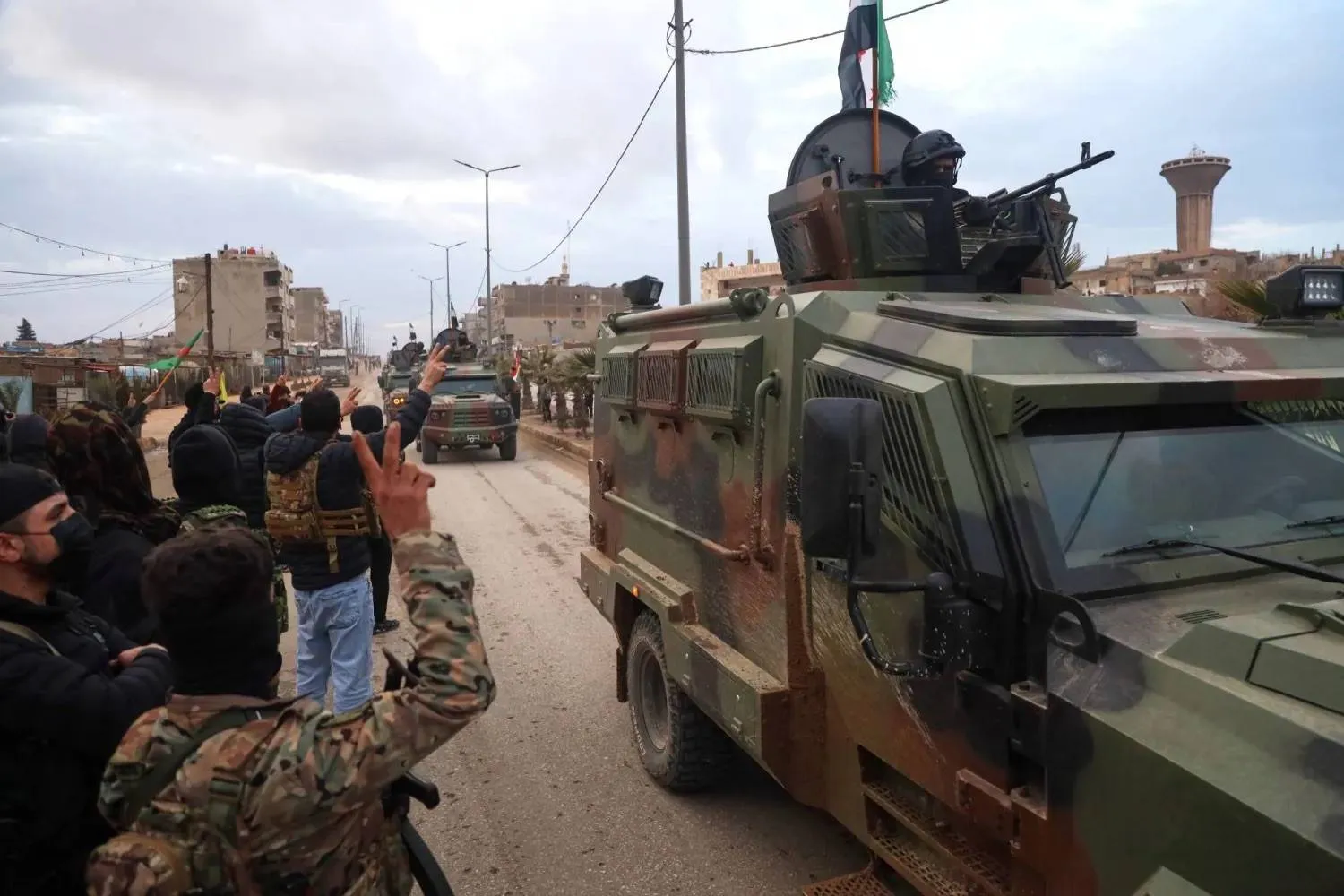
Fighters from the Syrian Democratic Forces welcome a convoy of the Syrian Ministry of Interior heading to Qamishli in northeastern Syria. (AP)
TT

Damascus Moves to Implement SDF Deal amid Regional and International Backing

Fighters from the Syrian Democratic Forces welcome a convoy of the Syrian Ministry of Interior heading to Qamishli in northeastern Syria. (AP)

Damascus is pressing ahead with steps to implement its agreement with the Syrian Democratic Forces (SDF) on the gradual integration of its fighters, redeployment in northeastern Syria, and the return of key facilities to state control.

The deal is receiving regional and international support and is being framed as an opportunity to integrate Syria’s Kurds into state institutions and help build a “new Syria.”

On Friday, a delegation from the Syrian Ministry of Defense was in Hasakah to discuss practical measures for incorporating SDF personnel into the national military, said the ministry’s Media and Communications Directorate.

The move is in line with the agreement announced on Jan. 29 between the Syrian government and the SDF. The accord includes a ceasefire, the gradual integration of Kurdish military and administrative structures into state institutions, and the restoration of government control over vital installations in the province.

Interior Ministry spokesman Nour al-Din al-Baba said the deployment of Internal Security Forces in Qamishli, in northeastern Syria, is proceeding under a clear timeline and operational plan to complete the agreement’s implementation.

This includes taking over and managing strategic facilities such as border crossings, Qamishli International Airport, and oil fields, with the aim of reactivating them “in service of the Syrian people,” he said in statements carried by state television Al-Ikhbariya.

Al-Baba added that the deployment is being carried out “in coordination with the other side in the city,” referring to the SDF, following a similar security deployment in Hasakah.

The agreement is also expected to address the issue of foreign fighters and to integrate the local Kurdish internal security force, known as the Asayish, into the Interior Ministry.

Al-Baba stressed that the ministry welcomes “all Syrian national cadres who serve the people.”

French support

French diplomatic sources told Asharq Al-Awsat that French Foreign Minister Jean-Noel Barrot informed SDF commander Mazloum Abdi that Paris wants to the January 29 agreement implemented “clause by clause” over the long term.

Barrot, who visited Iraq, Syria and Lebanon this week, described the deal as a “historic opportunity” for Syria’s Kurds to take part in building a new Syria alongside other components of society, the sources said.

The FM also discussed developments in Syria with leaders of Iraq’s Kurdistan Region, acknowledging their role in securing the ceasefire between Damascus and the SDF and agreeing to maintain close coordination to ensure the agreement’s success.

On Friday, Kurdistan Democratic Party leader Masoud Barzani met with Abdi and urged both the Syrian government and SDF to commit to the agreement.

A statement from Barzani’s office said the talks focused on conditions in northeastern Syria and underlined coordination among all parties to safeguard Kurdish rights within the country’s constitutional framework.



US Embassy Urges Americans to Leave Iraq

A photograph shows the damage following a reported drone strike on the US embassy in Baghdad's fortified "Green Zone" on March 14, 2026. (Photo by Murtadha RIDHA / AFP)
TT

US Embassy Urges Americans to Leave Iraq

A photograph shows the damage following a reported drone strike on the US embassy in Baghdad's fortified "Green Zone" on March 14, 2026. (Photo by Murtadha RIDHA / AFP)

US citizens should leave Iraq immediately, the US embassy in Baghdad said in an updated security alert ⁠on Saturday, following ⁠an overnight missile attack on the ⁠embassy's building.

"US citizens choosing to remain in Iraq are strongly encouraged to reconsider in light of the ⁠significant ⁠threat posed by Iran-aligned terrorist militia groups," the embassy said.


Israel Threatens to Strike Ambulances in Lebanon in Hezbollah Fighting

Rescue workers carry a body from an apartment destroyed in an Israeli airstrike in the southern port city of Sidon, Lebanon, Saturday, March 14, 2026. (AP Photo/Mohammad Zaatari)
TT

Israel Threatens to Strike Ambulances in Lebanon in Hezbollah Fighting

Rescue workers carry a body from an apartment destroyed in an Israeli airstrike in the southern port city of Sidon, Lebanon, Saturday, March 14, 2026. (AP Photo/Mohammad Zaatari)

The Israeli military warned on Saturday that it may strike ambulances and medical facilities which it said were being used unlawfully by Hezbollah in Lebanon, though it did not provide evidence for the claim.

"As part of its terrorist activities, Hezbollah is using ambulances extensively for military purposes," the Israeli military's Arabic spokesman Avichai Adraee said on X, adding that such use must immediately stop, AFP reported.

"If this practice does not stop, Israel will act in accordance with international law against any military activity carried out by the terrorist group Hezbollah using these facilities and ambulances," Adraee said.

A Hezbollah official said that the group was not using ambulances and medical facilities for military purposes.

The Israeli military did not immediately respond to a request to provide evidence that Hezbollah was using medical facilities or ambulances unlawfully.

At least 26 medics and first responders have been killed in Israeli strikes since March 2 according to the Lebanese Health Ministry. The Israeli military says it takes precautions to try to reduce any harm to civilians.

On Friday, Israeli aircraft dropped flyers over Beirut threatening to inflict damage on Lebanon similar to the devastation wrought on Gaza during Israel's two-year war with Palestinian militant group Hamas. Much of Gaza has been reduced to rubble and its population largely displaced.

On Friday Israel bombed a bridge in southern Lebanon which it said was being used by Hezbollah and Israeli Defense Minister Israel Katz threatened to strike national infrastructure exploited by Hezbollah.

Israel has deployed more troops to its northern border with Lebanon, and has signalled it is planning for a long campaign.

An Israeli official told Reuters on Friday that the campaign against Hezbollah would likely be intensified and continue even after strikes on Iran die down.

The official said that attacks on civilian infrastructure were being debated by the decision-makers.

Hezbollah leader Naim Qassem said on Friday that his group was prepared for a long confrontation.


UN Chief Says 'Diplomatic Avenues' Available to Stop War in Lebanon

Israeli soldiers work on the belts for their tanks at a staging area in the Upper Galilee in northern Israel near the border with Lebanon on March 13, 2026.  (Photo by Odd ANDERSEN / AFP) /
Israeli soldiers work on the belts for their tanks at a staging area in the Upper Galilee in northern Israel near the border with Lebanon on March 13, 2026. (Photo by Odd ANDERSEN / AFP) /
TT

UN Chief Says 'Diplomatic Avenues' Available to Stop War in Lebanon

Israeli soldiers work on the belts for their tanks at a staging area in the Upper Galilee in northern Israel near the border with Lebanon on March 13, 2026.  (Photo by Odd ANDERSEN / AFP) /
Israeli soldiers work on the belts for their tanks at a staging area in the Upper Galilee in northern Israel near the border with Lebanon on March 13, 2026. (Photo by Odd ANDERSEN / AFP) /

UN chief Antonio Guterres said Saturday on a visit to Beirut that diplomatic channels remained open to end the war between Israel and Iran-backed Hezbollah and urged the international community to support Lebanon.

"There is no military solution, only diplomacy, dialogue and full implementation of the UN Charter and Security Council resolutions. The diplomatic avenues are available, including through my special coordinator for Lebanon... and through key member states," he said.

Lebanon was dragged into the Middle East war last week when militant group Hezbollah attacked Israel in response to the killing of Iranian supreme leader Ali Khamenei in US-Israeli strikes.

"We are doing everything we can now to bring about an immediate de-escalation and the cessation of hostilities," Guterres told reporters.

"My special coordinator is engaging with all actors around the clock to bring the parties to the table and UNIFIL peacekeepers... remain in position," he said, referring to the UN Interim Force in Lebanon.

He said attacks against peacekeepers and positions were "completely unacceptable and they must stop. They are in breach of international law and may constitute war crimes".

Three peacekeepers serving with the Ghanaian contingent were wounded earlier this month in south Lebanon.

Guterres arrived in Beirut on Friday for what he called a "solidarity" visit, and launched a $325 million humanitarian appeal to support Lebanon as it responds to the displacement crisis.

On Saturday, he urged support for the Lebanese government, which last year committed to disarming Hezbollah.

"My message to the international community is simply step up your engagement, empower the Lebanese state and support the Lebanese Armed Forces to secure the capabilities and resources they need. Respond generously to the humanitarian appeal," he said.

The Israeli army has issued sweeping evacuation orders to residents of south Lebanon and Beirut's southern suburbs, with the Norwegian Refugee Council saying they cover 14 percent of Lebanese territory.

"Evacuation orders in a situation where so many vulnerable populations exist in the areas that are asked to be evacuated does not create enough security for civilians, and whatever does not create enough security for civilians inevitably becomes in violation of international humanitarian law," Guterres said.