


Egypt to Establish Middle East’s 1st Sodium Cyanide Plant for Gold Extraction

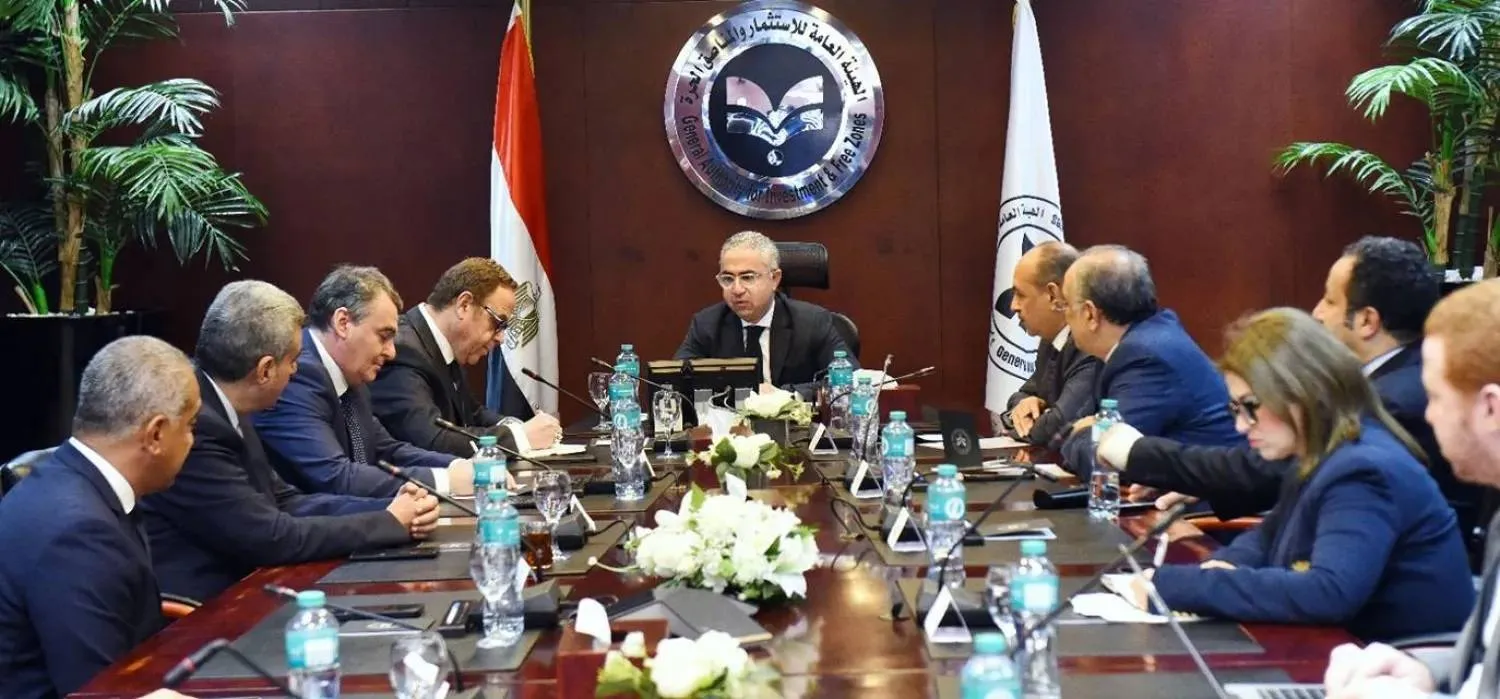
CEO of the General Authority for Investment and Free Zones (GAFI) Mohamed el-Gawsaky, received a delegation from DrasChem Specialty Chemicals (Egyptian Cabinet)
TT

Egypt to Establish Middle East’s 1st Sodium Cyanide Plant for Gold Extraction

CEO of the General Authority for Investment and Free Zones (GAFI) Mohamed el-Gawsaky, received a delegation from DrasChem Specialty Chemicals (Egyptian Cabinet)

The Egyptian government has announced the establishment of the first sodium cyanide production plant in the Middle East in Alexandria Governorate on the Mediterranean coast, with an annual production capacity of 50,000 tons and investments of $200 million in the first phase.

In a statement, the cabinet said on Saturday that CEO of the General Authority for Investment and Free Zones (GAFI) Mohamed el-Gawsaky met with a delegation from DrasChem Specialty Chemicals, a Private Free Zone company, to discuss the steps required to establish the company’s sodium cyanide production facility at the Sidi Kerir Petrochemicals Complex in Alexandria.

The DrasChem project plans to begin production in 2028 following the completion of the facility’s first phase, with initial investments estimated at $200 million. This phase targets the production and export of 50,000 tons of sodium cyanide annually, a key input in gold extraction.

The second phase will focus on either doubling production capacity or manufacturing additional sodium cyanide derivatives, while a third phase will target the production of sodium-ion battery components.

El-Gawsaky said the project aligns with the country’s developmental priorities, particularly those related to increasing exports, transferring and localizing advanced technology, deepening local manufacturing and creating sustainable job opportunities.

The CEO also noted that the plant would benefit from the results of Egypt's economic reform program, which has caused significant improvements in investment, trade, and logistics indicators.

El-Gawsaky urged Egyptian companies, including DrasChem, to adopt integrated, export-oriented industrial strategies, with a particular focus on African markets.

He said the Ministry of Investment and Foreign Trade aims to increase exports by $4 billion. The focus will be on sectors with high competitive advantages, particularly the chemicals sector.

He also highlighted that DrasChem’s sodium cyanide products are of strategic importance to gold mines in Africa, which account for about a quarter of global gold production.

Bassem El-Shemmy, Vice President for Strategic Partnerships at Austria-based Petrochemical Holding GmbH, the largest shareholder in DrasChem, said project partner Draslovka of the Czech Republic will, for the first time, transfer its proprietary technology - developed at its facilities in the US - to Africa and the Middle East.

This move, he said, will help position Egypt as a regional hub for gold extraction technologies and sodium-ion battery manufacturing, a more sustainable and cost-effective alternative to lithium-ion batteries.

For his part, Andrey Yurkevich, Deputy Managing Director for Strategy and Business Development at Petrochemical Holding GmbH, said the DrasChem facility will create up to 500 direct jobs and generate approximately $120 million in annual foreign-currency revenues.

He said that the project will enhance the stability and sustainability of local supply chains and strengthen Egypt’s regional standing as home to the first sodium cyanide production facility in both Egypt and the Middle East.


AlUla Conference for Emerging Market Economies Highlights Policies to Strengthen Resilience, Support Growth

The second AlUla Conference for Emerging Market Economies was held in AlUla on February 8–9 - SPA
TT

AlUla Conference for Emerging Market Economies Highlights Policies to Strengthen Resilience, Support Growth

The second AlUla Conference for Emerging Market Economies was held in AlUla on February 8–9 - SPA

At the conclusion of the second AlUla Conference for Emerging Market Economies, held in AlUla on February 8–9 and co-organized by the Saudi Ministry of Finance and the International Monetary Fund, Minister of Finance Mohammed Aljadaan and Managing Director of the International Monetary Fund Kristalina Georgieva issued a joint statement.

The statement expressed appreciation to emerging-market policymakers, leading global academics, and heads of regional and international financial institutions for convening once again in AlUla to discuss the key challenges facing emerging-market economies and the policies needed to strengthen resilience and support growth, SPA reported.

It noted that the second conference reaffirmed the value of a dedicated global forum focused on the shared challenges, opportunities, and aspirations of emerging market economies.

Over the two days, discussions centered on how emerging markets can navigate a global environment characterized by persistent uncertainty, geopolitical shifts, evolving trade patterns, and rapid technological change.

These developments, the statement said, underscore the urgency of strengthening policy frameworks and institutions to bolster resilience and seize opportunities ahead.

Several key messages emerged. First, sound macroeconomic and financial policies—underpinned by strong institutions and effective governance—remain the cornerstone of resilience in an increasingly shock-prone world. Experiences across many emerging markets demonstrate that credible policy frameworks and institutional upgrades have helped deliver better inflation outcomes, maintain financial stability, and preserve market access, even amid heightened uncertainty.

Second, having achieved greater stability, emerging markets now face the challenge of advancing to a new phase of reforms that deliver higher, more sustainable, and more job-rich growth. Unlocking private-sector potential will be central to this effort, including by deepening financial markets, reducing barriers to entrepreneurship and investment, and harnessing artificial intelligence through investments in digital infrastructure and skills development to help young people thrive in a changing global labor market.

Third, amid shifting trade and investment patterns, deeper intra-regional and inter-regional integration presents significant opportunities. Strengthening trade and regional cooperation remains critical as emerging markets adapt to the evolving global economic landscape.

According to SPA, the statement concluded by welcoming the commitment shown by emerging market economies to work together, learn from one another, and act decisively to address global challenges, and by expressing anticipation of continuing these discussions and building on the momentum at future editions of the AlUla Conference for Emerging Market Economies.


Saudi EXIM Bank Signs Trilateral MoU with Poland’s BGK and KUKE

The MoU enhances collaboration among the three parties in export support, financing, and insurance - SPA
TT

Saudi EXIM Bank Signs Trilateral MoU with Poland’s BGK and KUKE

The MoU enhances collaboration among the three parties in export support, financing, and insurance - SPA

Saudi Export-Import Bank (Saudi EXIM Bank) has signed a memorandum of understanding with two Polish financial institutions, Bank Gospodarstwa Krajowego (BGK) and Polish export credit agency (KUKE), strengthening cooperation in export support, financing, and insurance, and expanding trade and investment between Saudi Arabia and the Republic of Poland.

According to a press release issued by the Saudi EXIM Bank today, the agreement was signed by Saudi EXIM Bank Deputy CEO Dr. Naif bin Abdulrahman Al-Shammari, Member of the Board of BGK Mateusz Szczurek and CEO and President of the Board of KUKE Janusz Władyczak during the Saudi-Polish Investment Forum, SPA reported.

The MoU enhances collaboration among the three parties in export support, financing, and insurance, including export-related co-financing, guarantees, insurance, and reinsurance. It also promotes the exchange of information and expertise relating to export credit policies and practices, in addition to organizing meetings, workshops, training programs, and capacity-building initiatives.

The release added that the agreement enables Saudi and Polish companies to explore joint business and project opportunities of mutual interest, while facilitating access to non-oil export markets for both countries through cooperation among export finance and guarantee institutions.

On this occasion, Al-Shammari stated: “This memorandum comes as an extension of Saudi EXIM’s efforts to build high-quality partnerships with global export finance and credit insurance institutions, and to establish a cooperation framework that enables exporters and buyers in Saudi Arabia and Poland to access new markets. Through this cooperation, we look forward to enhancing the flow of mutual trade and investment and opening broader horizons for companies to benefit from the opportunities available in both countries.”

The signing of this MoU aligns with Saudi EXIM Bank's strategy to build effective partnerships with export finance and credit guarantee institutions worldwide, supporting the growth and competitiveness of Saudi non-oil exports in regional and global markets, in line with the objectives of Vision 2030.


Oil Gains as Traders Weigh Supply Risks Linked to US–Iran Tensions

A pumpjack, used to help lift oil from a well, in the Permian basin near Midland, Texas, US, October 8, 2025. REUTERS/Arathy Somasekhar/File Photo
TT

Oil Gains as Traders Weigh Supply Risks Linked to US–Iran Tensions

A pumpjack, used to help lift oil from a well, in the Permian basin near Midland, Texas, US, October 8, 2025. REUTERS/Arathy Somasekhar/File Photo

Oil prices edged up on Tuesday as traders gauged the potential for supply disruptions after US guidance for vessels transiting the Strait of Hormuz kept attention squarely on tensions between Washington and Tehran.

Brent crude oil futures were up 37 cents, or 0.5%, at $69.41 a barrel by 1136 GMT. US West Texas Intermediate crude rose 25 cents, or 0.4%, to $64.61.

"The market is still focused on the tensions between Iran and the US," said Tamas Varga, an oil analyst at brokerage PVM.

"But unless there are concrete signs of supply disruptions, prices will likely start going lower," he said. "The market is range-bound, it's an oversupplied market against geopolitics."

Prices rose more than 1% on Monday, when the US Department of Transportation's Maritime Administration advised US-flagged commercial vessels to stay as far from Iran’s territorial waters as possible and to verbally decline Iranian forces' permission to board if asked.

About a fifth of the oil consumed globally passes through the Strait of Hormuz between Oman and Iran, making any escalation in the area a major risk to global oil supplies.

Iran and fellow OPEC members Saudi Arabia, the United Arab Emirates, Kuwait and Iraq export most of their crude via the strait, mainly to Asia.

The guidance was issued despite Iran's top diplomat saying last week that Oman-mediated nuclear talks with the US were off to a "good start" and set to continue.

Goldman Sachs analysts wrote in a note on Tuesday that prices were supported by geopolitics, with a pickup in oil on vessels as buyers seek to secure more oil amid heightened uncertainty.

"While talks in Oman produced a cautiously positive tone, lingering uncertainty over potential escalation, sanctions tightening, or supply disruptions in the Strait of Hormuz has kept a modest risk premium intact," said Tony Sycamore, an analyst at IG.

Meanwhile, the European Union has proposed extending its sanctions against Russia to include ports in Georgia and Indonesia that handle Russian oil, the first time the bloc would target ports in third countries, according to a proposal document seen by Reuters.

The move is part of efforts to tighten sanctions on Russian oil, a key source of revenue for Moscow, over the war in Ukraine.

Indian Oil Corp bought six million barrels of crude from West Africa and the Middle East, traders said, as India steered clear of Russian oil in New Delhi's push for a trade deal with Washington, which the countries hope to conclude in March.
