


Hezbollah Overhaul Gives Qassem Tighter Administrative Control

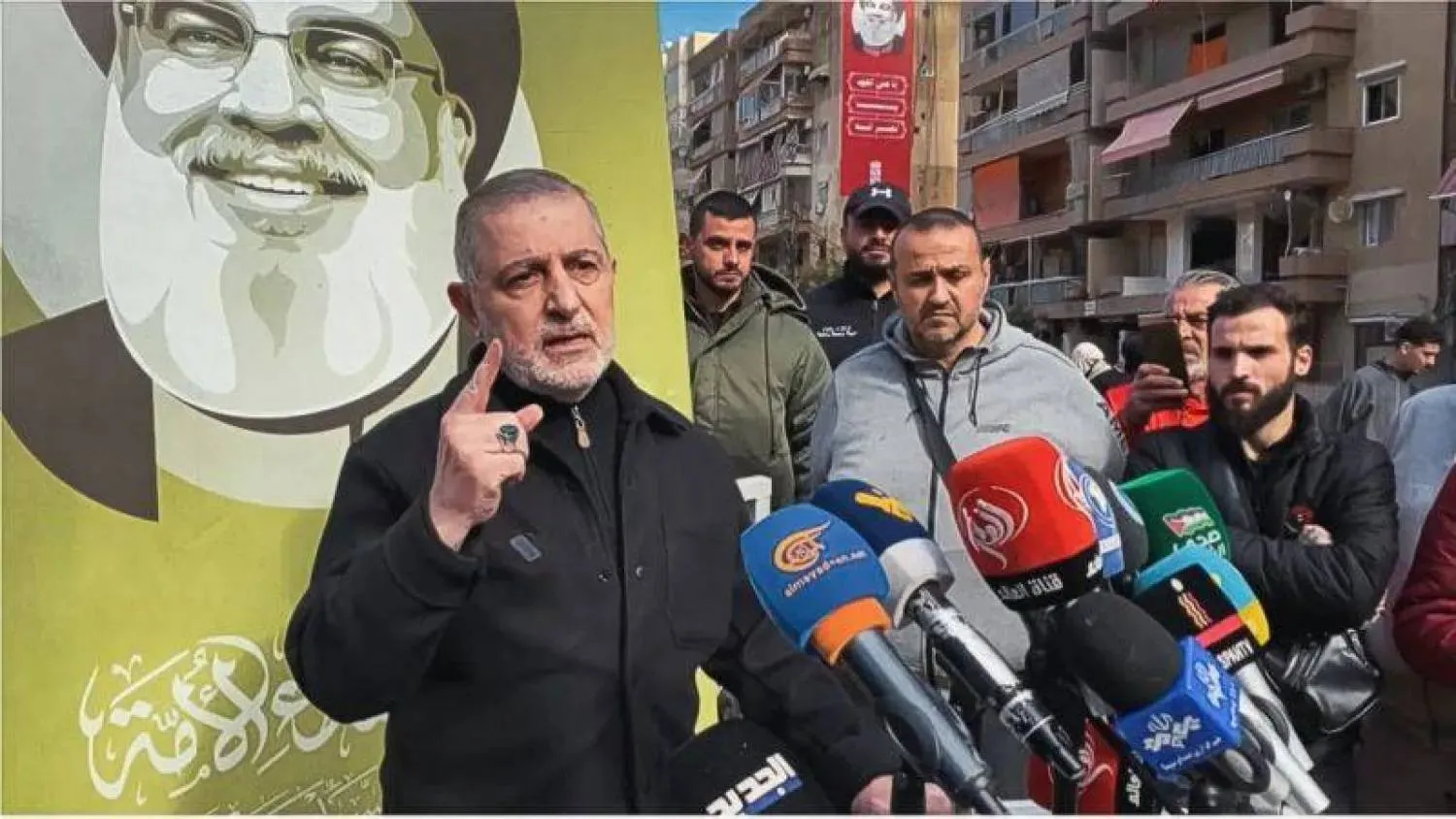
Wafiq Safa, head of Hezbollah’s Liaison and Coordination Unit, speaks to the media at the site of the killing of Hassan Nasrallah, Hezbollah’s secretary-general, in Beirut’s southern suburbs last year (Social media)
TT

Hezbollah Overhaul Gives Qassem Tighter Administrative Control

Wafiq Safa, head of Hezbollah’s Liaison and Coordination Unit, speaks to the media at the site of the killing of Hassan Nasrallah, Hezbollah’s secretary-general, in Beirut’s southern suburbs last year (Social media)

The resignation of Wafiq Safa, head of Hezbollah’s Liaison and Coordination Unit, a move that bore the hallmarks of a dismissal, has lifted the lid on a far-reaching internal shake-up of the group’s organizational structure after the heaviest blows it has suffered in its history.

The restructuring follows Hezbollah’s latest war with Israel, which decimated the group’s senior leadership, killing its long-time secretary-general Hassan Nasrallah, his designated successor Hashem Safieddine, a third potential successor Nabil Qaouq, along with much of its military command.

Well-informed Lebanese sources told Asharq Al-Awsat that Safa’s exit marks only the visible edge of bigger changes underway as the group moves to overhaul its leadership, security, and political apparatus in response to the unprecedented damage inflicted by the war.

Previously, that post led the organization without delving into the executive council's responsibilities, which function as a government-like body within the party.

Another key shift is the growing role of political figures in decision-making at the expense of clerics who had dominated the leadership in the previous phase.

New figures have also entered the decision-making circle, including individuals who worked with Qassem in the Islamic Daawa Party and Islamic committees before joining Hezbollah after its founding.

Raad seen as deputy secretary-general

The picture becomes clearer with the entry of Mohammad Raad, head of Hezbollah’s parliamentary bloc Loyalty to the Resistance, into the party’s decision-making core. There is a clear trend toward appointing him deputy secretary-general.

However, the decision is unlikely to be announced before parliamentary elections. MP Hassan Fadlallah is expected to assume leadership of the bloc after the latest elections.

Fneish to lead the party’s executive council

Sources told Asharq Al-Awsat that former minister and MP Mohammad Fneish has taken over responsibility for Hezbollah’s executive council, where he is tasked with reorganizing the party’s administrative and institutional structure. Sheikh Ali Daamoush is handling operational and organizational duties within the council.

Internal organizational measures

Opposition sources familiar with Hezbollah’s internal affairs said Safa was among the first officials affected by internal organizational decisions that curtailed media activity. A directive from the secretary-general’s office barred him from making statements without prior approval from the party’s media relations department.

The same sources said the measures went beyond media restrictions and were accompanied by a noticeable reduction in Safa’s political role, including contacts with political forces and involvement in elections and nominations. According to this account, he has had no public presence in recent months as a political envoy, neither to allies nor rivals.

Redistribution of roles

Sources explained that the unit, previously known in practice as the Security Committee, had handled internal security disputes and field tensions within Hezbollah’s environment or with other parties, intervening directly before coordinating with relevant actors and later with Lebanese state institutions, including security and judicial bodies. It also followed detainee cases and brokered reconciliations.

They added that the unit’s head benefited from growing influence within the party, particularly after being pushed to the forefront in sensitive files such as indirect negotiations and prisoner exchanges, enabling him to build political and international networks, including external channels.

Limiting political authority

Sources tracking the organizational file said the expansion of this role eventually led the unit to exceed its strictly security mandate by performing political functions, including receiving delegations and relaying messages.

They said that after the current leadership took charge, clear instructions were issued to restrict the Liaison and Coordination Unit’s role to security and technical coordination only, barring it from any political, negotiating, or media activity.

According to sources, all political decisions and contacts are now confined to the party’s political leadership, specifically to Secretary-General Naim Qassem, parliamentary bloc head Mohammad Raad, or the secretary-general’s political aide, Hussein Khalil. The security unit’s role is limited to technical coordination with Lebanese security agencies.

Broader structural shifts

Observers link these changes to broader transformations within Hezbollah since Qassem assumed leadership. They note that the previous phase saw prominent roles for clerical figures in the second and third ranks, such as Hashem Safieddine and Nabil Qaouq, who Israel killed in the recent war.

The current scene, by contrast, is marked by the rise of non-clerical political figures, including Mohammad Raad, Mahmoud Qmati, and Ibrahim Mousawi, signaling a gradual shift toward reinforcing the party’s political character.

The sources said media affairs have been centralized under a single administration overseen by MP Ibrahim Mousawi, with direct coordination with the leadership, as part of a policy aimed at unifying messaging and restricting public statements to authorized figures.

War fallout behind Safa’s removal

Political analyst Ali al-Amin told Asharq Al-Awsat that Safa’s sidelining comes amid the fallout from the war and its direct repercussions on Hezbollah, as well as the impact of Iran’s retrenchment and ongoing US-Iran negotiations. He said the party has come to realize that what was possible in the past is no longer sustainable.

Al-Amin said the decision affects a body with both personal and institutional dimensions, noting that Safa is subject to US sanctions, making the move a clear signal that Hezbollah no longer enjoys the same level of control over security bodies amid US pressure and Lebanese state demands to dismantle the apparatus.

He said Hezbollah is trying to adapt to new realities, adding that acceptance of this path will depend on how the party handles implementation of the principle of exclusive state control over weapons.

He noted that recent statements by Mohammad Raad had a tone that could appear positive about weapons exclusivity but fell short of complete clarity. He described the current step as an initial practical measure whose impact will be assessed later, both at the Lebanese official level and by US officials closely following the Lebanese file.

Al-Amin said Hezbollah will continue, whenever possible, to present itself as a political party, even if only superficially, in an effort to project a peaceful, civilian image and show alignment with state institutions.

He added that any progress or disruption in US-Iran negotiations would be reflected in greater flexibility in the party’s domestic behavior, unless a decisive international decision is taken to end Hezbollah’s current status.

In this context, reports have circulated that Hussein Abdallah has been tasked with heading the Liaison and Coordination Unit. Abdallah previously served as Hezbollah’s security chief in southern Lebanon and is considered close to Naim Qassem. Responsibility for contacts with the state and abroad has reportedly been assigned to his deputy, Ahmed Mahna.

Party-aligned account

A source close to Hezbollah offered a different account, telling Asharq Al-Awsat that the measures affecting Safa are part of an organizational restructuring the party has pursued since the end of the war as part of a comprehensive internal review affecting multiple positions and officials.

The source stressed that Safa remains within Hezbollah’s organizational structure.

By contrast, Al-Jadeed television reported that Safa submitted his resignation as head of the Liaison and Coordination Unit with internal approval, citing deep disagreements with Secretary-General Naim Qassem, Shura Council member and parliamentary bloc head Mohammad Raad, and the curtailment of his powers.



Syria Joining Anti-ISIS Coalition 'Marks New Chapter' in Global Security, US Envoy Says

A large Syrian flag flutters above Tishreen Park in Damascus, June 4, 2025. (AFP)
TT

Syria Joining Anti-ISIS Coalition 'Marks New Chapter' in Global Security, US Envoy Says

A large Syrian flag flutters above Tishreen Park in Damascus, June 4, 2025. (AFP)

The US-led international coalition to fight the ISIS has welcomed Syria in the fight against the extremists, saying that the priorities include the swift transfer of ISIS detainees to Iraq and third-country repatriation of families linked to ISIS held in two camps in Syria.

The State Department also welcomed a recent ceasefire that ended fighting between Syrian government forces and the US-backed and Kurdish-led Syrian Democratic Forces that were a main force in the fight against ISIS in Syria, The AP news reported.

Representatives from Syria — which officially joined the global coalition against ISIS in November during a historic visit by Syria’s President Ahmad al-Sharaa’s to Washington — attended a meeting on Monday of some officials from the 90-member coalition in Saudi Arabia.

“Regional solutions, shared responsibility. Syria’s participation in the D-ISIS Coalition meeting in Riyadh marks a new chapter in collective security,” Tom Barrack, the US envoy to Syria, said in comments posted on X on Tuesday.

The US military began transferring some of the about 9,000 ISIS detainees held in northeastern Syria last month to secure facilities in Iraq, following clashes between government forces and the SDF.

Monday's State Department statement said coalition members “underscored their readiness to work closely with the Syrian government” and encouraged members to provide direct support to Syrian and Iraqi efforts.

It said that in addition to the transfer of detainees to Iraq, the participants reaffirmed their priorities that include “dignified reintegration” of families from the al-Hol and Roj camps, in northeast Syria, to their communities of origin. Syria's government took over al-Hol in late January.

The camps house more than 25,000 mostly women and children linked to ISIS militants, the vast majority of them from Syria and Iraq. The State Department called on dozens of countries other than Syria and Iraq to repatriate their citizens from al-Hol and Roj camps.

“Officials commended Iraq’s efforts to securely detain ISIS militants” the statement said, adding that they also welcomed Syria’s assumption of responsibility for detention facilities and displacement camps housing ISIS militants and their family members.

The SDF, which controls much of the detention facilities in northeast Syria, will merge into the national army as part of a deal reached with the central government last month.

Part of the deal reached last month, government delegations visited over the past days the Qamishli International Airport in the predominantly Kurdish city of Qamishli as well as some oil fields and the headquarters of a national oil company as SDF members withdraw from some of their positions.

Government forces also entered parts of the northeastern city of al-Hassakeh. In the near future, Syria’s central authorities are supposed to take over border crossings with neighboring Iraq and Türkiye.


Egypt Approves Cabinet Reshuffle, State Media Say

An Egyptian flag flutters in Cairo, Egypt, January 15, 2023. REUTERS/Mohamed Abd El Ghany/File Photo
TT

Egypt Approves Cabinet Reshuffle, State Media Say

An Egyptian flag flutters in Cairo, Egypt, January 15, 2023. REUTERS/Mohamed Abd El Ghany/File Photo

Egypt's House of Representatives, the lower house of parliament, approved a relatively limited cabinet reshuffle on Tuesday, state media reported.

Mohamed Farid Saleh, who previously served as the executive chairman of the country's Financial Regulatory Authority, was appointed minister of investment and foreign trade, Reuters reported.

Ahmed Rostom was named minister of planning. He was a senior financial sector specialist at the World Bank.

The head of Egypt's State Information Service (SIS), Diaa Rashwan, will lead a revived Ministry of Information.

Meanwhile, the ministers of finance, foreign affairs, petroleum, supply, defense and interior kept their posts.


UN Warns Clock Ticking for Sudan's Children

Sudanese children play on a street in Tokar, in Red Sea State, following heavy flooding in October, 2024 © AFP/File
TT

UN Warns Clock Ticking for Sudan's Children

Sudanese children play on a street in Tokar, in Red Sea State, following heavy flooding in October, 2024 © AFP/File

The United Nations warned Tuesday that time was running out for malnourished children in Sudan and urged the world to "stop looking away".

Famine is spreading in Sudan's western Darfur region, UN-backed experts warned last week, with the grinding war between the army and RSF leaving millions hungry, displaced and cut off from aid.

Global food security experts say famine thresholds for acute malnutrition have been surpassed in North Darfur's contested areas of Um Baru and Kernoi, AFP reported.

Ricardo Pires, spokesman for the UN children's agency UNICEF, said the situation was getting worse for children by the day, warning: "They are running out of time".

In parts of North Darfur, more than half of all children are acutely malnourished, he told a press conference in Geneva.

"Extreme hunger and malnutrition come to children first: the youngest, the smallest, the most vulnerable, and in Sudan it's spreading," he said.

Fever, diarrhoea, respiratory infections, low vaccination coverage, unsafe water and collapsing health systems are turning treatable illnesses "into death sentences for already malnourished children", he warned.

"Access is shrinking, funding is desperately short and the fighting is intensifying.

"Humanitarian access must be granted and the world must stop looking away from Sudan's children."

Since April 2023, the conflict between Sudan's army and the paramilitary Rapid Support Forces has killed tens of thousands, displaced 11 million and triggered what the UN calls one of the world's worst humanitarian crises.

Shible Sahbani, the World Health Organization's representative in Sudan, said the country was "facing multiple disease outbreaks: including cholera, malaria, dengue, measles, in addition to malnutrition".

At the same time, health workers and health infrastructure are increasingly in the crosshairs, he told reporters.

Since the war began, the WHO has verified 205 attacks on healthcare, leading to 1,924 deaths.

And the attacks are growing deadlier by the year.

In 2025, 65 attacks caused 1,620 deaths, and in the first 40 days of this year, four attacks led to 66 deaths.

Fighting has intensified in the southern Kordofan region.

"We have to be proactive and to pre-position supplies, to deploy our teams on the ground to be prepared for any situation," Sahbani said.

"But all this contingency planning... it's a small drop in the sea."