
Israel’s Netanyahu Is Meeting with Trump This Week to Push for a Far Broader Iran Deal

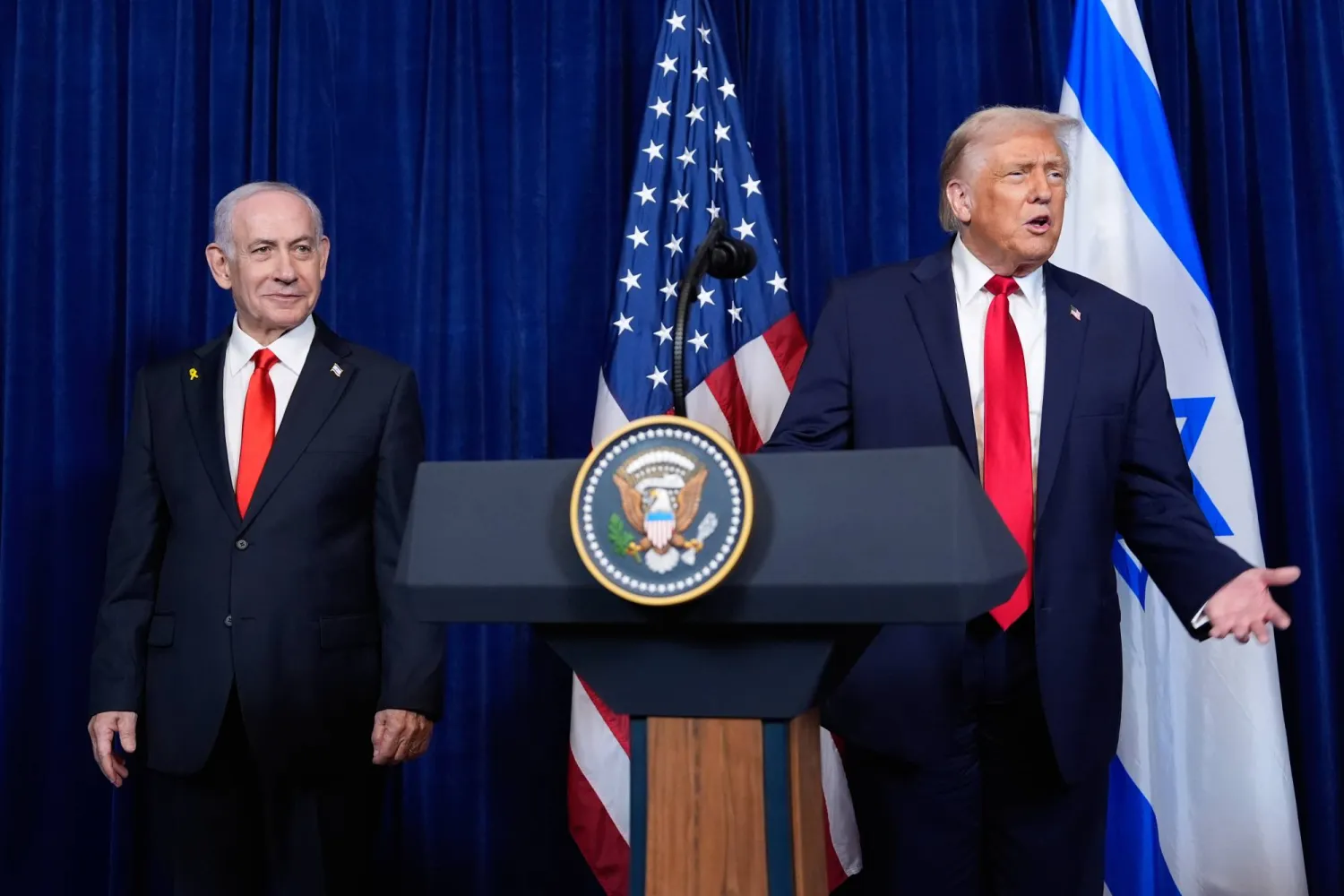
President Donald Trump answers a question from a reporter at the end of a news conference with Israel's Prime Minister Benjamin Netanyahu at Mar-a-Lago, Dec. 29, 2025, in Palm Beach, Fla. (AP)
TT

Israel’s Netanyahu Is Meeting with Trump This Week to Push for a Far Broader Iran Deal

President Donald Trump answers a question from a reporter at the end of a news conference with Israel's Prime Minister Benjamin Netanyahu at Mar-a-Lago, Dec. 29, 2025, in Palm Beach, Fla. (AP)

Prime Minister Benjamin Netanyahu is heading to Washington on Tuesday to encourage President Donald Trump to expand the scope of high-stakes nuclear talks with Iran. The negotiations resumed last week against the backdrop of an American military buildup.

Israel has long called for Iran to cease all uranium enrichment, dial back its ballistic missile program and cut ties to militant groups across the region. Iran has always rejected those demands, saying it would only accept some limits on its nuclear program in return for sanctions relief.

It's unclear if Iran's bloody crackdown on mass protests last month, or the movement of major US military assets to the region, has made Iran’s leaders more open to compromise, or if Trump is interested in broadening the already difficult negotiations.

Netanyahu, who will be in Washington through Wednesday, has spent his decades-long political career pushing for stronger US action toward Iran. Those efforts succeeded last year when the US joined Israel in 12 days of strikes on Iran's military and nuclear sites, and the possibility of additional military action against Iran is likely to come up in this week’s discussions.

Decisions are being made

Netanyahu's visit comes just two weeks after Trump’s special envoy Steve Witkoff and Jared Kushner, Trump’s son-in-law and Middle East adviser, met with the prime minister in Jerusalem. The US envoys held indirect talks in Oman with Iran's foreign minister on Friday.

“The Prime Minister believes that any negotiations must include limiting ballistic missiles and ending support for the Iranian axis,” Netanyahu's office said over the weekend, referring to Iran-backed armed groups like the Palestinian Hamas and Lebanon's Hezbollah.

Years of nuclear talks have made little progress since Trump scrapped a 2015 agreement with Iran, with strong encouragement from Israel. Iran has shown little willingness to address the other issues, even after suffering repeated setbacks. But the meeting with Trump gives Netanyahu an opportunity to shape the process and may also bolster his standing back home.

“Clearly these are the days when decisions are being made, America is expected to complete its force buildup, and it’s trying to exhaust the prospect of negotiations,” said Yohanan Plesner, head of the Israel Democracy Institute, a Jerusalem-based think tank.

“If you want to have influence on the process, only so much can be done via Zoom.”

Israel fears a narrow agreement

rump threatened a military strike against Iran last month over the killing of protesters and concerns of mass executions, moving a number of military assets into the region. Thousands were killed and tens of thousands detained at Iranian authorities crushed the protests over widespread economic distress.

As the protests largely subsided, Trump shifted his focus to Iran's nuclear program, which the US, Israel and others have long suspected is aimed at eventually developing weapons. Iran insists its program is entirely peaceful and says it has the right to enrich uranium for civilian purposes.

Sima Shine, an Iran expert formerly with Israel's Mossad spy agency who is now an analyst at Israel's Institute for National Security Studies, said Israel fears that the US might reach a narrow agreement with Iran in which it would temporarily halt uranium enrichment.

A deal in which Iran halts enrichment for several years would allow Trump to claim victory. But Israel believes any such agreement that does not end Iran's nuclear program and reduce its ballistic missile arsenal will eventually require Israel to launch another wave of strikes, she said.

Iran might be unable to enrich uranium after last year’s strikes, making the idea of a temporary moratorium more appealing.

In November, Iranian Foreign Minister Abbas Araghchi said Iran was no longer enriching uranium due to the damage from last year's war. The US and Israeli airstrikes killed nearly 1,000 people in Iran, while Iranian missile barrages killed almost 40 in Israel.

It's unclear how much damage was done to Iran's nuclear program. Inspectors from the International Atomic Energy Agency have been unable to visit the bombed nuclear sites. Satellite images show activity at two of them.

Netanyahu faces election this year

Netanyahu, who faces elections later this year, has long touted his close ties to world leaders, particularly Trump, who he has praised as the best friend Israel has ever had in the White House. This week's meeting allows Netanyahu to show Israelis he is a player in the Iran talks.

“The issue of relations between Netanyahu and Trump will be the issue of the campaign, and he is saying, ‘Only I can do this, it’s only me,’” Shine said.

Netanyahu is Israel's longest-serving prime minister, having held the office for a total of over 18 years. His government, the most nationalist and religious in Israel's history, is expected to survive until the election in October, or close to it.

Netanyahu was originally scheduled to visit Washington next week for the Feb. 19 launch of Trump's Board of Peace, an initiative that was initially framed as a mechanism for rebuilding Gaza after the Israel-Hamas war but has taken on a larger mandate of resolving global crises.

Netanyahu agreed to join the initiative, but is wary of it because it includes Türkiye and Qatar, countries he does not want to have a presence in postwar Gaza because of their relations with Hamas.

Moving the visit up could provide an “elegant solution” that allows Netanyahu to skip the launch without offending Trump, Plesner said. Netanyahu's office declined to comment.


Indonesia Says Proposed Gaza Peacekeeping Force Could Total 20,000 Troops

Israeli military vehicles drive past destruction in Gaza, as seen from the Israeli side of the Israel-Gaza border in southern Israel, January 21, 2026. REUTERS/Amir Cohen/File Photo
TT

Indonesia Says Proposed Gaza Peacekeeping Force Could Total 20,000 Troops

Israeli military vehicles drive past destruction in Gaza, as seen from the Israeli side of the Israel-Gaza border in southern Israel, January 21, 2026. REUTERS/Amir Cohen/File Photo

A proposed multinational peacekeeping force for Gaza could total about 20,000 troops, with Indonesia estimating it could contribute up to 8,000, President Prabowo Subianto’s spokesman said on Tuesday.

The spokesman said, however, that no deployment terms or areas of operation had been agreed.

Prabowo has been invited to Washington later this month for the first meeting of US President Donald Trump's Board of Peace. The Southeast Asian country last year committed to ready 20,000 troops for deployment for a Gaza peacekeeping force, but it has said it is awaiting more details about the force's mandate before confirming deployment.

"The total number is approximately 20,000 (across countries) ... it is not only Indonesia," presidential spokesman Prasetyo Hadi told journalists on Tuesday, adding that the exact number of troops had not been discussed yet but Indonesia estimated it could offer up to 8,000, Reuters reported.

"We are just preparing ourselves in case an agreement is reached and we have to send peacekeeping forces," he said.

Prasetyo also said there would be negotiations before Indonesia paid the $1 billion being asked for permanent membership of the Board of Peace. He did not clarify who the negotiations would be with, and said Indonesia had not yet confirmed Prabowo's attendance at the board meeting.

Separately, Indonesia's defense ministry also denied reports in Israeli media that the deployment of Indonesian troops would be in Gaza's Rafah and Khan Younis.

"Indonesia's plans to contribute to peace and humanitarian support in Gaza are still in the preparation and coordination stages," defence ministry spokesman Rico Ricardo Sirat told Reuters in a message.

"Operational matters (deployment location, number of personnel, schedule, mechanism) have not yet been finalised and will be announced once an official decision has been made and the necessary international mandate has been clarified," he added.


Iran Offers Clemency to over 2,000 Convicts, Excludes Protest-related Cases

FILE - In this photo obtained by The Associated Press, Iranians attend an anti-government protest in Tehran, Iran, Jan. 9, 2026. (UGC via AP, File)
TT

Iran Offers Clemency to over 2,000 Convicts, Excludes Protest-related Cases

FILE - In this photo obtained by The Associated Press, Iranians attend an anti-government protest in Tehran, Iran, Jan. 9, 2026. (UGC via AP, File)

Iran's supreme leader Ali Khamenei granted pardons or reduced sentences on Tuesday to more than 2,000 people, the judiciary said, adding that none of those involved in recent protests were on the list.

The decision comes ahead of the anniversary of the Iranian revolution, which along with other important occasions in Iran has traditionally seen the supreme leader sign off on similar pardons over the years.

"The leader of the Islamic revolution agreed to the request by the head of the judiciary to pardon or reduce or commute the sentences of 2,108 convicts," the judiciary's Mizan Online website said.

The list however does not include "the defendants and convicts from the recent riots", it said, quoting the judiciary's deputy chief Ali Mozaffari.

Protests against the rising cost of living broke out in Iran in late December before morphing into nationwide anti-government demonstrations that peaked on January 8 and 9.

Tehran has acknowledged that more than 3,000 people died during the unrest, including members of the security forces and innocent bystanders, and attributed the violence to "terrorist acts".

Iranian authorities said the protests began as peaceful demonstrations before turning into "foreign-instigated riots" involving killings and vandalism.

International organizations have put the toll far higher.

The US-based Human Rights Activists News Agency (HRANA) says it has verified 6,964 deaths, mostly protesters.


Macron Says Wants ‘European Approach’ in Dialogue with Putin

Russian President Vladimir Putin attends a meeting with Moscow Mayor Sergei Sobyanin at the Kremlin in Moscow, Russia February 9, 2026. (Sputnik/Vyacheslav Prokofyev/Pool via Reuters)
TT

Macron Says Wants ‘European Approach’ in Dialogue with Putin

Russian President Vladimir Putin attends a meeting with Moscow Mayor Sergei Sobyanin at the Kremlin in Moscow, Russia February 9, 2026. (Sputnik/Vyacheslav Prokofyev/Pool via Reuters)

French President Emmanuel Macron has said he wants to include European partners in a resumption of dialogue with Russian leader Vladimir Putin nearly four years after Moscow's invasion of Ukraine.

He spoke after dispatching a top adviser to Moscow last week, in the first such meeting since Russia launched its full-scale invasion of Ukraine in February 2022.

"What did I gain? Confirmation that Russia does not want peace right now," he said in an interview with several European newspapers including Germany's Suddeutsche Zeitung.

"But above all, we have rebuilt those channels of discussion at a technical level," he said in the interview released on Tuesday.

"My wish is to share this with my European partners and to have a well-organized European approach," he added.

Dialogue with Putin should take place without "too many interlocutors, with a given mandate", he said.

Macron said last year he believed Europe should reach back out to Putin, rather than leaving the United States alone to take the lead in negotiations to end Russia's war against Ukraine.

"Whether we like Russia or not, Russia will still be there tomorrow," Suddeutsche Zeitung quoted the French president as saying.

"It is therefore important that we structure the resumption of a European discussion with the Russians, without naivety, without putting pressure on the Ukrainians -- but also so as not to depend on third parties in this discussion."

After Macron sent his adviser Emmanuel Bonne to the Kremlin last week, Russia's Foreign Minister Sergei Lavrov on Thursday said Putin was ready to receive the French leader's call.

"If you want to call and discuss something seriously, then call," he said in an interview to state-run broadcaster RT.

The two presidents last spoke in July, in their first known phone talks in over two-and-a-half years.

The French leader tried in a series of phone calls in 2022 to warn Putin against invading Ukraine and travelled to Moscow early that year.

He kept up phone contact with Putin after the invasion but talks had ceased after a September 2022 phone call.