Macron Calls on Europe to Invest in Its Strategic Sectors

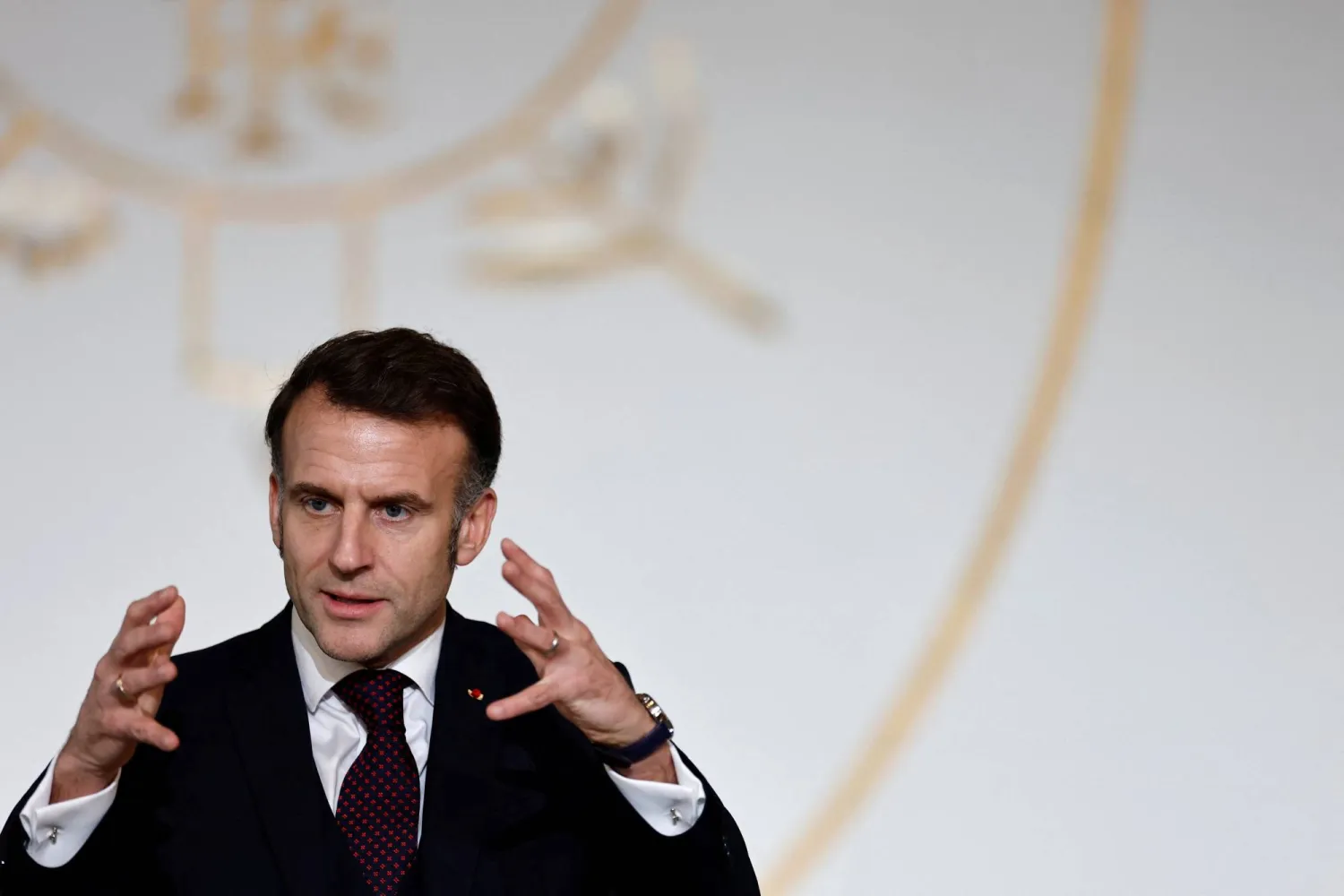
French President Emmanuel Macron delivers a speech during a meeting with students from the "Prepas Talents du service public" as part of a program that aims to give every young person an opportunity to join the civil service, at the Elysee Palace in Paris, France, 06 February 2026. (EPA)
TT

Macron Calls on Europe to Invest in Its Strategic Sectors

French President Emmanuel Macron delivers a speech during a meeting with students from the "Prepas Talents du service public" as part of a program that aims to give every young person an opportunity to join the civil service, at the Elysee Palace in Paris, France, 06 February 2026. (EPA)

French President Emmanuel Macron has called on Europe to boost investment in strategic sectors or risk being "swept aside" in the face of competition from the United States and China, in an interview published on Tuesday.

The French leader warned that US "threats" and "intimidation" were not over and urged against complacency, in an interview with several European publications including Le Monde, The Economist and The Financial Times.

Ahead of a European Union meeting, he advocated for "simplifying" and "deepening the EU's single market", and for "diversifying" trade partnerships.

"There are threats and intimidation. And then, suddenly, Washington backs down. And we think it's over. But don't believe it for a second. Every day, there are threats against pharmaceuticals, digital technology..." he said.

"When there is blatant aggression... we must not bow down or try to reach a settlement," he said.

"We tried this strategy for months, and it's not working. But above all, it strategically leads Europe to increase its dependence."

He said that the EU's public and private investment needed "some EUR1.2 trillion ($1.4 trillion) per year", including green and digital technologies, defense and security.

He also renewed his call for common European debt, an idea France has championed for years, but other countries have rejected.

"Now is the time to launch a common borrowing capacity for these future expenditures, future-oriented Eurobonds," Macron said.


US Unemployment Claims Dropped to 206,000 Last Week with Layoffs Still Sparse

A "now hiring" sign is displayed on a local business after, US employment growth slowed more than expected in July, in Encinitas, California, US August 1, 2025. REUTERS/Mike Blake
TT

US Unemployment Claims Dropped to 206,000 Last Week with Layoffs Still Sparse

A "now hiring" sign is displayed on a local business after, US employment growth slowed more than expected in July, in Encinitas, California, US August 1, 2025. REUTERS/Mike Blake

Fewer people applied for US unemployment benefits last week, another sign that layoffs remain low and that most Americans enjoy job security.

The Labor Department reported Thursday that jobless claims dropped to 206,000 last week from a revised 212,000 the week before. The four-week average of claims, which smooths out week-to-week ups and downs, ticked up to 204,000 last week from 199,750.

Claims for jobless benefits are a proxy for layoffs, and economists watch them because they can be a harbinger for where the job market is headed. For the past year, claims have been at a historically low range of around 200,000 to 230,000 a week.

“The labor market has yet to show any sign of wear and tear from the surge in oil prices since the start of the war with Iran and the global energy supply shock,” Carl Weinberg, chief economist at High Frequency Economics, wrote in a commentary, The AP news reported.

The number of people collecting unemployment benefits the week that ended Aug. 8 rose to 1.8 million from 1.78 million the week before.

The US unemployment rate is low at 4.1%, partly because the economy has proved resilient in the face of higher energy prices. But it’s also because President Donald Trump’s immigration crackdown and the ongoing retirement of baby boomers mean that fewer people are competing for jobs: More than 1.3 million people have dropped out of the US labor force over the past year.

The job market is tough for those looking for their first job and for those who lost their jobs and are looking for new work. At the same time, companies, remembering the worker shortages that followed the end of COVID-19 lockups, are still reluctant to let go of staff; but they aren’t eager to take on new workers. Economists regularly refer to a “no hire, no fire″ job market.

In July, companies, government agencies and nonprofits together cut 23,000 jobs. So far this year, employers are adding 61,000 jobs a month. That is an improvement on the 9,700 they averaged last year — the weakest hiring outside a recession since 2002. The lingering effects of high interest rates and Trump’s erratic trade policies discouraged companies from hiring in 2025.

Hiring this year remains well below the 166,00 monthly jobs created, on average, in 2023 and 2024, let alone the 491,000 a month recorded during the 2021-2022 hiring boom that followed pandemic lockdowns.


IMF Welcomes Lebanon Bank Law Changes as 'Major Step' 

Lebanese Central Bank headquarters in Beirut (Reuters)
TT

IMF Welcomes Lebanon Bank Law Changes as 'Major Step' 

Lebanese Central Bank headquarters in Beirut (Reuters)

The International Monetary Fund has welcomed the Lebanese parliament's passing of amendments to a bank resolution law as a major step, but challenges to implementing the law could further delay recovery for an economy battered by years of financial collapse and the conflict with Israel.

The reforms are among the IMF's requirements for Lebanon to access funding to bring government debt out of default after decades of profligate spending by the country's ruling elite, sending the economy into a tailspin in late 2019. Banks imposed sweeping capital controls, locking depositors out of their savings, and stopped issuing loans.

In January the IMF had demanded changes to the draft rescue law, Lebanon's Prime Minister Nawaf Salam told Reuters at the time.

Now, the bank resolution law aims to address vast funding shortfalls in the financial system and is among a set of measures that ultimately aim to fix the banking sector and allow depositors who have been frozen out of their savings to gradually recover their money.

“We met 99% of what they wanted,” legislator Alain Aoun, who sits on Parliament’s Finance and Budget Committee, told Reuters.

The most notable amendments to the law include changes to the Central Bank’s governance procedures. The makeup of the Higher Banking Commission – a governing body within the Central Bank — will be altered, Aoun said. The amendments empower the body to “decide the fate of Lebanon’s banks,” and would determine if a bank requires restructuring or liquidation and any further steps to rehabilitate it.

Federico Lima, the IMF representative in Lebanon, said on Wednesday that the "effective implementation of this new bank resolution framework is critical."

"In addition, we are continuing discussions with the Lebanese authorities on the improvements needed to align the draft Financial Stabilization and Depositor Recovery (FSDR) law with international principles," he added.

In 2022, the government put losses from the financial crisis at about $70 billion, a figure that analysts and economists forecast is now likely to be higher.

Last week, the parliament passed amendments to the law, but it would still be pending approval by the Lebanese president.

The possibility of members challenging the law before the Constitutional Council — which has precedent for annulling provisions of earlier financial legislation — could also bring further delays.

The draft had already undergone several rewrites because of competing demands from different financial institutions; the IMF called on Lebanon to improve the law to bring it in line with international standards and consider tax reforms to spark public spending on reconstruction efforts.

The World Bank ranks the Lebanese economic crisis among the worst globally since the mid-19th century. Depositors were frozen out of dollar accounts and the Lebanese pound fell by more than 90%. Additionally, the war with Israel was estimated to have caused $7 billion in damages.

"This is the only country in the world that has had a banking crises for seven years and has not tried to find a solution," a senior Lebanese official told Reuters. "Staying where we are shouldn't be an option."


Saudi Air Connectivity Program, Saudia Boost Operational Capacity to China and the US

The Saudi flag. Asharq Al-Awsat
TT

Saudi Air Connectivity Program, Saudia Boost Operational Capacity to China and the US

The Saudi flag. Asharq Al-Awsat

Saudi Air Connectivity Program (ACP), in collaboration with Saudia, has announced an increase in seat capacity across several international routes in 2026.

The new step reflects ongoing efforts to strengthen the Kingdom’s air connectivity with global markets, keep pace with growing travel demand, facilitate access to Saudi Arabia, and provide travelers with broader and more flexible travel options.

Direct routes between Saudi Arabia and China have seen increased seat capacity.

An additional weekly flight has been added to the Guangzhou-Jeddah (CAN-JED) route, bringing the total to four weekly flights and providing more than 124,000 seats annually in both directions.

An additional weekly flight has also been added to the Beijing Daxing-Riyadh (PKX-RUH) route, bringing the total to three weekly flights, with annual capacity exceeding 93,000 seats in both directions.

In addition, direct connectivity between Saudi Arabia and the United States has been enhanced with three additional weekly flights on the New York-Jeddah (JFK-JED) route, bringing the total to seven weekly flights and providing more than 211,000 seats annually in both directions.

These efforts build on the ongoing collaboration between the Air Connectivity Program and Saudi national carriers to expand the international destination network and strengthen the Kingdom’s connectivity with priority markets.

They also aim to meet growing travel demand, increase seat capacity, provide travelers with more diverse and flexible options, and facilitate the arrival of more international visitors to the Kingdom.

These efforts contribute to achieving the objectives of the National Tourism Strategy and the Aviation Sector Strategy, in alignment with the goals of Saudi Vision 2030.

The Air Connectivity Program aims to support the growth of Saudi Arabia’s tourism sector by strengthening air connectivity with global markets, developing existing air routes, and launching new international destinations.

These efforts contribute to the Kingdom’s target of connecting to 250 international destinations by 2030.

The program serves as an executive enabler of the National Tourism Strategy and the Aviation Program by building partnerships with government and private-sector entities across the tourism and aviation ecosystems, strengthening Saudi Arabia’s position as a leading global tourism destination.