


Warming Climate Threatens Greenland’s Ancestral Way of Life

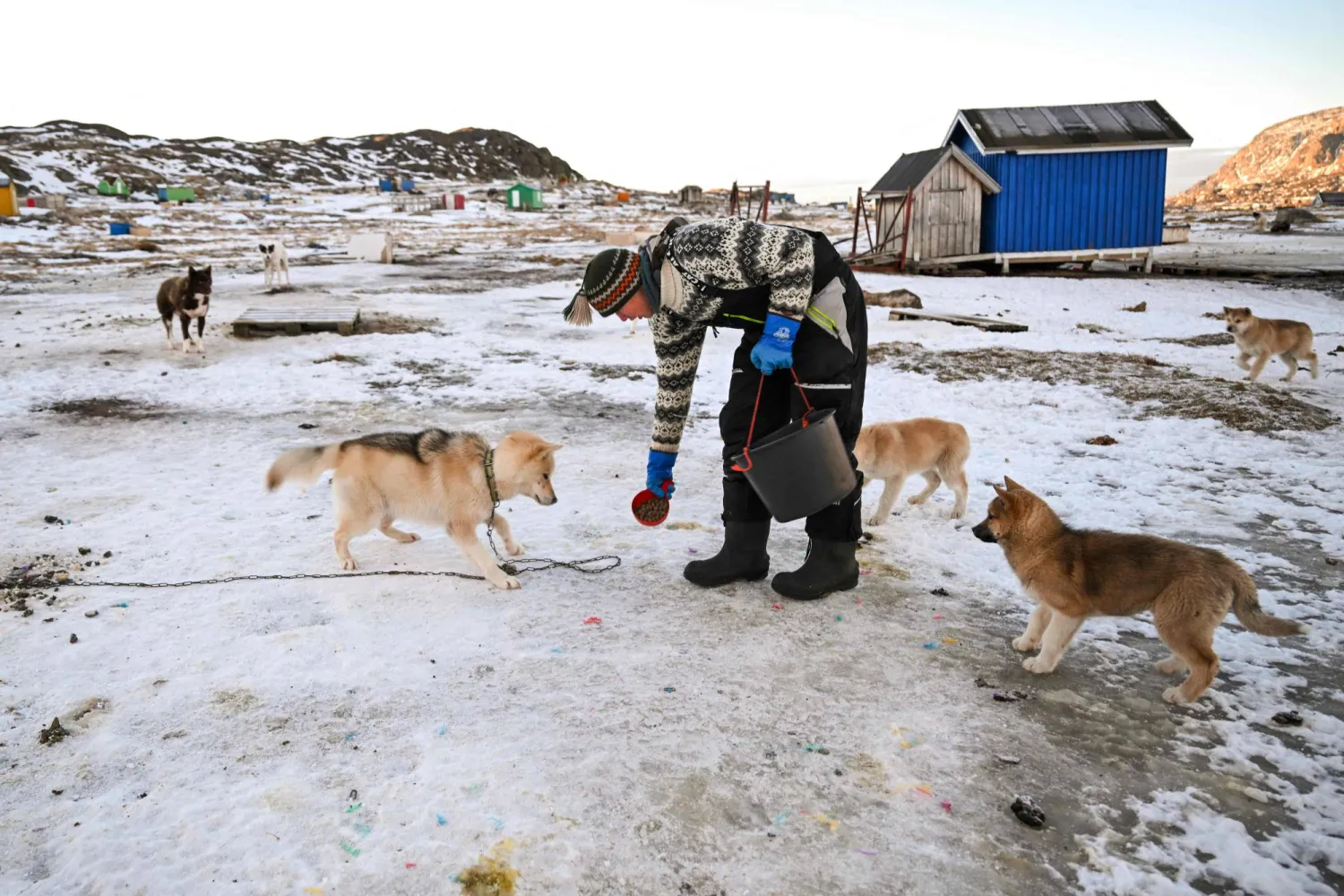
Musher Nukaaraq Lennert Olsen offers some dry food to his dogs after a ride near the "dog town" ofSisimiut, Greenland on January 31, 2026. (AFP)
TT

Warming Climate Threatens Greenland’s Ancestral Way of Life

Musher Nukaaraq Lennert Olsen offers some dry food to his dogs after a ride near the "dog town" ofSisimiut, Greenland on January 31, 2026. (AFP)

Standing in his boat with binoculars in hand, hunter Malik Kleist scans the horizon for seals. But this February, the sea ice in southwestern Greenland has yet to freeze, threatening traditional livelihoods like his.

"Normally the seals are on the ice or in the more calm waters. But today we had to sail all the way into the fjords to find them," the 37-year-old tells AFP.

The Arctic region is on the frontline of global warming, heating up four times faster than the rest of the planet since 1979, according to a 2022 study in scientific journal Nature, causing the sea ice to retreat.

Seals rely on pack ice to give birth, to rest and for protection.

Hunters increasingly have to sail farther along the jagged coast of Sisimiut, navigating into the fjords for several hours to find them.

Traditionally, hunters' boats would head straight out to sea, slowly pushing through the ice and creating holes that attract seals coming up for air.

But without any ice, "it's too windy and the waves are too big," Kleist says.

Last year was exceptionally warm in the vast autonomous territory, with several temperature records beaten, according to the Danish Meteorological Institute (DMI).

In December, the Summit Station, located at the height of Greenland's ice sheet, recorded an average temperature of -30.9 degrees C (-23.6 Fahrenheit), 8.1C higher than the December average during the period 1991-2020.

"It affects everything we do. Because normally around November, December the ice comes. And this year there's no ice, so it affects our living a lot," Kleist says.

- Financial woes -

For the same reason, the government has also had to postpone the annual winter musk ox hunt that was due to start on January 31.

There wasn't enough snow and ice to transport the massive animals that roam the Arctic tundra back from Kangerlussuaq where they are predominantly found, around 165 kilometers (103 miles) away. Greenland has no roads connecting its towns.

That has left some Sisimiut hunters with less income than usual.

"This time of year there is not much to hunt. So we rely on musk ox meat and skin," Kleist says.

"Many of my fellow hunters are struggling with money right now."

Every part of the animal, from the fur to the meat, is either used or sold.

The summer hunting season has therefore gained importance, enabling Greenlanders to fill their freezers to get them through the winter months, he tells AFP over a steaming bowl of fish stew.

The shorter winter season has also impacted another key activity in Greenland, one that has become increasingly important to the tourism sector: dogsled tours.

In the Sisimiut neighborhood where the dogs are kept, their thunderous barking mounts as Nukaaraq Olsen, a 21-year-old musher, attaches them to the sled.

Raring to get going, his 18 dogs are hard to hold back. Twenty minutes later, the group bounds off.

But the road is bumpy, and several times Olsen has to get up to manually push the sled, stuck on the tundra's rocks in patches where there is no ice.

"This year we had a lot of hot, warm days, even though it's December or January," he says.

Other parts of the route are no longer safe to use, due to repeated melting and freezing of snowfall which causes uneven layers, he explains.

- Dehydrated dogs -

The dogs' health is also affected by the changing climate.

They are used to quenching their thirst with snow, but with little or no snowfall, they can easily get dehydrated. Mushers have to take that into account when caring for their animals.

Many have even had to get rid of their dogs, the business of maintaining them no longer profitable with the dogsled season shrinking to just two months, says Emilie Andersen-Ranberg, a researcher at the University of Copenhagen who runs a dog clinic in Sisimiut.
Others, such as 72-year-old Johanne Bech, are finding novel ways to adapt.

She plans to put wheels on her sled to continue running dogsled tours during the summer period.

That solution is growing in popularity, as "the window with snow is getting more and more narrow," the veterinarian says.

Over the past 20 years, the number of sleddogs has been halved from 25,000 to 13,000, according to a 2024 article from the University of Greenland in 2024.

Yet Johanne Bech remains optimistic about the future.

"I hope this is just for a short time, so we can go back to a little more stable snow or more ice in the future."



Pioneering CNN Founder Ted Turner Dead at 87

Ted Turner speaks during the CNN World Report Contributors banquet in Atlanta on May 4, 1995. (AP)
TT

Pioneering CNN Founder Ted Turner Dead at 87

Ted Turner speaks during the CNN World Report Contributors banquet in Atlanta on May 4, 1995. (AP)

Ted Turner, the flamboyant US entrepreneur who transformed television news with the creation of CNN in 1980, has died at the age of 87, the network said Wednesday.

The mustached southerner, yachting enthusiast and philanthropist, whose empire also included sports clubs, had been suffering from the degenerative disease Lewy Body Dementia.

Cable News Network upended established broadcasting with its dedication to around-the-clock breaking news and shot to global recognition with its coverage of the Gulf War in 1990-91.

The 24-hour network was the first in the United States to run non-stop news and quickly built a worldwide footprint.

Correspondents brought live coverage from major events ranging from the collapse of the Soviet Union to the Chinese crackdown on the Tiananmen Square protests. CNN's decision to keep reporters in Baghdad amid US bombing on the Iraqi capital cemented the network's reputation as an indispensable source of breaking news.

"Ted is the giant on whose shoulders we stand, and we will all take a moment today to recognize him and his impact on our lives and the world," Mark Thompson, chairman and CEO of CNN Worldwide, said in a statement.

"He was and always will be the presiding spirit of CNN."

Born in Cincinnati, Ohio in November 1938, Robert Edward "Ted" Turner III went to a military boarding school in Tennessee, and then attended Brown University, but was expelled before graduating.

Turner took over a faltering family advertising business after his father, despondent over financial problems, committed suicide.

After buying a number of radio stations, Turner's purchase of a struggling Atlanta station in 1970 was his first move into television.

Ten years later, that became the flagship of his nationwide Turner Broadcasting System, the profits from which he parlayed into the launch of CNN.

CNN's success inspired the creation of other 24-hour news channels including Fox News by longtime Turner rival Rupert Murdoch, MSNBC and countless networks worldwide.

Turner's television empire expanded beyond CNN and included TBS and TNT channels for sports and entertainment, Turner Classic Movies and Cartoon Network, among others.


Antarctica's Tourism Boom Raises Concerns about Contamination and Disease

This handout photograph released by The British Antarctic Survey on April 8, 2026, shows Emperor Penguins on Antarctica on November 13, 2010. (Photo by PETER BUCKTROUT / BRITISH ANTARCTIC SURVEY / AFP)
TT

Antarctica's Tourism Boom Raises Concerns about Contamination and Disease

This handout photograph released by The British Antarctic Survey on April 8, 2026, shows Emperor Penguins on Antarctica on November 13, 2010. (Photo by PETER BUCKTROUT / BRITISH ANTARCTIC SURVEY / AFP)

Driven in part by fears that the frozen landscapes of Antarctica may be irreversibly melting away because of climate change, tourism to the bottom of the world is soaring. And experts warn that with more visitors comes an increased risk of contamination, illness and other damage to the continent.

While visitor numbers are still small — in part due to the high costs and time it can take — they are growing so fast that scientists and environmentalists are sounding alarms.

A deadly outbreak of the rare hantavirus aboard a Dutch ship on a weekslong polar cruise has brought attention to the growing tourism trend, The Associated Press said.

Most expeditions head to the Antarctic Peninsula, one of the fastest-warming places in the world. From 2002 to 2020, roughly 149 billion metric tons (164 billion tons) of Antarctic ice melted per year, according to the National Aeronautics and Space Administration.

A common route is to voyage south from Argentina toward Antarctica before heading north up the coast of Africa — the same route taken by the cruise ship MV Hondius.

“The sites you will see in Antarctica are extremely unique and not replicable anywhere else on the planet — the whales, the seals, the penguins, the icebergs — it’s all really stunning and it makes a huge impression on people,” said Claire Christian, executive director of the environmental group Antarctic and Southern Ocean Coalition.

Explosive growth of trips to the southern continent

In 2024, more than 80,000 tourists touched down on the vast ice-cloaked continent and 36,000 viewed from the safety of ships, according to data collected by the International Association of Antarctica Tour Operators.

The International Union of Concerned Scientists estimates that tourism to Antarctica has grown tenfold in the past 30 years.

That number could rise further in the next decade as costs fall with more ice-capable hulls hitting the water and technological advances, said Hanne Nielsen, a senior lecturer of Antarctic law at the University of Tasmania. Her colleagues at the university estimate the annual figure could triple or quadruple to over 400,000 visits in that time.

Some tourists come to Antarctica for “last chance tourism,” knowing the melting landscape is rapidly changing, Nielsen said.

Risks of contamination Officials have not indicated any evidence of contamination from the MV Hondius.

However, flocks of migratory birds brought avian flu from South America to Antarctica in recent years, according to the US Centers for Disease Control and Prevention.

That outbreak prompted the International Association of Antarctica Tour Operators and others to harden rules for tourists’ conduct and hygiene to protect visitors from being contaminated. To protect the fragile ecosystem from invasive species large and microscopic, visitors are told to stay away from animals and to avoid touching the ground with anything but their feet.

“There are rules that people are bound by when they’re heading south,” Nielsen said, describing her five voyages as a former guide. Crews and passengers use vacuums, disinfectants and brushes to scrub shoes and equipment clear of bugs, feathers, seeds and microbe-carrying dirt.

“Between the tongues and the laces of the boots you can find a lot of things,” she said.

Cruise ships have been struck by outbreaks of diseases like norovirus, which can spread quickly in a ship's close quarters. In 2020, a COVID-19 outbreak on the Diamond Princess turned the cruise ship into an incubator for the then-mysterious virus.

Hantavirus usually spreads by inhaling contaminated rodent droppings.

The Hondius' island hopping cruise The World Health Organization said Tuesday that MV Hondius left Ushuaia, Argentina, on April 1 and visited Antarctica and several isolated islands.

WHO is investigating possible human-to-human transmission on the cruise ship, said Dr. Maria Van Kerkhove, WHO’s director of epidemic and pandemic preparedness. Officials suspect the first infected person likely contracted the virus before boarding, she said, and officials have been told there are no rats on board.

Antarctica is governed by the Antarctic Treaty, which in 1959 enshrined the territory as a scientific preserve used only for peaceful purposes. A series of rules that followed “aim to ensure that all visits, regardless of location, do not adversely impact the Antarctic environment or its scientific and aesthetic values,” according to the treaty’s secretariat.

Companies and scientific ventures voluntarily comply with biosecurity guidelines and submit environmental impact assessments for Antarctic operations.

The treaty was written when tourism numbers were much lower, Christian said.

“Activity needs to be regulated appropriately, as you would with any of the world’s sensitive and precious ecological sites,” Christian said from Hiroshima, Japan, where she was preparing for an Antarctic Treaty Consultative Meeting. There she'll join calls to strengthen protections for Antarctica's penguins, whales, seabirds, seals and krill — tiny creatures at the base of the food chain.

For now, the lure of the frozen frontier continues to draw visitors.

“You can put a footprint in Antarctica and it’s still there 50 years later,” Christian said.


Bear Attack Injures 2 Hikers in Yellowstone National Park in the US

FILE - This photo provided by the National Park Service shows a sign marking the north entrance of Yellowstone National Park, May 7, 2018. (Jacob W. Frank/National Park Service via AP, File)
TT

Bear Attack Injures 2 Hikers in Yellowstone National Park in the US

FILE - This photo provided by the National Park Service shows a sign marking the north entrance of Yellowstone National Park, May 7, 2018. (Jacob W. Frank/National Park Service via AP, File)

Two hikers were injured in a bear attack on a popular hiking trail near Yellowstone National Park's Old Faithful geyser, park officials said Tuesday.

The attack was described by officials as a single event Monday afternoon along the Mystic Falls Trail.

A large area of the park near the Midway Geyser Basin was temporarily closed pending an investigation, The Associated Press reported. The area includes at least five trails and several backcountry campsites.

Park officials said one or more bears were involved, but did not specify which species. The park has populations of both grizzly bears and black bears, which can be difficult to tell apart at times. Grizzlies can be more aggressive and they grow much larger — as much as twice as big as black bears. Black bears usually have darker coloring.

Further information — including whether the victims were hiking together and whether they were hospitalized for their injuries — was not being immediately released, said Yellowstone spokesperson Ashton Hooker.

Yellowstone gets more than 4 million visits by tourists annually and attacks by grizzlies or black bears are rare.

In September, a hiker suffered injuries to his chest and arm in an attack on the Turbid Lake Trail northeast of Yellowstone Lake, and a grizzly killed a woman just west of Yellowstone in 2023. The last fatal bear mauling in the park was in 2015 when a 63-year-old Billings, Montana man was killed while hiking alone in the park's Lake Village area.

The fate of bears that attack humans is typically dictated by the circumstances of the encounter.

Following the 2015 fatal attack, officials captured and killed an adult female grizzly because it had eaten part of the victim's body and hid the rest, which is not normal behavior for a bear defending its young.

By comparison, last year's attack on the Turbid Lake Trail happened during a surprise encounter between the victim and the bear. The animal's reaction was considered natural, so it was not relocated or killed.

The heavily traveled Mystic Falls trail where Monday's attack occurred includes a loop that leads to a 70-foot (21-meter) tall waterfall. The trailhead is about two miles (three kilometers) northwest of Old Faithful.