


US Response Muted on New Israeli West Bank Measures

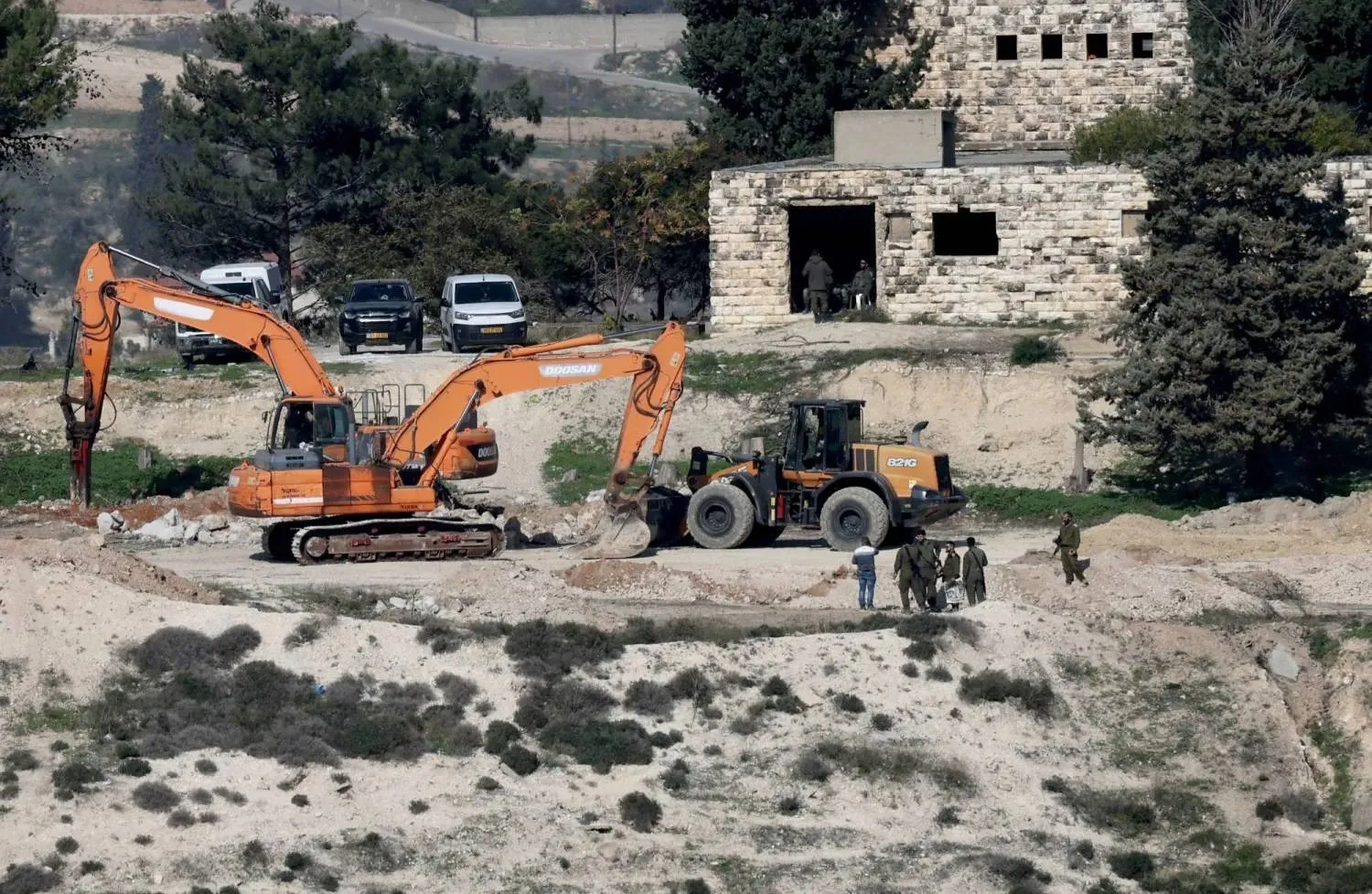
Israeli machinery levels land ahead of settlement construction near Jenin in the occupied West Bank, Dec. 23, 2025 (EPA)
TT

US Response Muted on New Israeli West Bank Measures

Israeli machinery levels land ahead of settlement construction near Jenin in the occupied West Bank, Dec. 23, 2025 (EPA)

Days ahead of Israeli Prime Minister Benjamin Netanyahu’s visit to Washington, his government moved on measures framed as procedural but laden with far-reaching sovereign implications.

Decisions by Israel’s security cabinet have made it easier for Israelis to purchase land in the West Bank and expanded Israeli enforcement tools in areas formally administered by the Palestinian Authority under the Oslo Accords.

A White House official reiterated President Donald Trump’s opposition to annexing the West Bank, but Washington’s response stopped short of any concrete measures.

The position, attributed to an unnamed official and unaccompanied by deterrent action, prompted speculation that the US stance amounted to tacit acquiescence rather than active opposition.

On the eve of Netanyahu’s arrival, Reuters cited a White House source as saying Trump continues to oppose Israeli annexation of the West Bank and views “stability” there as consistent with the goals of peace and Israel’s security.

The manner in which the position was conveyed, however, left room for interpretation. The issue, analysts say, is less whether Washington rejects annexation in principle than whether it opposes the cumulative steps that could lead to it.

Israeli officials have framed the measures as administrative, but critics view them as part of a broader pattern aimed at gradually altering conditions in the West Bank. Such steps, they argue, create facts on the ground that are later treated as irreversible.

In this reading, formal opposition to annexation does not preclude policies that effectively advance it without an explicit declaration, a process some observers describe as incremental annexation.

Limited US response

Restricting the US reaction to an unattributed statement suggests an effort to balance competing priorities: signaling continuity in Washington’s stated position while avoiding a confrontation with Netanyahu ahead of his visit.

Diplomats note that this approach indicates US objections are being managed through messaging rather than through policy leverage.

Even when the US language is explicit, its impact is limited unless it is accompanied by political cost. Governments typically adjust behavior in response to incentives or penalties, not statements alone.

In this context, the absence of measures reduces the deterrent effect of US opposition, leaving Israel with room to maneuver.

The timing of the Israeli decisions sends parallel messages. Domestically, they signal continued commitment to policies favored by right-wing constituencies and settler groups. Internationally, they suggest that reversing on-the-ground changes is becoming increasingly complex.

The approach reflects a familiar strategy of establishing new realities ahead of any renewed political process.

The moves also highlight the influence of Finance Minister Bezalel Smotrich within the governing coalition and his stated objective of undermining the practical foundations of a Palestinian state, even if the concept remains part of official rhetoric.

Measures described as technical adjustments thus take on broader political significance.

Impact on the two-state framework

The West Bank remains central to any viable Palestinian state. Steps that weaken Palestinian administrative authority or alter control over land are therefore assessed primarily by their effect on the feasibility of statehood.

Critics argue the latest measures move in the opposite direction, further blurring the distinction between Israeli control and Palestinian self-governance.

From Washington’s perspective, the situation underscores a broader contradiction. An administration that has shown limited engagement with the international consensus on a two-state solution is, in practice, also narrowing the range of alternative outcomes.

As prospects for two states diminish, analysts warn that other scenarios become more likely, including prolonged security control or recurring instability, complicating the US's assertions that current policies promote stability.

Reports in the US press citing Arab and Islamic condemnation, as well as concern at the United Nations, indicate that the West Bank remains a sensitive issue for many governments, including those maintaining ties with Israel.

Any perception of US leniency risks weakening those partners’ positions domestically.

At the United Nations, repeated warnings from international bodies have reaffirmed legal frameworks that Israel views as restrictive, but which others consider essential to any settlement.

While this divide is longstanding, critics note that developments on the ground are advancing faster than diplomatic efforts to address them.

As Washington emphasizes the importance of stability in the West Bank, the debate increasingly centers on what that stability entails: a temporary calm sustained by existing realities, or one underpinned by a credible political horizon.

For now, analysts say, each new Israeli step is being viewed less as an isolated decision than as a test of the credibility of the US's stated opposition.


Report: RSF Drone Strike on School Kills Two Children in Sudan’s Kordofan 

Displaced Sudanese gather near a food distribution point at the Abu al-Naga displacement camp in the Gedaref State, some 420km east of the capital Khartoum on February 6, 2026. (AFP)
TT

Report: RSF Drone Strike on School Kills Two Children in Sudan’s Kordofan 

Displaced Sudanese gather near a food distribution point at the Abu al-Naga displacement camp in the Gedaref State, some 420km east of the capital Khartoum on February 6, 2026. (AFP)

A drone strike blamed on Sudan's paramilitary Rapid Support Forces killed two children and injured 12 others Wednesday in the southern city of El-Rahad, a medical source told AFP.

El-Rahad lies in Sudan's Kordofan region, currently the fiercest battlefield in the war raging between the RSF and the regular army since April 2023.

"I saw a dozen students injured," Ahmed Moussa, an eyewitness to the attack, told AFP, adding that the drone had struck a traditional Quranic school.

El-Rahad, in North Kordofan state, was retaken by the army last February, as part of a rapid offensive that saw it push west to break a long-running siege on state capital El-Obeid.

The RSF has been trying to re-encircle El-Obeid since, including by launching successive drone strikes on the main highway out of the city, which connects the western region of Darfur with the capital Khartoum.

Since it began, the war has killed tens of thousands and left around 11 million people displaced, creating the world's largest hunger and displacement crises.

It has also effectively split the country in two, with the army holding the north, center and east while the RSF and its allies control the west and parts of the south.


Türkiye Signals May Launch ‘Simple’ Military Operation Against PKK in Iraq

PKK fighters in the Qandil Mountains of northern Iraq. (Reuters)
TT

Türkiye Signals May Launch ‘Simple’ Military Operation Against PKK in Iraq

PKK fighters in the Qandil Mountains of northern Iraq. (Reuters)

Türkiye has indicated it may launch a limited military operation against the Kurdistan Workers’ Party (PKK) in the Sinjar region of northern Iraq, while stressing its readiness to work with any government that assumes power in Baghdad.

Turkish Foreign Minister Hakan Fidan said the PKK is set to become a major issue for Iraq, noting that the group does not control any territory inside Türkiye, but “occupies large areas in Iraq”.

“How can a sovereign state allow this?” he asked, adding that “changes could soon take place” in several areas, including Iraq’s Sinjar, Makhmour and the Qandil Mountains.

Fidan outlined what he described as the PKK’s current deployment, saying Makhmour, south of Erbil near the Nineveh province, hosts the group’s civilian structures, while Sinjar, northwest of Mosul near the Syrian border, hosts its armed elements.

He said the leadership and command structures are based in the Qandil Mountains, with other strongholds near Duhok lying outside the area covered by Türkiye’s ongoing Claw Operation.

In a televised interview late Monday, Fidan stated that Sinjar is surrounded by Iraq’s Popular Mobilization Forces (PMF), revealing that Ankara has held around 20 meetings with PMF leader Faleh al-Fayyad to address the issue.

On possible military action against the PKK, he described it as “a simple military operation,” in which PMF forces would advance on the ground while Türkiye conducts air operations, estimating it would take two or three days.

Since 2024, Türkiye has pursued negotiations with imprisoned PKK leader Abdullah Ocalan, which led to his call on February 27, 2025, for the group to dissolve and lay down its arms.

The PKK subsequently announced a ceasefire, declared its dissolution on May 12, 2025, and held symbolic weapons-burning ceremonies in the Qandil Mountains in July. In October, it announced the withdrawal of its fighters from Türkiye to areas in Qandil.

On Baghdad’s position, Fidan said the Iraqi government would be forced to demonstrate genuine political will toward the PKK, insisting that the group cannot remain in Sinjar.

Iraq began addressing the issue during the tenure of former prime minister Mustafa al-Kadhimi and that, under current Prime Minister Mohammed Shia al-Sudani, the PKK has sought to expand its presence in Baghdad, he remarked.

Baghdad is in the process of forming a new government, months after holding parliamentary elections.

Over the past two years, Ankara and Baghdad have established a high-level security coordination mechanism to confront the PKK, holding five meetings in both capitals. The latest took place in April. Following Turkish President Recep Tayyip Erdogan’s visit to Iraq in April 2024, Iraq’s National Security Council formally designated the PKK a banned organization.

Fidan also said the Kurdish issue in Syria has direct implications for Iraq, hoping that Baghdad would draw lessons from recent developments in Syria, including the integration of Kurdish forces into the Syrian army, and take “prudent decisions to ease Iraq’s own transition”.


SDF Starts Withdrawing from Frontlines in Syria’s Hasakah  

Members of the SDF in Hasakah, northeastern Syria, on Tuesday during their withdrawal from frontline positions under an agreement with the Syrian government. (Reuters)
TT

SDF Starts Withdrawing from Frontlines in Syria’s Hasakah  

Members of the SDF in Hasakah, northeastern Syria, on Tuesday during their withdrawal from frontline positions under an agreement with the Syrian government. (Reuters)

The Syrian Democratic Forces (SDF) have begun withdrawing their troops from frontline positions in the city of Hasakah under an agreement reached with the Syrian government, according to news reports and photographs published by Reuters.

Earlier on Tuesday, SDF units started preparations to pull back from southern rural areas of Hasakah. Images circulated by local media showed SDF fighters withdrawing from the Panorama Roundabout checkpoint south of the city, ahead of handing it over to General Security forces.

The move followed a security meeting between the Internal Security Forces (Asayish) and Syrian security services to coordinate the deployment of internal security forces in the city, according to North Press.

Syrian security sources told Asharq Al-Awsat that implementation of the agreement is proceeding smoothly, including steps toward integration.

The SDF has nominated units to be incorporated as brigades within the Ministry of Defense, while some Asayish personnel are expected to join the General Security forces in predominantly Kurdish areas.

On Tuesday, the SDF also began withdrawing its military units and heavy equipment from contact lines inside Hasakah, particularly in southern neighborhoods around the Panorama Roundabout. This step is part of a permanent ceasefire and the launch of a gradual integration process stipulated in the January agreement.

Syrian affairs researcher from the Jusoor Center for Studies Mohammad Suleiman said the withdrawal involves redeploying SDF military forces from inside Hasakah to agreed barracks outside the city, including Dirbasiyah, Amuda, and the outskirts of Qamishli. At the same time, government internal security forces will deploy in the city centers of Hasakah and Qamishli to oversee security integration.

Suleiman noted differing interpretations of the agreement. The SDF considers the withdrawal limited to its military forces, with the Asayish remaining responsible for internal security, while the government views it as a timetable for a full SDF withdrawal from city neighborhoods.

He added that Syrian army units will also pull back to areas around Hasakah, including Shaddadi, while maintaining a ban on military forces entering cities, particularly those with a Kurdish majority.

The current phase marks the second stage of the agreement and includes the transfer of oil wells and Qamishli Airport to state control. A third phase will place border crossings under state control, notably the Nusaybin crossing with Türkiye and the Semalka crossing with the Iraqi Kurdistan Region.

The agreement also calls for the integration of Kurdish autonomous administration institutions into state bodies, stabilization of civilian employees, settlement of Kurdish civil and educational rights, and guarantees for the return of displaced residents to their homes.
