


Greece's Cycladic Islands Swept Up in Concrete Fever

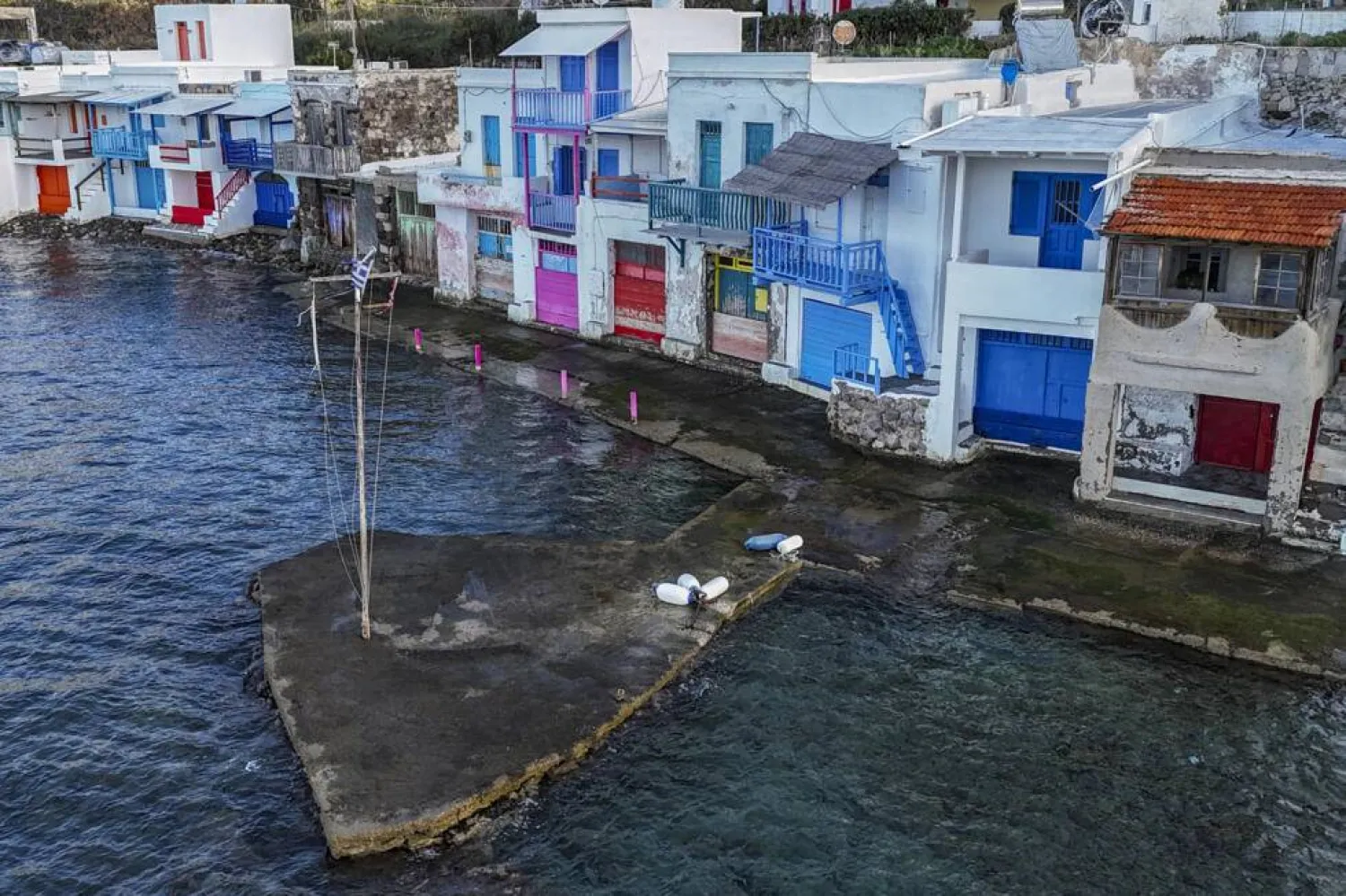
Real estate fever has broken out across Greece's Cyclades archipelago, threatening to destroy its picturesque landscapes. Aris MESSINIS / AFP
TT

Greece's Cycladic Islands Swept Up in Concrete Fever

Real estate fever has broken out across Greece's Cyclades archipelago, threatening to destroy its picturesque landscapes. Aris MESSINIS / AFP

On the sloping shoreline of the Greek Aegean island of Milos, a vast construction site has left a gaping wound into the island's trademark volcanic rock.

The foundations are for a hotel extension that attracted so much controversy last year that the country's top administrative court ended up temporarily blocking its building permit, said AFP.

Construction machinery still dots the site for a planned 59-room extension to the luxury resort, some of whose suites have their own swimming pools.

Milos Mayor Manolis Mikelis calls the project an "environmental crime".

"The geological uniqueness of Milos is known worldwide. We don't want its identity to change," he told AFP in his office, adorned with a copy of the island's most famous export, the Hellenistic-era statue of the love goddess Venus.

Fueled by a tourism boom, real estate fever has broken out across the Cyclades archipelago, threatening to destroy iconic landscapes of whitewashed houses and blue church domes.

In December, several mayors from the Cyclades as well as the Dodecanese -- which includes the highly touristic islands of Rhodes and Kos -- sounded the alarm.

"The very existence of our islands is threatened," they warned in a resolution initiated by the mayor of Santorini, Nikos Zorzos.

Tourism has become "a field for planting luxury residences to sell or rent," said Zorzos, whose island -- a top global destination -- welcomes roughly 3.5 million visitors for a population of 15,500.

- Rejecting 'plunder' -

The "Cycladic islands are not grounds for pharaonic projects", the mayors continued.

V Tourism, the company operating the hotel, argues that the expansion was approved in 2024 with "favorable opinions from all competent authorities".

But Mikelis, the mayor, noted that there are legislation "loopholes" when it comes to construction.

Like Santorini, Milos is a volcanic isle that is home to one of Greece's most unique beaches, Sarakiniko.

With its spectacular white formations rounded by erosion, the so-called 'moon beach' has bathers packed tighter than an astronaut's suit during summertime.

Yet Sarakiniko is not protected under Greek law.

Another hotel project there was blocked last year, and the environment ministry has given the owners a month's time to fill in its construction dig.

'Voracious'

Ioannis Spilanis, emeritus professor at the University of the Aegean, says what is happening in the Cyclades "is voracious, predatory real estate".

Once marginal land intended for grazing "have become lucrative assets. (Locals) are offered very attractive prices that are still low for investors."

"Then you build or resell for ten times more," he said.

In Ios, a small island with a vibrant nightlife, a single investor -- a Greek who made a fortune on Wall Street -- now owns 30 percent of the island, the mayors said in their December statement.

Tourism contributes between 28 and 33.7 percent of GDP, according to the Greek Tourism Confederation (SETE), making it a key sector that has propped up the country's economy for decades.

Some residents are gravely concerned about the real estate sweep's effects on Milos

Arrivals have been breaking record after record with more than 40 million visitors in 2024, a performance that was likely surpassed in 2025.

In Milos, which has more than 5,000 inhabitants, 48 new hotel projects are currently underway, according to the mayor, and 157 new building permits were awarded from January to the end of October 2025, according to the state statistical body.

On Paros, which has also experienced a real estate frenzy for several years, 459 building permits were granted over the same period, and on Santorini, 461.

The most ambitious projects in Greece are classified as "strategic investments", a fast-track procedure created in 2019 to facilitate investments deemed priorities.

But "there's often no oversight," said Spilanis, the academic.

Golden goose

And many of the new constructions are far removed from traditional Cycladic architecture.

But the tourism industry is a vital source of income on islands which are usually deserted in winter, and offering few other job prospects.

The tourism industry is a vital source of income on islands which are usually deserted in winter

"This island is a diamond, but unfortunately in recent years it’s become nothing but money, money, money," fumes a resident who spends half the year in Germany.

"But if I say that in public, everyone will jump down my throat!" she said.

In a 2024 report, the state ombudsman of the Hellenic Republic stressed the deterioration in quality of life on islands where residents can no longer find housing, as many owners prioritize lucrative short-term rentals, while waste management and water resources are also under major strain.

But there are signs of a slowdown in the Cyclades.

Santorini last year saw a 12.8-percent drop in air arrivals between June and September, while Mykonos had to settle for a meagre 2.4-percent increase.



'Breathtaking': Artemis Astronauts Blast towards Moon

This image taken from video provided by NASA shows the Earth, left, from NASA's Orion spacecraft as it fired its engines heading toward the moon Thursday, April 2, 2026. (NASA via AP)
TT

'Breathtaking': Artemis Astronauts Blast towards Moon

This image taken from video provided by NASA shows the Earth, left, from NASA's Orion spacecraft as it fired its engines heading toward the moon Thursday, April 2, 2026. (NASA via AP)

Four Artemis astronauts were zooming towards the Moon late Thursday after a major engine firing, a milestone that commits NASA to the first crewed lunar flyby in more than half a century.

With enough thrust to accelerate a stationary car to highway driving speed in less than three seconds, the Orion capsule engine blasted the astronauts on their trajectory towards the Moon, which they now will loop as part of the 10-day Artemis 2 mission, reported AFP.

In the moments that followed what the US space agency dubbed a "flawless" firing that lasted just under six minutes, astronaut Jeremy Hansen said that "humanity has once again shown what we are capable of."

The astronauts said they were "glued to the window" taking pictures, and later passed a floating microphone back and forth as they took questions from US television networks.

They said the spacecraft was a little chilly and they were still making it a home, but the crew was all smiles.

"There's nothing that prepares you for the breathtaking aspect of seeing your home planet both lit up bright as day, and also the Moon glow on it at night with the beautiful beam of the sunset," said Christina Koch.

Thursday's nudge came one day after the enormous orange-and-white Space Launch System (SLS) rocket carrying the Orion capsule launched from Kennedy Space Center in Florida for the long-anticipated journey around the Moon.

The astronauts are now on a "free-return" trajectory, which uses the Moon's gravity to slingshot around it before heading back towards Earth without propulsion.

"From this point forward, the laws of orbital mechanics are going to carry our crew to the Moon, around the far side and back to Earth," NASA official Lori Glaze said.

The astronauts are wearing suits that also serve as "survival systems" -- in the unlikely case of a cabin depressurization or leak, they'll maintain oxygen, temperature controls and the correct pressure for up to six days.

The astronauts -- Americans Reid Wiseman, Victor Glover and Koch along with Canadian Hansen -- spent their first hours in space performing checks and troubleshooting minor problems on the spacecraft that has never carried humans before, including a communications issue and a malfunctioning toilet.

Queried on the toilet situation, Koch said she was "proud to call myself the space plumber.

"I like to say that it is probably the most important piece of equipment on board," she said. "So we were all breathing a sigh of relief when it turned out to be just fine."

- 'Herculean' -

Crewmembers also had their first workouts of the mission on the spacecraft's "flywheel exercise device" -- each astronaut will carve out 30 minutes a day for fitness, a bid to minimize the muscle and bone loss that happens without gravity.

The 10-day mission is aimed at paving the way for a Moon landing in 2028.

Artemis 2 marks a series of historic accomplishments: sending the first person of color, the first woman and the first non-American on a lunar mission.

If all proceeds smoothly, the astronauts could also set a record by venturing farther from Earth than any human before.

"There is nothing normal about this," said Wiseman. "Sending four humans 250,000 miles away is a Herculean effort, and we are now just realizing the gravity of that."

The Artemis 2 mission is part of a longer-term plan to repeatedly return to the Moon, with the goal of establishing a permanent base that will offer a platform for further exploration.

The current era of American lunar investment has frequently been portrayed as an effort to compete with China, which aims to land humans on the Moon by 2030.

Asked about division closer to home and what message they had for Americans, Glover said from his vantage point, "You look amazing. You look beautiful."

"From up here, you also look like one thing," he added. "We're all one people."


Trump Ballroom Approved by Panel, Remains Stalled by Judge

Donald Trump has cited the need for the ballroom to host state dinners for visiting dignitaries. Mandel NGAN / AFP/File
TT

Trump Ballroom Approved by Panel, Remains Stalled by Judge

Donald Trump has cited the need for the ballroom to host state dinners for visiting dignitaries. Mandel NGAN / AFP/File

US President Donald Trump's White House ballroom won final planning approval on Thursday, but construction remains in limbo following a court order that he needs congressional approval.

The National Capital Planning Commission (NCPC), which has several Trump appointees on its board, greenlit the plans in an 8-1 vote, said AFP.

The project aims to construct a massive ballroom on the site of the White House's East Wing -- previously best known for housing the First Lady's offices. It was demolished in September.

Trump expressed his thanks in a post on his Truth social media platform, saying, "when completed, it will be the greatest and most beautiful ballroom of its kind anywhere in the world."

Planning approval does not, however, mean construction can go ahead unchecked.

On Tuesday, a federal judge ordered a halt to construction, saying Trump needed congressional approval. The president is "steward" of the White House, Judge Richard Leon wrote. "He is not, however, the owner!"

Will Scharf, the commission's chairman and a political ally of Trump, addressed the lawsuit before the vote, saying, "That order really does not impact our action here today.

"From my perspective, we have a project before us. We've been asked to review it, and that's really our job here today."

He noted that Judge Leon had placed a two-week delay on his stop-work order to allow the Trump administration to appeal.

The ballroom has become a passion project for Trump during his second term: the president often discusses the plan in public appearances, press conferences and meetings.

Trump has repeatedly said that a large ballroom is needed to host, among other key events, state dinners for visiting dignitaries.

"For more than 150 years, every president has dreamt about having a ballroom at the White House to accommodate people for grand parties, state visits, and even, in the modern day, inaugurations," Trump wrote on Truth. "I am honored to be the first president to finally get this much-needed project, which is on time and under budget, underway."

He has promised to meet the costs -- estimated to be upwards of $400 million -- with private donations, not tax payer money.


Waste Water to Clean Energy: Japanese Engineers Harness the Power of Osmosis

Engineers in the city of Fukuoka and their private partners have opened what is only the world's second osmotic power plant. Philip FONG / AFP
TT

Waste Water to Clean Energy: Japanese Engineers Harness the Power of Osmosis

Engineers in the city of Fukuoka and their private partners have opened what is only the world's second osmotic power plant. Philip FONG / AFP

A Japanese water plant is harnessing the natural process of osmosis to generate renewable energy that could one day become a common power source.

The possibility of generating power from osmosis -- when water molecules pass from a less salty solution to a more salty one -- has long been known.

But actually, generating energy from that has proved more complicated, in part due the difficulty of designing the membrane through which the molecules pass, said AFP.

Engineers in the city of Fukuoka and their private partners think they might have cracked it, and have opened what is only the world's second osmotic power plant.

It generates power from the transfer of molecules between treated sewage water and concentrated seawater, a waste product from a desalination plant in the city.

"If osmotic power generation technology advances to the point where it can be practically used with ordinary seawater... this, in turn, would represent a major contribution to efforts against global warming," said Kenji Hirokawa, manager at Sea Water Desalination Plant.

Osmosis is familiar to most people. It is the process that, for example, causes water to seep out of a cucumber or eggplant when sprinkled with salt.

Water molecules move across membranes from an area of low solution concentration to an area of higher concentrated solution.

At scale, that movement can be significant enough to turn a turbine and thereby generate electricity.

Desalination solution

Fukuoka is particularly well-placed to benefit from the technology because it has a readily available source of extremely salty water -- the brine leftover from desalination.

With no major rivers to sufficiently source its water, the city and wider Fukuoka region of 2.6 million people have relied on a major desalination plant to produce drinking water since 2005.

That left the city with large quantities of concentrated saline wastewater to deal with.

Ordinarily it is diluted and released back to the sea. Previous attempts to find alternatives, including salt making, failed to gain traction.

Then engineering firm Kyowakiden Industry approached the city about harnessing the salty wastewater for osmotic power.

"When our company rolls this out as a business, we aim to build plants roughly five to 10 times the scale of this current facility," said Tetsuro Ueyama, research and development manager at the Nagasaki-based company.

In Fukuoka's system, a generator is attached to a local desalination plant located near a sewage treatment facility.

It draws in highly saline wastewater from the desalination plant and receives treated sewage.

The two separate streams of liquid go through a number of chambers separated by semi-permeable membranes through which water molecules travel from the treated sewage toward the salty water.

That process increases the volume, pressure and speed of the saline water flow, spinning a turbine that generates electricity before the now-diluted mixture is discharged to sea.

The 700-million-yen ($4.4 million) power generation system came online last August, and once running at full capacity, it should generate up to 880,000 kilowatts annually, equivalent to the electricity consumption of 300 households.

However, it will remain devoted to supplying the power-thirsty facility, although it covers just a tiny fraction of its energy needs.

Not 'a pipe dream'

The engineers involved, however, are dreaming big.

The system will go through a five-year test to monitor its performance, including costs and maintenance, particularly for the membrane and other parts exposed to salt.

Financial details of the project have not been disclosed, but engineers admitted that for now the system's power costs "a lot more" than either fossil fuel or renewable energy.

Pumping the water into the system also uses energy itself, and scaling up osmotic power for grid-level energy production has not yet been done anywhere in the world.

Still, officials and experts believe the power source has a future, noting that unlike solar and wind, it is not dependent on weather or light.

And the current high costs are partly because the company had to build a one-of-a-kind power plant, Ueyama said.

Osmotic power has often been seen as primarily useful for estuary areas, where freshwater river flows meet the salty ocean.

But Ueyama said the technique being used in Japan could be useful for countries with large desalination facilities like Saudi Arabia and other Middle Eastern nations.

Kyowakiden is also working on technology that could generate similar power levels from less salty regular seawater.

"First we want to popularize this technology from Fukuoka to the rest of Japan. In order for us to do that, we want to further upgrade our technology to create osmotic power generation that can use ordinary ocean water to generate electricity," he said.

"We don't think this is a pipe dream."