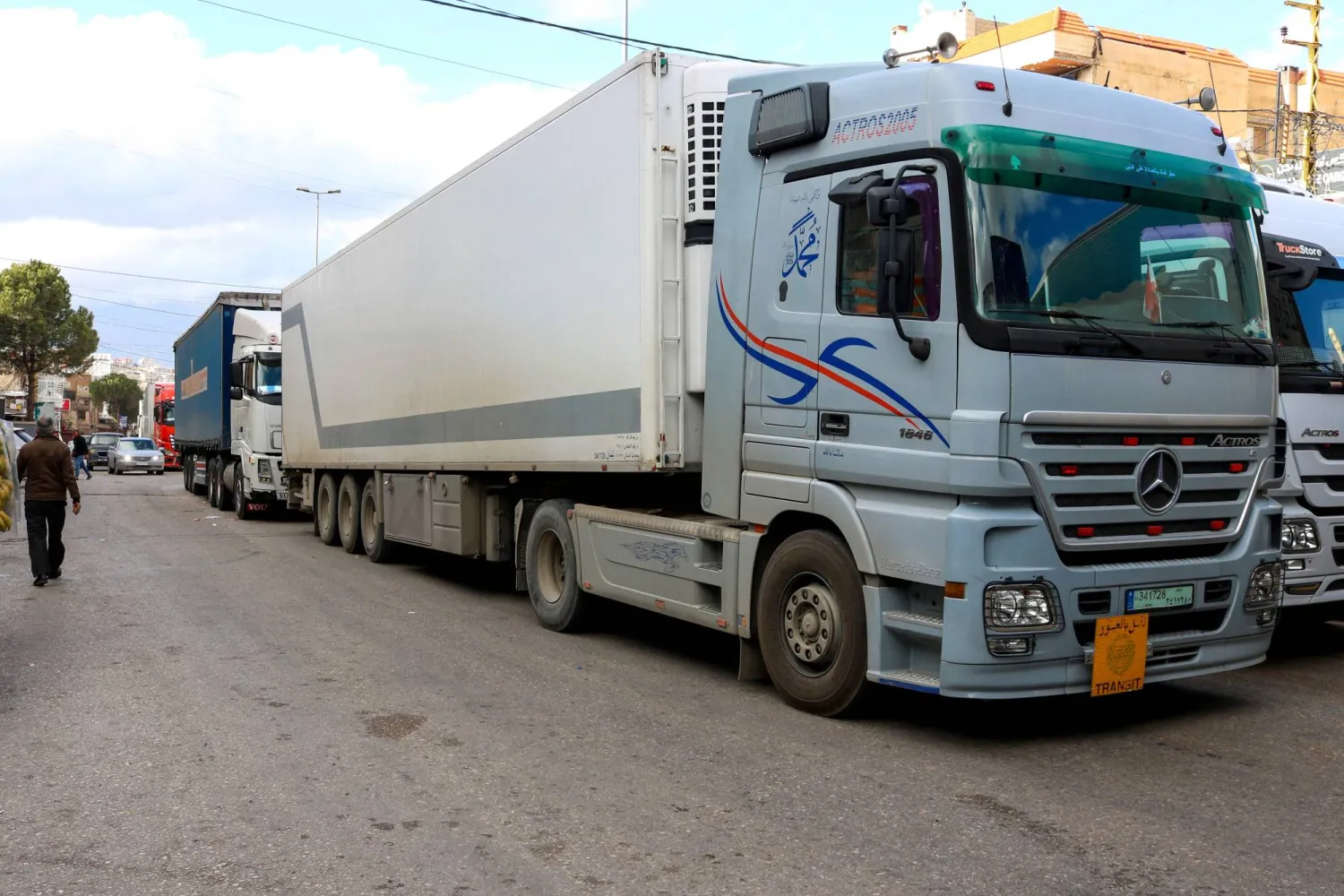
Lebanon, Syria Reach Temporary Solution for Freight Trucks Crisis

Lebanese truck drivers block the road on the Lebanese side of the Masnaa border crossing in protest against Syria's decision to ban non-Syrian trucks from entering its territory, on February 10, 2025. (Photo by Hassan JARRAH / AFP)
TT

Lebanon, Syria Reach Temporary Solution for Freight Trucks Crisis

Lebanese truck drivers block the road on the Lebanese side of the Masnaa border crossing in protest against Syria's decision to ban non-Syrian trucks from entering its territory, on February 10, 2025. (Photo by Hassan JARRAH / AFP)

Lebanon has secured temporary exemptions for freight vehicles hauling certain goods after a recent ban by Damascus on foreign trucks.

Damascus had issued a decision on Saturday stipulating that "non-Syrian trucks will not be allowed to enter" the country, and that goods being imported by road must be unloaded at specific points at border crossings.

The decision exempts trucks that are only passing through Syria to other countries.

Lebanese and Syrian trucks will now unload and reload goods at a joint zone along the border with a temporary mechanism put in place to regulate movement over seven days.

However, goods transported in tankers, hazardous materials, cement, raw materials for cement production, as well as meat and pharmaceuticals will be exempt from these border transfers.

The two sides will meet again on February 19 before the end of the seven-day deadline to evaluate the situation.


Abbas Urges Removal of Israeli 'Obstacles' on Gaza Ceasefire

A photograph shows tents and makeshift shelters at a camp for displaced Palestinians in Khan Yunis, in the southern Gaza Strip, on a foggy day on February 14, 2026. (Photo by Bashar Taleb / AFP)
TT

Abbas Urges Removal of Israeli 'Obstacles' on Gaza Ceasefire

A photograph shows tents and makeshift shelters at a camp for displaced Palestinians in Khan Yunis, in the southern Gaza Strip, on a foggy day on February 14, 2026. (Photo by Bashar Taleb / AFP)

Palestinian president Mahmoud Abbas called on Saturday for the removal of "all obstacles" he said Israel has imposed on the implementation of the second phase of the Gaza ceasefire, in a speech at an African Union summit in Ethiopia.

"We emphasize the need to lift all obstacles imposed by the Israeli occupation on the implementation of the provisions related to the second phase of the agreement," Abbas said.

This included the work of a technocratic committee established to oversee the day-to-day governance of Gaza, he added in a speech read by his prime minister Mohammed Mustafa.

Israel and Hamas agreed to a ceasefire in October as part of a US plan to end the war in Gaza. Both sides have repeatedly accused each other of violations.

According to Gaza's Health Ministry, more than 590 Palestinians have been killed by Israeli troops in the territory since the ceasefire began.


US Moves to Pursue Benghazi Consulate Attack Suspects

Zubayar al-Bakoush before arriving in the US last week. Photo: FBI Director Kash Patel on X
TT

US Moves to Pursue Benghazi Consulate Attack Suspects

Zubayar al-Bakoush before arriving in the US last week. Photo: FBI Director Kash Patel on X

Many Libyan figures have begun looking over their shoulders after their names were cited in a US indictment accusing them of involvement in the 2012 attack on the US consulate compound in the eastern city of Benghazi, which killed US Ambassador Christopher Stevens and three other Americans.

Statements by a former Central Intelligence Agency official suggest Washington is determined to widen the net to arrest all suspects said to have been involved in what it describes as a “terrorist attack.”

The campaign has not been limited to those previously detained, including Zubayar al-Bakoush.

Libyan rights activists said members of the Joint Force, led by Omar Boughdada, arrested Abrik Mazek al-Zawi, a member of the Ajdabiya Shura Council known as “Abrik al-Masriya,” in the Tamina area of Misrata.

The interim Government of National Unity, headed by Abdul Hamid Dbeibah, did not comment on the incident. Witnesses said an “armed security force abducted him.”

Al-Zawi, born in 1978, lived in the Al-Fateh district of Ajdabiya in eastern Libya. He worked in the housing and utilities sector and had previously served on the Ajdabiya Shura Council.

Over the past two days, US authorities published photographs of 29 Libyans extracted from surveillance footage taken during the storming of the US diplomatic compound and a CIA annex in Benghazi. They called on Libyans to provide information about the individuals, a day after announcing the arrest of al-Bakoush, who is accused of taking part in the 2012 assault.

Stevens was killed in the Sept. 11, 2012, attack along with US State Department employee Sean Smith and former Navy SEALs Glen Doherty and Tyrone Woods.

Al-Bakoush’s wife, Basma al-Fakhri, previously said that a heavily armed force identifying itself as belonging to the Internal Security Agency stormed their home earlier this month and took her husband away.

She said she went to the agency’s headquarters the next day to deliver medicine and clothes, only to receive an official statement denying any link to the arrest.

In addition to al-Bakoush and al-Zawi, US authorities previously took custody of Abu Anas al-Libi in 2013, Ahmed Abu Khattala in 2014, and Abu Agila Masud in 2022.

Abu Anas al-Libi was tried on charges linked to the 1998 bombings of US embassies in Kenya and Tanzania and died in prison in 2015. Abu Khattala was convicted in the Benghazi compound attack case and is serving a prison sentence.

Abu Agila Masud has been appearing before a federal court in Washington since being handed over by the Government of National Unity in early December 2022, on suspicion of involvement in the 1988 bombing of Pan Am Flight 103 over Lockerbie, Scotland.

Al-Bakoush faces eight criminal charges, according to the US Justice Department, including providing material support and resources to terrorist organizations, resulting in the deaths of four Americans. The indictment says he took part in the ground assault as part of the armed group that breached the compound’s entrance.

Since the suspects’ photos were circulated, Sarah Adams, a former CIA officer and national security expert, has weighed in on the crisis.

Writing on her account on X, she spoke of empowering individuals linked to extremist groups to hold official positions, and alleged that two prominent suspects in planning the attack later became ambassadors, giving them official cover and broad international mobility.

She also alleged the presence of “sleeper elements” inside the United States benefiting from transnational organizational frameworks.

Relations between Washington and Tripoli appear “to be fine” at present. Massad Boulos, a senior adviser to the US president, visited the Libyan capital twice in recent weeks.

Libyan political analyst Osama al-Shahoumi said reopening the Benghazi consulate attack file “did not come out of nowhere.”

Speaking to Libyan TV on Thursday evening, he said, “There is a long list of names that have not been held accountable, and the information has been available for years.”

Al-Shahoumi added that when he asked Adams whether new indictments could be unveiled in the future, as in al-Bakoush’s case, she said she hoped so, “because we want to remove more senior terrorists from the battlefield.”


After Two Years of War, Tally of Israel-Hamas Prisoner Swaps

A Hamas banner reading “We Are the Flood… We Are the Day After” during the handover of a group of Israeli hostages (file photo – AFP)
TT

After Two Years of War, Tally of Israel-Hamas Prisoner Swaps

A Hamas banner reading “We Are the Flood… We Are the Day After” during the handover of a group of Israeli hostages (file photo – AFP)

Israel’s military on Friday released new footage of the rescue of two hostages, Fernando Simon Marman and Norberto Louis Har, Israeli nationals who also hold Argentine citizenship, from a house in the southern Gaza city of Rafah.

The operation was carried out on Feb. 12, 2024, amid intense gunbattles with their captors from the Qassam Brigades, the armed wing of Hamas. Several of the gunmen were killed, along with other Palestinian civilians.

Since Oct. 7, 2023, when Hamas launched a surprise attack on Israeli towns and military sites along the Gaza border, and through the same month in 2025, three prisoner exchange deals were conducted between Israel and the Palestinian group.

The swaps took place during a two-year war in which Tel Aviv failed to recover additional hostages alive, although it retrieved numerous bodies.

Israel made several attempts to retrieve hostages by force. The army succeeded on three occasions, including the Rafah operation. In October 2023, it rescued soldier Ori Megidish from Al-Shati refugee camp west of Gaza City in a swift raid.

In June 2024, it recovered four hostages from the Nuseirat refugee camp in central Gaza during a large-scale military operation. The military also recovered the bodies of other captives in separate operations deep inside the enclave.

Across the three agreements, Hamas returned a total of 252 Israeli and foreign hostages, dead and alive, according to Israeli figures. Four of them had been captured in 2014, including two soldiers later confirmed dead, and two civilians who had crossed into Gaza and were said to have suffered from mental illness; both were returned alive.

In exchange, Israel released more than 3,985 Palestinians from Gaza, the West Bank, and Jerusalem.

They included 486 serving life sentences, 319 serving long-term sentences, among them 13 detained since before the Oslo Accords, 114 women, and 279 minors. Forty-one had previously been freed in the 2011 deal that secured the release of Israeli soldier Gilad Shalit and were later rearrested.

Another 22 had not yet been sentenced.

Of the total, 2,724 were detained in Gaza after Oct. 7, 2023.

Negotiations were repeatedly marred by disputes over exchange ratios. Hamas demanded higher numbers in return for Israeli soldiers, at one stage seeking 500 Palestinian prisoners per soldier.

Israeli and mediator pressure led to agreed formulas of 30 prisoners for each civilian hostage and 50 for each soldier. However, Israel continued to release only 30 in some cases.

The first swap followed a six-day temporary truce in late November 2023. Hamas and other Palestinian factions released 50 Israeli hostages classified as humanitarian cases, including women and children, in exchange for 240 Palestinian prisoners, among them 169 boys and 71 women.

During the third week of the war, Hamas also freed four elderly Israeli women without compensation. Separately, 10 Thai workers and one Filipino were released alive during the deal through mediation efforts.

Efforts to extend the truce and secure further releases collapsed, and the war resumed with greater intensity for Gaza’s population.

After prolonged mediation, a three-phase ceasefire agreement was reached in mid-January 2025. The plan provided for the release of living civilian hostages in the first phase, soldiers in the second, and bodies in the third.

It stipulated the release of 30 Palestinian prisoners, including some serving life sentences, for each civilian freed by Hamas, and 50 Palestinians for each soldier, including 30 serving life terms and 20 serving long sentences.

Hamas released 25 living hostages classified as humanitarian cases, including women, children, civilians over 50, and wounded or sick non-combatants. It also handed over the bodies of eight hostages and freed five Thai workers without compensation.

After those releases, Israel refused to free the agreed number of Palestinians in exchange for soldiers and insisted on classifying Arbel Yehoud, whom Palestinians described as a soldier, as a civilian. Her release had been scheduled for late January, and the dispute temporarily stalled the deal.

Mediators later intervened, and she was freed after Israel maintained she was a civilian, allowing displaced residents to return from southern to northern Gaza after Israel had linked their return to her release.

During that phase, five female soldiers abducted from the Nahal Oz site east of Gaza were freed and classified as humanitarian cases, with 30 Palestinians released in exchange for each. At the time, at least 13 Israeli soldiers remained in Hamas captivity, including the highest-ranking officer, Asaf Hamami, commander of the Southern Brigade in the Gaza Division, who was later confirmed dead.

In that deal, Hamas surprised Israel with the number of hostages returned alive, despite Israeli assessments that some had been killed. They included Avera Mengistu and Hisham al-Sayed, who had entered Gaza in 2014 and were captured at the time. After years in captivity, both were confirmed alive upon their release.

Israel freed 1,778 Palestinians in that agreement, including 1,024 Gazans detained during the war. It also released 294 prisoners serving life or long-term sentences, among them 71 women.

On March 18 of the same year, Israel resumed its military campaign after talks to extend the truce failed.

On May 12, Hamas handed over hostage Edan Alexander, an Israeli soldier with US citizenship, as a goodwill gesture toward US President Donald Trump, in exchange for improvements to Gaza’s humanitarian conditions and progress in negotiations, without securing the release of Palestinian prisoners. Israel did not implement those understandings.

Following arduous negotiations, a comprehensive agreement to end the war was reached in October 2025. Israel recovered the remaining 20 living hostages in a single batch and retrieved the dead in stages after searches. The last was Israeli police officer Ran Gvili, whose body was found on Jan. 26 after weeks of efforts to recover it.

In return, Israel released 1,968 Palestinian prisoners, including 1,718 detained during the Gaza war. The group included 250 prisoners, among them 192 serving life sentences and 25 serving long terms. Most were deported outside Gaza to other countries.