

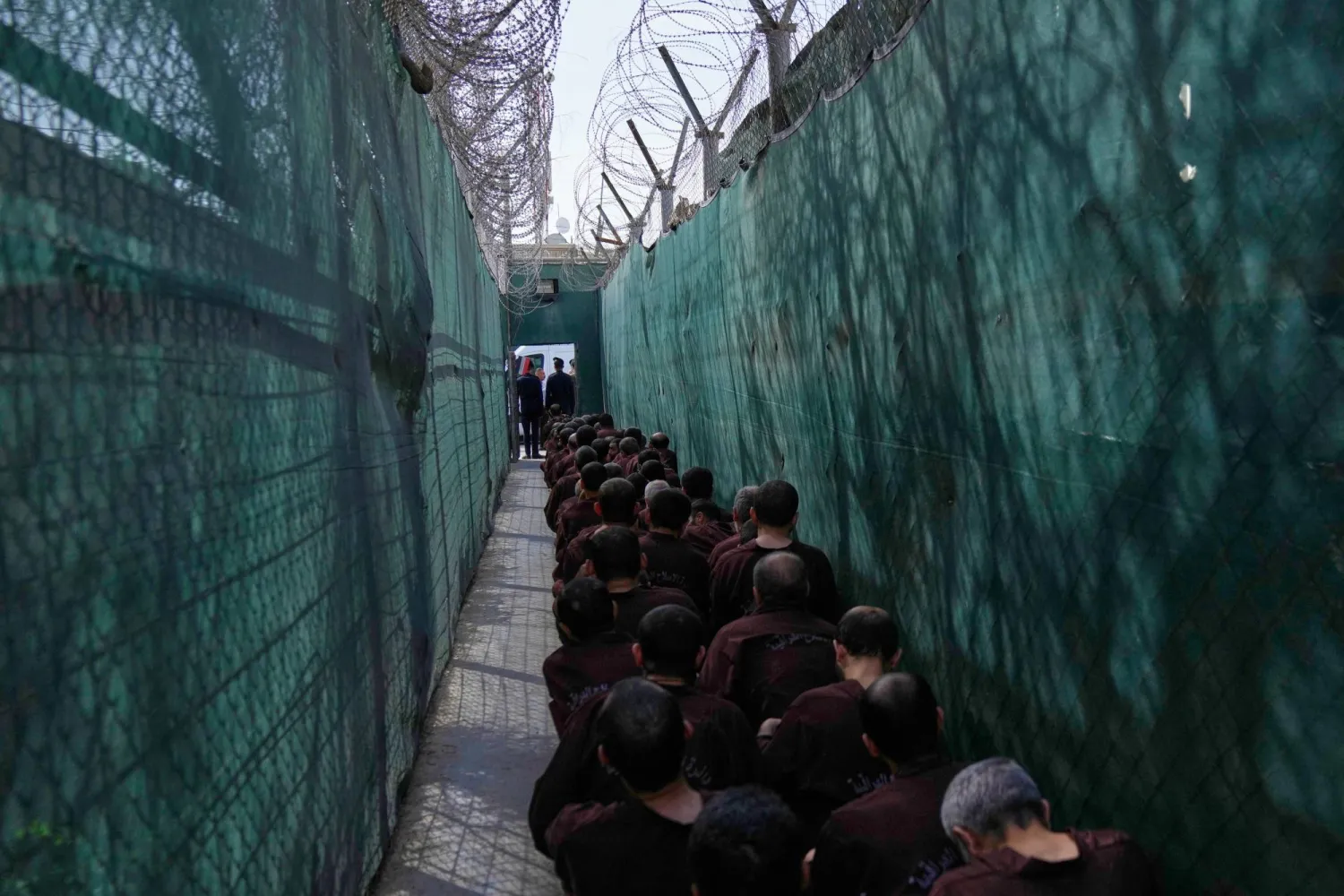

ISIS Suspects Transferred from Syria to Iraq are Interrogated in a Baghdad Prison

Iraqi security forces lead suspected ISIS militants for questioning, after they were transferred from Syria to Iraq, at Al-Karkh Central Prison in Baghdad, Iraq, Thursday, Feb. 12, 2026. (AP Photo/Hadi Mizban)
TT

ISIS Suspects Transferred from Syria to Iraq are Interrogated in a Baghdad Prison

Iraqi security forces lead suspected ISIS militants for questioning, after they were transferred from Syria to Iraq, at Al-Karkh Central Prison in Baghdad, Iraq, Thursday, Feb. 12, 2026. (AP Photo/Hadi Mizban)

Inside a heavily guarded detention facility in Baghdad, men from scores of different countries and nationalities were brought one after another into interrogation rooms and questioned by Iraqi officers.

The prisoners are suspected members of the militant ISIS goup recently transferred from Syria to Iraq at the request of Baghdad — a move welcomed by the US-led coalition that had for years fought against ISIS.

Over a period of several weeks, the US military escorted more than 5,000 ISIS detainees from 60 different nationalities from prisons in northeastern Syria run by the US-backed and Kurdish-led Syrian Democratic Forces, to Baghdad.

The transfers have helped calm fears that the fighting in Syria would allow the ISIS prisoners to flee from detention camps there and join militant sleeper cells that even to this day are able to stage attacks in both Iraq and Syria.

On Thursday, The Associated Press was given rare access to the sprawling detention facility in western Baghdad — now known as Al-Karkh Central Prison but more widely known as Camp Cooper after the 2003 US-led invasion that ousted Saddam Hussein — where the men are being interrogated.

Laying the groundwork for trials Iraq is looking to put on trial some of the thousands of the ISIS detainees who were held for years in Syria without charges or access to the judicial system.

Iraqi Judge Ali Hussein Jafat, who is heading the committee interrogating ISIS detainees brought from Syria, says it's not easy because of the sheer numbers of prisoners involved.

It's "complicated and not easy at all,” he said, adding that the detainees are from 14 Arab and 46 other countries.

Many of the detainees have respiratory diseases, so a medical center was set up to treat them, he said.

To make room for the newcomers from Syria, thousands of prisoners long held at Al-Karkh were transferred to other prisons in Iraq.

The interrogations are usually a staggered affair — the men were brought in batches, handcuffed, in yellow or brown uniforms and wearing medical face masks and taken into a long corridor with rooms on both side.

One by one they are then taken into interrogation rooms, where they sit on a chair as an officer takes down their information. From behind a small window, the AP could observe the questioning but not discern the questions or the detainees' answers. It wasn't clear if the prisoners were under duress.

Some of the prisoners are taken to the medical center for a checkup.

How the transfer came about

The forces of Syria's new government that in December 2024 ousted strongman Bashar Assad launched an offensive in January, capturing wide swaths of territory from the Kurdish-led SDF.

A ceasefire was later reached, ending the fight and the SDF withdrew as part of the agreement.

At the time, the United States announced that many of the nearly 9,000 detainees held in more than a dozen Syrian detention centers will be transferred to Iraq.

So far, 5,383 ISIS suspects have been brought to Iraq. The last batch is expected to arrive on Sunday, Jafat said.

A dark past

When ISIS declared a caliphate — a self-proclaimed territory under a traditional form of their extremist rule — in large parts of Syria and Iraq that the militant group seized in 2014, it attracted extremists from around the world.

From the caliphate, the extremists plotted attacks around the world that left hundreds dead from Europe to Arab countries and Asia.

The group also carried out brutalities in Syria and Iraq, including the enslavement of thousands of Yazidi women and girls who were taken when the militants overran northern Iraq. Strict rules were implemented, with ISIS beheading its opponents, thieves having their hands amputated while women accused of adultery were stoned to death.

Over the years, an international campaign by a US-led coalition defeated ISIS in Iraq in 2017 and in Syria in 2019.

“Some of them are extremely dangerous,” Jafat said about the detainees.

He added that he has so far seen detainees from Australia, Canada, Türkiye, Germany, Britain and the former Soviet Union.

Many of the countries don't want the militants who are their nationals back and Jafat said it is too early to say whether the detainees could be extradited or repatriated to their countries of origin.

Those who committed crimes in Iraq will stand trials in Iraq and the proceedings will be open to the public, he added.



Arab Parliament Speaker Condemns Israeli Settlement Plan in West Bank

Arab Parliament logo
TT

Arab Parliament Speaker Condemns Israeli Settlement Plan in West Bank

Arab Parliament logo

Arab Parliament Speaker Mohammed Al-Yamahi strongly condemned Israel’s plan to implement the expansionist settlement project in the E1 area of the occupied West Bank and rejected the remarks made by Israel’s security minister calling for the killing of dozens of Palestinians in the Gaza Strip, the Saudi Press Agency reported on Friday.

He stressed that proceeding with the project despite international warnings defies international law and relevant international resolutions.

He called on the international community, the UN Security Council, parliaments, and international organizations to take concrete measures to halt settlement and annexation activities, hold those responsible for incitement accountable, and work toward achieving peace, which begins with ending the occupation and enabling the Palestinian people to exercise their legitimate rights.


Syria Requests to Join Anti-chemical Weapons Partnership

The logo of the Organization for the Prohibition of Chemical Weapons (OPCW) is seen during a special session in the Hague, Netherlands June 26, 2018. REUTERS/Yves Herman Purchase Licensing Rights
TT

Syria Requests to Join Anti-chemical Weapons Partnership

The logo of the Organization for the Prohibition of Chemical Weapons (OPCW) is seen during a special session in the Hague, Netherlands June 26, 2018. REUTERS/Yves Herman Purchase Licensing Rights

Syria on Friday said it had requested to join the International Partnership Against Impunity for the Use of Chemical Weapons on the anniversary of a 2013 chemical attack on a suburb of the capital Damascus.

In a joint statement with France commemorating the attack during former leader Bashar al-Assad's rule on opposition-held areas, Syria announced its bid to join the partnership of dozens of countries, launched by Paris in January 2018.

France welcomed the step as "a clear demonstration of Syria's commitment to strengthening accountability and justice and combating impunity" following its more than decade-long civil war.

Damascus and Paris also said they "commemorate the victims, extend their deepest sympathies and solidarity to their families, and reaffirm their joint commitment to supporting efforts to uncover the truth, ensure justice, and hold those responsible for these crimes accountable".

In August 2013, the Syrian army under Assad was accused of using chemical weapons to target areas then under the opposition’s control.

According to US intelligence and rights groups, more than 1,400 men, women and children died as a result.

With Syria at the height of its civil war, the Assad government denied responsibility, but agreed to hand over its chemical arsenal in order to avert US strikes.

Assad went on to remain in power for more than a decade, only to be ousted in 2024 by opposition forces, headed by now President Ahmed al-Sharaa.

Survivors of the attacks, including medics, at the time risked their lives by posting dozens of videos online, and spoke to journalists including AFP reporters about the horror they had witnessed.

The footage showed dozens of corpses, many of them children, outstretched on the ground.

Other images showed unconscious children, people foaming at the mouth and doctors trying to help them breathe.

The scenes provoked revulsion and condemnation around the globe.

- 'Painful chapter' -

A United Nations report later said there was clear evidence sarin gas had been used.

Syria agreed to join the Organization for the Prohibition of Chemical Weapons (OPCW) and disclose and hand over its toxic stockpile under Russian and US pressure, averting the threat of strikes by Washington and its allies.

But that was not the last of the chemical attacks: the OPCW went on to blame Assad's forces for others later in the civil war.

Marking 13 years since the attack, Syrian Foreign Minister Asaad al-Shaibani called it "one of the most painful chapters in Syria's history".

"Tomorrow, the Syrian Arab Republic begins a new phase in dealing with the legacy of these weapons. We have initiated the necessary technical and logistical procedures for their disposal, in cooperation with our international partners," he added, also vowing to pursue those involved in the attack.

Several Syrian officers linked to the attack have been arrested since Assad's fall.

Syria's civil war began in 2011, with a brutal crackdown on dissent that yielded an armed rebellion. More than half a million people ended up being killed, with millions more forced into exile.

The OPCW reinstated Syria last month, five years after taking the unprecedented step of stripping it of its voting rights.


Iran's Qalibaf Urges Baghdad to Break Economic Dependence on Washington

 Iranian Parliament Speaker Mohammad Baqer Qalibaf (R) attends a ceremony marking 40 days since the burial of Supreme Leader Ali Khamenei in Karbala, central Iraq, Aug. 20, 2026. (AFP)
Iranian Parliament Speaker Mohammad Baqer Qalibaf (R) attends a ceremony marking 40 days since the burial of Supreme Leader Ali Khamenei in Karbala, central Iraq, Aug. 20, 2026. (AFP)
TT

Iran's Qalibaf Urges Baghdad to Break Economic Dependence on Washington

 Iranian Parliament Speaker Mohammad Baqer Qalibaf (R) attends a ceremony marking 40 days since the burial of Supreme Leader Ali Khamenei in Karbala, central Iraq, Aug. 20, 2026. (AFP)
Iranian Parliament Speaker Mohammad Baqer Qalibaf (R) attends a ceremony marking 40 days since the burial of Supreme Leader Ali Khamenei in Karbala, central Iraq, Aug. 20, 2026. (AFP)

Iranian Parliament Speaker Mohammad Baqer Qalibaf on Friday urged Baghdad to reduce its reliance on the dollar and draw up what he called a “precise roadmap” for economic cooperation between the two countries.

Qalibaf made the remarks during a visit to the southwestern Iraqi city of Najaf, as the region awaits what has been described as an unprecedented package of US sanctions on Iran and its trading partners.

Iran must plan to overcome what Qalibaf called “unjust sanctions,” after US Treasury Secretary Scott Bessent announced what he described as the toughest sanctions ever imposed on Iran, according to Reuters.

Earlier, at a consultative meeting with business figures at the Iranian embassy in Baghdad, Qalibaf called for a “precise roadmap” for economic ties with Iraq that would include moving away from the US dollar.

He said the two countries should end their reliance on the US currency and use local currencies in trade.

“The era of US dominance over the world has ended, but we have not made proper use of the opportunities available to us, and we are still conducting trade through outdated methods,” Qalibaf said.

Iraq relies entirely on the dollar for its oil exports, which generate more than 90% of national revenues. The proceeds are deposited in US dollars into an account held in the name of the Central Bank of Iraq at the Federal Reserve Bank of New York.

‘Difficult and trying circumstances’

In stark contrast, Iraqi Prime Minister Ali al-Zaidi sought to reassure public-sector employees and pensioners that monthly salaries and government payments were fully secured, even as he warned that Iraq was facing “difficult and trying circumstances” due to regional developments and disruptions to oil exports through the Strait of Hormuz.

Speaking at the Baghdad Dialogue conference, organized by the Iraqi Institute for Dialogue, al-Zaidi said Iraq faced major economic challenges and described the closure of the Strait of Hormuz as a key obstacle.

The strait, he said, “was not closed even during the harshest days of the blockade.”

Al-Zaidi said the government had found alternative routes for oil exports and activated border crossings to bolster trade, adding that the state had “more than one solution” to preserve economic stability and contain the fallout from the crisis.

He said Iraq was working to expand oil exports through Türkiye’s Ceyhan port, while efforts continued to develop export routes through Banias and Aqaba.

“We are working to increase Iraq’s export quota through OPEC, and we aim to reach 8 million to 10 million barrels per day within six years,” al-Zaidi said.

“Iraq fought ISIS on behalf of the region and the world, and it is only fair that it receive a crude oil export quota commensurate with the size of its population and its oil reserves.”

On the political front, al-Zaidi said political forces were in full agreement that the government should press ahead with its anti-corruption campaign.

He described “the battle against the looting of public funds” as a matter of honor for him.

The government launched an operation dubbed “Dawn Crackdown” on June 28 to combat the looting of public funds. The operation has targeted political officials, lawmakers, and businesspeople.