


What is the Two-state Solution to the Israel-Palestinian Conflict?

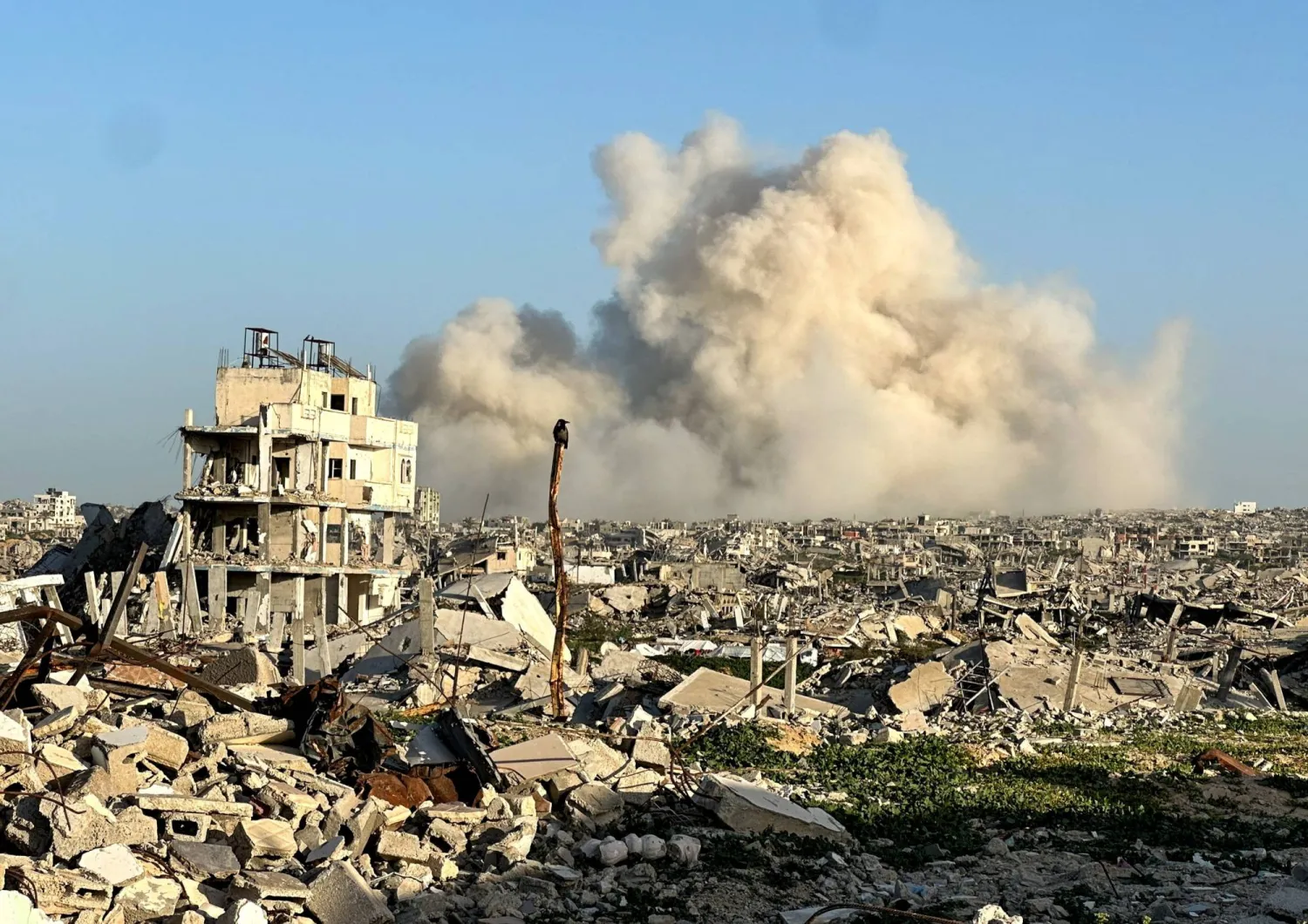
FILE PHOTO: Smoke rises following an explosion, within the "yellow line" zone, which is controlled by Israel, in Khan Younis in the southern Gaza Strip, February 10, 2026. Picture taken with a phone. REUTERS/Haseeb Alwazeer/File Photo
TT

What is the Two-state Solution to the Israel-Palestinian Conflict?

FILE PHOTO: Smoke rises following an explosion, within the "yellow line" zone, which is controlled by Israel, in Khan Younis in the southern Gaza Strip, February 10, 2026. Picture taken with a phone. REUTERS/Haseeb Alwazeer/File Photo

Israel has taken steps ‌to help settlers acquire land in the occupied West Bank and widen its powers in parts of the territory where Palestinians have some self-rule - measures they said aimed to undermine the two-state solution.

It marks the latest blow to the idea of establishing a Palestinian state co-existing peacefully alongside Israel in territory Israel captured in the 1967 Middle East war. Long backed by world powers, this vision formed the bedrock of the US-backed peace process ushered in by the 1993 Oslo Accords.

But the obstacles have only grown with time. They include accelerating Jewish settlement on occupied land and uncompromising positions on core issues including borders, the fate of Palestinian refugees and the status of Jerusalem.

WHAT ARE ISRAEL'S NEW DECISIONS?

They would expedite settler land purchases by making public previously confidential West Bank land registries, and also repeal a Jordanian law governing land purchases in the West Bank, which was controlled by Jordan from 1948 until 1967.

Further, Israel would expand "monitoring and enforcement actions" to parts of the West Bank known as areas A and B, specifically "regarding water offences, damage to archaeological sites and environmental hazards that pollute the entire region", a statement by the finance and defense ministers said.

The West Bank was split into Areas A, B and C under the Oslo Accords. The Palestinian Authority has full administrative and security control in Area A - 18% of the territory. In Area B, around 22%, ‌the PA runs civil ‌affairs with security in Israeli hands. Most Palestinians in the West Bank live in areas A and B.

Israel ‌has ⁠full control over ⁠the remaining 60% - Area C, including the border with Jordan.

Palestinian President Mahmoud Abbas said the measures violate international law and aim to undermine Palestinian institutions and a future two-state solution.

Ultranationalist Israeli Finance Minister Bezalel Smotrich called the decision a "real revolution" and said, "We will continue to kill the idea of a Palestinian state."

WHAT ARE TWO-STATE SOLUTION'S ORIGINS?

Conflict ignited in British-ruled Palestine between Arabs and Jews who had migrated there, seeking a national home as they fled antisemitic persecution in Europe and citing biblical ties to the land throughout centuries in exile.

In 1947, the United Nations agreed on a plan partitioning Palestine into Arab and Jewish states with international rule over Jerusalem. Jewish leaders accepted the plan, which gave them 56% of the land. The Arab League rejected it.

The state of Israel was declared on May 14, 1948. A day later, five Arab states attacked. The war ended with ⁠Israel controlling 77% of the territory.

Some 700,000 Palestinians fled or were driven from their homes, ending up in Jordan, Lebanon ‌and Syria as well as in the Gaza Strip, the West Bank and East Jerusalem.

In the 1967 ‌war, Israel captured the West Bank, including East Jerusalem, from Jordan and Gaza from Egypt.

Although 157 of the 193 UN member states already recognize Palestine as a state, it is ‌not itself a UN member, meaning most Palestinians are not recognized by the world body as citizens of any state. About nine million live as ‌refugees in Syria, Lebanon, Jordan and territories captured by Israel in 1967. Another 2 million live in Israel as Israeli citizens.

HAS A DEAL EVER BEEN CLOSE?

The Oslo Accords, signed by Israeli Prime Minister Yizhak Rabin and Palestine Liberation Organization Chairman Yasser Arafat, led the PLO to recognize Israel's right to exist and renounce violence. Palestinians hoped this would be a step towards independence, with East Jerusalem as their capital.

The process suffered multiple reverses on both sides.

Hamas killed more than 330 Israelis in suicide attacks from 1994 to 2005, according ‌to Israel's government. In 2007, the group seized Gaza from the PA in a brief civil war. Hamas' 1988 charter advocates Israel's demise, though in recent years it has said it would accept a Palestinian state along 1967 borders. ⁠Israel says that stance is a ⁠ruse.

In 1995, Rabin was assassinated by an ultranationalist Jew seeking to derail any land-for-peace deal.

In 2000, US President Bill Clinton brought Arafat and Israeli Prime Minister Ehud Barak to Camp David to clinch a deal, but it failed, with the future of Jerusalem, deemed by Israel as its "eternal and indivisible" capital, the main obstacle.

The conflict escalated with a second Palestinian intifada (uprising) in 2000 to 2005. US administrations sought to revive peacemaking, to no avail, with the last bid collapsing in 2014.

HOW BIG ARE THE OBSTACLES TODAY?

While Israel withdrew settlers and soldiers from Gaza in 2005, settlements expanded in the West Bank and East Jerusalem, their population rising from 250,000 in 1993 to 700,000 three decades later, according to Israeli organization Peace Now. Palestinians say this undermines the basis of a viable state.

Jewish settlement in the West Bank accelerated sharply after the 2023 start of the Gaza war.

During the Second Intifada two decades ago, Israel also constructed a barrier in the West Bank it said was intended to stop Palestinian suicide bombers from entering its cities. Palestinians call the move a land grab.

The PA led by President Mahmoud Abbas administers islands of West Bank land surrounded by a zone of Israeli control comprising 60% of the territory, including the Jordanian border and the settlements, arrangements set out in the Oslo Accords.

Prime Minister Benjamin Netanyahu's government is the most right-wing in Israeli history and includes religious nationalists who draw support from settlers. Smotrich has said there is no such thing as a Palestinian people.

Hamas and Israel have fought repeated wars over the past two decades, culminating in the attacks on communities in southern Israel on October 7, 2023, that ignited the Gaza war.


Iran War Hands Syria Windfall as Airlines Reroute over Its Airspace

A Jazeera Airways Airbus A320neo takes off from Damascus International Airport, as regional airlines resume their flights to Syria after a hiatus because of the war, in Damascus, Syria, May 31, 2026. Syria's General Authority of Civil Aviation/Handout via REUTERS
TT

Iran War Hands Syria Windfall as Airlines Reroute over Its Airspace

A Jazeera Airways Airbus A320neo takes off from Damascus International Airport, as regional airlines resume their flights to Syria after a hiatus because of the war, in Damascus, Syria, May 31, 2026. Syria's General Authority of Civil Aviation/Handout via REUTERS

Syria recorded nearly 12,000 aircraft transits in May as regional airlines rerouted around airspace disrupted by conflict in the Middle East and into skies that most carriers had avoided for more than a decade.

Figures from Syria's General Authority for Civil Aviation show 11,801 flights crossed Syrian airspace, more than double the 4,267 recorded in February, the last full month before the Iran war disrupted regional aviation. Overflights in May were about 375% higher than in the same month last year.

Syria's airspace was a no-go zone throughout the 14-year civil war that ended with the ousting of President Bashar al-Assad in late 2024.

The turnaround is potentially lucrative for Syria, which increased the fees it charges airlines early this year.

Based on a flat fee of $499 per flight introduced by Syria's new government, last month's traffic could ‌have generated as much ‌as $5.9 million in overflight revenue, according to Reuters calculations.

The General Authority for Civil ‌Aviation ⁠declined to comment on ⁠revenue potential and the new fees.

Airlines were forced to reassess Syria after US and Israeli airstrikes began the Iran war on February 28 the airspace over Iraq and the Gulf that airlines previously relied upon was shut during March.

A ceasefire led to the reopening of airspace in April, but the majority of flights to Europe from Dubai and Doha - two of the world's busiest aviation hubs - have since crossed central Syria rather than Iraq, according to flight-tracking services Flightradar24 and AirNav.

Flying over Syria cuts journey times and fuel costs as airlines try to lessen the impact of the surge in international oil ⁠prices caused by the disruption linked to the Iran war.

SYRIA IS STILL HIGH RISK

Syria ‌upgraded infrastructure at Damascus International Airport after receiving advanced radar and ‌navigation systems from Türkiye late last year, according to Turkish Transport Minister Abdulkadir Uraloglu.

Even so, OPSGroup, an aviation risk monitoring advisory body, said ‌that airspace over Syria is still considered risky and is operating with "procedural control only" - the most basic level ‌of air traffic control.

Traffic remains less than half the levels before Syria's war, according to aviation officials, and the increase in traffic is largely limited to Gulf carriers as Europe's aviation safety agency still recommends airlines avoid flying over the country and region due to the Iran conflict.

Asian and North American carriers are also largely avoiding Middle Eastern airspace.

Syrian authorities, however, are upbeat.

"The increase ‌in overflight traffic reflects the beginning of a real shift in how airlines view Syrian airspace, as a viable and dependable route once again within the regional ⁠air traffic network," General Authority ⁠for Civil Aviation head Omar al-Hosari told Reuters.

He said GACA had updated air routes, reassessed traffic patterns and strengthened navigation, surveillance and air traffic control systems and adopted risk-based safety assessments in line with standards set by the International Civil Aviation Organization.

As part of an overhaul of the payment systems for overflights, GACA has outsourced the collection of charges to Syrian handling agents, as well as OPSGroup and International Flight Planning Solutions, a private Lebanese flight-planning firm.

Syria's flat fee of $499 per flight - divided between a $430 charge and a $69 communication fee - is regardless of aircraft type, size or operation type, according to a GACA document reviewed by Reuters and FAS Aero, one of the handling agents contracted by the government. Handling agents often add further fees on top.

Under Assad, Syria charged $75 for smaller aircraft to fly over the country, or about $1 to 1.25 per metric ton for larger planes, according to OPSGroup and a Syrian aviation official, who spoke on condition of anonymity.

The GACA document also shows a 50% reduction in levies for domestic flights and aircraft registered in Syria, and full exemptions for aircraft belonging to heads of states, official delegations, and search and rescue operations.


Iran Eyes Limited US Deal to Relieve Economic Strain and Buy Time

 A drone view shows vessels at the Strait of Hormuz, as seen from Musandam, Oman, June 1, 2026. (Reuters)
A drone view shows vessels at the Strait of Hormuz, as seen from Musandam, Oman, June 1, 2026. (Reuters)
TT

Iran Eyes Limited US Deal to Relieve Economic Strain and Buy Time

 A drone view shows vessels at the Strait of Hormuz, as seen from Musandam, Oman, June 1, 2026. (Reuters)
A drone view shows vessels at the Strait of Hormuz, as seen from Musandam, Oman, June 1, 2026. (Reuters)

Iran is pushing for a limited interim agreement with the United States in a bid to ease mounting economic pressure and stabilize the situation at home, while avoiding major concessions on its nuclear program, according to sources and analysts.

The approach reflects a familiar playbook for the Iranian regime: absorb pressure, avoid irreversible compromises and keep negotiations alive without shifting core positions, three Iranian sources close to decision-makers said, according to Reuters.

But the latest push is also driven by more immediate concerns. Officials see a narrow deal as a way to buy time, unlock financial relief and contain rising domestic risks over a deteriorating economy without addressing the most contentious issues.

The diplomatic maneuvering follows weeks of escalation after US-Israeli strikes in late February spiraled into a broader regional conflict. Iranian attacks across the Gulf heightened fears over the security of the Strait of Hormuz, a chokepoint for roughly a fifth of global oil and liquefied natural gas supplies.

Three months on, and ‌despite a fragile ‌ceasefire in early April, the conflict has hardened into a stalemate. A US blockade on ‌Iranian ⁠ports and Tehran's ⁠grip on the Strait have sustained mutual pressure, driving up economic costs while leaving the risk of renewed fighting unresolved.

Against that backdrop, both sides have lowered expectations of a comprehensive settlement. Instead, they are exploring what officials describe as a temporary memorandum — effectively an interim deal — aimed at preventing a return to open conflict, while deferring core disputes over Iran's nuclear activities.

TEHRAN SEEKS BREATHING SPACE

For Tehran, such an arrangement is primarily a means of converting military and economic pressure into liquidity, breathing space and de-escalation, without curbing sensitive nuclear work.

Iran is seeking an end to hostilities across all fronts, including Lebanon, access to billions of dollars in oil revenues, waivers on crude ⁠exports, a lifting of the US port blockade and continued leverage over the strait, ‌while postponing decisions on the most contentious issues.

The framework would center on temporary ‌easing and phased access through the waterway, leaving unresolved questions over enrichment capacity and Tehran's stockpile of highly enriched uranium, including material enriched to ‌60%.

Alex Vatanka, a senior fellow at the Middle East Institute in Washington, said Tehran's calculation is shaped less by battlefield ‌risks than by economic pressure and uncertainty.

"Iranian leaders understand that time is not necessarily on their side... their calculation appears to be that dialogue, even limited dialogue, is preferable to entering an open-ended period of economic attrition and uncertainty that could gradually weaken its ability to govern at home and project influence abroad."

TEHRAN FEARS PROTEST REVIVAL

Much rests on the success of negotiations. President Donald Trump is under pressure to reopen ‌the Strait of Hormuz and curb US fuel prices, while fending off criticism from Iran hawks in his own Republican party over any concessions to Tehran.

Iran's leadership also ⁠faces domestic pressures. Years of sanctions, ⁠economic mismanagement and conflict have fueled inflation, currency depreciation and a sharp decline in living standards.

Short-term financial inflows are therefore crucial to Tehran's interest in a preliminary deal, the sources said, as they could keep the economy running, ease immediate pressures and stave off a resurgence of unrest.

In January, Iran's clerical establishment and the Revolutionary Guards killed thousands while suppressing nationwide protests sparked by economic grievances.

Hamidreza Azizi, a visiting fellow at the German Institute for International and Security Affairs (SWP) in Berlin, said a memorandum could also address mounting concerns about the long-term resilience of the system.

"By ending the conflict, reducing economic strain, removing US military pressure around Iran, and creating space for reconstruction, an MoU could help prevent a gradual erosion of state capacity and governance," Azizi said.

STRAIT REMAINS IRAN'S LEVERAGE

The Strait of Hormuz remains central to Iran's leverage. Within the clerical establishment, it is increasingly seen less as a bargaining chip than as a durable strategic asset.

Any arrangement that restores shipping while preserving that leverage would leave Tehran's influence over the chokepoint intact, the sources said, allowing flows to resume while stability remains tied to political negotiation.

One source said a limited deal would effectively restore prewar conditions without forcing Iran to yield to Washington’s demands, adding: "With the start of the war, Trump gave Iran the gift of control over the Strait."


In Finland, Radioactive Spent Nuclear Fuel Soon to Be Buried Underground

Picture taken on May 18, 2026 shows the "hot cell" fuel handling chamber at the encapsulation plant of nuclear waste management company Posiva at the site of what is expected to be the world's first permanent repository for radioactive spent nuclear fuel at the Onkalo nuclear repository in Eurajoki, southwestern Finland. (AFP)
TT

In Finland, Radioactive Spent Nuclear Fuel Soon to Be Buried Underground

Picture taken on May 18, 2026 shows the "hot cell" fuel handling chamber at the encapsulation plant of nuclear waste management company Posiva at the site of what is expected to be the world's first permanent repository for radioactive spent nuclear fuel at the Onkalo nuclear repository in Eurajoki, southwestern Finland. (AFP)

The elevator display reads "433", the number of meters below ground. The doors slide open, revealing the entrance to what is expected to be the world's first permanent repository for radioactive spent nuclear fuel.

Blasted into 1.9 billion-year-old stable bedrock in Eurajoki, southwest Finland, the geological repository for spent nuclear waste -- dubbed Onkalo which means "cave" in Finnish -- is nearly ready to start operations.

Countries have been wrestling with what to do with dangerous nuclear by-products since the first plants were built in the 1950s. Currently, most of it is in temporary storage.

Final repositories are being built in other countries, including neighboring Sweden and France, but Finland is expected to be first to open an underground storage solution.

The Finnish Radiation and Nuclear Safety Authority (STUK) is due to give approval in its final assessment in June, after which an operating license can be granted.

"We hope we can start the operation either at the end of this year or most probably at the beginning of next year," said Philippe Bordarier, chief executive of nuclear operator Teollisuuden Voima Oyj (TVO).

His voice echoed in the damp tunnel where the spent nuclear fuel will be buried in holes drilled into the bedrock, where it will remain harmfully radioactive for thousands of years.

The waste currently cooled in water pools at an interim storage site, at the nearby Olkiluoto power plant next to the Baltic Sea, will be first to be deposited, Bordarier said.

With space for 6,500 tons of uranium, Onkalo is aimed at providing permanent storage for spent fuel from Finland's five nuclear reactors -- three of them located in Olkiluoto.

Nuclear waste management company Posiva began building the site in 2004, with the cost now estimated at one billion euros ($1.16 billion).

- 'Forever'-

Spent fuel is planned to be deposited in Onkalo's massive network of tunnels for 100 years, but operations may be extended if new nuclear reactors are built.

Subsequently, the vault will be sealed to provide safe storage for at least 100,000 years.

"Basically, it needs to be safe forever," noted Lauri Parviainen, a Posiva chemist who showed reporters around the facilities.

The fuel will be highly radioactive for "tens of thousands of years", he said.

After 100,000 years, they will be "about the same level as the uranium ore of which the fuel is made."

Above ground, the spent nuclear fuel will be encapsulated in highly corrosion-resistant copper canisters.

The canisters will be lowered into holes drilled in the tunnels, before the holes are filled with bentonite clay to seal them, Parviainen explained.

"So if the bentonite stays in place, we are safe," he said.

Once each 300-meter-long disposal tunnel is filled, it will be sealed with a steel-reinforced concrete plug.

- Long-term risks -

Jarkko Kyllonen, an expert on nuclear safety at Finland's nuclear regulator STUK, has assessed risk scenarios for the Onkalo project stretching up to a million years into the future.

Considering the "hazard potential of the waste, the first 10,000 years are very important for keeping the capsules intact," he told AFP.

The main long-term risks are corrosion of the copper canisters or earthquakes during future ice ages, which could potentially damage the capsules and cause radioactive fuel to leak, Kyllonen said.

But the results of various risk assessments conducted over the years have been "positive".

While France's plans for a similar underground nuclear tomb have met with strong opposition, Onkalo has received broader backing in Finland.

There was some opposition locally when the plans were first introduced in the 1970s, but "people have gotten used to it, and they trust the assessments made by STUK", Matti Kojo, social sciences professor at Lut University, told AFP.

"At the moment, support for nuclear power is at a historically high level in Finland," he noted.

The Finnish Association for Nature Conservation remains critical of the project, however, insisting that nuclear waste poses a long-term, serious risk.

"No one can guarantee the safety of Onkalo for thousands of years," director Tapani Veistola told AFP in an e-mail.

- Finland's nuclear push -

Under Finnish law, nuclear waste produced in Finland has to be deposited in the country, Climate and Environment Minister Sari Multala told AFP.

"Before the legal change in 1994, the spent nuclear fuel was exported to, for example, Russia," she said.

Increasing nuclear power in Finland has been a priority for the right-wing government, and the country is considering building so-called small modular reactors (SMRs).

How the spent nuclear fuel from future SMRs would be managed "has not been decided yet," Multala said. An assessment should be completed by March next year, she added.
