Lebanon's Berri Says Parliamentary Election Must be Held on Time

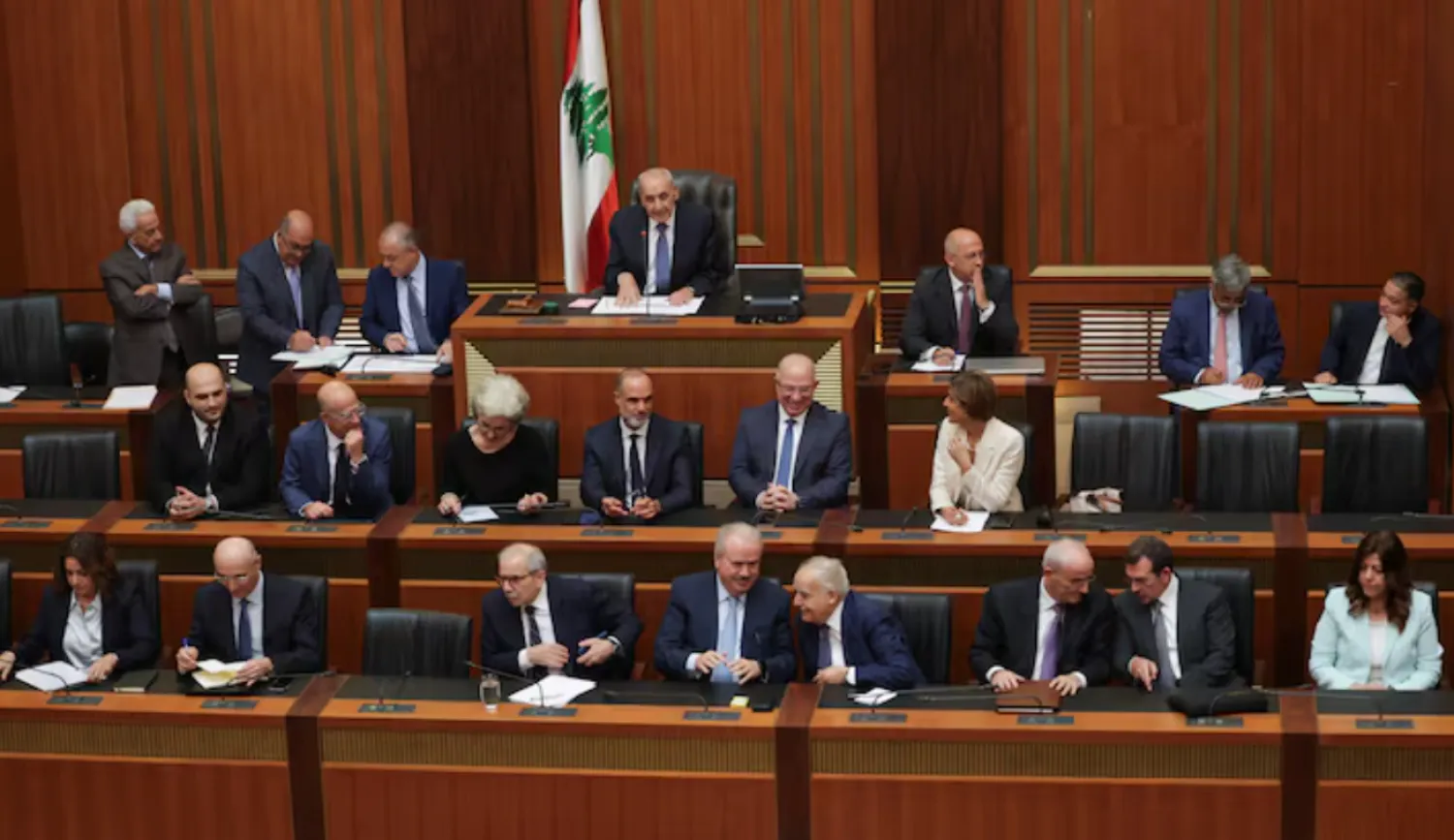
Lebanese Parliament Speaker Nabih Berri and members of the Lebanese government attend a parliament session in Beirut, Lebanon July 15, 2025. REUTERS/Emilie Madi
TT

Lebanon's Berri Says Parliamentary Election Must be Held on Time

Lebanese Parliament Speaker Nabih Berri and members of the Lebanese government attend a parliament session in Beirut, Lebanon July 15, 2025. REUTERS/Emilie Madi

Lebanese Parliament Speaker Nabih Berri said on Friday he was committed to holding a parliamentary election as scheduled on May 10, despite calls from some politicians to postpone the vote.

Several politicians have called for a delay, citing security concerns in southern Lebanon, where Israel has carried out air strikes targeting Hezbollah, Reuters reported.

Berri said in a statement carried by the state-run National News Agency that he had informed President Joseph Aoun and the government of his position.

"It is not permissible that, at the start of a new era, we obstruct its launch by disrupting, postponing or extending the most important constitutional entitlement, which is the foundation for forming authorities and producing political life," Berri said.

Berri has opened the candidacy registry for the election and submitted the first nomination request for the Tyre-Zahrani district in southern Lebanon.

Lebanon last held a parliamentary election in May 2022, a vote marked by low turnout and deep public anger over a financial collapse. The election saw some gains by reformist candidates emerging from the 2019 protest movement, while the Iran-backed Hezbollah and its allies lost their parliamentary majority.


Rubio Meets with Shaibani, Abdi in Munich to Consolidate Damascus-SDF Ties

Syrian Foreign Minister Asaad al-Shaibani and US Secretary of State Marco Rubio. SANA
TT

Rubio Meets with Shaibani, Abdi in Munich to Consolidate Damascus-SDF Ties

Syrian Foreign Minister Asaad al-Shaibani and US Secretary of State Marco Rubio. SANA

US Secretary of State Marco Rubio met with Syrian Foreign Minister Asaad al-Shaibani and Commander-in-Chief of Syrian Democratic Forces (SDF) Mazloum Abdi at the Munich Security Conference, the State Department announced on Saturday.

Rubio “emphasized the importance of implementing the permanent ceasefire and integration agreement in northeast Syria, and ensuring full respect and safety for the rights of all Syrians,” the State Department said in a statement.

He also “welcomed the Syrian government’s commitment to fully cooperate with the United States and the Global Coalition to Defeat ISIS,” it added.

The appearance of al-Shaibani and Abdi, along with co-chair of the Foreign Relations Committee of the Autonomous Administration Elham Ahmed at the Munich Conference was seen as a remarkable development in the course of relations and the implementation of the January 30 agreement to gradually integrate the Kurds' military and civilian institutions into the state.

Wael Alwan, Executive Director of the Jusoor Center for Studies, who is close to the Syrian government, told Asharq Al-Awsat that Abdi and Elham Ahmed were invited to the Conference following coordination between the US Special Envoy to Syria, Tom Barrack, and al-Shaibani, to hold meetings and discussing several issues, including assigning Abdi a position in the Ministry of Foreign Affairs, most likely as Assistant Minister.

Alwan also noted that the issue of integration remains “complex” and faces many obstacles.

Coordinator of the Independent Kurdistan Movement in Syria, Zaid Safouk also spoke to Asharq Al-Awsat, saying “what appears in the media is one thing, and reality is another.”

“The Foreign Minister attended the Munich Conference alone as a representative of the Ministry of Foreign Affairs, while both Abdi and Elham Ahmed attended separately... each representing his or her institution,” he said.

He pointed out that the United States, “by bringing them together at the same table, tried to present the three as a single delegation and to show that it alone controls the situation.”

“But the reality is different,” Safouk added.

Meeting with Members of Congress

According to SANA, al-Shaibani held talks on Saturday with a number of US Congressmen, headed by Senator Jeanne Shaheen. Abdi and Elham Ahmed took part in the meeting.

The discussions focused on the latest developments in Syria and the region, with both sides “stressing the importance of preserving Syria’s unity, sovereignty and territorial integrity, in addition to supporting the political process in a way that achieves security and stability,” SANA said.

The SDF stated that the meeting focused on discussing the integration agreement, ways to ensure a ceasefire, and enhancing stability.


MSF Suspends Some Work at Gaza's Nasser Hospital due to Presence of Armed Men

A Palestinian war-wounded man waits at the entrance, hoping to receive medical treatment, at a clinic run by medical charity Medecins Sans Frontieres (MSF), amid shortages of medical supplies, in Khan Younis, southern Gaza Strip, December 31, 2025. REUTERS/Ramadan Abed
TT

MSF Suspends Some Work at Gaza's Nasser Hospital due to Presence of Armed Men

A Palestinian war-wounded man waits at the entrance, hoping to receive medical treatment, at a clinic run by medical charity Medecins Sans Frontieres (MSF), amid shortages of medical supplies, in Khan Younis, southern Gaza Strip, December 31, 2025. REUTERS/Ramadan Abed

Doctors Without Borders has announced the suspension of some operations at one of Gaza 's largest functioning hospitals after patients and staff reported seeing armed, masked men roaming parts of the building.

Nasser Hospital in Khan Younis is one of the territory's few functioning hospitals. Hundreds of patients and war-wounded have been treated there daily, and it was a hub for Palestinian prisoners released by Israel in exchange for Israeli hostages as part of the current ceasefire deal.

The comments by the aid group, which is also known by its acronym MSF, are a rare announcement by an international organization about the presence of armed men in or near medical facilities in Gaza since the war began over two years ago.

MSF said in a statement all its noncritical medical operations at Nasser Hospital were suspended due to security breaches that posed “serious security threats to our teams and patients."

“MSF teams have reported a pattern of unacceptable acts including the presence of armed men, intimidation, arbitrary arrests of patients and a recent situation of suspicion of movement of weapons,” it said.

While the suspension occurred in January, it was first disclosed in MSF’s “frequently asked questions” section on its website. It's unclear when the post was made, but the site said it was updated Feb. 11.

MSF said it made the difficult decision after an increase of patients and staff seeing armed men in parts of the hospital compound since the US-brokered October ceasefire was reached. The gunmen were seen in areas where the group didn’t operate.

Attacks on health facilities MSF said it wasn’t able to indicate the armed men's affiliation. It said it had expressed concern to the “relevant” authorities, without elaborating, stressing that hospitals must remain neutral, civilian spaces. It said its concerns were heightened by previous, deliberate Israeli attacks on health facilities.

Throughout the war, which began with the Hamas-led attack on Israel on Oct. 7, 2023, Israel has repeatedly struck hospitals, including Nasser, accusing the militant group of operating in or around them. Hamas security men often have been seen inside hospitals, blocking access to some areas.

Some hostages released from Gaza have said they spent time during captivity in a hospital.

While Hamas remains the dominant force in areas not under Israeli control, including Nasser Hospital, other armed groups have mushroomed across Gaza as a result of the war, including groups backed by Israel’s army in the Israeli-controlled part of the strip.

Nasser Hospital staff say that in recent months it has been repeatedly attacked by masked, armed men and militias, despite police presence there.

The Hamas-run interior ministry, which oversees police in Gaza, said officers would be deployed to secure hospitals and rid them of armed presence. It said it would take legal action against violators and was implementing stricter measures to ensure patients’ safety.

While international law gives hospitals special protections during war, they can lose this immunity if combatants use them to hide fighters or store weapons, according to the International Committee of the Red Cross. Still, there must be plenty of warning to allow the evacuation of staff and patients before any operations take place. If harm to civilians from an attack is disproportionate to the military objective, it is illegal under international law.

Aid groups and rights organizations say Israel has decimated Gaza's health system, forcing most of its hospitals to shut down while heavily damaging others. During the war, Israeli forces raided a number of hospitals, detaining hundreds of staff.

Israel also has targeted the police in Gaza.

A weakened medical system MSF said it will continue supporting critical services at Nasser Hospital, including inpatient and surgical departments for patients with traumatic or burn injuries. However, it is ending support to the pediatrics and maternity wards, including the neonatal intensive care unit. It has also indefinitely suspended its outpatient consultations for 3D burn screening and mental health, as well as other services.

Zaher al-Waheidi, head of the records department at Gaza's health ministry, said MSF's suspension would have a significant impact as hundreds of patients are admitted to the maternity and burn wards daily. He said the ministry would take over maternity patient care, but said burn victims won't have many options.

Israel has been cracking down on aid groups operating in Gaza and the occupied West Bank, including MSF. The group is one of more than three dozen that Israel has banned from operating in the strip for failing to comply with new registration rules.

MSF says Israel's decision will have a catastrophic impact on its work in Gaza, where it provides funding and international staff for six hospitals and operates two field hospitals and eight primary health centers, clinics and medical points. It also runs two of Gaza’s five stabilization centers, helping children with severe malnutrition.

The toll of war While the heaviest fighting has subsided, the fragile ceasefire has been seen almost daily Israeli fire. Israeli forces have carried out repeated airstrikes and frequently fire on Palestinians near military-held zones, killing 591 Palestinians since the ceasefire took effect, according to Gaza health officials.

The ministry said the overall Palestinian death toll from the war is at least 72,051.

The ministry, part of the Hamas-led government, maintains detailed casualty records that are seen as generally reliable by UN agencies and independent experts. It does not give a breakdown of civilians and militants. Militants have carried out shooting attacks on troops, and Israel says its strikes are in response to that and other violations. Four Israeli soldiers have been killed.


US Military Says Struck More than 30 ISIS Targets in Syria

US soldiers patrol the countryside of Rumaylan in Syria's northeastern Hasakeh province on June 7, 2023. (AFP)
TT

US Military Says Struck More than 30 ISIS Targets in Syria

US soldiers patrol the countryside of Rumaylan in Syria's northeastern Hasakeh province on June 7, 2023. (AFP)

The US military said Saturday that its forces had struck more than 30 ISIS group targets in Syria this month, maintaining pressure on the militants after a deadly attack on US troops last year.

The strikes also came as the United States Central Command (CENTCOM) in recent weeks transferred thousands of ISIS detainees from Syria to Iraq, after they had been held in prisons run for years by Kurdish-led forces, AFP reported.

US forces "conducted 10 strikes against more than 30 ISIS targets in Syria... to sustain relentless military pressure on remnants from the terrorist network," a CENTCOM statement said.

The airstrikes, carried out between February 3 and February 12, hit ISIS "infrastructure and weapons storage targets", it said.

The forces additionally conducted "five strikes against an ISIS communication site, critical logistics node, and weapons storage facilities" between January 27 and February 2, the statement said.

Washington has blamed an ISIS militant for ambushing and killing two US soldiers and a US civilian interpreter in Palmyra on December 13.

Syria's interior ministry has said the ISIS gunman was a member of the security forces who had been set to be fired for extremism.

The US launched Operation Hawkeye Strike in response to the attack.

"More than 50 ISIS terrorists have been killed or captured and over 100 ISIS infrastructure targets have been struck with hundreds of precision munitions during two months of targeted operations," the CENTCOM statement added.

On Friday, CENTCOM said it had completed the transfer of more than 5,700 detained ISIS suspects, from 61 countries, from Syria to Iraq.

The operation began last month as Damascus's capture of territory surrounding the prisons from Kurdish-led forces sparked questions over the fate of the ISIS prisoners, prompting Washington to step in.

Alongside the US-led anti-ISIS coalition, the Kurdish-led Syrian Democratic Forces spearheaded the battle that led to the militant group's territorial defeat in Syria in 2019.

Washington has however drawn close to Syria's new authorities, recently saying the purpose of its alliance with the Kurdish forces was largely over.

As Damascus seeks to extend its control over all of Syria, US forces confirmed on Thursday their withdrawal from Al-Tanf base near Syria's border with Jordan and Iraq.