Israeli FM Saar to Attend Trump’s First Board of Peace Meeting on Thursday, Officials Say

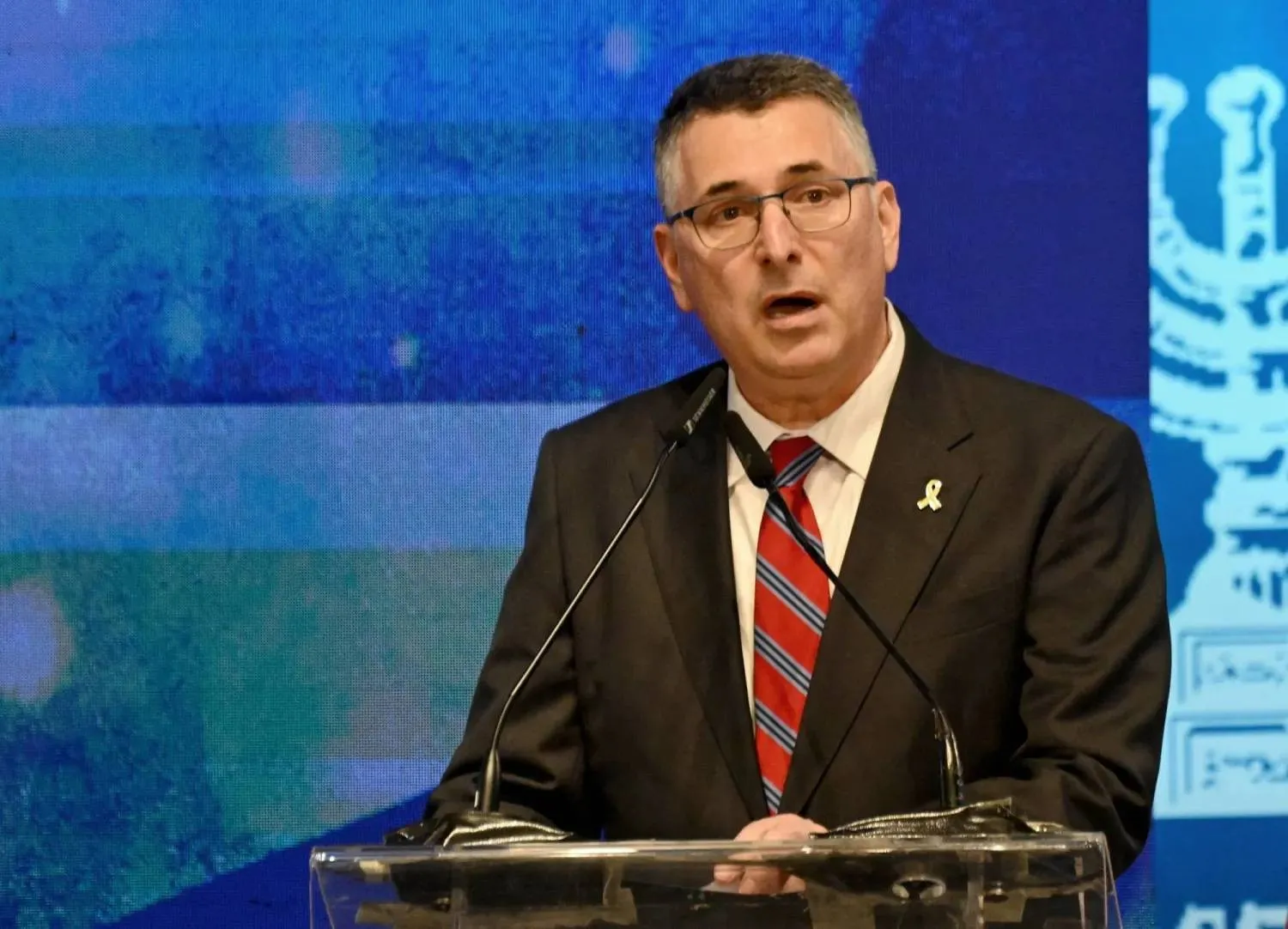
Israeli Foreign Minister Gideon Saar. (EPA)
TT

Israeli FM Saar to Attend Trump’s First Board of Peace Meeting on Thursday, Officials Say

Israeli Foreign Minister Gideon Saar. (EPA)

Israeli Foreign Minister Gideon Saar will attend U.S. President Donald Trump's first formal Board of Peace meeting on February 19, two Israeli officials said on Saturday.

US officials told Reuters this week that Trump will announce a multi-billion-dollar reconstruction plan for Gaza and detail plans for a UN-authorized stabilization force for the Palestinian enclave at the meeting in Washington.

Delegations from at least 20 countries, including heads of state, are expected to attend the meeting of ‌the board whose creation ‌was endorsed by a United Nations ‌Security ⁠Council resolution as part ⁠of Trump's plan to end the Gaza war.

Regional powers, including Türkiye, Egypt, Saudi Arabia and Qatar, as well as major emerging nations such as Indonesia, have joined the board.

The US officials ⁠said the meeting will focus on ‌Gaza, where two years of war ‌have left much of the Palestinian enclave in ruins.

Israel and ‌Palestinian group Hamas agreed to Trump's plan last ‌year with a ceasefire taking effect in October. More than 590 Palestinians, many of them civilians, and four Israeli soldiers have been killed in rounds of violence that have erupted since.

Both ‌sides have accused each other of violating the ceasefire, even as Trump's administration has ⁠pressed for progress ⁠to the next steps envisaged in the plan.

One of those is the deployment of the International Stabilization Force, as Israeli troops further withdraw and Hamas disarms.

The US officials said Trump will announce that several countries plan to provide several thousand troops to the stabilization force that is expected to deploy in Gaza in the months ahead.

Hamas has so far rejected demands to lay down its weapons and Israel has said that if the group does not disarm peacefully, Israel will have to force it to do so.


Gaza's Nasser Hospital Condemns Move by MSF to Suspend Most Services

11 February 2026, Palestinian Territories, Nablus: Israeli army forces raided the city of Nablus in the northern West Bank, deploying foot patrols around the Old City, the eastern market, and the city center. Photo: Mohammed Nasser/APA Images via ZUMA Press Wire/dpa
TT

Gaza's Nasser Hospital Condemns Move by MSF to Suspend Most Services

11 February 2026, Palestinian Territories, Nablus: Israeli army forces raided the city of Nablus in the northern West Bank, deploying foot patrols around the Old City, the eastern market, and the city center. Photo: Mohammed Nasser/APA Images via ZUMA Press Wire/dpa

One of Gaza’s last functioning large hospitals condemned the move by an international organization to pull out of operations over concerns about armed men, claiming on Sunday that the hospital had installed civil police for security. The move comes as at least 10 Palestinians were killed in clashes with the Israeli military in Gaza.

Doctors Without Borders, also known by its acronym MSF, said in a statement Saturday that all its noncritical medical operations at Nasser Hospital were suspended due to security breaches that posed “serious” threats to its teams and patients. MSF said there had been an increase in patients and staff seeing armed men in parts of the compound since the US-brokered October ceasefire was reached.

Nasser Hospital said Sunday that the increase in armed men was due to a civilian police presence aimed at protecting patients and staff and said MSF's “allegations are factually incorrect, irresponsible, and pose a serious risk to a protected civilian medical facility.”

Nasser Hospital one of few functioning hospitals left in Gaza

Nasser Hospital in Khan Younis is one of the territory’s few functioning hospitals. Hundreds of patients and war-wounded have been treated there daily, and the facility was a hub for Palestinian prisoners released by Israel in exchange for Israeli hostages as part of the current ceasefire deal.

“MSF teams have reported a pattern of unacceptable acts including the presence of armed men, intimidation, arbitrary arrests of patients and a recent situation of suspicion of movement of weapons,” the organization said. The suspension occurred in January but was only recently announced.

Nasser Hospital staff say that in recent months it has been repeatedly attacked by masked, armed men and militias, which is why the presence of an armed civilian police force is crucial. Hamas remains the dominant force in areas not under Israeli control, including in the area where Nasser Hospital is located. But other armed groups have mushroomed across Gaza as a result of the war, including groups backed by Israel’s army in the Israeli-controlled part of the strip.

Throughout the war, which began with the Hamas-led attack on Israel on Oct. 7, 2023, Israel has repeatedly struck hospitals, including Nasser, accusing the militant group of operating in or around them. Hamas security men often have been seen inside hospitals, blocking access to some areas.

Some hostages released from Gaza have said they spent time during captivity in a hospital, including Nasser Hospital.

Ten Palestinians killed in strikes across Gaza

At least 10 Palestinians were killed Sunday by Israeli fire in the Gaza Strip, hospital authorities said.

The dead include five men, all in their 20s, who were killed in an Israeli strike in the eastern part of Khan Younis city, according to the Nasser Hospital, which received the bodies. The strike hit a group of people in an area close to the Yellow Line which separates Israeli-controlled areas from the rest of Gaza, it said.

The Israeli military did not comment on the strike but has said in the past it will attack militants if its troops are threatened, especially near the Yellow Line.

Rami Shaqra said his son, al-Baraa, was among the militants who were securing the area from potential attacks by the Israeli forces or Israeli-backed armed groups, when they were hit by the Israeli military. He said that they were killed by an airstrike.

Associated Press footage from the morgue showed at least two of the men had headbands denoting membership in the Qassam Brigades, the militant arm of Hamas. In northern Gaza, a drone strike hit a group of people in the Falluja area of Jabaliya refugee camp, killing five people, according to the Shifa Hospital.

The Israeli military said it was striking northern Gaza in response to several ceasefire violations near the Yellow Line, including militants attempting to hide in debris and others who attempted to cross the line while armed.

The Oct. 10 US-brokered ceasefire deal attempted to halt a more than two-year war between Israel and Hamas. While the heaviest fighting has subsided, the ceasefire has seen almost daily Israeli fire.

Israeli forces have carried out repeated airstrikes and frequently fire on Palestinians near military-held zones, killing 601 Palestinians, according to Gaza health officials. The ministry, which is part of the Hamas-led government, maintains detailed casualty records that are seen as generally reliable by UN agencies and independent experts. But it does not give a breakdown of civilians and militants.

Militants have carried out shooting attacks on troops, and Israel says its strikes are in response to that and other violations. Four Israeli soldiers have been killed.


Syrian Army Says It Took Control of Shaddadi Base after Coordination with US

Syrian Democratic Forces members stand by vehicles, as they withdraw from the front lines, following an agreement between the Syrian government and the Syrian Democratic Forces, in Hasakah, Syria, February 10, 2026. REUTERS/Orhan Qereman
TT

Syrian Army Says It Took Control of Shaddadi Base after Coordination with US

Syrian Democratic Forces members stand by vehicles, as they withdraw from the front lines, following an agreement between the Syrian government and the Syrian Democratic Forces, in Hasakah, Syria, February 10, 2026. REUTERS/Orhan Qereman

The Syrian army said it took control of the Shaddadi military base ‌in ‌northeastern Syria ‌after coordination ⁠with the United States, ⁠the Syrian state news agency reported ⁠on Sunday.

The ‌move follows ‌the US ‌pullout ‌from al-Tanf strategic base after a Washington-brokered ‌deal to integrate the ⁠Kurdish led ⁠Syrian Democratic Forces into central Syrian institutions.

Syrian officials described the takeover as part of broader efforts to reassert state authority over territories that had been outside direct government control for years during the conflict.


Al-Alimi Calls from Munich for a New Regional Security Framework

Al-Alimi presents Yemen’s vision for maritime security during a panel discussion in Munich (SABA).
TT

Al-Alimi Calls from Munich for a New Regional Security Framework

Al-Alimi presents Yemen’s vision for maritime security during a panel discussion in Munich (SABA).

Yemen’s Presidential Leadership Council Chairman Rashad Al-Alimi has called for a fundamental rethinking of the international approach to regional security, warning that escalating threats in the Red Sea and the Bab el-Mandeb represent a geopolitical shift rather than a series of isolated incidents.

Speaking at the Munich Security Conference during a panel on maritime security, Al-Alimi said that safeguarding international shipping requires addressing the root causes of Yemen’s conflict, not relying on short-term containment measures.

He argued that sustainable maritime security begins with supporting Yemen’s state institutions and strengthening their capacity to restore stability and combat terrorism.

Al-Alimi criticized previous international responses to attacks on shipping in the Red Sea as largely tactical and reactive, focused on immediate protection rather than long-term solutions.

He said that while international naval operations have helped reduce direct risks to commercial vessels, they have also contributed to further militarization without resolving the underlying sources of instability.

He stressed that maritime security cannot be achieved through military presence alone. Instead, it depends on building a capable Yemeni state with effective political, military and economic deterrence, preventing armed groups from using Yemen’s geography as a platform to threaten global trade.

Temporary pauses in attacks, he warned, do not eliminate the risk, as Houthi militias will remain a persistent threat unless addressed through a comprehensive deterrence strategy.

Al-Alimi called for a proactive international counterterrorism approach that treats such groups as long-term geopolitical threats rather than challenges that can be managed through de-escalation or political incentives.

He also urged stronger coordination through existing regional mechanisms, including Red Sea coastal frameworks and joint task forces, within broader international partnerships aimed at achieving lasting security.

Turning to regional cooperation, Al-Alimi renewed his call for deeper Yemeni-Gulf integration, advocating Yemen’s gradual inclusion in the Gulf Cooperation Council as a strategic pathway to economic and political stability.

Speaking at a session organized by the Gulf Research Center in cooperation with the International Crisis Group, he proposed a “Gulf Marshall Plan” for Yemen’s reconstruction, inspired by the Saudi Development and Reconstruction Program for Yemen and aligned with Saudi Vision 2030.

He concluded by stressing that any future peace process must include dismantling armed militias and ending external interference. He noted that Yemen’s long-term stability depends on internal reconciliation, stronger ties with Gulf neighbors and a shift away from sectarianism and uncontrolled weapons.