


Israel Resumes Contentious West Bank Land Registration in New Step to Deepen Control

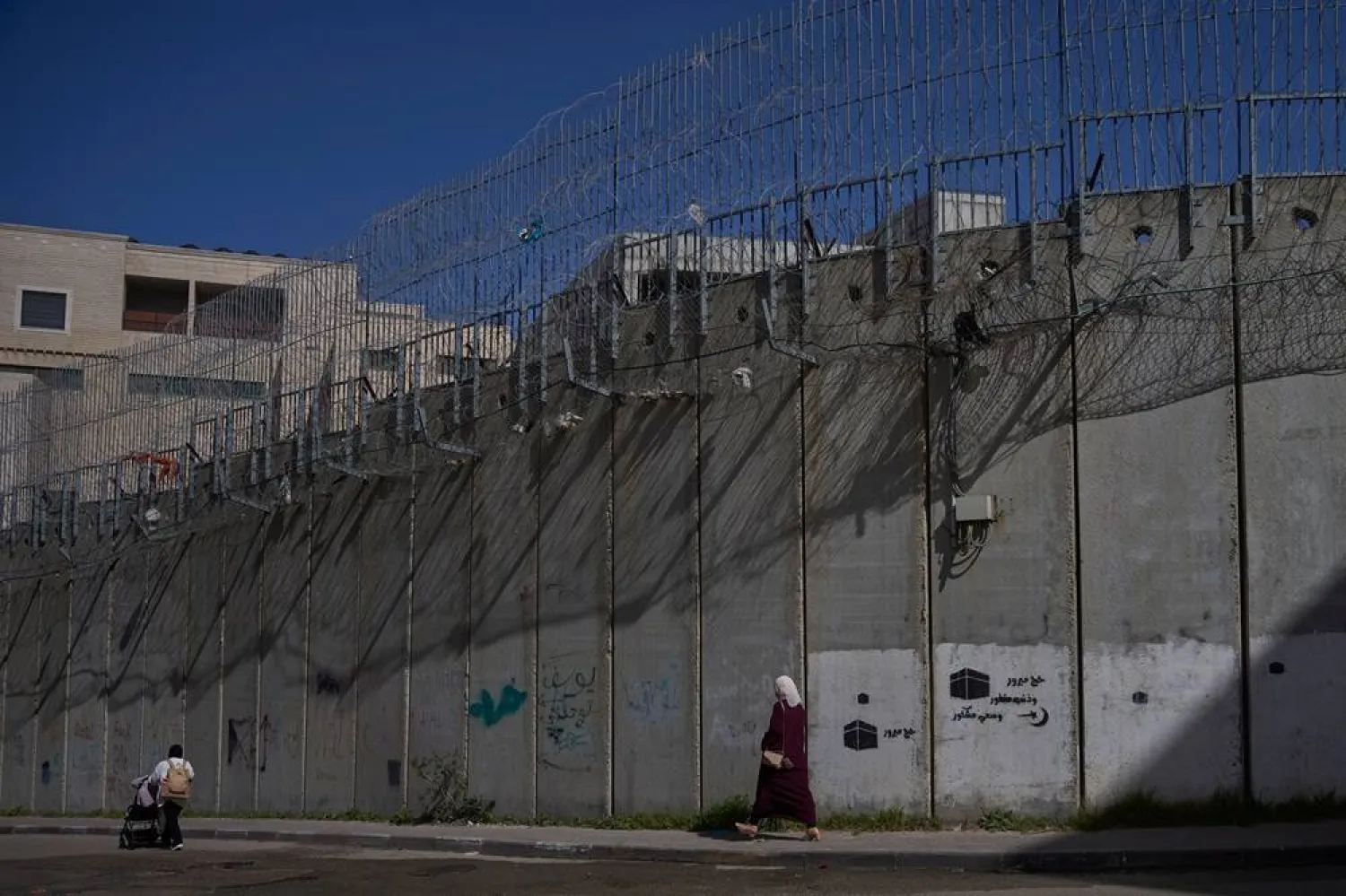
 Palestinians walk along the separation barrier between the West Bank and east Jerusalem neighborhood of Beit Hanina, Sunday Feb. 15, 2026. (AP)
Palestinians walk along the separation barrier between the West Bank and east Jerusalem neighborhood of Beit Hanina, Sunday Feb. 15, 2026. (AP)
TT

Israel Resumes Contentious West Bank Land Registration in New Step to Deepen Control

 Palestinians walk along the separation barrier between the West Bank and east Jerusalem neighborhood of Beit Hanina, Sunday Feb. 15, 2026. (AP)
Palestinians walk along the separation barrier between the West Bank and east Jerusalem neighborhood of Beit Hanina, Sunday Feb. 15, 2026. (AP)

Israel will begin a contentious land regulation process in a large part of the occupied West Bank, which could result in Israel gaining control over wide swaths of the area for future development, according to a government decision on Sunday.

The decision paves the way for the resumption of “settlement of land title” processes, which had been frozen in the West Bank since the Middle East War in 1967. It means that when Israel begins the land registration process for a certain area, anyone with a claim to the land must submit documents proving ownership.

“This move is very dramatic and allows the state to gain control of almost all of Area C,” said Hagit Ofran, the director of Israeli anti-settlement watchdog group Peace Now. Area C refers to the 60% of the West Bank that is under full Israeli military control, according to agreements reached in the 1990s with the Palestinians.

The decision is the latest step to deepen Israeli control over the West Bank. In recent months, Israel has greatly expanded construction in Jewish settlements, legalized outposts and made significant bureaucratic changes to its policies in the territory to strengthen its hold and weaken the Palestinian Authority.

Sunday's decision was first announced last May but required further development before it was approved in this week’s Cabinet meeting.

Under the decision, Israeli authorities will announce certain areas to undergo registration, which will force anyone who has a claim to the land to prove their ownership.

Ofran said the process for proving ownership can be “draconian” and is rarely transparent, meaning any land that undergoes the registration process in areas currently owned by Palestinians is likely to revert to Israeli state control.

“Palestinians will be sent to prove ownership in a way that they will never be able to do,” Ofran told The Associated Press. "And this way Israel might take over 83% of the Area C, which is about half of the West Bank.”

The registration process could start as soon as this year, she said.

The proposal had been put forward by some of Israel’s far-right members of the ruling coalition, including the Minister of Justice Yariv Levin. “The government of Israel is committed to strengthening its grip on all its parts, and this decision is an expression of that commitment,” he said.

A ‘dangerous escalation’

Palestinian Authority President Mahmoud Abbas’ office in a statement called the decision “a grave escalation and a flagrant violation of international law,” which amounts to “de facto annexation.” It called on the international community, especially the UN Security Council and the United States, to intervene immediately.

Previous US administrations have sharply condemned an expansion of Israeli activity and control in the West Bank, but Prime Minister Benjamin Netanyahu has a particularly close relationship with President Donald Trump. The two met last week in Washington, their seventh meeting in the past year.

And yet Trump has opposed annexation, Ofran noted.

Palestinians are not permitted to sell land privately to Israelis, though measures announced last week aim to nullify this. Currently, settlers can buy homes on land controlled by Israel’s government. Last week's decision also aimed to expand Israeli enforcement of several aspects of in the West Bank, including environmental and archaeological matters in Palestinian-administered areas.

More than 700,000 Israelis live in the occupied West Bank and east Jerusalem, territories captured by Israel in 1967 from Jordan and sought by the Palestinians for a future state. The international community overwhelmingly considers Israeli settlement construction in these areas to be illegal and an obstacle to peace.

Jordan's Foreign Ministry in a statement called on the international community to “assume its legal and moral responsibilities, and to compel Israel, the occupying power, to stop its dangerous escalation.”

Over 300,000 Palestinians are estimated to live in Area C of the West Bank, with many more in surrounding communities dependent on its agricultural and grazing lands, including plots for which families retain land deeds or tax records dating back decades.



UN Says Al-Hol Camp Population Has Dropped Sharply as Syria Moves to Relocate Remaining Families

US military vehicles escort buses transporting ISIS detainees from Syria to Iraq, according to a security source from the Syrian Democratic Forces, in Qamishli, Syria, February 8, 2026. (Reuters)
TT

UN Says Al-Hol Camp Population Has Dropped Sharply as Syria Moves to Relocate Remaining Families

US military vehicles escort buses transporting ISIS detainees from Syria to Iraq, according to a security source from the Syrian Democratic Forces, in Qamishli, Syria, February 8, 2026. (Reuters)

The UN refugee agency said Sunday that a large number of residents of a camp housing family members of suspected ISIS group militants have left and the Syrian government plans to relocate those who remain.

Gonzalo Vargas Llosa, UNHCR's representative in Syria, said in a statement that the agency “has observed a significant decrease in the number of residents in al-Hol camp in recent weeks."

“Syrian authorities have informed UNHCR of their plan to relocate the remaining families to Akhtarin camp in Aleppo Governorate (province) and have requested UNHCR’s support to assist the population in the new camp, which we stand ready to provide,” he said.

He added that UNHCR “will continue to support the return and reintegration of Syrians who have departed al-Hol, as well as those who remain.”

The statement did not say how residents had left the camp or how many remain. Many families are believed to have escaped either during the chaos when government forces captured the camp from the Kurdish-led Syrian Democratic Forces last month or afterward.

There was no immediate statement from the Syrian government and a government spokesperson did not respond to a request for comment.

At its peak after the defeat of ISIS in Syria in 2019, around 73,000 people were living at al-Hol. Since then, the number has declined with some countries repatriating their citizens. The camp’s residents are mostly children and women, including many wives or widows of ISIS members.

The camp’s residents are not technically prisoners and most have not been accused of crimes, but they have been held in de facto detention at the heavily guarded facility.

Forces of Syria’s central government captured the al-Hol camp on Jan. 21 during a weekslong offensive against the SDF, which had been running the camp near the border with Iraq for a decade. A ceasefire deal has since ended the fighting.

Separately, thousands of accused ISIS militants who were held in detention centers in northeastern Syria have been transferred to Iraq to stand trial under an agreement with the US.

The US military said Friday that it had completed the transfer of more than 5,700 adult male ISIS suspects from detention facilities in Syria to Iraqi custody.

Iraq’s National Center for International Judicial Cooperation said a total of 5,704 suspects from 61 countries who were affiliated with ISIS — most of them Syrian and Iraqi — were transferred from prisons in Syria. They are now being interrogated in Iraq.


Rubio: US Satisfied with Overall ‘Trajectory’ in Syria

US Secretary of State Marco Rubio gives a thumbs-up as he boards a plane while departing Bratislava Airport in Bratislava, Slovakia, Sunday, Feb. 15, 2026. (Reuters)
TT

Rubio: US Satisfied with Overall ‘Trajectory’ in Syria

US Secretary of State Marco Rubio gives a thumbs-up as he boards a plane while departing Bratislava Airport in Bratislava, Slovakia, Sunday, Feb. 15, 2026. (Reuters)

US Secretary of State Marco Rubio said on Sunday that Washington is pleased with the "trajectory" in Syria, which has launched talks with Kurdish minority groups, despite troubles.

"There's been some days that have been very concerning, but we like the trajectory," Rubio said on a brief visit to Bratislava. "We have to keep it on that trajectory. We've got good agreements in place."

Rubio added, however, that a deal between Syrian authorities and the Kurdish minority must now be implemented.

"That's not going to be easy and there other such agreements that they need to reach with the Druze, with the Bedouins, with the Alawites -- with all the elements of a very diverse society in Syria," Rubio said.

Syrian leaders in Damascus and Kurdish officials announced in January, after months of deadlock and armed clashes, that they had reached an agreement to integrate Kurdish forces and autonomous areas of Syria into the Syrian state.

A de facto separate Kurdish state was established in northeast of the country during Syria's civil war (2011-2024).

The United States had supported Kurdish forces in their fight against the ISIS group starting in 2014.

But after the overthrow of Bashar al-Assad at the end of 2024, the President Donald Trump's administration backed Syrian leader Ahmed al-Sharaa -- whose opposition forces drove Assad from power -- in his bid to impose authority over the entire country.

Rubio on Sunday defended the administration's embrace of Sharaa -- even against the former Kurdish allies -- by arguing that Washington faced a difficult decision in Syria.

The process, "as difficult as it's been, is far better than a Syria that would've been broken up into eight pieces with all kinds of fighting going on, all kinds of mass migration," Rubio said. "So we were very positive about that."


Indonesia Says 8,000 Troops Ready for Possible Peacekeeping Mission in Gaza by June

Women walk down a hill overlooking a camp for displaced Palestinians in Khan Younis, in the southern Gaza Strip, on February 14, 2026. (AFP)
TT

Indonesia Says 8,000 Troops Ready for Possible Peacekeeping Mission in Gaza by June

Women walk down a hill overlooking a camp for displaced Palestinians in Khan Younis, in the southern Gaza Strip, on February 14, 2026. (AFP)

Indonesia's military said Sunday that up to 8,000 troops are expected to be ready by the end of June for a potential deployment to Gaza as part of a humanitarian and peace mission, the first firm commitment to a critical element of US President Donald Trump’s postwar reconstruction plan.

The Indonesian National Armed Forces, known as TNI, has finalized its proposed troop structure and a timeline for their movement to Gaza, even as the government has yet to decide when the deployment will take place, army spokesperson Brig. Gen. Donny Pramono said.

“In principle, we are ready to be assigned anywhere,” Pramono told The Associated Press, “Our troops are fully prepared and can be dispatched at short notice once the government gives formal approval.”

Pramono said the military prepared a composite brigade of 8,000 personnel, based on decisions made during a Feb. 12 meeting for the mission.

Under the schedule, troops will undergo health checks and paperwork throughout February, followed by a force readiness review at the end of the month, Pramono said. He also revealed that about 1,000 personnel are expected to be ready to deploy as an advance team by April, followed with the rest by June.

Pramono said that being ready does not mean the troops will depart. The deployment still requires a political decision and depends on international mechanisms, he said.

Indonesia's Foreign Ministry has repeatedly said any Indonesian role in Gaza will be strictly humanitarian. Indonesia’s contribution would focus on civilian protection, medical services, reconstruction, and its troops would not take part in any combat operations or actions that could lead to direct confrontation with armed groups.

Indonesia would be the first country to formally commit troops to the security mission created under Trump’s Board of Peace initiative for Gaza, where a fragile ceasefire agreement between Israel and Hamas has held since Oct. 10 following two years of devastating war.

Indonesia, the world’s most populous Muslim majority nation, does not have formal diplomatic relations with Israel and has long been a strong supporter of a two-state solution. It has been deeply involved in providing humanitarian aid to Gaza, including funding a hospital.

Indonesian officials have justified joining the Board of Peace by saying it was necessary to defend Palestinian interests from within, since Israel is included on the board but there is no Palestinian representation.

The Southeast Asian country has experience in peacekeeping operations as one of the top 10 contributors to United Nations missions, including in Lebanon.