

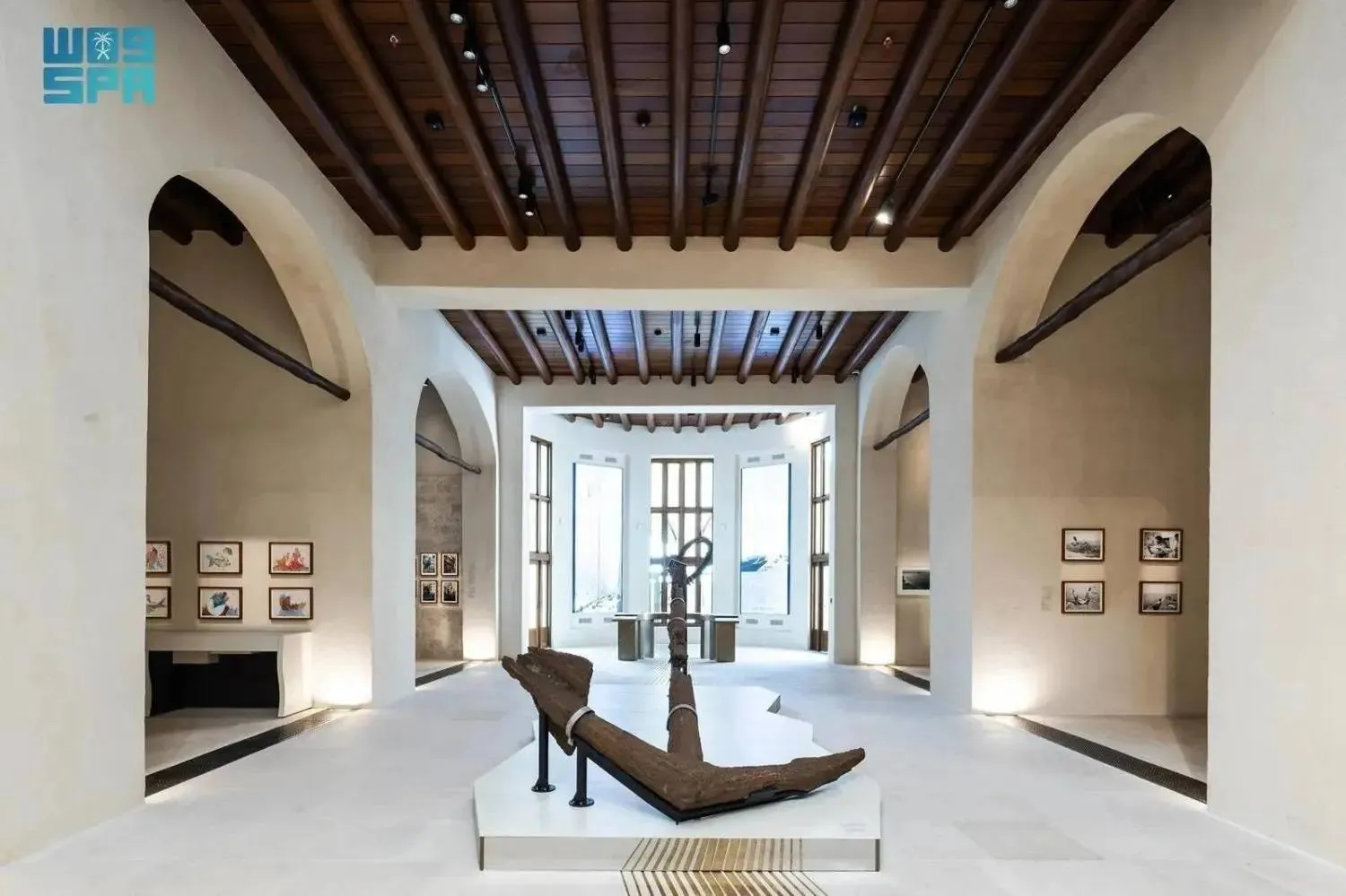

'Sunken Treasures' Exhibition on Exploring Maritime Heritage to Be Held at Red Sea Museum

"Sunken Treasures: The Maritime Heritage of the Red Sea" runs from February 25 to May 29. (SPA file photo)
TT

'Sunken Treasures' Exhibition on Exploring Maritime Heritage to Be Held at Red Sea Museum

"Sunken Treasures: The Maritime Heritage of the Red Sea" runs from February 25 to May 29. (SPA file photo)

The Red Sea Museum, under the Museums Commission, announced the opening of "Sunken Treasures: The Maritime Heritage of the Red Sea", running from February 25 to May 29.

The exhibition presents archaeological discoveries from the Red Sea as witnesses to human journeys, cultural exchange, and the enduring relationship between maritime heritage and environmental conservation, said the Museum Commission in a statement on Sunday.

"Sunken Treasures" invites visitors to discover how shipwrecks became archives of history and eventually transformed into living coral reefs. Through archaeological artifacts, immersive visual experiences, and interactive technologies, the exhibition reveals the Red Sea coast as a cultural corridor upon which layers of history have accumulated over millennia.

Curated by Director of the Red Sea Museum Eman Zidan and Chief of the French-Saudi Archeological Mission in Farasân Islands Dr. Solène Marion de Procé, the exhibition unfolds across four thematic sections that together tell the story of maritime life, risk, and discovery in the Red Sea. The journey begins with "The Red Sea Passage", exploring how seasonal winds and navigation patterns shaped trade routes connecting the Mediterranean, southern Arabia, East Africa, and the Indian Ocean.

"Life Aboard the Ship" transports visitors into the world of historic seafarers, presenting the ship not just as a means of transport, but an integrated world of maritime voyages, where crew, cargo, and navigation tools reveal the accumulated expertise of reading the sea and sky. Pottery, coins, glass, and ceramic objects preserve stories of movement, connection, and communication across the Red Sea.

"Shipwrecks: From a Voyage to a Memory" explores the dramatic moment when journeys are cut short. Through storms, waves, or collision with coral reefs, vessels shift from means of crossing into silent traces.

"Exploring for Tomorrow" traces the transformation of shipwrecks from discovery to interpretation as scientific sources of knowledge. The section highlights conservation and restoration efforts carried out by the Heritage Commission and archaeological missions working on the Saudi coast of the Red Sea, following guidelines and frameworks that ensure protection for future generations.

"Sunken Treasures" demonstrates the Red Sea Museum's commitment to preserving the tangible, intangible, and natural heritage of the Red Sea while creating opportunities for cultural exchange, education, and sustainable development.

The exhibition is enriched through collaboration with key institutional partners, including the Heritage Commission and Historic Jeddah Program, who have loaned objects that strengthen the presentation of authentic material evidence of maritime and coastal heritage, reflecting a shared commitment to safeguarding the Maritime Heritage of Saudi Arabia.

The exhibition showcases the Red Sea Museum as a platform for knowledge creation and scientific research. It highlights how submerged cultural heritage is transformed into valuable historical knowledge through research-driven storytelling, while fostering collaboration between marine specialists, scientists, conservators, and the wider community.



Australian Museum Recovers Egyptian Artifacts after Break-in

Mask recovered with the thief (Queensland Police Service Official Website)
TT

Australian Museum Recovers Egyptian Artifacts after Break-in

Mask recovered with the thief (Queensland Police Service Official Website)

Australian police have recovered a trove of stolen Egyptian artifacts and charged a 52-year-old man with a nighttime smash-and-grab at a museum.

The man was accused of breaking a window and making off with the priceless treasures in the early hours of Friday from the Abbey Museum of Art and Archeology in the Queensland town of Caboolture.

Police said they found all the stolen goods -- except for a wooden cat sculpture -- with only minor damage when they searched a car the following day at a ferry terminal south of the museum.

They arrested the suspect on the same evening.

"Police will allege the man was found in possession of the last missing artifact, the wooden cat sculpture," they said.

The man, named by local media as Miguel Simon Mungarrieta Monsalve, was charged with various counts including breaking and entering, and three counts of wilful damage.

In court on Monday, a prosecutor said the man stole a mummy mask, a collar, a piece of jewelry and the wooden cat while also causing "irreparable damage" to other items, according to public broadcaster ABC.

The suspect told police that he believed the museum had links to the Catholic Church, the prosecutor was quoted as telling the court.

The museum said it was "relieved and grateful" to get the artifacts back, but they could not go back on display immediately.

"Each piece must first undergo professional assessment and conservation to protect its long-term future."


Louvre Museum's Denon Gallery Damaged by Water Leak, Mona Lisa Unaffected

A view shows the Porte des Lions, the new public entrance to the renovated Denon wing (Aile Denon) at the Louvre Museum in Paris, France, December 2, 2025. REUTERS/Gonzalo Fuentes
TT

Louvre Museum's Denon Gallery Damaged by Water Leak, Mona Lisa Unaffected

A view shows the Porte des Lions, the new public entrance to the renovated Denon wing (Aile Denon) at the Louvre Museum in Paris, France, December 2, 2025. REUTERS/Gonzalo Fuentes

The Louvre museum's Denon gallery, where its most valuable paintings are displayed, was hit by a water leak on Thursday evening, although the area which houses Leonardo Da Vinci's Mona Lisa was unaffected, said a Louvre spokesperson.

The spokesperson said the water leak had been stopped in the early hours of Friday and that the gallery would soon re-open.

The leak happened in the room 707, where paintings from 19th century French artist Charles Meynier and 16th century Italian artist Bernardino Luini are displayed. The water caused some damage to a ceiling painted by Meynier, Reuters reported.

The water leak is the second in less than three months in a museum that has gone through a spate of recent setbacks - including a spectacular jewel heist, strikes and a massive ticket fraud investigation- that have put its management under intense scrutiny.


Saudi Heritage Commission Uncovers 147 Architectural Units at Ra’s Qurayyah Port

Comparative analysis and organic sampling indicate the site’s timeline spans from the pre-Islamic era - SPA
TT

Saudi Heritage Commission Uncovers 147 Architectural Units at Ra’s Qurayyah Port

Comparative analysis and organic sampling indicate the site’s timeline spans from the pre-Islamic era - SPA

The Saudi Heritage Commission has concluded its second archaeological season at the Ra’s Qurayyah Port in Al-Ahsa Governorate, Eastern Region, uncovering 147 diverse architectural units, including large courtyards and ancient wells.

Located 26 km northwest of Al-Uqair Port, the site yielded significant artifacts, including an Abbasid dirham minted in 148 AH, bronze ornaments, and glazed pottery, SPA reported.

Comparative analysis and organic sampling indicate the site’s timeline spans from the pre-Islamic era through the early Islamic period and into the late 4th century AH.

This discovery aligns with the national cultural strategy to document the Kingdom’s tangible heritage and strengthen its scientific and historical presence on a global scale.