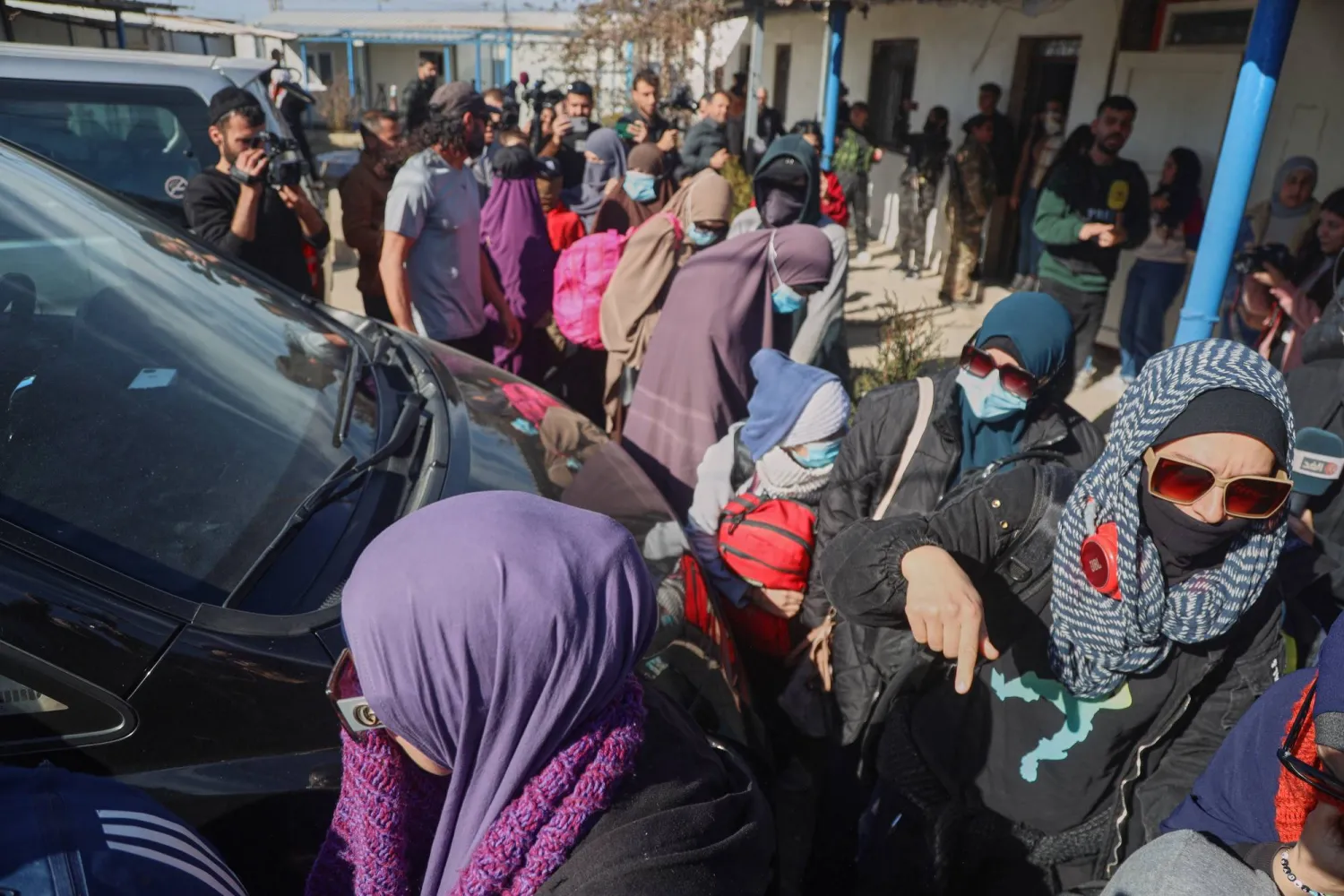
Australian Citizens with Alleged ISIS Ties Depart Syria’s Roj for Repatriation

Family members of suspected ISIS militants who are Australian nationals walk toward a van bound for the airport in Damascus during the first repatriation operation of the year at Roj Camp in eastern Syria, Monday, Feb. 16, 2026. (AP Photo/Baderkhan Ahmad)
TT

Australian Citizens with Alleged ISIS Ties Depart Syria’s Roj for Repatriation

Family members of suspected ISIS militants who are Australian nationals walk toward a van bound for the airport in Damascus during the first repatriation operation of the year at Roj Camp in eastern Syria, Monday, Feb. 16, 2026. (AP Photo/Baderkhan Ahmad)

A group of Australian citizens left on Monday a camp in northeast Syria housing people with alleged ties to ISIS militants to begin the journey to their home country, part of an ongoing repatriation process.

Relatives of the 34 individuals, from 11 families, traveled from Australia to accompany them, said Hakmiyeh Ibrahim, the director of the Roj camp. They will make their way to the Syrian capital, Damascus, and then fly to Australia, The Associated Press reported.

Roj camp houses about 2,200 people from around 50 nationalities, mostly women and children, who have supposed links to the extremist group. Most in the camp are not technically prisoners and have not been accused of a crime, but they have, in effect, been detained in the heavily guarded camp, controlled by the Kurdish-led Syrian Democratic Forces.

The most well-known resident of the Roj camp, Shamima Begum, was 15 when she and two other girls fled from London in 2015 to marry ISIS fighters in Syria. Begum married a Dutch man fighting for ISIS and had three children, who all died. She recently lost an appeal against the British government’s decision to revoke her UK citizenship.

Monday's operation is the first this year. Ibrahim, the camp director, said 16 families were repatriated last year, including German, British and French nationals. In 2022, three Australian families were repatriated.

The fate of the Roj camp and the similar but larger al-Hol camp has been a matter of debate for years. Human rights groups have cited poor living conditions and pervasive violence in the camps, but many countries have been reluctant to take back their citizens who are detained there.

Government forces took control of al-Hol camp last month amid fighting with the SDF that led to state forces seizing most of the territory in northeast Syria previously controlled by the Kurdish forces.

The UN refugee agency said Sunday that a large number of residents of al-Hol camp have left and that the Syrian government plans to relocate those who remain.

Separately, thousands of accused ISIS militants who were held in detention centers in northeastern Syria have been transferred to Iraq by the US military to stand trial there.


Aid Mechanisms Deployed to Fill UN Void in Yemen’s Houthi-Controlled Areas

The Houthis deprived millions of Yemenis of life-saving aid (local media)
TT

Aid Mechanisms Deployed to Fill UN Void in Yemen’s Houthi-Controlled Areas

The Houthis deprived millions of Yemenis of life-saving aid (local media)

Humanitarian operations in Yemen are entering a new and more complex phase after the United Nations was forced to rely on alternative aid-delivery mechanisms in Houthi-controlled areas, following the closure of its offices and the seizure of its assets. The move has reshaped relief efforts in one of the world’s worst humanitarian crises.

The shift comes as Amman prepares to host an international donor conference aimed at curbing the rapid deterioration in food security, amid warnings that hunger could spread to millions more people this year.

Recent humanitarian estimates show that about 22.3 million Yemenis - nearly half the population - will require some form of assistance in 2026, an increase of 2.8 million from last year. The rise reflects deepening economic decline and persistent restrictions on humanitarian work in conflict zones.

Aid sources say the United Nations is reorganizing its operations by transferring responsibility for distributing life-saving assistance to a network of partners, including international and local non-governmental organizations and the International Committee of the Red Cross, which continues to operate in those areas.

The transition aims to ensure continued access to food and medicine for the most vulnerable despite the absence of a direct UN presence, which has been undermined by restrictions imposed by the Houthis.

International agencies are increasingly adopting a “remote management” model to reduce risks to staff and maintain aid flows. Relief experts caution, however, that this approach brings serious challenges, including limited field oversight and difficulties ensuring aid reaches beneficiaries without interference.

Humanitarian reports warn that operational constraints have already deprived millions of Yemenis of essential assistance at a time of unprecedented food insecurity. More than 18 million people are suffering from acute hunger, with millions classified at emergency levels under international food security standards.

The upcoming donor conference in Jordan is seen as a pivotal opportunity to re-mobilize international support and address a widening funding gap that threatens to scale back critical humanitarian programs.

Discussions are expected to focus on new ways to deliver aid under security and administrative constraints and on strengthening the role of local partners with greater access to affected communities.

Yemen’s crisis extends beyond food. The health sector is under severe strain, with about 40 percent of health facilities closed or at risk of closure due to funding shortages. Women and girls are particularly affected as reproductive health services decline, increasing pregnancy and childbirth-related risks.

The World Health Organization has warned that deteriorating conditions have fueled outbreaks of preventable diseases amid falling immunization rates, with fewer than two-thirds of children receiving basic vaccines.

More than 18,600 measles cases and 188 deaths were recorded last year, while Yemen reported the world’s third-highest number of suspected cholera cases between March 2024 and November 2025.


Washington Finalizing Draft Sudan Ceasefire Mechanism

A man walks near heavily-damaged buildings in the Lamab suburb on the southwestern outskirts of Sudan's capital Khartoum on July 30, 2025 as residents return amidst reconstruction efforts. (Photo by Ebrahim Hamid / AFP)
TT

Washington Finalizing Draft Sudan Ceasefire Mechanism

A man walks near heavily-damaged buildings in the Lamab suburb on the southwestern outskirts of Sudan's capital Khartoum on July 30, 2025 as residents return amidst reconstruction efforts. (Photo by Ebrahim Hamid / AFP)

Washington is preparing to send the final draft of a proposed UN-backed mechanism to monitor a humanitarian ceasefire in Sudan to the warring parties, according to Massad Boulos, special adviser to US President Donald Trump for Middle East affairs.

Speaking at a Sudan session during the Munich Security Conference, Boulos said work on the monitoring mechanism - coordinated with the United Nations - has been under way for weeks as a prelude to a broader political process.

He stressed that Trump is determined to “end the war in Sudan and stop the suffering of Sudanese facing the world’s worst humanitarian crisis.”

His remarks came during a panel alongside British Home Secretary Yvette Cooper and German Federal Minister for Economic Cooperation and Development Reem Alabali-Radovan, following a brief exchange with Sudanese Prime Minister Kamel Idris, who moderated the session.

Idris said the Sudanese government would not negotiate with the Rapid Support Forces (RSF), arguing that it “no longer exists” as a legal entity.

He noted that the RSF had been established under Sudanese law and later dissolved, saying those currently fighting are “a mix of militias and foreign mercenaries from Colombia and other countries.”

Idris stressed that the Sudanese army is acting defensively, while its rivals are committing war crimes and crimes against humanity.

In comments to Asharq Al-Awsat after the session, he stressed that the government is not categorically opposed to dialogue, saying it was willing to meet with the backers of the RSF rather than the fighters themselves.

Asked about the US-Saudi initiative referenced by Boulos, Idris said Sudan has its own peace proposal that complements earlier initiatives, including the US-Saudi effort. The plan, he remarked, focuses on protecting the state and ending unprecedented war crimes committed by rebel militias.

He said the Sudanese initiative does not include direct dialogue with militias and does not recognize them, describing them instead as mercenary groups.

Idris rejected the idea of a ceasefire lacking concrete measures, saying any truce must include relocating militias to designated camps, screening their fighters, and examining the possibility of reintegrating some into society.

Boulos, for his part, noted that his efforts are being carried out within an international “Quartet” comprising the United States, Saudi Arabia, Egypt, and the United Arab Emirates. He stressed that he maintains equal distance from both sides and warned against all forms of external military support.

Alabali-Radovan called for international pressure to end the conflict, citing the scale of the humanitarian crisis, while Cooper stressed the need for accountability, specifically citing crimes committed in El Fasher, saying she is awaiting a UN report to ensure those responsible are held to account.


Israeli Approval of West Bank Land Registration Draws Outrage 

A Palestinian man from the village of Burqa, walks past a fence decorated with Israeli flags installed by Jewish settlers after they announced their control over the historical Al-Masoudiya Ottoman era train station, which operated between the Palestinian cities of Nablus and Tulkarm in the 1920s, just north of the city of Nablus, in the northern Israeli-occupied West Bank on February 15, 2026. (AFP)
TT

Israeli Approval of West Bank Land Registration Draws Outrage 

A Palestinian man from the village of Burqa, walks past a fence decorated with Israeli flags installed by Jewish settlers after they announced their control over the historical Al-Masoudiya Ottoman era train station, which operated between the Palestinian cities of Nablus and Tulkarm in the 1920s, just north of the city of Nablus, in the northern Israeli-occupied West Bank on February 15, 2026. (AFP)

Israel's government has approved a process to register land in the West Bank, drawing condemnation from Arab nations and critics who labelled it a "mega land grab" that would accelerate annexation of the Palestinian territory.

Israel's foreign ministry said the measure would enable "transparent and thorough clarification of rights to resolve legal disputes" and was needed after unlawful land registration in areas controlled by the Palestinian Authority.

But Egypt, Qatar and Jordan criticized the move as illegal under international law.

In a statement, the Egyptian government called it a "dangerous escalation aimed at consolidating Israeli control over the occupied Palestinian territories".

Qatar's foreign ministry condemned the "decision to convert West Bank lands into so-called 'state property'," saying it would "deprive the Palestinian people of their rights".

The Palestinian Authority called for international intervention to prevent the "de facto beginning of the annexation process and the undermining of the foundations of the Palestinian state".

Israeli anti-settlement watchdog Peace Now called Sunday's measure a "mega land grab".

According to public broadcaster Kan, land registration will be reopened in the West Bank for the first time since 1967 -- when Israel captured the territory in the Middle East war.

The Israeli media reported that the process will take place only in Area C, which constitutes some 60 percent of West Bank territory and is under Israeli security and administrative control.

Palestinians see the West Bank as foundational to any future Palestinian state, but many on Israel's religious right want to take over the land.

Last week, Israel's security cabinet approved a series of measures backed by far-right ministers to tighten control over areas of the West Bank administered by the Palestinian Authority under the Oslo accords in place since the 1990s.

Those measures, which also sparked international backlash, include allowing Jewish Israelis to buy West Bank land directly and allowing Israeli authorities to administer certain religious sites in areas under the Palestinian Authority's control.

Excluding Israeli-annexed east Jerusalem, more than 500,000 Israelis live in West Bank settlements and outposts, which are illegal under international law.

Around three million Palestinians live in the territory.