


Saudi Arabia to Launch Real Estate Indicators, Expand ‘Market Balance’ Program Nationwide

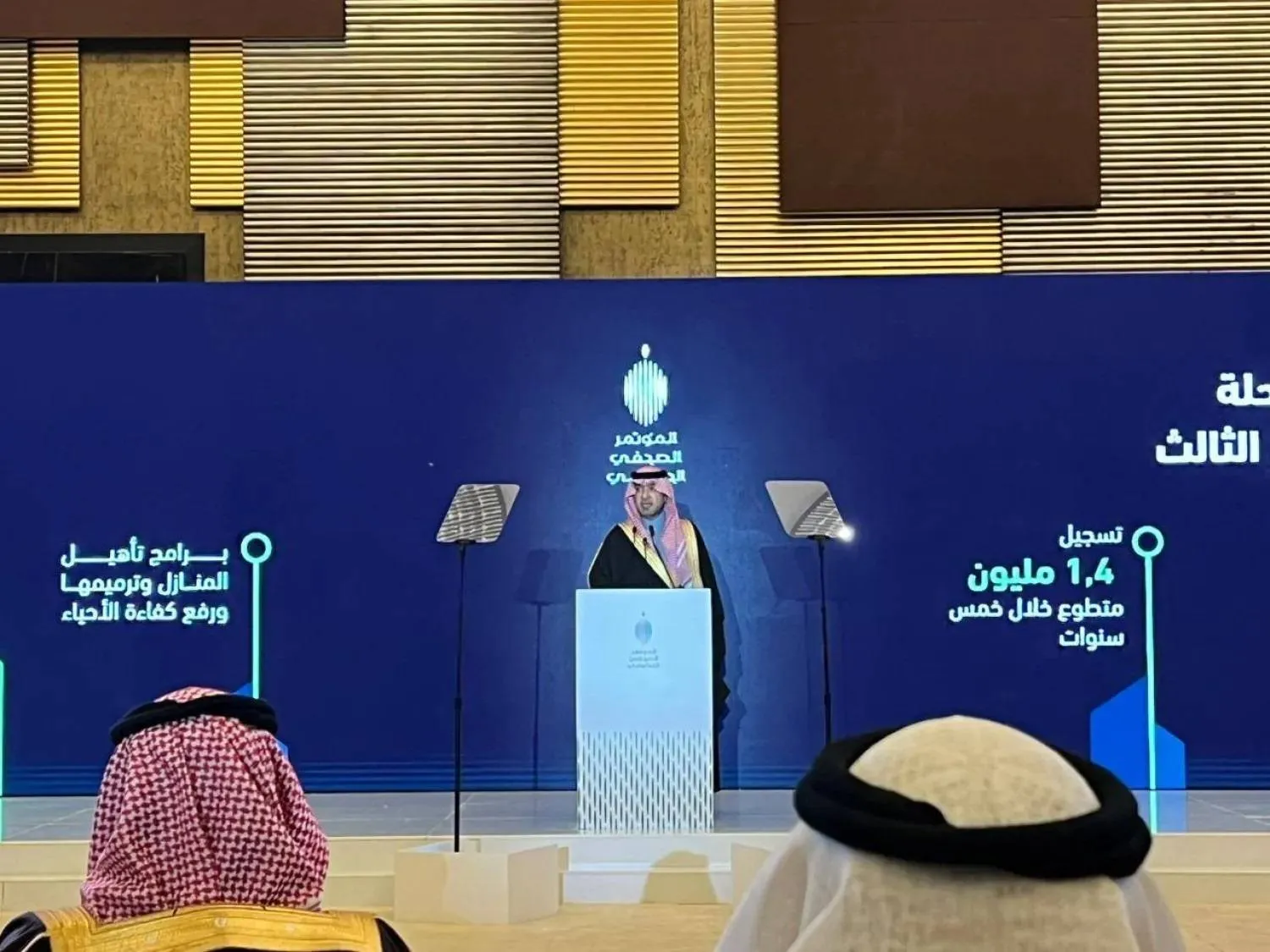
The Minister of Municipalities and Housing addresses attendees during the government press conference (Asharq Al-Awsat). 
TT

Saudi Arabia to Launch Real Estate Indicators, Expand ‘Market Balance’ Program Nationwide

The Minister of Municipalities and Housing addresses attendees during the government press conference (Asharq Al-Awsat). 

Saudi Arabia will roll out real estate market indicators in the first quarter of this year and expand the Real Estate Market Balance program to all regions of the Kingdom, following its initial implementation in Riyadh, Minister of Municipalities and Housing Majed Al-Hogail announced on Monday.

Al-Hogail, who also chairs the General Real Estate Authority, made the remarks during a government press conference in Riyadh attended by Minister of Media Salman Al-Dossary, President of the Saudi Data and Artificial Intelligence Authority (SDAIA) Abdullah Alghamdi, and other senior officials.

Al-Hogail said the housing and social ecosystem now includes more than 313 non-profit organizations supported by over 345,000 volunteers working alongside the public and private sectors.

He highlighted tangible outcomes, including housing assistance for 106,000 social security beneficiaries and the prevention of housing loss in 200,000 cases.

Development Initiatives

He noted that the non-profit sector is driving impact through more than 300 development initiatives and over 1,000 services, while empowering 100 non-profit entities and activating supervisory units across 17 municipalities.

Among key programs, Al-Hogail highlighted the Rental Support Program, which assisted more than 6,600 families last year, expanding the reach of housing aid.

He also traced the growth of the “Jood Eskan” initiative, which began by supporting 100 families and has since evolved into a nationwide program that has provided homes to more than 50,000 families across the Kingdom.

Since its launch, the initiative has attracted more than 4.5 million donors, with total contributions exceeding SAR 5 billion ($1.3 billion) since 2021.

Al-Hogail added that the introduction of electronic signatures has reduced the homeownership process from 14 days to just two.

In 2025 alone, more than 150,000 digital transactions were completed, and the needs of over 400,000 beneficiary families were assessed through integrated national databases. A mobile application for “Jood Eskan” is currently being deployed to further streamline services.

International Support and Economic Growth

Minister of Media Salman Al-Dossary said the Saudi Program for the Development and Reconstruction of Yemen launched 28 new development projects and initiatives worth SAR 1.9 billion ($506.6 million), including fuel grants for power generation and support for health, energy, education, and transport sectors across Yemeni governorates.

He also reported strong growth in the communications and information technology sector, which created more than 406,000 jobs by the end of 2025, up from 250,000 in 2018, an 80 percent cumulative increase. The sector’s market size reached nearly SAR 190 billion ($50.6 billion) in 2025.

Industry, Localization, and Philanthropy

In the industrial sector, investments exceeded SAR 9 billion ($2.4 billion), alongside five new renewable energy projects signed under the sixth phase of the National Renewable Energy Program.

Industrial and logistics investments worth more than SAR 8.8 billion ($2.34 billion) were also signed by the Saudi Authority for Industrial Cities and Technology Zones.

Al-Dossary said the Kingdom now hosts nearly 30,000 operating industrial facilities with total investments of about SAR 1.2 trillion ($320 billion), while the Saudi Export-Import Bank has provided SAR 115 billion ($30.6 billion) in credit facilities since its establishment.

On workforce development, nearly 100,000 social security beneficiaries were empowered through employment, training, and productive projects by late 2025, with localization rates in several specialized professions reaching as high as 70 percent.

Alghamdi said total donations through the “Ehsan” platform have reached SAR 14 billion ($3.7 billion) across 330 million transactions, reflecting the rapid growth of digital philanthropy in the Kingdom.


Alswaha Strengthens Saudi Arabia’s AI Partnerships, Expands Computing Infrastructure

Minister of Communications and Information Technology Abdullah Alswaha's meetings are part of Saudi Arabia’s efforts to build an integrated AI ecosystem. SPA
TT

Alswaha Strengthens Saudi Arabia’s AI Partnerships, Expands Computing Infrastructure

Minister of Communications and Information Technology Abdullah Alswaha's meetings are part of Saudi Arabia’s efforts to build an integrated AI ecosystem. SPA

Minister of Communications and Information Technology Abdullah Alswaha held a series of meetings with leaders of major global technology and investment companies during the second day of his visit to Silicon Valley.

The meetings focused on strengthening Saudi Arabia’s partnerships in artificial intelligence (AI), expanding computing capabilities and infrastructure, accelerating the development of advanced applications and robotics, and attracting high-value investments.

Alswaha met with OpenAI CEO Sam Altman and senior company executives to discuss expanding cooperation in advanced AI models, leveraging the computing capabilities and infrastructure being developed by HUMAIN to support the large-scale deployment of AI models, and accelerating the development of advanced national applications in priority sectors.

In the field of AI infrastructure, Alswaha met with Dell Technologies Chairman and CEO Michael Dell to discuss accelerating enterprise adoption of AI solutions, integrating Dell AI Factory solutions with HUMAIN’s computing capabilities to support the deployment of enterprise AI at scale, and advancing knowledge transfer and national capability development to support the transformation of key sectors in the Kingdom.

He also met with Cognition AI Co-Founder and CEO Scott Wu and senior company executives to discuss expanding the use of autonomous software engineering solutions, improving developer productivity, enabling the deployment of Devin and software agents through HUMAIN’s computing capabilities, and accelerating national capabilities in building and operating AI applications.

Alswaha also met with Solidigm Senior Vice President and Head of Global Operations Kyle Fukuda to discuss using advanced storage solutions in the computing infrastructure and data centers being developed by HUMAIN, improving data access efficiency and computing resource utilization, and supporting the expansion of AI applications in the Kingdom.

In the investment sector, Alswaha met with Social Capital Founder and CEO Chamath Palihapitiya to discuss attracting the firm’s investments into the infrastructure and computing capabilities being developed by the Kingdom, expanding investment in advanced technologies, and connecting global capital with high-value opportunities in Saudi Arabia.

These meetings are part of Saudi Arabia’s efforts to build an integrated AI ecosystem encompassing advanced models, computing capabilities, data centers, infrastructure, applications, robotics, and investment, further strengthening the competitiveness of the Kingdom’s digital economy and reinforcing its position as a global hub for technology, innovation, and AI.


China’s Car Exports in First 8 Months Surpass 2025 Total, as EV Sales Soar

FILE - Aerial view of new cars waiting for shipment at a port in Shanghai, China, on Jan. 14, 2026. (Chinatopix via AP, File)
TT

China’s Car Exports in First 8 Months Surpass 2025 Total, as EV Sales Soar

FILE - Aerial view of new cars waiting for shipment at a port in Shanghai, China, on Jan. 14, 2026. (Chinatopix via AP, File)

China’s passenger car exports in the first eight months of this year already surpassed last year's total, an industry association said Thursday, though domestic sales continued to decline.

Passenger car exports in August jumped 67.1% from the year before to around 890,000 units, driven by plug-in hybrids and pure electric vehicles, according to the China Association of Automobile Manufacturers (CAAM).

China exported more than 6.2 million passenger vehicles in January-August. Exports of all types of vehicles totaled 7.1 million last year, CAAM data show, including about 6 million passenger vehicles.

The world’s largest car exporter is on track to achieve 50% to 70% growth in full-year passenger vehicle exports, according to S&P Global Ratings.

At home, passenger car sales fell 25.6% year-on-year in August to just below 1.5 million vehicles.

China’s domestic car market is under pressure from intense competition and price wars, while the slowing economy has undermined consumer confidence.

China’s car exports have been stronger than expected so far this year, helped by competitive pricing and quality, said Stephen Chan, an associate director at S&P Global Ratings.

“It’s likely that strong export growth will largely mitigate the domestic weakness,” The Associated Press quoted him as saying.

Over the past few months the energy shock from the Iran war and rising fuel prices have led more drivers of gasoline and diesel-powered vehicles to shift to EVs.

Hefty tariffs have in effect kept most Chinese-made passenger cars out of the US market. But China has been exporting and selling more of its vehicles to Europe, Latin America, Africa and Southeast Asia.

Chinese automakers are also setting up more factories overseas.

Weak domestic demand is increasing carmakers’ incentives to redirect capacity overseas, analysts at Morgan Stanley said in a recent research note, and Chinese carmakers are increasingly moving beyond vehicle exports toward local assembly and manufacturing to ease impacts from trade barriers and reduce logistics costs.


‘Disciplined Pricing’: Saudi Arabia Tightens Motor Insurance Oversight, Protects Competition

 A vehicle showroom in Riyadh (Asharq Al-Awsat) 
 A vehicle showroom in Riyadh (Asharq Al-Awsat) 
TT

‘Disciplined Pricing’: Saudi Arabia Tightens Motor Insurance Oversight, Protects Competition

 A vehicle showroom in Riyadh (Asharq Al-Awsat) 
 A vehicle showroom in Riyadh (Asharq Al-Awsat) 

Saudi Arabia’s Insurance Authority is tightening oversight of motor insurance pricing to ensure rates are fair, sound and sustainable, while curbing practices that could undermine competition.

It has also introduced six regulatory standards for motor insurance pricing, requiring insurers to set premiums that are fair and reasonable and to base them on underwriting criteria that avoid pricing below technically sustainable levels or exposing insurers to losses.

Consumer protection

Specialists told Asharq Al-Awsat that the rules should make pricing more transparent without pushing insurers toward uniform rates, preserving competition on price, service and claims quality.

They cautioned that consumers could be negatively affected if the standards artificially narrowed price differences. But rules that curb undisciplined pricing while leaving room for genuine competition would benefit the market and policyholders.

Salem Baajajah, a professor of economics at King Abdulaziz University, stressed that oversight should focus on the fairness of pricing methodologies rather than making final rates similar across insurers.

He explained that the measures would help prevent unfair pricing, price dumping and other harmful practices while allowing insurers to compete through operational efficiency, claims management, service quality, innovation and more accurate risk models.

Fair trade

Consumer protection specialist Abdulaziz Al-Khudairi noted that the Insurance Authority was also addressing ambiguities surrounding vehicle leases to protect lessees’ rights, increase transparency and apply the principle of “fair trade.”

He explained that comprehensive insurance rules require financing companies to obtain at least three insurance quotes annually and offer the lessee the lowest-priced option, preventing customers from bearing unnecessary additional costs.

According to Al-Khudairi, discounts granted by insurers, including for a claims-free record, are credited to a dedicated insurance account for the lessee, with the balance settled at the end of the contract.

The rules also require vehicles to be revalued annually to reflect depreciation, with premiums declining accordingly instead of remaining based on the vehicle’s original new-car value throughout the financing period.

Al-Khudairi added that the lessee is the “primary beneficiary” in cases of partial loss, receiving compensation for repairs and managing vehicle maintenance, while the lessor is the “secondary beneficiary” in a total loss, covering the outstanding financing balance.

Rising prices

Some policyholders reported that motor insurance prices in Saudi Arabia have risen steadily, in some cases to six times previous levels. They expect the new standards to produce fairer rates based on clear and sound principles.

The Saudi Insurance Market Report for the first quarter of 2026 showed coverage expanding to 11.2 million vehicles, with gross written motor insurance premiums reaching SAR 5 billion ($1.3 billion). The monthly complaint rate fell to 0.09 percent from 0.12 percent.
