
Former Jordanian Prime Minister Ahmad Obeidat, who died earlier this month, was both a key player and a witness to sensitive chapters in his country’s history.
Obeidat began his career in the 1970s as an assistant director of intelligence, later serving as head of the General Intelligence Department until 1982. At the height of the Palestinian-Jordanian confrontation, he was abducted by the Popular Front for the Liberation of Palestine before the events of September 1970.
He also served for two years as interior minister before King Hussein appointed him prime minister in early 1984, a post he held until April 1985, concurrently serving as defense minister.
For more than 15 years, Obeidat remained at the center of decision-making. He later took on roles drawing on his legal background, from chairing the Royal Commission that drafted the National Charter in the early 1990s to serving in human rights and judicial positions, most recently as head of the board of trustees of the National Center for Human Rights until 2008.
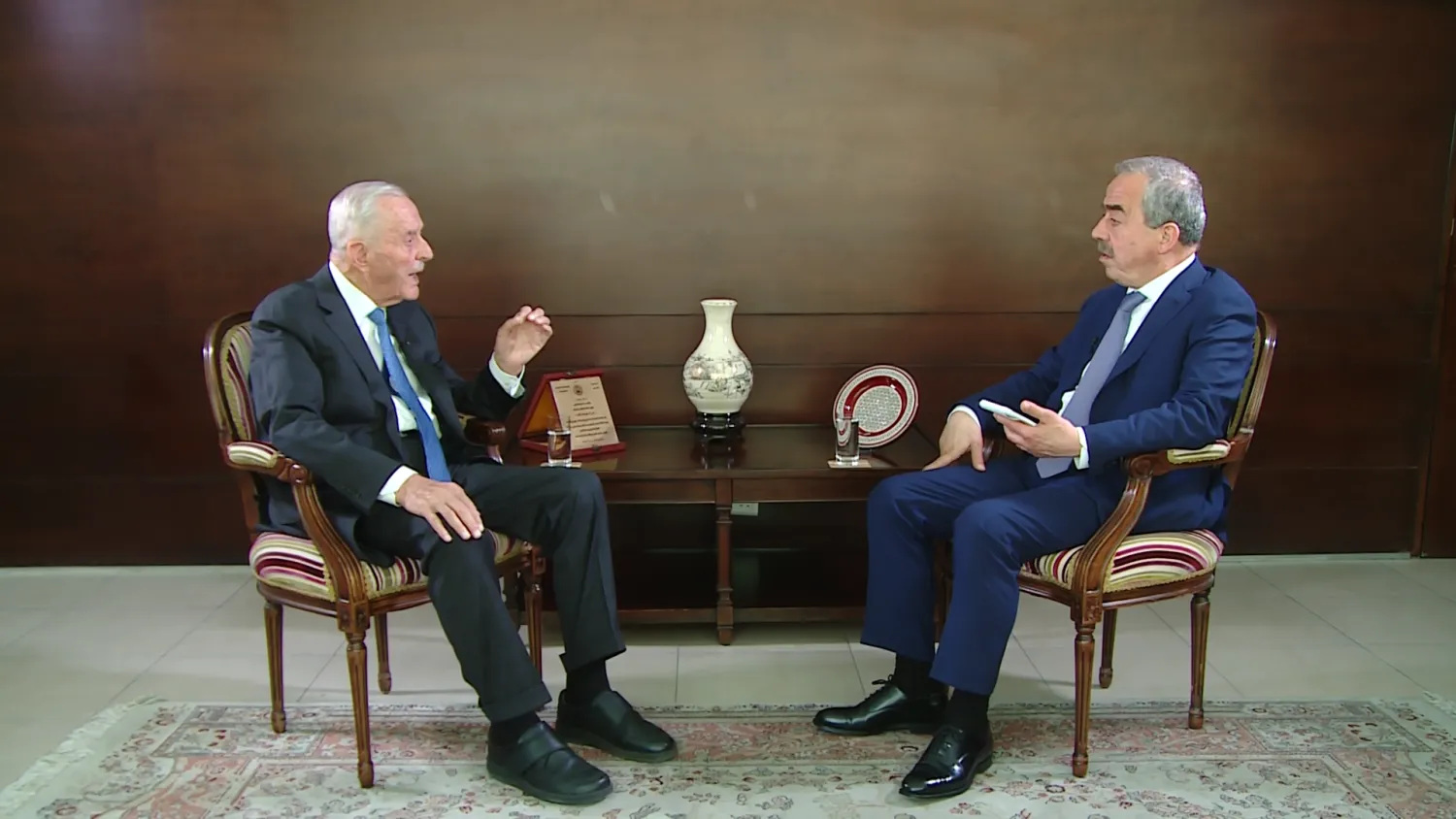
Weeks before Oct. 7, 2023, the day of the Al-Aqsa Flood Operation, Asharq Al-Awsat met Obeidat in Amman. The interview had been scheduled for publication in October 2023, but the major developments that followed led to its postponement, particularly as Obeidat addressed contentious issues, notably Jordanian-Palestinian relations.
In the first part of the interview, Obeidat revisits his formative years, when his political and professional journey began as a law student in Baghdad on the eve of the July 14, 1958 revolution, before returning to Iraq after the fall of the monarchy amid sweeping regional transformations.
The account moves to his early professional life in Jordan, from a brief stint in legal practice to joining the Public Security Directorate, then serving in the Political Investigations Office, which formed the nucleus of organized intelligence work. It concludes with a detailed narrative of the establishment of the General Intelligence Department in 1964, its early structure and founding members, at a time when the Jordanian state was rebuilding its institutions in an intensely turbulent region.
Asked where he was when the 1958 revolution broke out in Iraq, Obeidat said he had completed his first year in law studies and returned to Jordan for the summer break.
“While I was in Irbid, news arrived of the July 14 revolution in Iraq that overthrew the monarchy. After the summer break ended, I went back to Baghdad, where a republican government under Abdul Karim Qassem had taken power,” he recalled.
The return was not easy. “We faced difficulties on the road. The border between Jordan and Iraq was nearly closed, so we had to return via Damascus and then through desert routes to Baghdad. It was an exhausting journey,” he added.
Obeidat left Baghdad in 1961 after completing his final exams. “On the last day of exams in the fourth year, I went home, packed and returned to Jordan the same day. The border between Baghdad and Amman had reopened.”
Among his contemporaries at law school was Saddam Hussein, who studied in the evening section. Obeidat said he saw him only once by chance. “He was with others, one of whom later became a governor,” he revealed.
He returned to Baghdad again in 1983 as Jordan’s interior minister to attend a conference of Arab interior ministers, more than two decades after graduating. There, he met his Iraqi counterpart, Saadoun Shaker. “It was an ordinary relationship,” Obeidat said, describing the ties as largely ceremonial.
From customs to intelligence
After returning to Jordan in 1961, Obeidat initially considered practicing law. But limited opportunities in Irbid and his family’s financial constraints led him to seek public employment.
He was appointed to the Customs Department in Amman, where he worked for several months before joining the Public Security Directorate in April 1962 as a first lieutenant following three months of training at the police academy.
At the time, there was no separate intelligence agency. Public Security included a branch handling general investigations. Soon after, the Political Investigations Office was formed, staffed by legal officers from the army and Public Security, including Mudar Badran and Adeeb Tahaoub from military justice, alongside Obeidat and Tariq Alaaeddin from Public Security.
The office handled cases referred by security and official bodies, including military intelligence and the Royal Court. After reviewing its work, the late King Hussein ordered the establishment of a legally grounded intelligence body. The General Intelligence Law was issued in 1964, formally creating the department, explained Obeidat.
Mohammad Rasoul Al-Kilani became its first director, followed by Mudar Badran, then Nadhir Rashid. Al-Kilani briefly returned before Obeidat assumed the post, succeeded later by Tariq Alaaeddin.
The shock of 1967
Recalling the 1967 war, Obeidat described it as “a defeat, not a setback. A military, political, psychological, and social defeat in every sense.”
He said there was no institutional intelligence view on Jordan’s participation. “The political opinion of a figure of Wasfi Tal’s stature was that entering the 1967 war was a mistake. He was not in office, but he remained close to the king and influential,” said Obeidat.
According to Obeidat, King Hussein believed Israel would occupy the West Bank whether Jordan participated or not.
“Participation was a gamble that might succeed or fail. The catastrophe was discovering that the Egyptian air force had been destroyed within half an hour,” he added.
Despite the bitterness, he said: “We did not fear for the regime, but we sought to contain public anger and absorb the shock.”
September and the assassination of Wasfi Tal
Obeidat first met Yasser Arafat after the events of September 1970. He confirmed that Arafat left Amman with an official Arab delegation to attend the Cairo summit and returned immediately afterward.
He recalled being informed mid-flight of the death of Egyptian President Gamal Abdel Nasser. “King Hussein was deeply affected.”
On the assassination of Prime Minister Wasfi Tal in Cairo, Obeidat said the gunmen who confronted Tal at the hotel entrance were not responsible for the fatal shot. “The fatal bullet came from behind, from a sniper in another unseen location. To this day, the sniper has not been identified,” he added.
He rejected the notion that Tal had been reckless. “Wasfi was not a gambler. He had a distinct political project,” he stressed.
Obeidat said the Black September Organization accused Tal of ordering the expulsion of fedayeen from forested areas in Jerash and Ajloun. He denied that Tal was directly responsible, saying the clashes began after fedayeen attacked a police station and killed officers, prompting a spontaneous army response.
Abduction without interrogation
Before September 1970, Obeidat was abducted by the Popular Front for the Liberation of Palestine while serving as assistant intelligence director.
Armed vehicles stopped his car as he was leaving his home in Jabal Al-Taj with his family. He and his brother-in-law were taken to the Wehdat camp. “We were treated politely. We drank tea. No one asked me a single question,” he recalled.
After several hours, he was driven to another house in Amman and later returned home. The next morning, members of Fatah took him briefly to one of their offices, only to release him on foot without explanation.
“Not a single question was asked,” Obeidat said. “It was bewildering.”
He resumed his duties after ensuring his family’s safety. “At the time, intelligence, like any official institution, was threatened and targeted,” he said, reflecting on one of the most volatile periods in Jordan’s modern history.