


Board of Peace Pledges on Gaza Face Test of Implementation on the Ground

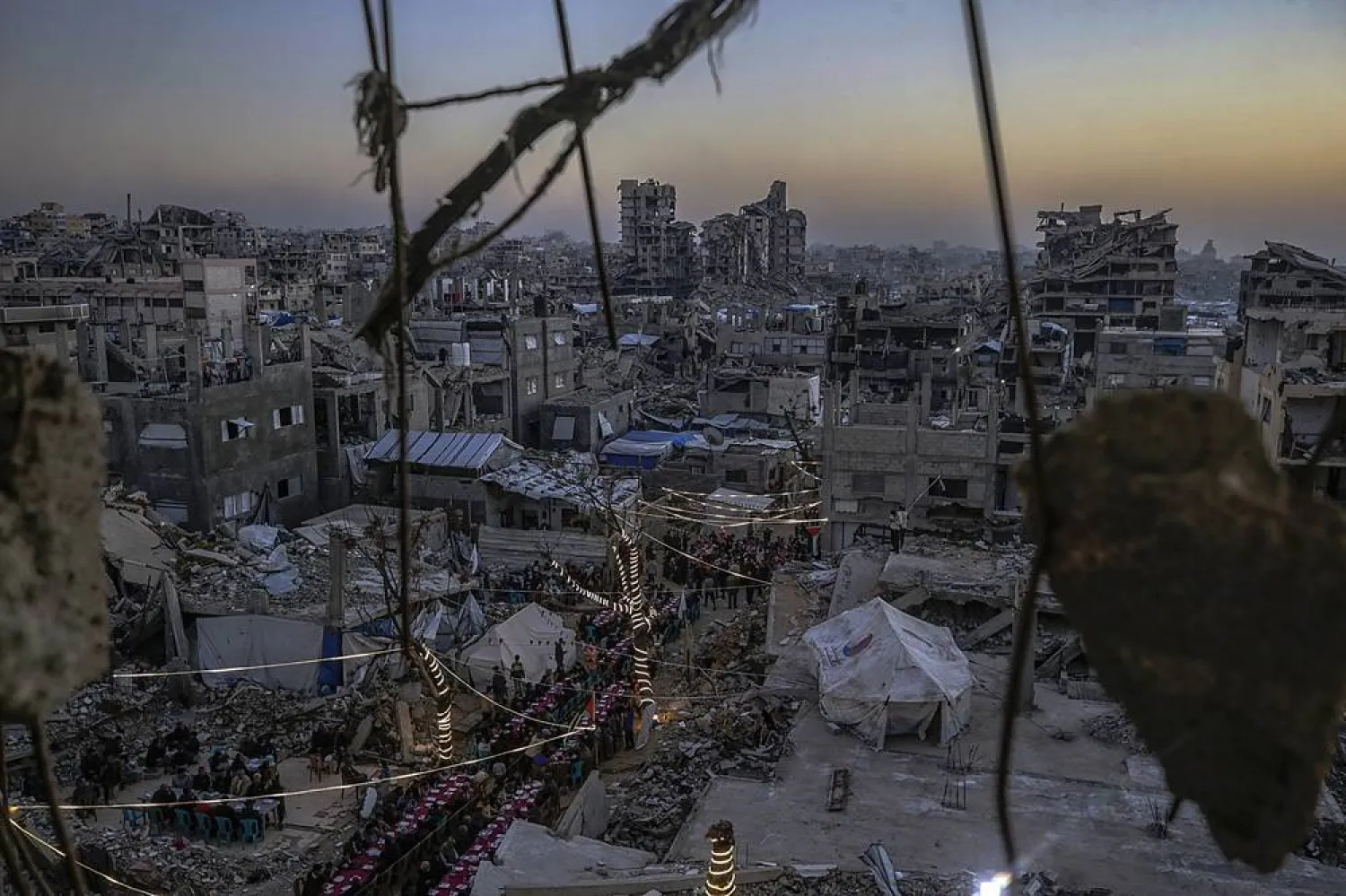
Palestinians gather between destroyed houses to break their fast together during the holy month of Ramadan in the northern Gaza Strip, 20 February 2026. (EPA)
TT

Board of Peace Pledges on Gaza Face Test of Implementation on the Ground

Palestinians gather between destroyed houses to break their fast together during the holy month of Ramadan in the northern Gaza Strip, 20 February 2026. (EPA)

The first meeting of the Board of Peace, chaired by US President Donald Trump and attended by Arab and Israeli representatives in the absence of the Palestinian Authority, set out ambitious goals but left key issues unresolved.

Washington distilled its priorities into two tracks: funding the reconstruction of Gaza and disarming Hamas. Arab participants, however, tied their demands to full implementation of the Gaza ceasefire, deployment of an international stabilization force, and enabling the technocrats’ committee to operate across the enclave without obstruction from Tel Aviv.

The meeting, which drew representatives from more than 40 countries and observers from 12 others, may struggle to translate pledges into practice, experts told Asharq Al-Awsat.

They pointed to formidable hurdles, foremost Israel’s continued deployment in Gaza and the absence of clear understandings on Hamas disarmament, warning that these issues could stall or even freeze the agreement.

Concerns

Indonesian President Prabowo Subianto urged caution against efforts that could derail the peace process in Gaza, Germany’s dpa news agency reported, citing Indonesia’s Antara News on Friday.

Trump announced that the United States would contribute $10 billion to the board, saying Saudi Arabia, Kazakhstan, Azerbaijan, the United Arab Emirates, Morocco, Bahrain, Qatar, Uzbekistan, and Kuwait had pledged more than $7 billion to the Gaza relief package.

He pressed hard on Hamas disarmament, saying the group would hand over its weapons as promised and warning of a harsh response if it did not.

Israel’s Foreign Minister Gideon Saar struck the same note in his address to the board, voicing support for disarming Hamas and other factions. Prime Minister Benjamin Netanyahu had already set the tone ahead of the meeting, declaring that there would be no reconstruction before Gaza is disarmed.

General Jasper Jeffers, commander of the newly formed International Stabilization Force, said Indonesia, Morocco, Kazakhstan, Kosovo, and Albania had pledged troops. Egypt and Jordan, which border Gaza, agreed to train police and security forces.

Egypt, in remarks delivered by Prime Minister Mostafa Madbouly, underscored the need to preserve the link between the West Bank and Gaza to allow the Palestinian Authority to resume its responsibilities in the enclave.

He called for empowering Palestinians to manage their own affairs and for the technocrats’ committee to begin work from inside Gaza and across all its areas.

Qatar’s Prime Minister and Foreign Minister Sheikh Mohammed bin Abdulrahman Al Thani pledged $1 billion from Doha to back the board’s push for a final settlement, saying the Board of Peace under Trump’s leadership would drive full implementation of the 20-point plan without delay.

Saeed Okasha, an Israeli affairs analyst at the Al-Ahram Center for Political and Strategic Studies, said the proposals unveiled by the Board of Peace lack operational clarity and risk creating confusion in implementation, potentially leading to paralysis.

Trump, he said, rushed to launch the board without first resolving core obstacles or forging solid understandings.

Palestinian political analyst Nizar Nazzal shared that view, arguing that the board’s pledges could falter because they emphasize economic measures, such as reconstruction funding, without a clear roadmap, and security measures, such as disarming Hamas, without addressing Israeli withdrawal or the group’s future.

“This sidestepping of political commitments will collide with security complexities and delay implementation of contentious provisions such as deploying stabilization forces, Israeli withdrawal, or empowering the technocrats’ committee,” he said.

Hamas

Hamas, for its part, has avoided direct confrontation with Trump’s recent calls for its disarmament. In a statement on Thursday, it said any arrangements in Gaza must begin with a “complete halt to the Israeli aggression.”

In another statement later that evening, the group said any political track or arrangements discussed regarding the Gaza Strip and the future of our Palestinian people must start with a complete cessation of the aggression, lifting the siege, and guaranteeing our people’s legitimate national rights, foremost among them the right to freedom and self-determination.

US mediator Bishara Bahbah said on Thursday that Hamas disarmament hinges on guarantees and protection for its members.

Okasha said an end to the offensive in Gaza, as Hamas demands, is unlikely so long as disarmament remains unresolved, pointing to US and Israeli statements.

The course Hamas appears to be charting, he said, suggests it wants to remain in place, a stance that could block implementation of the agreement and even pave the way for a return to war, especially as Washington has yet to clarify the mandate and timeline for deploying the stabilization force.

Nazzal said negotiating with Hamas over ending its existence is unrealistic. Its future must be addressed through serious, genuine understandings rather than a continuation of transactional trade-offs, he said.



Eight Hezbollah Members Killed in Israel’s Friday Strikes on Lebanon

A bulldozer clears debris near heavily-damaged buildings in the village of Bednayel in Lebanon's eastern Bekaa Valley region on February 21, 2026, following Israeli strikes. (AFP)
TT

Eight Hezbollah Members Killed in Israel’s Friday Strikes on Lebanon

A bulldozer clears debris near heavily-damaged buildings in the village of Bednayel in Lebanon's eastern Bekaa Valley region on February 21, 2026, following Israeli strikes. (AFP)

Attacks carried out by Israel on Friday in eastern Lebanon killed eight members of Hezbollah, an official from the group told AFP on Saturday.

Lebanon's health ministry said Friday that a total of 10 people were killed in strikes that hit the eastern Bekaa region.

The Israeli military said it targeted "several terrorists of Hezbollah's missile array in three different command centers in the Baalbek area".

Lebanon's president on Saturday condemned the attacks, the latest despite a ceasefire with Hezbollah.

In a statement, Joseph Aoun called the attacks "a blatant act of aggression aimed at thwarting diplomatic efforts" by the United States and other nations to establish stability.

A lawmaker from Hezbollah called on Beirut to suspend meetings of a multinational committee tasked with monitoring the truce.

Washington is one of five members on the committee overseeing the ceasefire implemented in November 2024, with the body scheduled to meet again next week.

Israel has repeatedly bombed Lebanon despite the ceasefire, usually saying it is targeting Hezbollah but occasionally also the group's Palestinian ally Hamas.

The Friday attacks on southern and eastern Lebanon killed 12 people, according to the health ministry, 10 of them in the east of the country.

Israel's military said it struck "several terrorists of Hezbollah's missile array in three different command centers in the Baalbek area".

Hezbollah said a commander was killed in the raids. Its lawmaker Rami Abu Hamdan said on Saturday the group "will not accept the authorities acting as mere political analysts, dismissing these as Israeli strikes we have grown accustomed to before every meeting of the committee".

He called on Beirut to "suspend the committee's meetings until the enemy ceases its attacks".

Hezbollah, while weakened following war with Israel, remains a strong political force in Lebanon represented in parliament.

Lebanon's government last year committed to disarming the Iran-backed group, with the army saying last month it had completed the first phase of the plan covering the area near the Israeli border.

Israel, which accuses Hezbollah of rearming since the war, has called the Lebanese army's progress on disarming the group insufficient.


Ramadan’s First Friday Prayers Are Held at Jerusalem’s Al-Aqsa Mosque

Palestinians worshippers gather at Al-Aqsa Mosque compound for the first Friday prayers during the holy month of Ramadan, in the Old City of Jerusalem, 20 February 2026. (EPA)
TT

Ramadan’s First Friday Prayers Are Held at Jerusalem’s Al-Aqsa Mosque

Palestinians worshippers gather at Al-Aqsa Mosque compound for the first Friday prayers during the holy month of Ramadan, in the Old City of Jerusalem, 20 February 2026. (EPA)

Tens of thousands of Palestinians gathered under heavy Israeli restrictions at Jerusalem's Al-Aqsa Mosque compound for the first Friday prayers of the Muslim holy month of Ramadan, including some who were allowed to enter from the occupied West Bank.

The Ramadan prayers at Al-Aqsa took place for the first time since a shaky ceasefire deal between Israel and Hamas went into effect in October. It was the first opportunity many had to leave the West Bank and pray at the site in Jerusalem’s Old City since Ramadan last year.

Israel restricted the number of Palestinians allowed to enter from the West Bank to 10,000 on Friday, and only allowed men over 55 and women over 50 as well as children up to 12. It has imposed similar restrictions in the past, citing security concerns.

The hilltop, which Jews refer to as the Temple Mount, is the holiest site in Judaism and was home to the ancient biblical temples. Muslims call the site the Noble Sanctuary. Today it is home to Al-Aqsa Mosque, the third-holiest site in Islam.

It has frequently been a flashpoint in the Israeli-Palestinian conflict.

Israeli police said more than 3,000 police were deployed across Jerusalem. They said their presence was not meant to show aggression or force but was aimed at providing help in case of an emergency.

Many Palestinians view the heightened Israeli security presence, and increasing visits by religious and nationalist Israeli Jews, as a provocation. They fear that Israel intends to take over or partition the compound. The Israeli government denies having any such plans.

Jerusalem’s Islamic Waqf, the Jordanian religious authority that administers the compound, said there were 80,000 in attendance. In normal times, Ramadan Friday prayers at Al-Aqsa can draw up to 200,000.

Ezaldeen Mustafah, a Palestinian from the West Bank, was among those lamenting the restrictions.

“We need more people than this,” he said.

Some Palestinians from the West Bank on Friday said they were turned away from crossing into Jerusalem even though they had permits. Jihad Bisharat said he was told his permit had been canceled and was sent back. Israel's army didn't immediately respond to a request for comment.

The Old City, home to major religious sites sacred to Jews, Christians and Muslims, is in east Jerusalem, which Israel captured in the 1967 Mideast war, along with the West Bank and the Gaza Strip. The Palestinians want all three territories for a future state with its capital in east Jerusalem. Israel annexed east Jerusalem, a move not recognized by most of the international community, and considers the entire city to be its capital.

Ramadan in Gaza

Many Palestinians said the month’s typically festive spirit is eluding them as they struggle with grief and losses following two years of conflict in Gaza sparked by Hamas' Oct. 7, 2023, attack into Israel.

“All the mosques have been bombed,” said Ramiz Firwana, a Gaza resident who gathered with other worshippers for a Friday sermon and prayers held in schoolyard.

On Thursday evening, families sat amid the rubble and destruction for iftar, the meal held at the end of the daily dawn-to-dusk fast.

“Despite the displacement, the pain and the destruction, we want to rejoice and live,” said Mohammad Kollab, from Khan Younis. “We are not a people destined only for destruction and killing."

Israel’s military offensive has killed more than 72,000 Palestinians, according to Gaza’s Health Ministry, and caused widespread destruction and displaced most of the territory’s residents. Israel launched the offensive after Hamas-led militants killed some 1,200 people, mostly civilians, and took another 251 hostage in the initial attack.

The Oct. 10 US-brokered ceasefire deal has brought an end to major military operations and the release of the remaining hostages. But Palestinians, including many civilians, are still being killed in near-daily strikes that Israel says are aimed at militants who threaten or attack its forces.


Parliamentary Elections Preparations Kick off in Lebanon Despite Doubts They Will Be Held

Head of the Lebanese Forces Samir Geagea announces the launch of its electoral campaign in Bcharre. (National News Agency)
TT

Parliamentary Elections Preparations Kick off in Lebanon Despite Doubts They Will Be Held

Head of the Lebanese Forces Samir Geagea announces the launch of its electoral campaign in Bcharre. (National News Agency)

Political forces in Lebanon have kicked off their preparations for the upcoming parliamentary elections in May despite doubts that they may not be held. No more than ten candidates have so far submitted their nominations as the political powers work on postponing the elections while still preparing to run in them.

Shiite duo

Parliament Speaker Nabih Berri has repeatedly said that the elections will be held on time.

He received on Friday a delegation from Hezbollah’s Loyalty to the Resistance bloc headed by MP Mohammed Raad. Talks focused on political developments and the elections.

Berri’s Amal movement and Hezbollah are allies that form the so-called “Shiite duo”.

Following the meeting, Raad said both sides share the same views and that their alliance still stands.

“Together, they will form national unity against all challenges,” he declared. “We will run in the elections together.”

It remains to be seen what other alliances the Shiite duo will manage to forge.

The Free Patriotic Movement (FPM), headed by MP Jebran Bassil, had previously ended its alliance with Hezbollah, but reports have said the two sides may hold negotiations related to the elections.

Geagea: Elections are critical

Samir Geagea’s Lebanese Forces launched on Friday the party’s electoral campaign from Bcharre, announcing the nomination of MP Setrida Tawk Geagea and former MP Joseph Ishak, who will both run in the province.

More candidates will be announced within a week, leading LF sources told Asharq Al-Awsat.

Samir Geagea described the elections as a “pivotal juncture in reclaiming the state and consolidating its sovereignty,” calling for a large turnout.

Sources from the LF acknowledged that the elections may be postponed, but until that happens, the party will operate as though they are going to be held on time.

The FPM had last week cited “negative” signals that may impede the elections given the ongoing dispute over the voting of expatriates and other differences.

The LF sources told Asharq Al-Awsat that preparations for the elections are taking place “on all levels” and “covering all of their aspects.”

The remaining candidates will be announced within days, they revealed.

“For us, the main question is why and how will the current parliament’s term be extended and who will dare to even suggest it?” they said.

“We are therefore convinced that the elections will be held. We are making our preparations based on the firm conviction that the elections need to be held. There really is no reason to delay them, and we will stand against anyone who tries to do so,” they added.

The Interior Ministry had announced that candidates have between February 10 and March 10 to submit their nominations.