

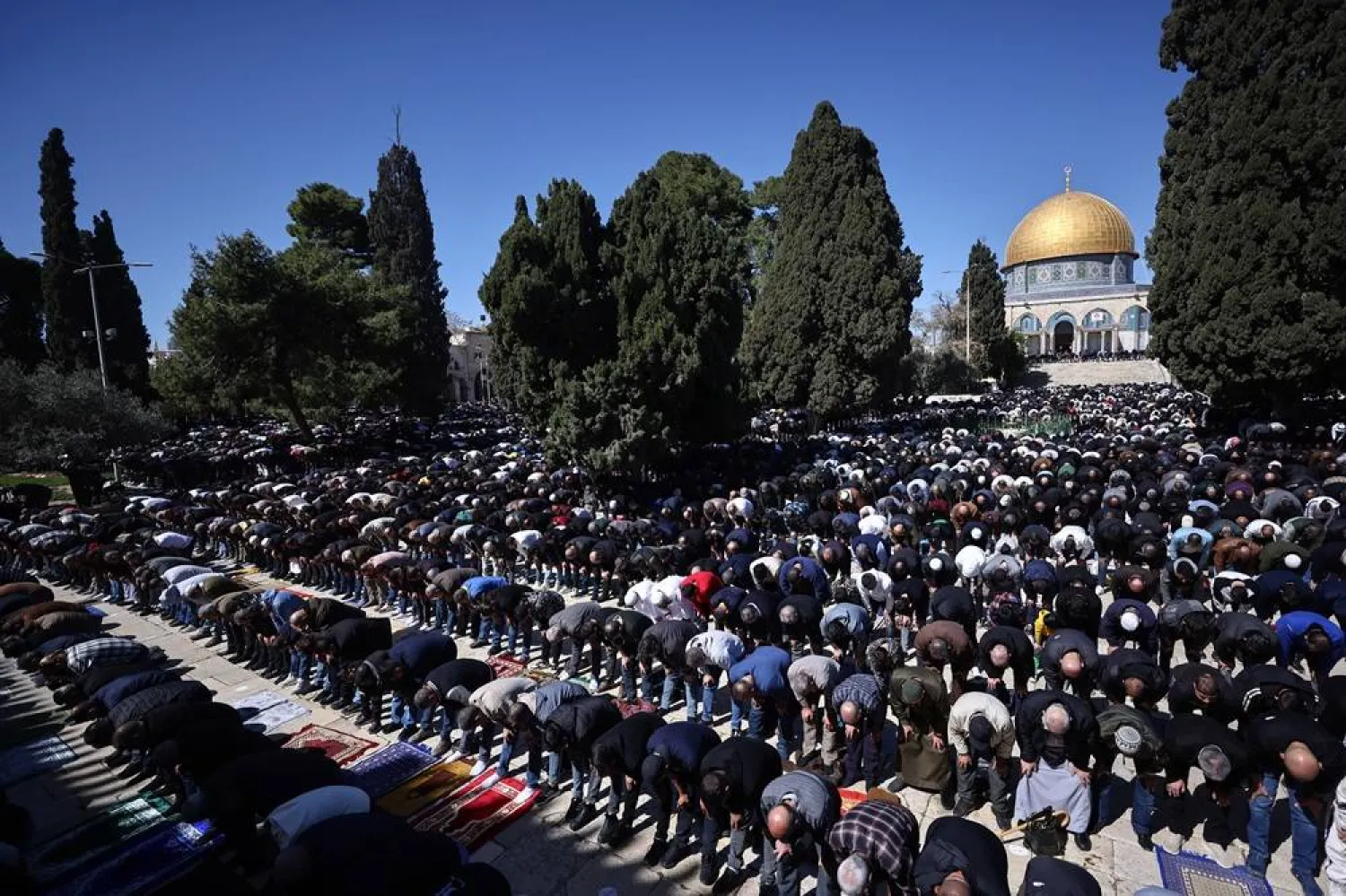

Ramadan’s First Friday Prayers Are Held at Jerusalem’s Al-Aqsa Mosque

Palestinians worshippers gather at Al-Aqsa Mosque compound for the first Friday prayers during the holy month of Ramadan, in the Old City of Jerusalem, 20 February 2026. (EPA)
TT

Ramadan’s First Friday Prayers Are Held at Jerusalem’s Al-Aqsa Mosque

Palestinians worshippers gather at Al-Aqsa Mosque compound for the first Friday prayers during the holy month of Ramadan, in the Old City of Jerusalem, 20 February 2026. (EPA)

Tens of thousands of Palestinians gathered under heavy Israeli restrictions at Jerusalem's Al-Aqsa Mosque compound for the first Friday prayers of the Muslim holy month of Ramadan, including some who were allowed to enter from the occupied West Bank.

The Ramadan prayers at Al-Aqsa took place for the first time since a shaky ceasefire deal between Israel and Hamas went into effect in October. It was the first opportunity many had to leave the West Bank and pray at the site in Jerusalem’s Old City since Ramadan last year.

Israel restricted the number of Palestinians allowed to enter from the West Bank to 10,000 on Friday, and only allowed men over 55 and women over 50 as well as children up to 12. It has imposed similar restrictions in the past, citing security concerns.

The hilltop, which Jews refer to as the Temple Mount, is the holiest site in Judaism and was home to the ancient biblical temples. Muslims call the site the Noble Sanctuary. Today it is home to Al-Aqsa Mosque, the third-holiest site in Islam.

It has frequently been a flashpoint in the Israeli-Palestinian conflict.

Israeli police said more than 3,000 police were deployed across Jerusalem. They said their presence was not meant to show aggression or force but was aimed at providing help in case of an emergency.

Many Palestinians view the heightened Israeli security presence, and increasing visits by religious and nationalist Israeli Jews, as a provocation. They fear that Israel intends to take over or partition the compound. The Israeli government denies having any such plans.

Jerusalem’s Islamic Waqf, the Jordanian religious authority that administers the compound, said there were 80,000 in attendance. In normal times, Ramadan Friday prayers at Al-Aqsa can draw up to 200,000.

Ezaldeen Mustafah, a Palestinian from the West Bank, was among those lamenting the restrictions.

“We need more people than this,” he said.

Some Palestinians from the West Bank on Friday said they were turned away from crossing into Jerusalem even though they had permits. Jihad Bisharat said he was told his permit had been canceled and was sent back. Israel's army didn't immediately respond to a request for comment.

The Old City, home to major religious sites sacred to Jews, Christians and Muslims, is in east Jerusalem, which Israel captured in the 1967 Mideast war, along with the West Bank and the Gaza Strip. The Palestinians want all three territories for a future state with its capital in east Jerusalem. Israel annexed east Jerusalem, a move not recognized by most of the international community, and considers the entire city to be its capital.

Ramadan in Gaza

Many Palestinians said the month’s typically festive spirit is eluding them as they struggle with grief and losses following two years of conflict in Gaza sparked by Hamas' Oct. 7, 2023, attack into Israel.

“All the mosques have been bombed,” said Ramiz Firwana, a Gaza resident who gathered with other worshippers for a Friday sermon and prayers held in schoolyard.

On Thursday evening, families sat amid the rubble and destruction for iftar, the meal held at the end of the daily dawn-to-dusk fast.

“Despite the displacement, the pain and the destruction, we want to rejoice and live,” said Mohammad Kollab, from Khan Younis. “We are not a people destined only for destruction and killing."

Israel’s military offensive has killed more than 72,000 Palestinians, according to Gaza’s Health Ministry, and caused widespread destruction and displaced most of the territory’s residents. Israel launched the offensive after Hamas-led militants killed some 1,200 people, mostly civilians, and took another 251 hostage in the initial attack.

The Oct. 10 US-brokered ceasefire deal has brought an end to major military operations and the release of the remaining hostages. But Palestinians, including many civilians, are still being killed in near-daily strikes that Israel says are aimed at militants who threaten or attack its forces.




Egypt Says It Held Calls with US Witkoff, Regional Counterparts

 Egyptian Foreign Minister Badr Abdelatty speaks during a joint news conference with Russian Foreign Minister Sergei Lavrov following their meeting in Moscow, Russia April 3, 2026. (Pavel Bednyakov/Pool via Reuters)
Egyptian Foreign Minister Badr Abdelatty speaks during a joint news conference with Russian Foreign Minister Sergei Lavrov following their meeting in Moscow, Russia April 3, 2026. (Pavel Bednyakov/Pool via Reuters)
TT

Egypt Says It Held Calls with US Witkoff, Regional Counterparts

 Egyptian Foreign Minister Badr Abdelatty speaks during a joint news conference with Russian Foreign Minister Sergei Lavrov following their meeting in Moscow, Russia April 3, 2026. (Pavel Bednyakov/Pool via Reuters)
Egyptian Foreign Minister Badr Abdelatty speaks during a joint news conference with Russian Foreign Minister Sergei Lavrov following their meeting in Moscow, Russia April 3, 2026. (Pavel Bednyakov/Pool via Reuters)

Egypt's Foreign Minister Badr Abdelatty held separate calls to discuss proposals for regional de-escalation with ‌US Envoy ‌Steve Witkoff ‌and ⁠regional counterparts including Iranian ⁠Foreign Minister Abbas Araqchi, the ministry said in a ⁠statement on ‌Sunday.

Egypt, ‌Türkiye and ‌Pakistan have ‌emerged as active intermediaries in the crisis, with ‌Islamabad recently hosting a meeting to ⁠discuss ⁠regional de-escalation and proposals to reopen the Strait of Hormuz.


Hezbollah Says Targeted Israeli Warship with Cruise Missile

A man checks his phone on a beach as smoke rises from Israeli artillery shells on Qlaileh village, visible from Tyre city, south Lebanon, March 28, 2026. (AP)
TT

Hezbollah Says Targeted Israeli Warship with Cruise Missile

A man checks his phone on a beach as smoke rises from Israeli artillery shells on Qlaileh village, visible from Tyre city, south Lebanon, March 28, 2026. (AP)

Hezbollah on Sunday said it had targeted an Israeli warship with a cruise missile off the Lebanese coast, the first such claim by the group since the start of the Middle East war.

In a statement, the Iran-backed group said it targeted the vessel 68 nautical miles off the Lebanese coast, claiming the warship was "preparing to launch attacks on Lebanese territory".

Israeli warships have been used on several recent occasions to launch strikes on Lebanon.


IMF Hails Yemen’s Reforms, Supports its Recovery Path

The light of the setting sun illuminates some clouds in the sky over Sanaa, Yemen, 30 March 2026. (EPA)
TT

IMF Hails Yemen’s Reforms, Supports its Recovery Path

The light of the setting sun illuminates some clouds in the sky over Sanaa, Yemen, 30 March 2026. (EPA)

The Executive Board of the International Monetary Fund (IMF) on Saturday resumed Article IV consultations with the Yemeni legitimate government after 11 years.

Reflecting the country’s improved institutional performance, this development is an important indicator of restoring channels of cooperation with international financial institutions and boosting confidence in the reform path being taken by the government.

“The renewed consultation reflects enhanced institutional capacity and data production,” the IMF said in a statement.

It positively noted the government’s efforts to achieve the minimum economic stabilization despite the extraordinary circumstances the country is going through.

The Fund said Yemen’s economy is gradually emerging from the deep recession following the suspension of oil exports in 2022, with the pace of contraction moderating and fiscal and external pressures easing. However, it warned that the war in the Middle East is expected to weigh on Yemen’s economy this year, while risks to the outlook remain substantial.

IMF directors affirmed the authorities' commitment to revenue mobilization and fiscal governance enables the delivery of essential public services.

They noted that a market-based exchange rate supports Yemen’s economic recovery and social stability.

Directors said that engagement with creditors to support a comprehensive debt treatment is also essential to restore debt sustainability.

Meanwhile, the prioritization of essential spending is expected to weigh temporarily on the fiscal balance, the IMF said, but over time will help protect the most vulnerable.

The Yemeni government welcomed the approval of the IMF’s Article IV consultation results after an 11-year pause - an important step restoring international engagement and confidence in its reform agenda to strengthen financial management, transparency and fight corruption, despite the war outcomes and the suspension of oil exports as a result of Houthi attacks.

The government reaffirmed its commitment to continue implementing a comprehensive reform program in various sectors, and to work in coordination with international partners to alleviate human suffering and achieve economic stability.

It then noted the adoption of the 2026 general budget as part of efforts to revive state institutions.

Despite the positive indicators, the IMF said the challenges facing Yemen's economy remain large and complex amid the ongoing war, institutional fragmentation and lack of financial resources.

The IMF stressed that the risks surrounding the future outlook remain high, especially in light of regional developments and their potential impact on the global economy.

It said inflation, fluctuating exchange rates and rising import costs will cause major pressure on the economy, requiring the adoption of balanced precautionary policies to maintain monetary and financial stability.

From 2027 onward, the IMF said the economy is expected to begin regaining momentum as inflation declines, real incomes recover and remittances and non-oil exports expand under the authorities’ Agriculture Plan.