US Military Strikes Another Alleged Drug Boat in Eastern Pacific, Killing 3

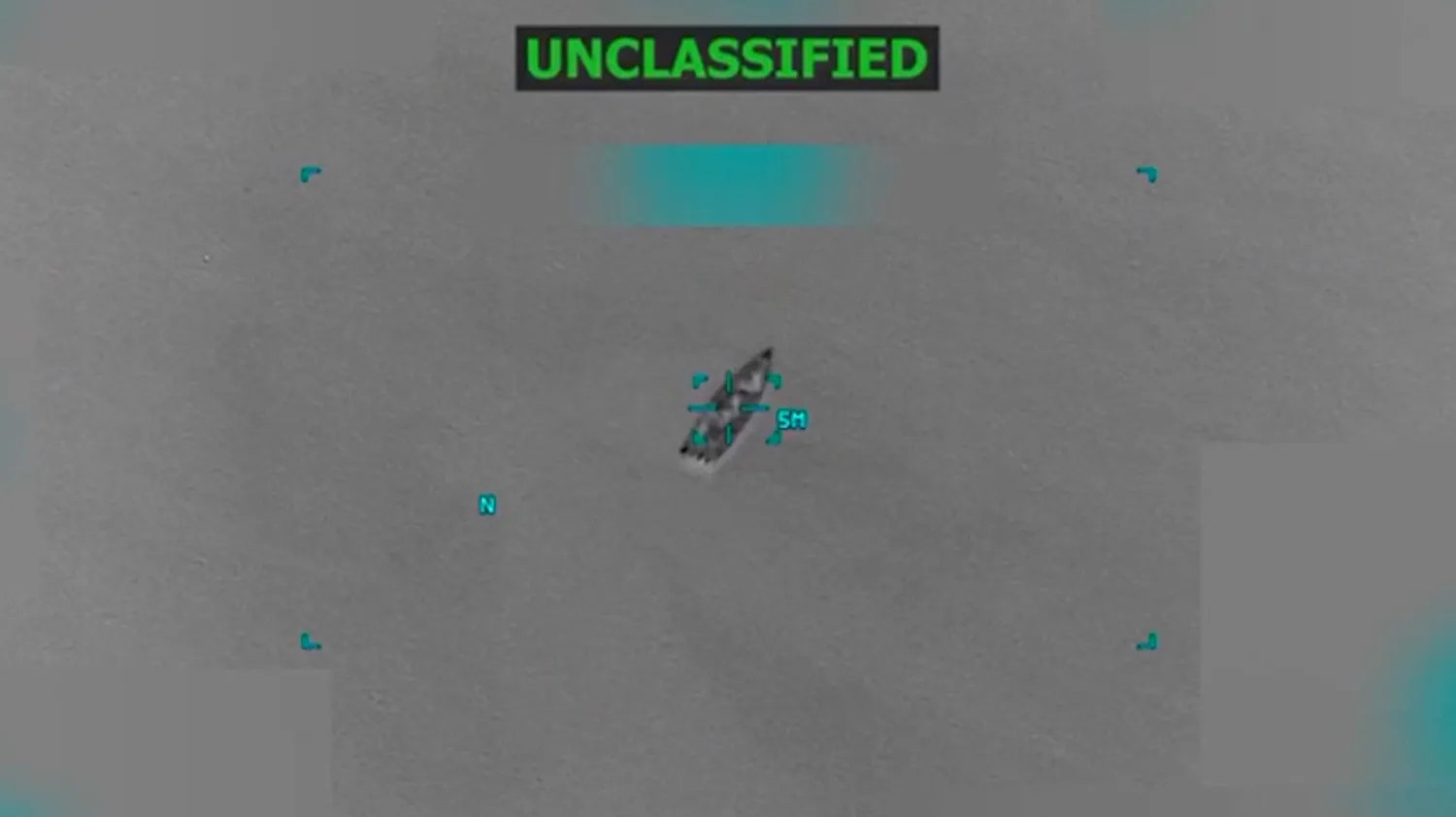
A shot of a boat targeted by a US raid in the Caribbean (archive - Reuters)
TT

US Military Strikes Another Alleged Drug Boat in Eastern Pacific, Killing 3

A shot of a boat targeted by a US raid in the Caribbean (archive - Reuters)

The US military said Friday that it has carried out another deadly strike on a vessel accused of trafficking drugs in the Eastern Pacific Ocean.

US Southern Command said on social media that the boat “was transiting along known narco-trafficking routes in the Eastern Pacific and was engaged in narco-trafficking operations.” It said the strike killed three people. A video linked to the post shows a boat floating in the water before bursting into flames.

Friday’s attack raises the death toll from the Trump administration’s strikes on alleged drug boats to at least 148 people in at least 43 attacks carried out since early September in the Caribbean Sea and eastern Pacific Ocean.

President Donald Trump has said the US is in “armed conflict” with cartels in Latin America and has justified the attacks as a necessary escalation to stem the flow of drugs. But his administration has offered little evidence to support its claims of killing “narcoterrorists.”

Critics have questioned the overall legality of the strikes as well as their effectiveness, in part because the fentanyl behind many fatal overdoses is typically trafficked to the US over land from Mexico.


Trump Hails ‘Really Big Night’ After Far-Right Win in Germany

(L-R) Alternative for Germany (AfD) party and parliamentary group co-chairman Tino Chrupalla, top candidate of the AfD party in Saxony-Anhalt Ulrich Siegmund, and AfD party and parliamentary group co-chairwoman Alice Weidel pose for the media during a press conference in Berlin, Germany, 07 September 2026. (EPA)
TT

Trump Hails ‘Really Big Night’ After Far-Right Win in Germany

(L-R) Alternative for Germany (AfD) party and parliamentary group co-chairman Tino Chrupalla, top candidate of the AfD party in Saxony-Anhalt Ulrich Siegmund, and AfD party and parliamentary group co-chairwoman Alice Weidel pose for the media during a press conference in Berlin, Germany, 07 September 2026. (EPA)

US President Donald Trump on Tuesday hailed what he called a "really big" victory by Germany's far-right movement after the Alternative for Germany (AfD) party scored a dramatic upset in state elections.

"Wow! The Populist Party in Germany just had a really big night," Trump posted on his Truth Social platform, before going on to bash the country's immigration regulations.

"They finally got tired of the absolutely horrible Immigration rules and regulations which have hurt Germany so badly."

Trump's celebratory post -- which did not name the party specifically -- came two days after the AfD emerged as the largest party in elections in the eastern state of Saxony-Anhalt.

The anti-immigration, Russia-friendly and pro-Trump AfD party took almost 44 percent of the vote, and has vowed a "remigration and deportation offensive" targeting migrants.

The prospect of the first far-right government taking charge of a German state since World War II has deeply unsettled many migrants and minority groups.

The AfD in Saxony-Anhalt is labelled a "right-wing extremist" group by Germany's domestic intelligence agency, and its triumphant lead candidate Ulrich Siegmund's staff are known former members of a since-banned neo-Nazi organization.

Trump supporters have cheered on the AfD, with former US ambassador to Germany Richard Grenell celebrating the results as "a new day in Germany" and tech billionaire Elon Musk rushing to be among the first to celebrate AfD's victory with a resounding "Well done!"

"THEY ARE ON THE RISE, and not going to take it anymore! MGGA!!!," Trump posted on social media, a German variation on his "Make America Great Again" platform.


US Treasury Chief Bessent Backs Using US Financial Power as Foreign Policy Tool

 US Treasury Secretary Scott Bessent stands at the podium for a rehearsal before the Republican convention Tuesday, Sept. 8, 2026, in Dallas. (AP)
US Treasury Secretary Scott Bessent stands at the podium for a rehearsal before the Republican convention Tuesday, Sept. 8, 2026, in Dallas. (AP)
TT

US Treasury Chief Bessent Backs Using US Financial Power as Foreign Policy Tool

 US Treasury Secretary Scott Bessent stands at the podium for a rehearsal before the Republican convention Tuesday, Sept. 8, 2026, in Dallas. (AP)
US Treasury Secretary Scott Bessent stands at the podium for a rehearsal before the Republican convention Tuesday, Sept. 8, 2026, in Dallas. (AP)

US Treasury ‌Secretary Scott Bessent advocated on Tuesday for Washington's use of financial power as a foreign policy tool with the goal of advancing the interests of American allies, including in financial and political situations abroad.

"I believe that I can use the balance sheet of the US for foreign policy. So, we have a foreign policy goal and that is to create allies in the Western hemisphere," Bessent said in an event at the SMU Cox School of Business.

"Argentina was the front-runner ‌for that ‌and it was my belief that the Milei ‌government ⁠had sound policies," ⁠he said, referring to Argentine President Javier Milei's government.

Last year, the US provided Argentina with a multibillion-dollar support package to help stabilize its currency and bolster Milei ahead of midterm elections.

Bessent's comments marked an open acknowledgement of the Trump administration's willingness to use US financial resources to shape the politics ⁠and economies of foreign countries.

President Donald Trump's administration ‌has tried to sway political contests ‌across other parts of Latin America and has moved to increase ‌US presence and influence in the region.

Trump also ordered ‌the seizure of ousted Venezuelan leader Nicolas Maduro in a deadly raid and the US military has carried out multiple strikes on boats in the Caribbean that have killed dozens.

Rights advocates, both in ‌the US and around the world, say such actions are imperial and amount to extrajudicial killings. ⁠Trump ⁠casts them as attempts to advance US interests and counter drug trafficking and illegal immigration.

Bessent also spoke about the US having joined Japan in a rare joint yen-buying intervention on July 31, which signaled determination to prevent a selloff in the yen and Japanese government bonds from spilling over into global markets.

"When we intervened with the Japanese yen, I have pretty good insight into what the Japanese, what the Bank of Japan is going to do, what Japanese policy makers are going to do," Bessent said.

The Trump administration has also used tariffs as a foreign policy tool.


Russia Torments Kyiv with New ‘Horror' Jet Drones

Ukraine developed its anti-drone defenses hastily after Russia's 2022 invasion. Sergei SUPINSKY / AFP/File
TT

Russia Torments Kyiv with New ‘Horror' Jet Drones

Ukraine developed its anti-drone defenses hastily after Russia's 2022 invasion. Sergei SUPINSKY / AFP/File

Flying several kilometers in the air and close to the speed of a commercial plane, Moscow's new long-range jet-powered drones are causing havoc for Kyiv's stretched air defenses.

Moscow has been launching waves of the attack drones at the Ukrainian capital in recent weeks, paralyzing the city with near constant air alerts.

President Volodymyr Zelensky on Sunday slammed the "horror that's been happening in the sky these past few days" as a new tactic by Russian leader Vladimir Putin, and vowed a response.

The new drones pose a challenge to Ukraine's relatively effective and low-cost anti-drone defense shield, built hastily after Russia's 2022 invasion.

Ukraine has quickly become a world leader in drone defense and has struck deals with several Western and Middle Eastern countries to share technology.

But its vaunted network of drone interceptors -- which had been shooting down the vast majority of more conventional drones, built with internal combustion engines and propellers -- has had a harder task against the new jet-powered devices.

Experts say they are fitted with Chinese-made aircraft-style mini jet engines, and can fly five kilometers in the air at a speed of 400-600 kilometers (250-370 miles) per hour -- up to three times the rate of the previous versions, which were based on Iran's Shahed drones.

The latest model can carry up to 90 kilograms of explosives, nearly double the payload of earlier versions, and is much bulkier -- six meters long with a 5.5-meter wingspan.

That altitude and speed puts them out of range for Ukraine's current fleet of interceptors and "wipe out the progress we had made in the fight", Ukrainian military expert Sergiy Zgurets told AFP.

In terms of air defense, analysts say the new drones more closely resemble a cruise missile than a conventional drone.

It is estimated that Russia fired 2,800 of the jet-powered drones in August, up from 1,500 in July and just a few hundred in June.

A Ukrainian air force spokesman said around 60 percent of them are destroyed, compared to more than 90 percent of the slower-moving lower-flying drones.

- City at standstill -

The new attacks come with Kyiv already strained by a sharp increase in Russian ballistic missile strikes, which have killed dozens since the start of the summer.

On Friday, a jet-powered drone struck the headquarters of Ukraine's security services in the historic center of Kyiv, a highly symbolic hit carried out in broad daylight.

Ukraine accused Russia of using the strike to disrupt the weekend visit of US envoys Steve Witkoff and Jared Kushner to both Moscow and Kyiv to try to revive stalled peace talks.

The wave of attacks has brought Kyiv to a near-standstill at times, with up to a dozen air alerts ringing out every day.

During alerts, many businesses and institutions close and the metro service is restricted, causing gridlock on the roads and people to gather outside on the street.

Many schools, which returned from summer break last week, have announced a switch to remote learning.

The situation has disrupted social and economic life to such an extent that the authorities announced a rare relaxation of security protocols to allow the city of some three million people to keep functioning.

- Six-month wait -

Kyiv officials have been criticized for failing to anticipate the threat.

Analysts say Russia started producing jet-powered drones 18 months ago, and can now churn out some 3,000 a month.

Moscow "has a window of opportunity with these jet drones", said Ukrainian blogger Nikolaevsky Vaniok, who is close to the country's air defense community and followed by more than 2.6 million on Telegram.

Faced with the threat, Zelensky convened his military cabinet last week to speed up the production of faster interceptor drones.

Prototypes exist and work is under way "to bring this new weapon up to the required level of efficiency", he said.

One major Ukrainian arms company that makes interceptors for conventional drones told AFP they were "actively working on a solution".

Zgurets, the head of the Defense Express analysis center, said Ukraine needed a more complex response than just better interceptors.

A fuller response would combine aviation, surface-to-air systems, electronic warfare and more strikes against launch and production sites inside Russia, he said.

"The Russians have gained an edge in this technological cycle," he said, warning it could take "up to six months" for Ukraine to develop effective countermeasures.