


Iranian Students Chant Anti-Government Slogans, as US Threats Loom

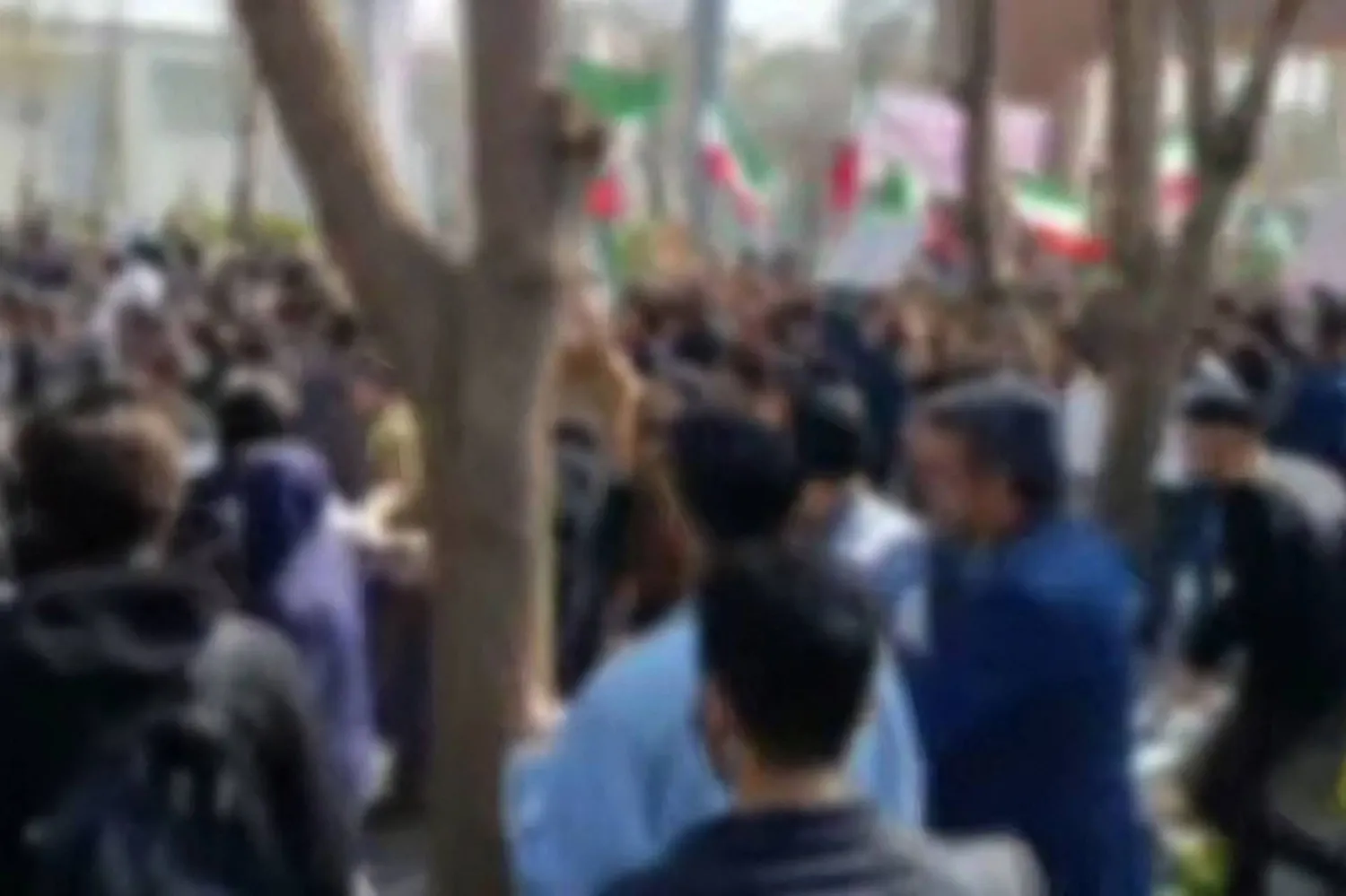
This video grab taken from UGC images posted on social media and verified by AFPTV teams in Paris on February 21, 2026, shows Iranians clashing near the Department of Aerospace Engineering of Sharif University in Tehran. (UGC / AFP)
TT

Iranian Students Chant Anti-Government Slogans, as US Threats Loom

This video grab taken from UGC images posted on social media and verified by AFPTV teams in Paris on February 21, 2026, shows Iranians clashing near the Department of Aerospace Engineering of Sharif University in Tehran. (UGC / AFP)

Iranian students chanted anti-government slogans and scuffled with counter-protesters on Saturday in the latest display of anger at the country's clerical leaders, who also face a US military build-up aimed at pressuring them into a nuclear deal.

The gatherings at universities, which were reported by both local and diaspora media outlets, followed a mass protest movement that was met with a government crackdown last month that left thousands dead.

The crackdown had prompted US President Donald Trump to threaten to intervene militarily, though the focus of his threats eventually shifted to Iran's nuclear program, which Western governments fear is aimed at producing a bomb.

The US and Iran recently resumed Oman-mediated talks aimed at securing a deal, but Washington has simultaneously increased its military presence in the region, dispatching two aircraft carriers, jets and weaponry to back its warnings.

Videos geolocated by AFP to Tehran's top engineering university showed fights breaking out in a crowd on Saturday as people shouted "bi sharaf", or "disgraceful" in Farsi.

Footage posted by the Persian-language TV channel Iran International, which is based outside the country, also showed a large crowd chanting anti-government slogans at Sharif University of Technology.

Iranians had reprised their protest slogans earlier this week to mark the 40th day since thousands of people were killed as a wave of demonstrations was peaking on January 8 and 9.

They gathered again at several universities in the capital on Saturday, local media reported.

The unrest first broke out in December over prolonged financial strain, but exploded into mass anti-government demonstrations that were suppressed in a violent crackdown by security forces.

The clerical authorities acknowledge more than 3,000 deaths, but say the violence was caused by "terrorist acts" fueled by Iran's enemies.

The US-based Human Rights Activists News Agency (HRANA), however, has recorded more than 7,000 killings in the crackdown, the vast majority protesters, though the toll may be far higher.

Iranian authorities had initially acknowledged the legitimacy of the protesters' economic demands, but as the movement took on an overtly anti-government tone, they accused archenemies the United States and Israel of whipping up "riots".

Local news outlet Fars said that what was supposed to be a "silent and peaceful sit-in" on Saturday of students commemorating those killed was disrupted by people chanting slogans including "death to the dictator" -- a reference to Iran's supreme leader.

A video posted by Fars showed a group chanting and waving Iranian flags facing off with a crowd wearing masks and being held back by men in suits.

Both groups were holding what appeared to be memorial photographs.

- Talks and threats -

Ever since the initial wave of protests, the United States and Iran have been trading threats of military action.

Trump sent the aircraft carrier USS Abraham Lincoln to the region, accompanied by a flotilla of 12 support ships, while a second carrier group attached to the USS Gerald R Ford is en route to the area via the Mediterranean.

The US has also redeployed dozens of other warplanes to the Middle East -- where it maintains several bases -- while boosting its land-based air defenses.

The build-up is aimed at pressuring Iran's authorities to cut a deal on the country's nuclear program, even as the two sides have pursued talks on the subject.

Iranian Foreign Minister Abbas Araghchi told US media this week that following the latest round of negotiations in Geneva, Iran would be submitting a draft proposal for an agreement, saying "in the next two, three days, that would be ready".

Araghchi also said the "US side has not asked for zero enrichment" of uranium, contradicting statements from American officials.

Trump had suggested on Thursday that "bad things" would happen if Tehran did not strike a deal within 10 days, a period which he subsequently extended to 15.

Iran denies it is trying to produce nuclear weapons and says its program is peaceful, but insists on its right to enrich uranium for civilian purposes.

The US media outlet Axios reported this week, citing an unnamed senior US official, that the US was prepared to consider a proposed deal that only permitted "small, token enrichment".

A previous round of nuclear diplomacy between the US and Iran last year was interrupted by Israel's surprise bombing campaign against country.

The United States ultimately joined its ally, striking key nuclear facilities before declaring a ceasefire.



Minister Says US Can Access Minerals, Military Bases in Somaliland

Minister of the Presidency of the Republic of Somaliland, Khadar Hussein Abdi looks on during an interview in Hargeisa on February 21, 2026. (Photo by Tony KARUMBA / AFP)
TT

Minister Says US Can Access Minerals, Military Bases in Somaliland

Minister of the Presidency of the Republic of Somaliland, Khadar Hussein Abdi looks on during an interview in Hargeisa on February 21, 2026. (Photo by Tony KARUMBA / AFP)

Somaliland is willing to give the United States access to its minerals and military bases, a minister has told AFP, as the breakaway region of Somalia seeks international recognition.

Israel became the only country in the world to recognize Somaliland's independence in December -- something the territory has been seeking since declaring its autonomy from Somalia in 1991.

The government in Mogadishu still considers Somaliland an integral part of Somalia even though the territory has run its own affairs since 1991, with its own passports, currency, army and police force.

"We are willing to give exclusive (access to our minerals) to the United States. Also, we are open to offer military bases to the United States," Khadar Hussein Abdi, minister of the presidency, told AFP in an interview on Saturday.

"We believe that we will agree on something with the United States."

Somaliland president Abdirahman Mohamed Abdullahi already suggested in recent weeks granting Israel privileged access to its mineral resources.

And Khadar Hussein Abdi said he could not rule out the possibility of also allowing Israel to set up a military presence.

The African Union and most Arab countries have thrown their support behind Somalia and condemned the move.

The US, however, defended what it said was Israel's right to recognize Somaliland, although President Donald Trump said he was unlikely to follow suit, despite pressure from some within his Republican party.


Senior Iranian Official: New Talks with US Planned in Early March, Interim Deal Possible

Pedestrians walk past a billboard depicting a US aircraft carrier with damaged fighter jets on its deck and a sign in Farsi and English reading, "If you sow the wind, you'll reap the whirlwind," in Tehran, Iran, Sunday, Feb. 22, 2026. (AP Photo/Vahid Salemi)
TT

Senior Iranian Official: New Talks with US Planned in Early March, Interim Deal Possible

Pedestrians walk past a billboard depicting a US aircraft carrier with damaged fighter jets on its deck and a sign in Farsi and English reading, "If you sow the wind, you'll reap the whirlwind," in Tehran, Iran, Sunday, Feb. 22, 2026. (AP Photo/Vahid Salemi)

Iran and the United States have differing views over the scope and mechanism to lift sanctions on Tehran in exchange for curbs on its nuclear program, a senior Iranian official told Reuters on Sunday, adding that new talks were planned in early March.

The official said Tehran could seriously ⁠consider a combination of ⁠exporting part of its highly enriched uranium (HEU) stockpile, diluting the purity of its HEU and a regional consortium for enriching uranium, but in return Iran's ⁠right to "peaceful nuclear enrichment" must be recognized.

"The negotiations continue and the possibility of reaching an interim agreement exists," the official said.

Iran's Foreign Minister Abbas Araqchi said on Friday that he expected to have a draft counterproposal ready within days following nuclear talks with the ⁠United ⁠States this week, while US President Donald Trump said he was considering limited military strikes.

The senior official said Tehran will not hand over control of its oil and mineral resources but US companies can always participate as contractors in Iran’s oil and gas fields.


Witkoff Says Trump Questioning why Iran Has Not 'Capitulated'

US Special Envoy Steve Witkoff listens as President Donald Trump (not pictured) speaks at the inaugural Board of Peace meeting at the US Institute of Peace in Washington, D.C., US, February 19, 2026. REUTERS/Kevin Lamarque
TT

Witkoff Says Trump Questioning why Iran Has Not 'Capitulated'

US Special Envoy Steve Witkoff listens as President Donald Trump (not pictured) speaks at the inaugural Board of Peace meeting at the US Institute of Peace in Washington, D.C., US, February 19, 2026. REUTERS/Kevin Lamarque

US envoy Steve Witkoff said on Saturday that President Donald Trump is questioning why Iran has not "capitulated" in the face of Washington's military build-up aimed at pressuring them into a nuclear deal.

The United States and Iran this week resumed Oman-mediated talks in Geneva aimed at averting the possibility of military action, after Washington dispatched two aircraft carriers, jets and weaponry to the region to back its warnings.

In a Fox News interview with Trump's daughter-in-law Lara, Witkoff said the president was "curious" about Iran's position after he had warned them of severe consequences in the event they failed to strike a deal.

"I don't want to use the word 'frustrated,' because he understands he has plenty of alternatives, but he's curious as to why they haven't... I don't want to use the word 'capitulated,' but why they haven't capitulated," AFP quoted him as saying.

"Why, under this pressure, with the amount of seapower and naval power over there, why haven't they come to us and said, 'We profess we don't want a weapon, so here's what we're prepared to do'? And yet it's sort of hard to get them to that place."

The US envoy also confirmed in the interview that he had met with Reza Pahlavi, who has not returned to Iran since before the 1979 Iranian Revolution that ousted the monarchy.

"I met him at the direction of the president," he said, without providing further details.

US-based Pahlavi last week told a crowd in Munich that he was ready to lead the country to a "secular democratic future" after Trump said regime change would be best for the country.

Witkoff's comments come after Iranian Foreign Minister Abbas Araghchi said a draft proposal for an agreement with Washington would be ready in a matter of days.

Trump said on Thursday that Iran had at most 15 days to make a deal on concerns starting with its nuclear program.

As talks between the two nations continued in Geneva, Iran's supreme leader Ali Khamenei on Tuesday said that Trump would not succeed in destroying the country.