


Iranian Students Rally for Second Day as Fears of War with US Mount

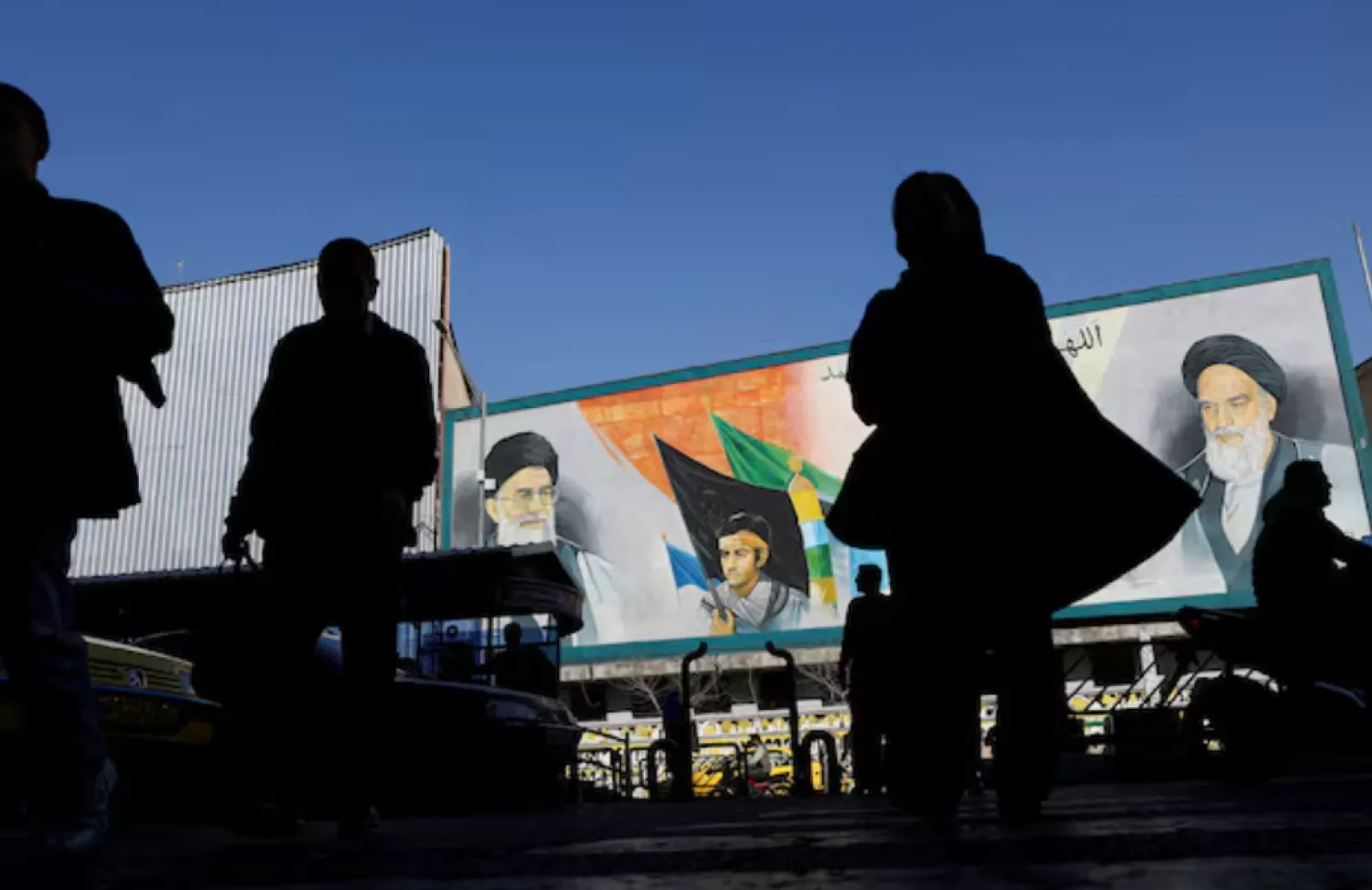
People walk near a mural featuring images of Iran's Supreme Leader Ayatollah Ali Khamenei and leader of Iran's 1979 Islamic Revolution Ayatollah Ruhollah Khomeini, on a street in Tehran, Iran, February 17, 2026. Majid Asgaripour/WANA (West Asia News Agency) via REUTERS
TT

Iranian Students Rally for Second Day as Fears of War with US Mount

People walk near a mural featuring images of Iran's Supreme Leader Ayatollah Ali Khamenei and leader of Iran's 1979 Islamic Revolution Ayatollah Ruhollah Khomeini, on a street in Tehran, Iran, February 17, 2026. Majid Asgaripour/WANA (West Asia News Agency) via REUTERS

Iranian students gathered for fresh pro- and anti-government rallies Sunday commemorating those killed in recent protests, as fears loomed of renewed conflict with the United States over the country's nuclear programme.

The initial demonstrations were sparked in December by economic hardship in the sanctions-hit country, but quickly expanded into mass anti-government protests that marked one of the largest challenges to the Islamic republic's clerical leadership in years.

US President Donald Trump had initially cheered on the protesters, threatening to intervene on their behalf as authorities launched a deadly crackdown, but his threats soon shifted to Iran's nuclear programme, which the West believes is aimed at developing atomic weapons, AFP reported.

Washington and Tehran have since returned to the negotiating table, but Trump has simultaneously pursued a major military build-up in the Middle East aimed at pressuring Iran to cut a deal.

Following campus rallies commemorating the protest dead on Saturday, the Fars news agency on Sunday published videos of fresh crowds of dozens of people waving Iranian flags and carrying memorial photographs at universities in the capital Tehran.

One showed a rowdy gathering at Sharif University of Technology shouting "death to the shah" -- a reference to the monarchy ousted by the 1979 Islamic revolution -- as they faced off with another group, with men in uniforms between them.

Fars said there had been "tensions" at at least three universities in Tehran where some students chanted "anti-establishment" slogans.

Iran International, a media outlet based outside the country and branded a "terrorist" organization by Tehran, shared a video on social media of students holding up the pre-revolution flag at Sharif University, as well as videos of rallies at other institutions of higher learning.

A video geolocated by AFP of what appeared to be the demonstration at Sharif University showed a large crowd chanting anti-government slogans as they thronged around students waving the flag of the toppled monarchy.

The authorities acknowledge more than 3,000 deaths in the unrest, including members of the security forces and bystanders, but say the violence was caused by "terrorist acts" fuelled by Iran's enemies.

The US-based Human Rights Activists News Agency (HRANA), however, has recorded more than 7,000 killings in the crackdown, the vast majority protesters, though the toll may be far higher.

- Negotiations -

Representatives of the US and Iran recently met in Geneva for a second round of Oman-mediated nuclear talks, with Iran promising to send a draft proposal for a deal to avert military action in the coming days.

Axios reported on Sunday, citing an unnamed senior US official, that if Iran submitted its proposal in the next 48 hours, Washington was ready to meet again "in Geneva on Friday in order to start detailed negotiations to see if we can get a nuclear deal".

The US has dispatched two aircraft carriers to the region, along with other jets and ships, and has also shored up its air defenses in the Middle East.

Trump's chief Middle East negotiator Steve Witkoff said Saturday in a Fox News interview that the president was questioning why Iran had not yet given in to US pressure.

"He's curious as to why they haven't... I don't want to use the word 'capitulated', but why they haven't capitulated," he said.

"Why, under this pressure, with the amount of seapower and naval power over there, why haven't they come to us and said, 'We profess we don't want a weapon, so here's what we're prepared to do'?"

Iran has long denied it is trying to produce nuclear weapons, but insists on its right to enrich uranium for civilian purposes.

- Fears of war -

A previous round of nuclear diplomacy last year was interrupted by Israel's surprise bombing campaign against the Islamic republic.

That sparked a 12-day conflict in June that the US briefly joined with strikes on nuclear facilities

Iran has maintained that it will defend itself in the event of any new attack.

Despite the latest talks, Iranians' fears of a new conflict have grown.

"I don't sleep well at night even while taking pills," Tehran resident Hamid told AFP, saying he worried for his "family's health... my kids and grandchildren".

IT technician Mina Ahmadvand, 46, believes that "at this stage, war between Iran and the US as well as Israel is inevitable and I've prepared myself for that eventuality".

"I don't want war to happen, but one should not fool around with the realities on the ground."

The concerns have prompted several foreign countries to urge their citizens to leave Iran, including Sweden, Serbia, Poland and Australia, which warned "commercial flights are currently available but this could change quickly".



Fighting Reaches Outskirts of Ukraine’s Stronghold Kostiantynivka

 This photograph shows a barbed wire defense line running across a field at an undisclosed location in the Kharkiv region, eastern Ukraine, on May 1, 2026, amid the Russian invasion of Ukraine. (AFP)
This photograph shows a barbed wire defense line running across a field at an undisclosed location in the Kharkiv region, eastern Ukraine, on May 1, 2026, amid the Russian invasion of Ukraine. (AFP)
TT

Fighting Reaches Outskirts of Ukraine’s Stronghold Kostiantynivka

 This photograph shows a barbed wire defense line running across a field at an undisclosed location in the Kharkiv region, eastern Ukraine, on May 1, 2026, amid the Russian invasion of Ukraine. (AFP)
This photograph shows a barbed wire defense line running across a field at an undisclosed location in the Kharkiv region, eastern Ukraine, on May 1, 2026, amid the Russian invasion of Ukraine. (AFP)

Russian troops are ‌inching towards the city of Kostiantynivka in Ukraine's eastern Donetsk region, trying to establish a foothold close to a heavily defended area, Ukraine's top army official said on Saturday.

Kostiantynivka, along with other cities, forms a so-called fortress belt in the country's east - an area well-fortified by the Ukrainian military.

"We are repelling the Russian occupiers' persistent attempts to gain a foothold in the outskirts of Kostiantynivka using infiltration tactics. Counter-sabotage measures are going on in the ‌city," Oleksandr Syrskyi, ‌Ukraine's army chief, said on the Telegram ‌app.

A ⁠Ukrainian battlefield mapping ⁠project called DeepState shows Russian troops control an area around only one kilometer (0.6 mile) from the city's southern outskirts.

Small chunks of Kostiantynivka in the southeast are marked as a grey zone, meaning neither Ukraine nor Russia has full control over them.

Russia's defense ministry said on ⁠Wednesday its forces had taken control of ‌Novodmytrivka, just north of Kostiantynivka. Moscow's ‌top general Valery Gerasimov said in April that troops were ‌advancing in the north and south of the ‌city.

Syrskyi said that Russian offensive attempts had risen noticeably in April. Since Monday, Russian troops have carried out 83 assaults in this sector using small infantry groups, he added.

Russia demands that ‌Ukraine pull back from areas in the Donetsk and neighboring Luhansk regions that it ⁠failed to capture ⁠in its four-year full-scale war. US-brokered peace talks stalled over the issue as Ukrainian officials say Kyiv will not cede land it still controls.

For the past few years, Russian troops have not managed to capture any big city agglomerations in Ukraine, inching forward and taking control over small settlements, mostly in Ukraine's east.

The small city of Pokrovsk, whose more than 60,000 pre-war population mostly fled, was the most significant gain in the past year. It took Moscow's troops months to advance, and Kyiv says it still has some positions in the city.


Report: Explosion of Bombs Left Over from Strikes Kill 14 Iranian Revolutionary Guard Members

Smoke billows from an Israeli strike on Tehran. (Reuters file)
TT

Report: Explosion of Bombs Left Over from Strikes Kill 14 Iranian Revolutionary Guard Members

Smoke billows from an Israeli strike on Tehran. (Reuters file)

An explosion of leftover bombs from strikes during the war against Iran killed 14 members of the Revolutionary Guard, Iranian media reported Friday.

A report by the Nournews website, believed to be close to Iran’s security, said the explosion happened near the northern city of Zanjan, which is northwest of Tehran.

It was the largest number of Revolutionary Guard members reported to be killed since the ceasefire began on April 7.

The report said the ammunition included cluster bombs and air mines dropped during the fighting.


US, Philippines Deploy Anti-Ship Missile System in Batanes Near Taiwan for War Games

 A vehicle used for the Navy-Marine Expeditionary Ship Interdiction System (NMESIS), stands during joint Philippine-US military exercises in Basco, Batanes province, Philippines, May 2, 2026. (Reuters)
A vehicle used for the Navy-Marine Expeditionary Ship Interdiction System (NMESIS), stands during joint Philippine-US military exercises in Basco, Batanes province, Philippines, May 2, 2026. (Reuters)
TT

US, Philippines Deploy Anti-Ship Missile System in Batanes Near Taiwan for War Games

 A vehicle used for the Navy-Marine Expeditionary Ship Interdiction System (NMESIS), stands during joint Philippine-US military exercises in Basco, Batanes province, Philippines, May 2, 2026. (Reuters)
A vehicle used for the Navy-Marine Expeditionary Ship Interdiction System (NMESIS), stands during joint Philippine-US military exercises in Basco, Batanes province, Philippines, May 2, 2026. (Reuters)

Philippine and US forces on Saturday showcased the NMESIS anti-ship missile system in Batanes province, near Taiwan, during annual war games, as tensions simmer over the self-governed island that China views as its own territory.

The Philippines' northernmost province, with about 20,000 residents, sits around 100 miles south of Taiwan, along the Luzon Strait, a strategic corridor on the frontline of the great power competition between the US and China for dominance in the Asia-Pacific region.

"Training out here in Batanes allows us a different environment than what we're normally allowed to operate in," said US Staff Sergeant Darren Gibbs.

"So it gives us unique opportunities to actually utilize the system and train within our capabilities, and it offers experiences we don't normally get offered in our day-to-day training."

Gibbs said the NMESIS is designed for remote operation, and that "the purpose of this system is for it to be ‌fully autonomous, for us ‌not to require a driver or passenger inside the vehicle itself."

"We will tell it ‌where ⁠to go and ⁠then we program what it needs to do," he said.

The NMESIS, a highly mobile coastal anti-ship missile system designed to target surface vessels from land-based positions at ranges of about 185 km (115 miles), was flown into Batanes on a US C-130 transport aircraft, and positioned in the capital Basco, which has one of the island province's two small runways.

Francisco Lorenzo, Philippine exercise director, told Reuters that deployment of US weapons such as the NMESIS to Batanes was part of efforts to test operational feasibility in remote locations. The NMESIS was also deployed to Batanes in last year's war games.

"It is part of training so ⁠as to test the feasibility or rehearse their deployment there when need arises," Lorenzo ‌said. One of the objectives of the Balikatan, as the annual "shoulder-to-shoulder" drills ‌of US and Philippine forces are called, is to practice "defense of our territory with our allies", he said.

The NMESIS would not ‌be used in live exercise operations and was brought to Batanes only for deployment rehearsal and simulation support during ‌the war games.

He said the system would be withdrawn from Batanes once the drills were finished. The US also deployed its Typhon missile system to the Philippines in 2024 for use in joint exercises.

Beijing routinely criticizes the deployment of US weapons in the Philippines, saying it heightens regional tension.

Security analyst Chester Cabalza, founder and president of the Manila-based think tank International Development and Security Cooperation, told ‌Reuters "the NMESIS can spark a powder keg for Beijing and asymmetric deterrence for Manila and Taipei in the Bashi Channel along the Luzon Strait."

The system can be ⁠airlifted and deployed to ⁠any coastline in the Philippine archipelago within hours, Cabalza said, and its placement in Batanes is likely viewed by Beijing as part of the "US-led encirclement" of China.

WAR GAMES INVOLVE 17,000 TROOPS

Philippine and US forces also carried out maritime strike drills in Itbayat, a Batanes municipality about 155 km from Taiwan and the northernmost part of the country.

More than 17,000 troops are taking part in this year's war games, including about 10,000 from the US, even as Washington remains heavily engaged in the Middle East.

China recently intensified its activities in the South China Sea and the Taiwan Strait, increasing its naval presence around Taiwan and sending an aircraft carrier through the strait. It also put up a barrier this month at the mouth of the Scarborough Shoal, according to satellite images reviewed by Reuters.

Philippine President Ferdinand Marcos Jr has said Filipinos working and living in Taiwan would have to be evacuated in the event of war over the self-governed island and that would "drag the Philippines kicking and screaming into the conflict."

Philippine Defense Secretary Gilberto Teodoro said in an April 28 interview with Reuters that Manila has a contingency plan to evacuate Filipinos in Taiwan if conflict erupts but gave no further details.